

Markus Kellermann Founder & CEO
Convo vs Gong: Do You Need Revenue Intelligence or Real-Time Help?
Markus Kellermann Founder & CEO
Gong is built for 50-rep enterprise sales orgs with six-figure budgets. Most teams need something different. An honest comparison from the founder of one of its smaller competitors.
TL;DR: Convo vs Gong in 2026
- Gong and Convo both run AI on sales calls, but at opposite moments. Gong analyzes the call after it ends. Convo helps your rep during it.
- Gong is the enterprise revenue platform, with deep post-call analytics, forecasting, and deal scoring for 50+ rep orgs, at $100-200 per user per month and a multi-month rollout.
- Convo works while the call is still live. It feeds your rep the response, the next question, and context from past calls in the moment, then drafts the follow-up after.
- Buy Gong when you need forecasting and coaching at scale. Reach for Convo when the deal is decided on the call itself, which for most teams is exactly where it's decided. Try Convo.
"Why Don't You Just Use Gong?"
I get asked this a lot. Investors, prospects, other founders. The question usually comes with a look that says "you do know Gong exists, right?"
Yes. I know Gong exists. I've watched their demos, read their research, studied how they built what is arguably the most influential sales intelligence company of the last decade. Their data on talk-to-listen ratios alone changed how an entire generation of sales reps think about calls.
So why did I build Convo instead of telling every sales team to just buy Gong?
Because I think the real question isn't "which is better?" but "which problem are you actually trying to solve?" And for most of the teams I talk to, the answer points somewhere Gong isn't designed to go.
I'm going to be transparent. I'm the founder of Convo. I built a product that competes with Gong in some ways and doesn't compete at all in others. I'll be honest about both. If Gong is the right tool for you, I'll tell you that too.
What's the Difference Between Convo and Gong?
Gong started as a conversation intelligence tool. Record calls, transcribe them, analyze what reps said and how prospects responded. But over the past few years, it has evolved into something bigger, a revenue intelligence platform. That means it now combines call data with CRM activity, email engagement, deal progression, and pipeline signals to produce forecasts, deal risk scores, and coaching insights for entire sales organizations.
Convo took a different direction with the same underlying technology. Instead of analyzing calls after they end, it helps you during the call itself. Real-time suggestions appear on your screen while you're talking. If a prospect raises a pricing objection, you get a framework to handle it right now, not in a coaching session three days later. After the call, Convo drafts your follow-up email, extracts action items, and generates a summary.
That's the simplest way I can frame it. They're both analyzing sales conversations with AI. But they're solving different problems for different people at different price points.
| Convo | Gong | |
|---|---|---|
| Core function | Real-time help during calls + post-call automation | Post-call analytics + pipeline forecasting |
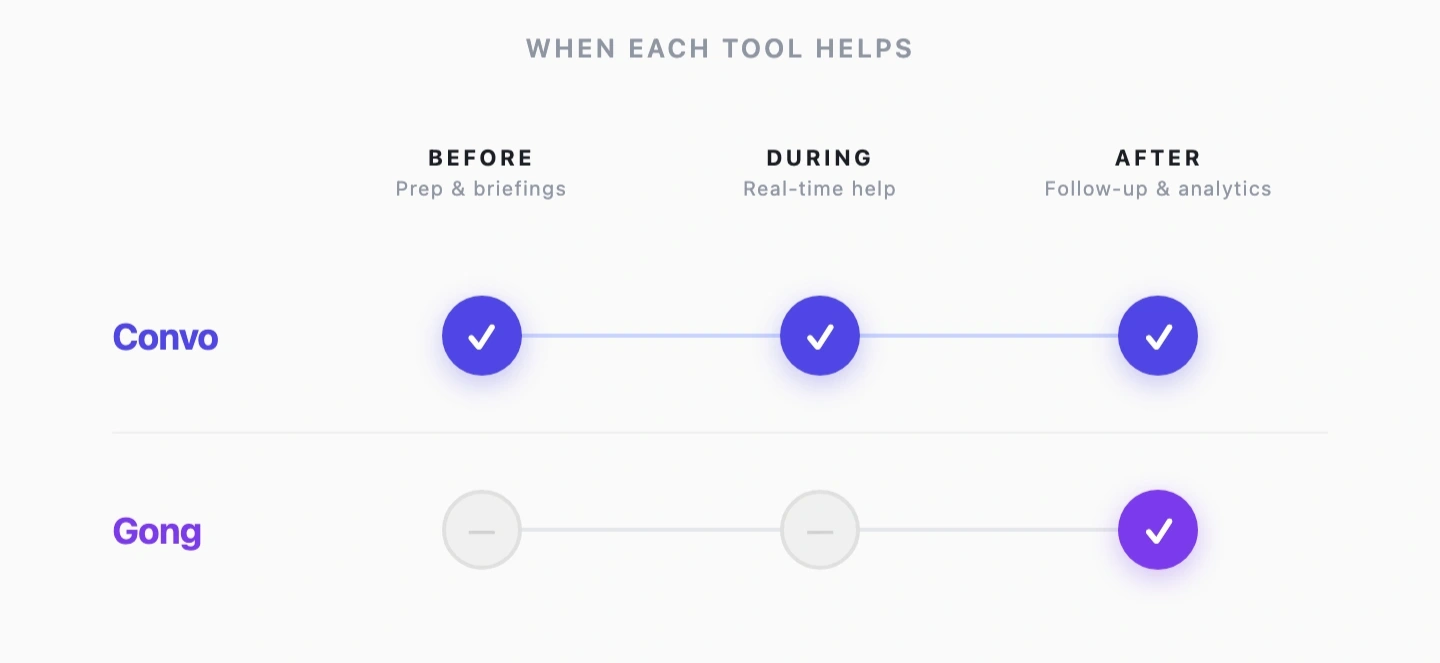
| When it helps | Before, during, and after the meeting | After the meeting |
| Target user | Any rep whose deals turn on the live call | Sales orgs with 20-200+ reps |
| Pricing | $22.49/month | $100-200/user/month |
| Setup time | 2 minutes | 3-6 months |
| Bot in meeting | No | Yes (Gong Notetaker) |
| Audio processing | Local (your device) | Cloud (Gong servers) |
| Pipeline forecasting | No | Yes |
| Deal scoring | No | Yes |
| CRM integration | Native Salesforce, HubSpot, Pipedrive | Native Salesforce, HubSpot |
The Problem Gong Solves Brilliantly
I want to give credit where it's due. Gong essentially created the revenue intelligence category, and what they've built is genuinely impressive.
Before Gong, sales managers coached reps based on what reps told them happened on the call. "How did the demo go?" "Good, I think they're interested." That's not coaching. That's a vibe check.
Gong changed that. Suddenly managers could see the actual call data. Talk-to-listen ratios. How many questions were asked. Which topics correlated with won deals. Where in the conversation prospects went cold. This was revelatory for sales teams. Research from McKinsey showed that B2B companies using analytics-driven sales approaches see 5-10% revenue growth above their peers. Gong made that accessible.
And then they went further. Deal scoring, pipeline forecasting, competitive intelligence, CRM analytics. Today Gong isn't just a sales coaching software tool. It's the operating system for enterprise revenue teams. If you're a chief sales officer managing 50 reps with a $5M pipeline and your board wants accurate quarterly forecasts, Gong is probably what you need.
The key word there is "probably." And "50 reps." And "$5M pipeline."
The Problem Gong Doesn't Solve
Here's what I noticed when I was doing founder sales for Convo. I was on 10-15 calls a week. Discovery calls, demos, follow-ups. And my problem wasn't that I needed analytics after the call. My problem was that I needed help during the call.
A prospect would ask about enterprise pricing, and I'd freeze for two seconds trying to remember the numbers. Someone would raise a competitive objection about Fireflies or Otter, and I'd give a vague answer because I couldn't recall the exact differentiators in the moment. A client would reference something we discussed three meetings ago, and I'd nod along pretending to remember.
Gong would have caught all of these moments. Three days later. In a dashboard I'd look at when I got around to it. By then, the call was over, the impression was made, and the deal had already moved forward or stalled based on how I performed in that moment.
That's why I built Convo. Not to replace Gong, but to fill the gap Gong doesn't cover, the live moment of the conversation.
What the Cost Difference Actually Means
Let's talk about money because this is where the comparison gets uncomfortable.
Gong's pricing isn't published, but it's well documented by industry analysts. For a typical deployment you're looking at $100-200 per user per month, with 15-seat minimums and mandatory platform fees. For a 10-person sales team, that's $12,000-24,000 per year. For 50 reps, you're in the $60,000-120,000 range. Plus 3-6 months of implementation before you see meaningful ROI.
Convo is $22.49/month on the Starter plan. $52.49/month on Professional. No minimums, no platform fees, no implementation project. You download it, open it, and it's working on your next call.
| Team Size | Convo (annual) | Gong (estimated annual) |
|---|---|---|
| 1 person (founder) | $180 | Not available (minimum seats) |
| 5 reps | $900 | $6,000-12,000 |
| 20 reps | $3,600 | $24,000-48,000 |
| 50 reps | $9,000 | $60,000-120,000 |
But if you're not running a 50-rep org with a six-figure tooling budget, that pricing doesn't make sense. You don't need pipeline forecasting to win the call you're on. You need someone whispering the right answer in your ear when the prospect asks a question you didn't prepare for, whether you're a consultant on client calls or a rep at a growing team.
Two Different Coaching Models
This is where the strategic difference matters most, and where the sales enablement approach diverges.
Gong's model is manager-dependent and post-call. A manager watches call recordings, identifies key moments, leaves timestamped comments, creates playlists of good and bad examples, and discusses them in 1:1s. This is powerful. It scales the manager's ability across dozens of reps. But it requires a manager who has time to watch recordings, a cadence for feedback sessions, and reps who act on input days after the call happened.
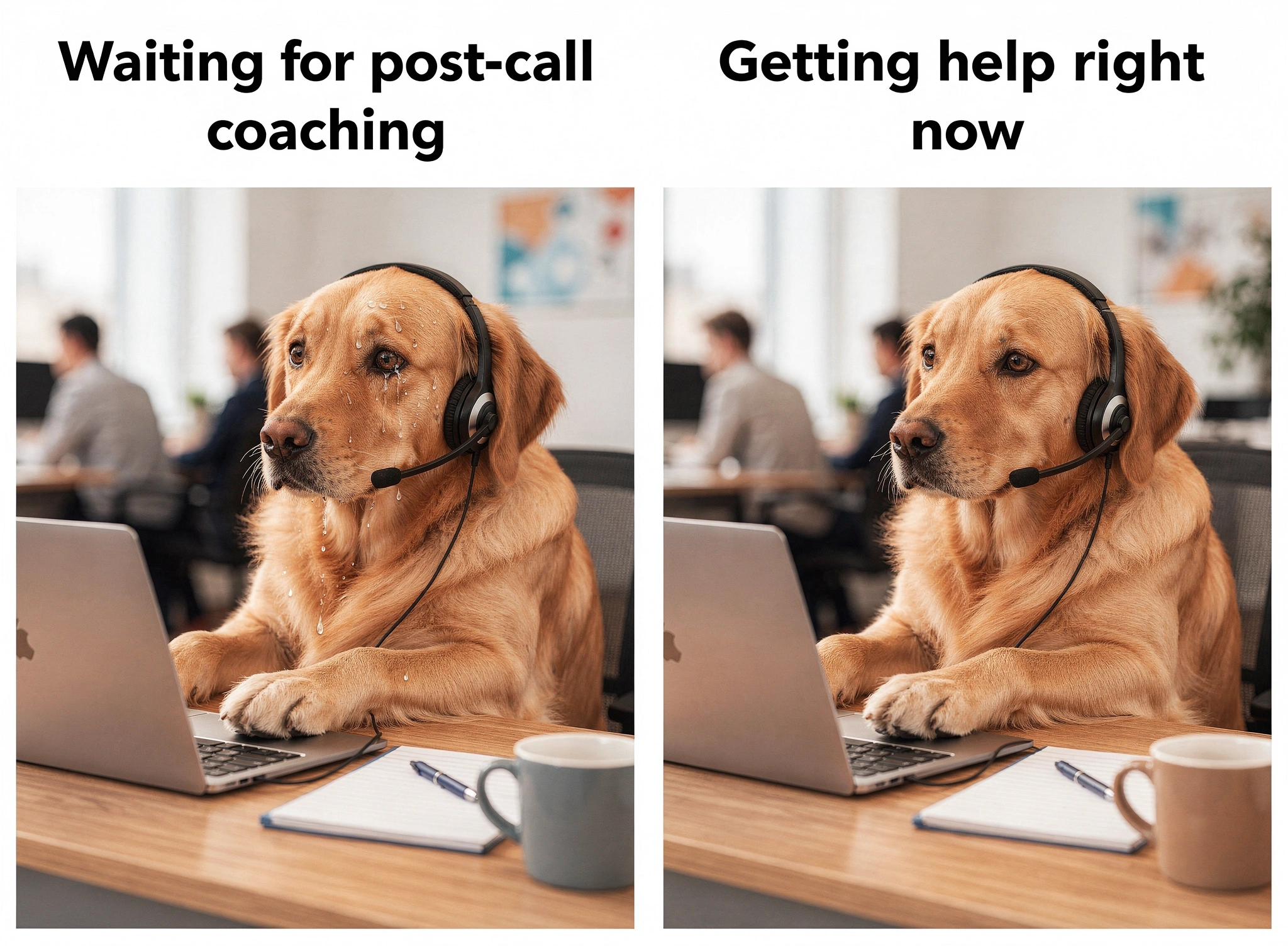
Convo's model is AI-driven and in the moment. The AI watches the call as it happens and surfaces suggestions in real time. If you've been talking for four minutes straight, you see your talk-to-listen ratio ticking up. If the prospect mentions a competitor, you get a comparison framework on screen. If they raise a pricing objection, you see a suggested response. The feedback happens while the behavior is happening, not in a review session afterward.
Neither model is wrong. They serve different needs. Harvard Business Review research on meeting productivity supports both. Professionals who get specific, timely feedback on their communication patterns improve faster, whether that feedback comes from a manager reviewing a recording or from AI surfacing it live.
A 50-rep org with a VP of Sales and a dedicated enablement team can build a performance culture around Gong. Weekly call reviews, team learning sessions, analytics dashboards. That infrastructure exists.
A 5-person startup where every rep is also doing their own prospecting, follow-ups, and CRM updates doesn't have that infrastructure. There's no enablement team. There's no time to watch recordings. The rep needs help now, on this call, with this prospect who just asked a question they don't have a great answer for.
The Recording Question
Every sales team eventually hits the same question. Does the recording bot bother prospects?
Gong joins meetings as a visible participant called "Gong Notetaker." Everyone in the meeting sees it. Some enterprise buyers expect it and don't care. Others, especially in sensitive contexts like legal, healthcare, or early-stage relationship calls, find it off-putting. I've heard chief sales officers say their close rates on prospect calls are measurably different when the bot is visible versus when it isn't.
Convo takes a different approach. It captures audio directly from your device's system audio. No bot joins the meeting. No participant list entry. No recording notification from a third party. Other people on the call don't know it's there. From a legal perspective, this is more like taking your own notes than having a third party intercept the conversation.
I'm not going to pretend this is always an advantage. Some enterprise sales teams actually want the recording to be visible for compliance reasons. In regulated industries, a visible recording indicator can be a feature, not a bug. Gong's approach works well in that context.
But if you're running discovery calls where building trust matters, or client conversations where a visible bot changes the dynamic, or any call where you'd rather the technology stay invisible, that's where Convo's bot-free approach makes a real difference.
When Gong Is the Right Choice
I said I'd be honest, so here it is. Gong is the better choice if any of these fit your org.
- You need deep, org-wide post-call analytics across a large team. Gong aggregates every rep's calls into dashboards and pattern detection at a depth Convo's live coaching and manager view aren't built to match.
- Your board cares about forecast accuracy. Gong's forecasting engine combines call signals with CRM data to predict quarterly revenue. Convo doesn't do forecasting.
- You need deal-level risk scoring. "This deal has gone silent for 14 days and no economic buyer is engaged." That's Gong territory.
- You have a dedicated RevOps or enablement team that will actually use the data. Gong produces a lot of insights. Someone needs to act on them.
- Your budget supports $100+/user/month and your sales cycle is long enough (60+ days) for pattern detection to meaningfully help.
If that describes your org, you should evaluate Gong seriously. Their sales analytics and coaching infrastructure is best in class for enterprise.
When Convo Makes More Sense
Convo is the better fit if any of these sound like you.
- Your deals are decided on the live call, and you don't have an enablement team watching recordings to coach from afterward. You need the help now, in the moment.
- You want real-time help during calls, not post-call analysis. The difference between knowing what you should have said and knowing it in time.
- Your conversations are sensitive. Client advisory, recruiting, consulting, legal. Situations where a visible recording bot creates friction.
- You need the full meeting lifecycle covered. Convo briefs you before the call (context from past conversations), helps during (real-time suggestions), and automates after (follow-up emails, action items, summaries).
- You'd rather prove value on your next call than commit a six-figure budget and a multi-month rollout up front.
- You want to start today, not in 3-6 months. Convo is a desktop app. Download, open, use on your next call.
The best sales productivity tools are the ones that match where your team actually is right now. Not where you hope to be in two years.
What About the Tools in Between?
Gong and Convo aren't the only options. The conversation intelligence platforms space has gotten crowded.
| Tool | Best For | Price | How It Compares |
|---|---|---|---|
| Chorus | ZoomInfo customers needing CI | $80+/user/month | Acquired by ZoomInfo. Good Salesforce integration. Less depth than Gong on analytics |
| Clari | Forecasting-heavy RevOps teams | $100-125/user/month | Best-in-class forecasting accuracy. Less conversation depth |
| Avoma | Mid-market teams wanting CI without enterprise price | $24/user/month | Solid all-rounder at a fair price point |
| Fireflies | Meeting documentation + CRM sync | $10/user/month | Strong CRM integration. No real-time help. Visible bot |
| Otter | Searchable meeting archives | $16.99/month | Best search across meetings. Transcription-focused |
The Honest Summary
Gong built something genuinely important for enterprise sales. Forecasting, deal intelligence, team-level analytics. If you're running a 50-rep org with a RevOps team and a six-figure tooling budget, it earns its price.
Convo built something different. It helps while the conversation is happening, briefs you before, and drafts the follow-up after. It's for any team whose deals are won on the live call rather than in a dashboard reviewed later.
The tools aren't interchangeable because the problems they solve aren't the same. Gong makes sales organizations smarter over time. Convo makes individual conversations better right now.
Use our meeting cost calculator to see what your sales meetings actually cost. And if you're curious what real-time sales coaching looks like in practice, try Convo.
Frequently Asked Questions
What is the difference between Convo and Gong? Gong is a revenue intelligence platform for enterprise sales teams. It records calls, analyzes them post-call, and combines conversation data with CRM and pipeline signals to produce forecasts and coaching insights. Convo is a real-time meeting assistant that helps during the call with live AI suggestions and automates follow-up work after. Gong costs $100-200/user/month with 3-6 month implementation. Convo costs $22.49/month and sets up in 2 minutes.
Is Gong worth it for small sales teams? For most teams under 20 reps, Gong's pricing ($100-200/user/month with seat minimums) and implementation timeline (3-6 months) are hard to justify. The ROI math works at scale, where a 10% improvement in forecast accuracy prevents costly hiring mistakes. For smaller teams, tools like Convo, Avoma ($24/user/month), or Fireflies ($10/user/month) offer the core call analysis capabilities at a fraction of the cost. See our full Gong alternatives breakdown.
What is conversation intelligence vs revenue intelligence? Conversation intelligence analyzes individual calls, things like transcription, talk ratios, topic detection, and key moments. Revenue intelligence is broader. It combines call data with CRM activity, email engagement, and pipeline signals to forecast deals and score risk. Most teams need the conversation layer first. The revenue layer becomes valuable when you have 20+ reps and a complex enough pipeline for ML models to learn from.
Does Gong have real-time help? Gong's feedback model is post-call. Managers review recordings, leave comments, and discuss in 1:1s. Gong does not provide suggestions during live calls. For in-the-moment help, tools like Convo surface AI-powered suggestions, objection handling frameworks, and context from past meetings on your screen while the call is happening.
What are the best Gong alternatives in 2026? The best Gong competitors depend on what you need. For real-time help on the call, Convo ($22.49/month). For mid-market call analysis, Avoma ($24/user/month). For CRM-focused meeting documentation, Fireflies ($10/user/month), compared head-to-head in Fireflies vs Gong. For forecasting-focused pipeline analytics, Clari ($135/user/month), which we compare directly in Clari vs Gong. For searchable meeting archives, Otter ($16.99/month). See our conversation intelligence platform comparison including Clari Copilot and Salesloft.
Can Convo replace Gong? For any team whose main need is help during the call, yes. Convo covers live suggestions, post-call automation, and pre-meeting briefings at a fraction of the cost. For enterprise sales orgs that need pipeline forecasting, deal scoring, and team-level analytics across 50+ reps, no. Those are capabilities Gong built specifically for that scale. The tools solve different problems.
What sales analytics tools do small teams actually need? Start with the basics, which are talk-to-listen ratios, question frequency, and key moment detection. These three metrics alone will improve your sales performance more than any dashboard. Tools like Convo track these automatically. Add CRM hygiene (keep deal stages accurate) and follow-up tracking (are reps actually following up 5+ times?). That's enough analytics infrastructure for most teams under 20 people. Enterprise platforms like Gong and Clari add pipeline analytics and deal scoring, but they're overkill until you have the complexity to justify them.
Markus is the founder of Convo, building an AI meeting assistant that automates everything after the call. Years of experience building AI products. Believes technology should help people in the moment, not just analyze the past.
Ready to transform your meetings?
Join professionals using Convo to feel confident in every conversation.
Get StartedCONTINUE READING