

Iván Abad Founder & COO
Is It Illegal to Record Someone Without Their Permission?
Iván Abad Founder & COO
I record every sales call. Recording is legal in 39 states, while 11 require everyone's consent. The 2026 state list, virtual meeting traps, and your options.
TL;DR: Is It Illegal to Record Someone Without Their Permission?
- In most of the US, no. Federal law and 39 states use one-party consent: if you're a participant in the conversation, your own consent is enough.
- 11 states require everyone's consent: California, Delaware, Florida, Illinois, Maryland, Massachusetts, Montana, Nevada, New Hampshire, Pennsylvania, and Washington. Connecticut and Oregon are hybrids.
- On multi-state calls, the strictest law wins. If anyone is dialing in from an all-party consent state, get consent or don't record.
- How you record matters as much as where. A notetaker bot is a third party in your meeting; capturing locally as a participant is a different legal footing. And recording calls you're not part of is illegal everywhere.
I Record Every Sales Call
I've recorded hundreds of sales calls over the past year. Every discovery call, every demo, every closing conversation. Captured and reviewed so I can actually get better instead of guessing how things went.
Is it legal? Yes. It's also one of the best things I've done for my sales performance. I review my talk-to-listen ratio after calls. I catch objections I missed in the moment. I prep sharper follow-ups because I'm working from what actually happened, not what I think happened. I use Convo for all of this. It captures audio locally on my device, no bot joins the meeting, and nobody on the other end knows it's there. From a legal standpoint, it's much closer to taking notes on what I hear than to wiretapping.
But I didn't always know the rules. About six months ago, a prospect in California mentioned that their legal team was looking into whether their vendors' sales call recording tools complied with state wiretapping laws. The value of recording my calls is too clear to give up so I wanted to be sure I was doing it legally in every state.
Here's what I found.
The Short Answer
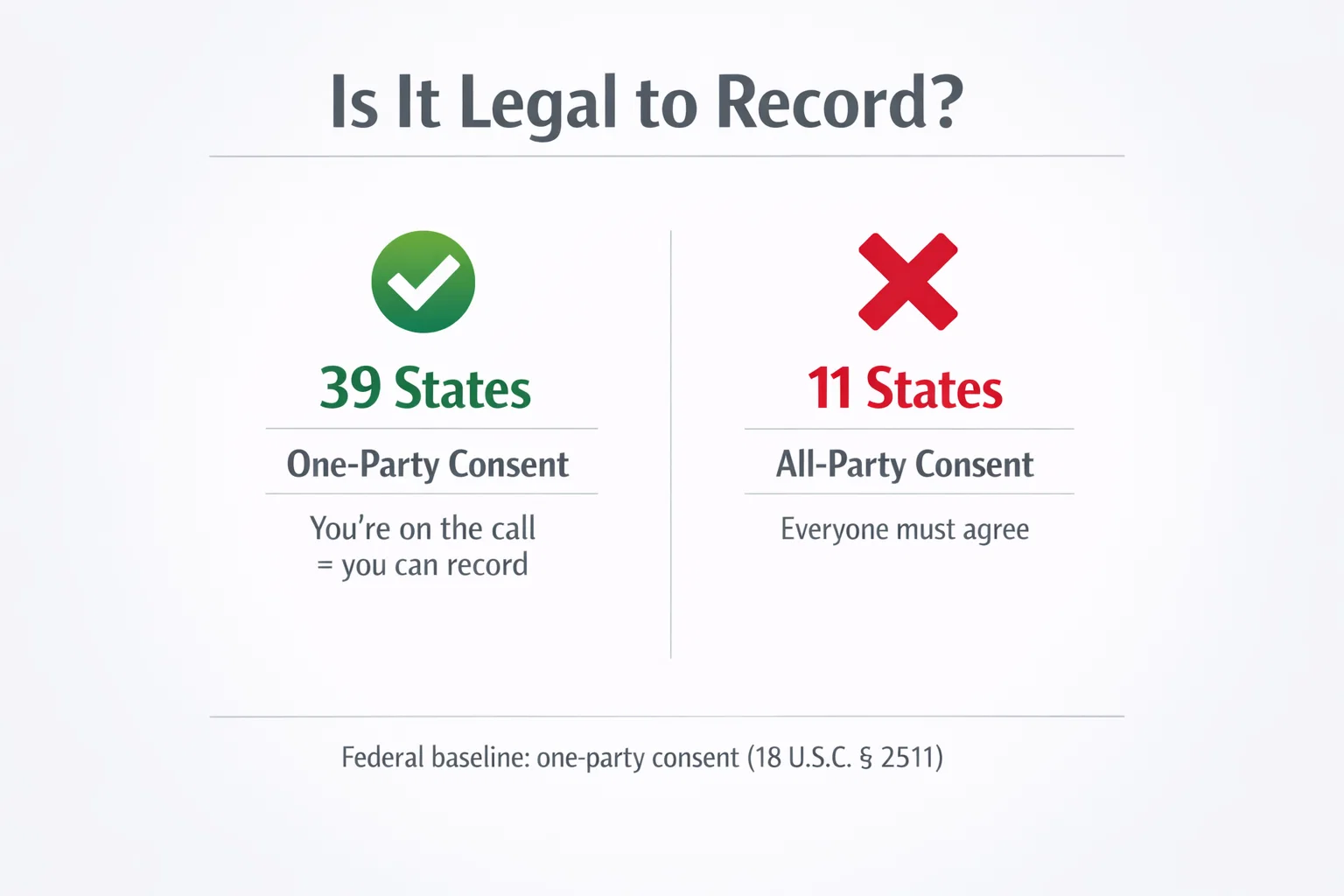
Is it illegal to record someone without their permission? In most cases, no. As long as you're a participant in the conversation, you're fine.
Federal law (18 U.S.C. § 2511) sets what's called one-party consent as the baseline. That means one person on the call consents to the recording (you), and that's legally enough. Violating federal wiretapping law can carry up to five years in prison and civil liability, but the standard itself is simple: if you're on the call, you can record it.
39 states follow this same standard. If you're a participant, you can record without telling anyone.
11 states are different. They require all-party consent, meaning every person on the call has to agree. If you record a conversation with someone in one of those states without telling them, you could face criminal charges, civil damages starting at $1,000, and attorney's fees on top of that.
Want the short answer?
If you're a participant in the conversation, recording is legal in most of the US. The sharper question is how you record. Try Convo free for 7 days: it captures audio locally on your device, no bot joins the call, and no third party touches the conversation. Works with Zoom, Google Meet, and Teams.
All-Party Consent States: The 2026 List
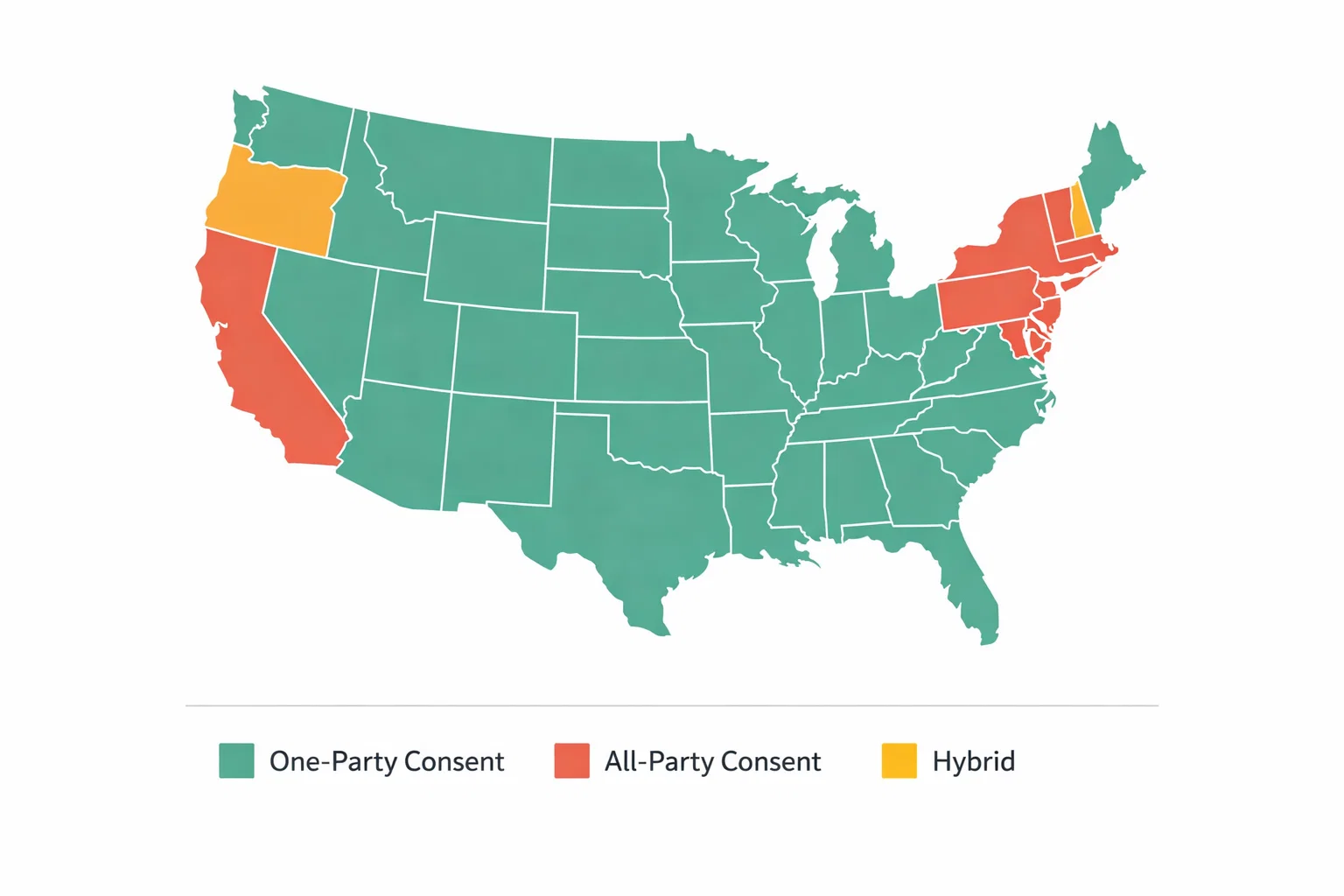
These are the two-party (all-party) consent states in 2026: California, Delaware, Florida, Illinois, Maryland, Massachusetts, Montana, Nevada, New Hampshire, Pennsylvania, and Washington. If anyone on your call is in one of these, everyone needs to consent:
| State | Key Detail |
|---|---|
| California | Most aggressive enforcement. Has claimed jurisdiction over interstate calls, so if one party is in California, their law may apply no matter where you're calling from |
| Delaware | All-party consent for both phone and in-person |
| Florida | Felony violation. All parties must consent |
| Illinois | Strict enforcement history, especially around biometric data and recording |
| Maryland | All-party consent. Courts have applied this broadly |
| Massachusetts | All-party consent. One of the stricter enforcement states |
| Montana | All-party consent, though enforcement tends to be less aggressive |
| Nevada | All-party consent required |
| New Hampshire | All-party consent. Felony violation |
| Pennsylvania | All-party consent. Felony with penalties up to 7 years |
| Washington | All-party consent. Felony violation |
What changed recently (2024-2026): Pennsylvania added a narrow exception in 2024 that lets recipients of telemarketing calls and robocalls record them without the caller's consent, specifically to document TCPA violations; everything else about Pennsylvania's all-party rule still stands. Maryland lawmakers debated loosening their statute in 2025, but no bill passed. Nothing else on this list has moved. Recording Law's two-party consent guide is a good tracker if you want to watch for changes.
The other 37 states plus DC follow one-party consent. If you're in Texas and the other person is in New York, you can record. Your consent is enough.
For a full state-by-state breakdown, the Justia 50-state recording law survey and the Reporters Committee recording guide are the best resources out there.
Virtual Meetings Make This Trickier
Here's where it gets messy if you're doing remote sales or any kind of client work.
When you're on a video call with people in multiple states, the general rule is that the strictest law applies. So if you're in New York (one-party) talking to a prospect in California (all-party), California's standard probably governs.
California has been especially aggressive here. Courts have pulled jurisdiction over interstate calls just because one participant was in California. Where you are doesn't matter. Where they are does.
Think about what that means for a typical remote sales team. You're on a Zoom call with six people in four states. Is anyone in a two-party consent state? Do you even know where everyone's dialing in from? If you're running calls on Google Meet or Microsoft Teams, the honest answer is usually no.
So the practical move is either get consent upfront or use a recording method that doesn't create the legal exposure in the first place. I went with the second option.
Why How You Record Matters
Most guides about recording laws focus entirely on where you record. But how you record changes the legal picture just as much. This is the thing that clicked for me when I was researching this.
Bot-based tools
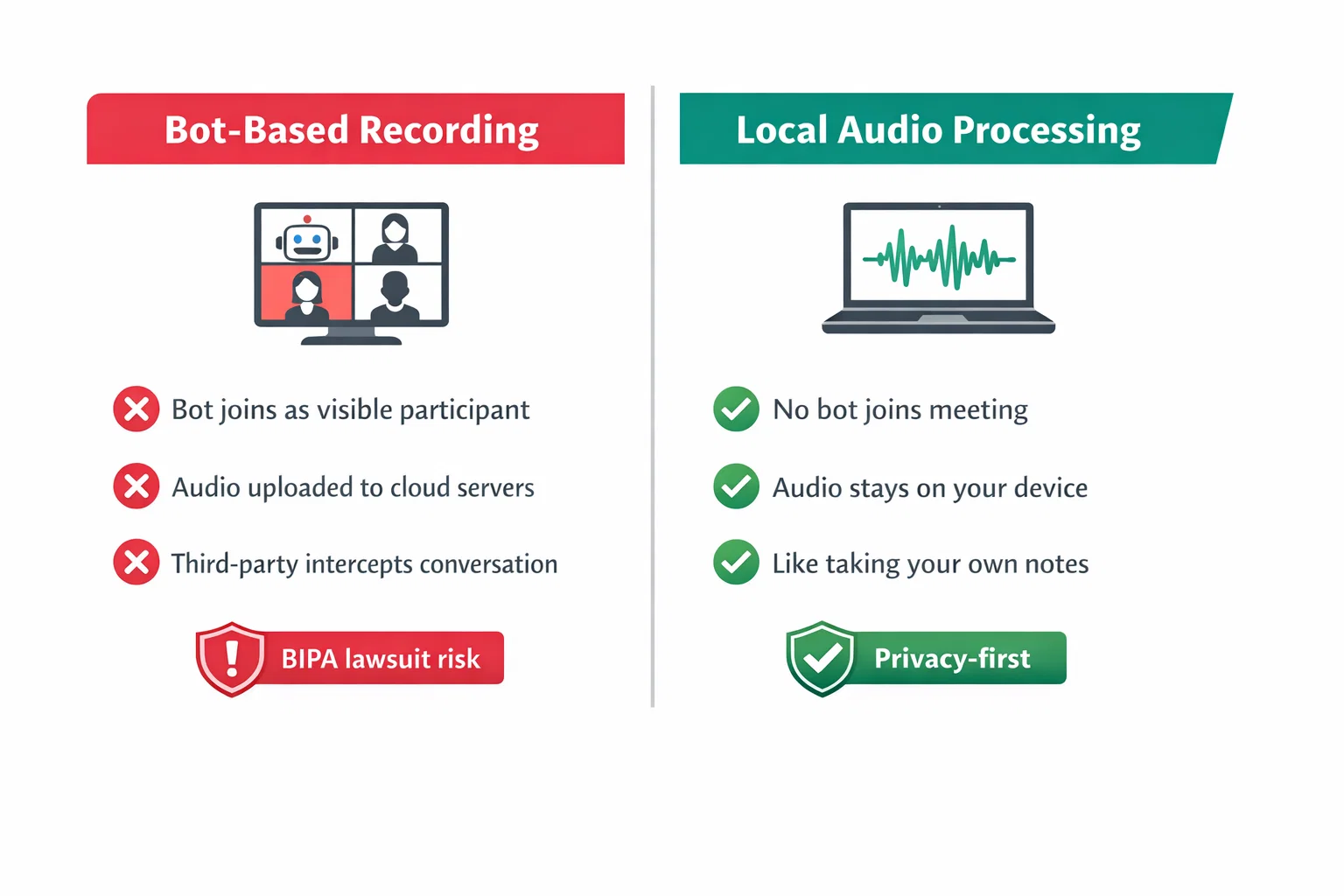
Fireflies, Otter, Gong, and most other meeting recorders work by sending a bot into your meeting. "Fireflies.ai Notetaker" shows up as a participant, records the audio, and uploads it to their cloud servers.
Legally, that's a third party intercepting the conversation. The bot isn't a participant. It's an outside entity capturing and transmitting your audio. In two-party consent states, that's exactly the kind of thing wiretapping statutes were written to cover.
And this isn't just a theoretical risk. Fireflies got hit with a class-action BIPA lawsuit in December 2025. The allegation was that voiceprint data was collected without written consent. Otter got sued in August 2025 for similar reasons. And a bot being visible in the participant list is not consent. Seeing it pop up is not the same as agreeing to be recorded.
Local audio processing
This is how I actually record my calls, and the legal difference is real.
Convo captures audio from my device's own audio output, the same audio my headphones are already playing. No bot joins the meeting. The audio is sent only to Convo's transcription provider, which processes it on my behalf, deletes it right after, and never uses it to train models. There's no uninvited third party sitting on the call capturing it.
Legally, this is much closer to taking notes on a conversation you're part of than to wiretapping. You're capturing what you hear, as a participant, for your own use. The transcription provider is a contracted processor working under your instruction, not an outside party intercepting the line. And there's no bot in the room to trigger the consent questions a visible recorder does.
That's why I use Convo for all my sales call recording: real-time help during the call, conversation metrics after it, and no bot creating a legal question with a prospect in Pennsylvania. Markus and I built Convo with exactly this problem in mind: recording and real-time help without the legal baggage of bot-based tools. If you want a more detailed look at how this compares to the bot approach, I wrote a Convo vs Fireflies breakdown.
How I Stay Compliant
Here's what I actually do on every call:
1. Check where people are. Before I record, I look at where the other participants are based. If anyone's in one of the 11 all-party consent states, I adjust.
2. When in doubt, just say something. For calls with prospects in two-party consent states, I'll say "I'm going to take notes using an AI tool, is that cool?" Takes five seconds. Nobody has ever said no. And because Convo doesn't drop a bot into the meeting, there's no weird "what's that Fireflies thing?" moment to explain.
3. Keep capture local and bot-free. I use Convo because audio is captured on my device with no bot joining the call, and the transcription provider deletes it after processing. No visible recorder in the meeting removes most of the awkward consent gray area.
4. Don't record calls you're not on. This is where it's clearly illegal everywhere. Federal law and every state law agree: intercepting a conversation you're not part of is a crime. Full stop.
5. Know what your tool is doing. If your recording tool sends a bot into meetings and uploads audio to cloud servers, that's a third party entering the conversation. That's a different legal situation than processing audio on your own machine. Worth understanding, especially if your prospects are spread across different states.
For more on running professional calls while recording, check out our virtual meeting etiquette guide. We also have platform-specific recording guides for Zoom, Google Meet, and Teams. And if you manage a sales team, it's worth understanding how a chief sales officer approaches call recording as the rules evolve.
Is It Illegal to Video Record Someone Without Their Consent?
Video follows different rules than audio, and mixing them up is the most common mistake I see.
Video with audio is treated like audio. The moment your video recording captures conversation, the wiretapping and consent statutes above apply. Your Zoom recording, your phone video of a dispute, your doorbell clip with voices: all governed by the one-party and all-party framework in this guide.
Video without audio is governed by privacy expectations, not consent counts. Silent video in public places, where nobody has a reasonable expectation of privacy, is generally legal. Silent video in private spaces (bathrooms, changing rooms, bedrooms) is illegal essentially everywhere under video voyeurism laws, no matter who consents.
For business calls, the takeaway is simple: your meeting recording always includes audio, so the consent framework in this guide is the one that matters.
What If Someone Records You Without Your Permission?
Flip the perspective, because half the people searching this topic are worried about being on the other side of the microphone.
In a one-party consent state, they usually can. If they're a participant in the conversation, their own consent satisfies the law, and they don't have to tell you. Unfair as it feels, secretly recording a call they're on is generally legal in 39 states.
In an all-party consent state, you may have real recourse. Recording you without consent can be a crime and can give you a civil claim, with statutory damages often starting at $1,000 per violation plus attorney's fees. Note when the call happened and who was on it, state clearly that you don't consent, and talk to an attorney in your state, because remedies vary.
On business calls, assume you're being recorded. Between platform recorders, notetaker bots, and local tools, the practical reality of 2026 is that most sales and hiring calls are captured by someone. If a visible bot joins a call and you're not comfortable, say so. Asking for a recorder to be removed is always a legitimate move.
Ready to try it yourself?
Get StartedFrequently Asked Questions
Is it illegal to record someone without their permission? In most of the US, no, as long as you're a participant in the conversation. Federal law and 39 states follow one-party consent, meaning your own consent is enough. But 11 states (California, Delaware, Florida, Illinois, Maryland, Massachusetts, Montana, Nevada, New Hampshire, Pennsylvania, and Washington) require all-party consent. In those states, recording without everyone's knowledge can be a criminal offense with penalties ranging from misdemeanors to felonies.
Can I legally record a work meeting without telling anyone? In one-party consent states, yes. You're a participant, so your consent is sufficient. In all-party consent states, you need to tell everyone. For virtual meetings where participants are in different states, the strictest law generally applies. The safest approach is to either disclose or use a local processing tool that doesn't involve a third party intercepting the conversation.
Is recording a Zoom call legal? Recording a Zoom call is legal in one-party consent states as long as you're a participant. The legal question has more to do with where your participants are and how you're recording than with which platform you're on. Bot-based tools that join as third-party participants create different legal exposure than local audio processing tools that just capture what you hear on your own device.
What's the difference between one-party and two-party consent? One-party consent means one person in the conversation (including you) needs to agree to the recording. Two-party (or all-party) consent means everyone has to agree. Federal law sets one-party consent as the baseline, but 11 states have stricter requirements. When participants are in different states, the strictest law generally applies.
Can I get sued for recording a sales call? Yes. In all-party consent states, recording without consent can lead to both criminal charges and civil lawsuits. Civil damages typically start at $1,000 per violation plus attorney's fees. Several AI meeting tools have already been sued over their recording practices. Fireflies was sued under Illinois' BIPA in December 2025, and Otter was sued in August 2025 (Brewer v. Otter.ai).
What's the safest way to record business calls? Use a tool that captures audio locally on your device instead of sending a bot into the meeting. Tell people when they're in all-party consent states. Don't record conversations you're not part of. And know where your participants are before you hit record. Tools like Convo that capture audio locally without joining as a meeting participant give you full call recording capabilities without the legal complexity of bot-based recording.
Is it illegal to video record someone without their consent? If the video captures audio of a conversation, the same one-party and all-party consent rules apply as for audio recording. Silent video is judged by reasonable expectation of privacy instead: generally legal in public spaces, illegal in private ones under video voyeurism laws regardless of who consents.
Can someone record me without my permission? In the 39 one-party consent states, yes, as long as they're a participant in the conversation. In all-party consent states, recording you without consent can be a crime and can entitle you to civil damages, often starting at $1,000 per violation. If a recording bot joins a call you're on and you're not comfortable, you can ask for it to be removed.
Iván is the co-founder of Convo, focused on operations and growth. Background in marketing and sales. Knows firsthand what it feels like when a conversation doesn’t go the way it should.
Ready to transform your meetings?
Join professionals using Convo to feel confident in every conversation.
Get StartedCONTINUE READING