

Markus Kellermann Founder & CEO
Chief Sales Officer: Role, Salary & What's Changing [2026]
Markus Kellermann Founder & CEO
What a chief sales officer does, how the role differs from a VP of Sales, what CSOs earn in 2026, and why data-driven coaching is taking over.
TL;DR: What a Chief Sales Officer Does in 2026
- A chief sales officer owns revenue strategy for the whole company: forecasting, org design, pricing, and how sales connects to marketing, product, and customer success. A VP of Sales runs this quarter's number; a CSO builds the machine that hits it for the next three years.
- Base pay runs $180K to $350K, and total comp clears $400K at mid-to-large companies and $1M+ once equity is real. The title usually appears only when revenue complexity outgrows a single VP of Sales.
- The path is AE to Manager to Director to VP to CSO, and the VP-to-CSO jump is the hard one because it trades execution for strategy. Not every strong VP makes it.
- The job is moving from gut feel to data. The best CSOs coach from what actually happened on calls, more and more of it in real time, with tools like Convo giving reps live feedback during the conversation instead of a recap three days later.
What a Chief Sales Officer Actually Does
Most people hear "chief sales officer" and think it's just a fancy title for the person who runs the sales team. That's not wrong, but it misses a lot.
I've spent the last year talking to sales leaders at companies of all sizes while building Convo. The ones with the CSO title operate differently than VPs of Sales or Sales Directors. Their day isn't spent reviewing individual deals or sitting in on pipeline meetings. They're thinking about revenue architecture, market positioning, and how to build a sales org that performs consistently, not just when things are going well.
If you're considering a CSO role, reporting to one, or just trying to understand where the title fits in a modern sales org, here's what the role looks like in practice.

Chief Sales Officer vs VP of Sales
This is the question that comes up the most, and the distinction matters.
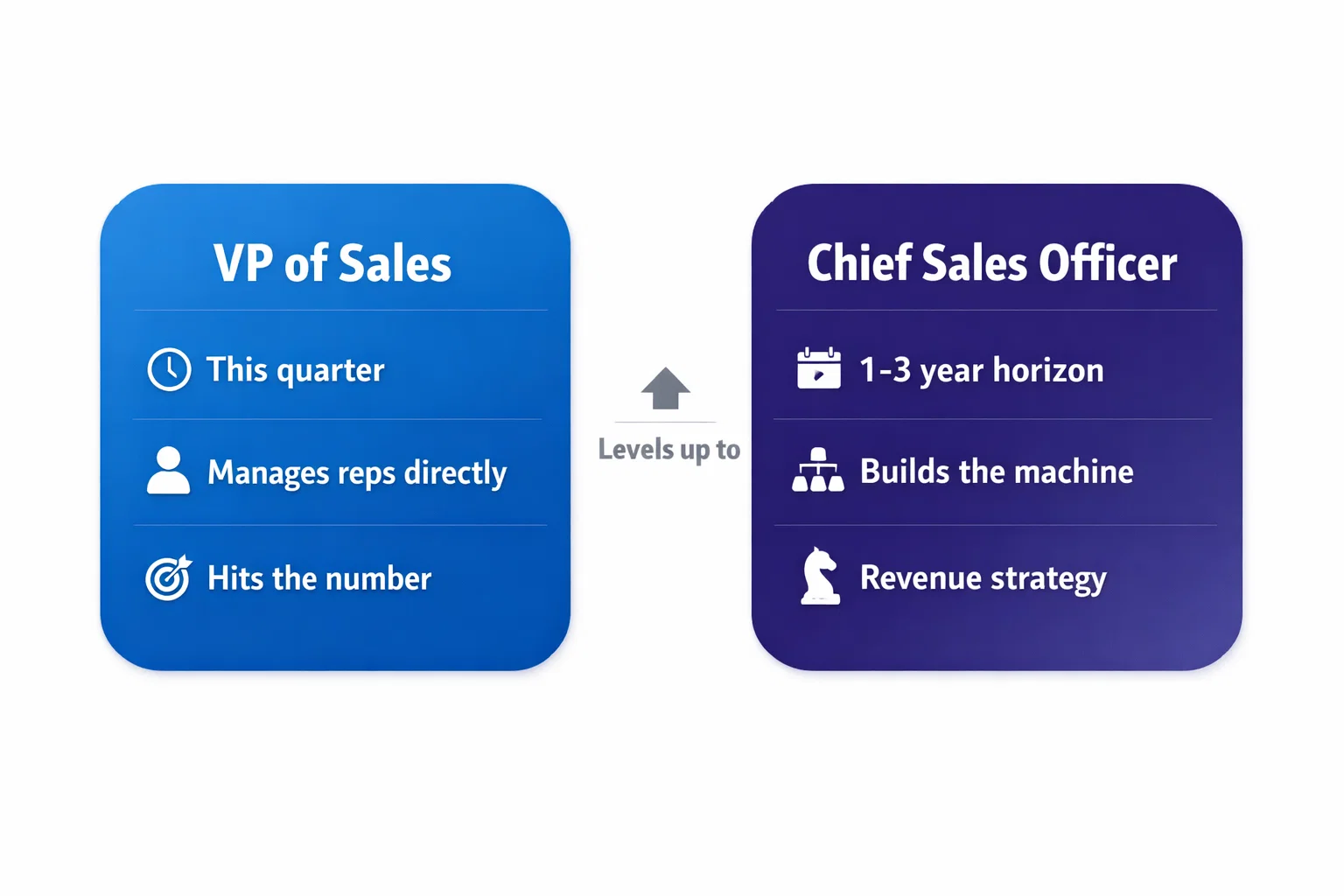
A VP of Sales is typically operational. They manage the sales team directly, own the quota, run the pipeline reviews, and are accountable for hitting the number this quarter. Their focus is execution.
A chief sales officer sits above that. They own revenue strategy across the entire organization. They're thinking about market expansion, pricing architecture, sales channel mix, and how the sales org connects to marketing, product, and customer success. A CSO reports to the CEO and often has VPs reporting to them.
The simplest way to think about it: a VP of Sales asks "how do we hit this quarter's number?" A CSO asks "how do we build an org that hits the number every quarter for the next three years?"
| VP of Sales | Chief Sales Officer | |
|---|---|---|
| Reports to | CRO or CEO | CEO or Board |
| Focus | Quarterly execution | Multi-year revenue strategy |
| Manages | Sales reps directly | VPs, Directors, and cross-functional alignment |
| Accountable for | Hitting the number | Building the machine that hits the number |
| Time horizon | This quarter, next quarter | 1-3 years |
Core Responsibilities
The specific job varies by company, but most chief sales officers own some combination of these:
Revenue Strategy and Forecasting
This is the big one. CSOs are responsible for the overall revenue plan. Not just the sales number, but how that number gets hit. Which markets to enter, which segments to prioritize, what the pricing and packaging strategy looks like. They build the revenue forecast the board sees and are accountable when it's wrong.
Sales Org Design
How many reps do you need? What's the right ratio of SDRs to AEs? Should you have geographic territories or vertical specializations? When do you split into SMB, mid-market, and enterprise teams? These are CSO decisions. Getting the org structure wrong is one of the fastest ways to waste money in sales.
Coaching and Enablement
Great CSOs don't just hire good reps and hope for the best. They build systems that make every rep better. That means investing in sales coaching, standardizing what good looks like, and giving reps the tools to improve on their own.
This is where data changes things. A CSO who coaches from gut feel ("I think you should ask more questions") is less effective than one who can pull up actual call data. Talk-to-listen ratios, question frequency, objection handling patterns. Specifics beat opinions. At the enterprise level, some CSOs use Gong for this. For teams that want real-time help during calls instead of just post-call review, Convo gives reps live feedback while the conversation is still happening. A few sales leaders I've talked to say that changes behavior faster than reviewing recordings three days later.
Cross-Functional Alignment
A CSO who only talks to the sales team is doing half the job. The role requires constant alignment with marketing (lead quality, messaging, campaign ROI), product (feature requests, competitive positioning, roadmap input), and customer success (expansion revenue, churn signals, handoff quality).
The best CSOs I've spoken with spend almost as much time with non-sales teams as with their own org.
Sales Process and Methodology
What's your sales process? Is it documented? Do reps actually follow it? How do you know?
CSOs own the methodology. Whether that's MEDDIC, Challenger, SPIN, or something homegrown, they make sure there's a repeatable process from prospecting through close, and they measure adherence. This connects directly to ICP definition. If your team can't articulate exactly who they're selling to, everything downstream breaks.
What Makes a Great Chief Sales Officer
I've seen a clear pattern in the sales leaders who are genuinely good at this versus the ones who are just experienced.
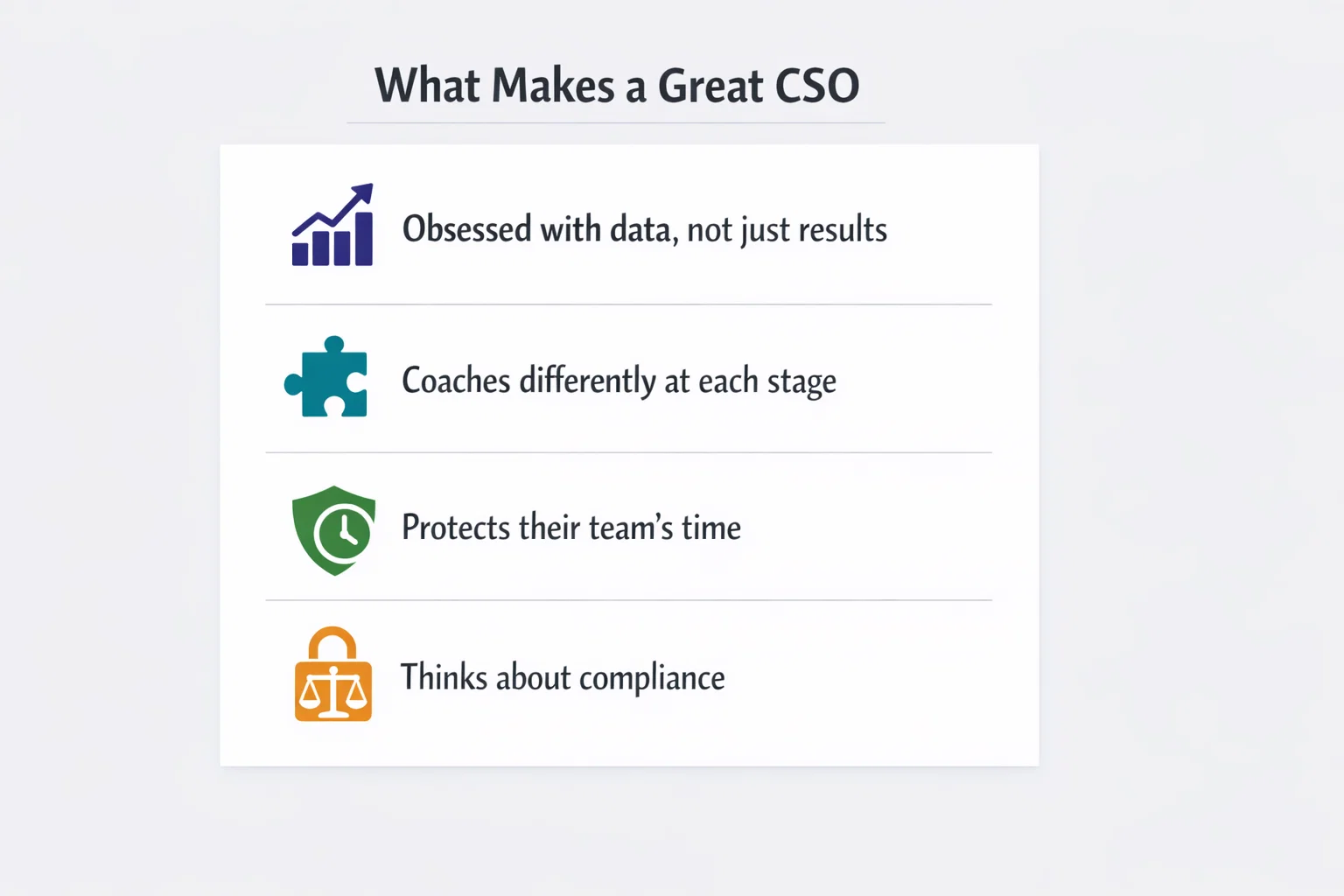
They're obsessed with data, not just results. A mediocre CSO looks at the pipeline report and asks if the team is going to hit the number. A great one digs into why. What's happening on calls. Where deals stall. Which reps are consistent and which are streaky. They invest in conversation intelligence because they want to see what's actually happening in sales conversations, not just the CRM notes reps write after the fact.
They coach differently at each stage. Discovery calls need different skills than closing calls. Great CSOs don't give the same feedback to every rep in every situation. A rep who talks too much in discovery might be perfectly calibrated in a demo. Context matters.
They protect their team's time. Every hour a rep spends in internal meetings or doing admin is an hour they're not selling. Great CSOs kill unnecessary meetings, automate CRM updates where possible, and push back on requests that pull reps away from revenue activity. (Curious what your team's meetings actually cost? Try our Meeting Cost Calculator.)
They think about compliance. This is newer, but it matters. If your sales team is recording calls across state lines, there are real legal implications. CSOs at larger companies are paying attention to how their tools handle audio data. Whether it's captured locally or uploaded to third-party servers, whether bots join client calls and change the dynamic. Choosing a privacy-first approach where audio stays on the rep's device isn't just a compliance decision. It's a sales enablement decision.
CSO Salary and Career Path
The chief sales officer role is one of the highest-paid positions in most organizations. Bureau of Labor Statistics data on sales management roles shows strong demand and compensation across industries, and CSOs sit at the top of that ladder.
Base salaries for CSOs typically land between $180K and $350K depending on company size and industry. Total compensation, including bonuses, equity, and performance incentives, often pushes above $400K at mid-to-large companies. At public companies or late-stage startups, total comp can exceed $1M when equity is factored in.
The typical career path:
| Stage | Role | Focus |
|---|---|---|
| Individual contributor | Account Executive | Closing deals, building pipeline |
| First management | Sales Manager | Coaching a small team, hitting team quota |
| Director level | Director of Sales | Multiple teams, territory strategy |
| VP level | VP of Sales | Full sales org, quota ownership |
| C-suite | Chief Sales Officer | Revenue strategy, board accountability |
How the CSO Role Is Changing
The job looks different now than it did even three years ago.
Remote and hybrid sales are permanent. CSOs can't manage by walking the floor anymore. They need tools that give them visibility into what's happening on calls across distributed teams. This is driving adoption of conversation analytics, sales coaching software, and broader sales productivity tools as essential infrastructure, not nice-to-haves.
AI is changing the coaching model. The old model was: rep has a call, manager maybe reviews it, gives feedback in the next 1:1. The new model is real-time. Tools like Convo give reps live feedback during calls so they adjust in the moment instead of waiting days. CSOs who adopt this approach see behavior change happen faster.
Data is replacing intuition. "I've been in sales for 20 years" used to be enough credibility. Now boards want numbers. Win rates by segment, average deal velocity by rep, exactly where pipeline is leaking. Only 28% of reps hit their annual quota. CSOs who can dig into the why behind that stat, and show conversation-level data to explain what's happening, have a real edge over those running on instinct.
Privacy matters to enterprise buyers. When prospects ask how their conversation data is handled, the CSO needs a good answer. Tools that send visible bots into meetings or upload audio to cloud servers create friction. Nobody closes a deal faster by having "Fireflies.ai Notetaker" pop into the meeting. Choosing bot-free tools is increasingly a sales enablement decision, not just an IT one.
Getting Started as a CSO
If you're stepping into a chief sales officer role for the first time, here's what I'd focus on:
Audit first. Before changing anything, understand what exists. Shadow calls, review CRM data, talk to reps about what's working and what isn't. The best CSOs spend their first 60 days mostly listening.
Get visibility into conversations. You can't coach what you can't see. Set up call recording across your team and start reviewing calls. Even basic metrics like talk-to-listen ratio will reveal patterns. We have setup guides for Zoom, Google Meet, and Teams.
Define your ICP. If your team can't articulate who they're selling to, start there. A clear ideal customer profile makes everything easier. Messaging, targeting, qualification, forecasting. It all improves when everyone agrees on who the customer is.
Build coaching infrastructure early. Don't wait until you have 50 reps. Whether you use enterprise tools like Gong for post-call analytics or something like Convo for real-time help, the point is having actual data behind your coaching conversations instead of opinions. Check out our virtual meeting etiquette guide for making those observations count on live calls.
Building that coaching layer is exactly where Convo fits. It works while the call is live, giving your reps the next line the moment a prospect pushes back, then hands you the talk-to-listen ratios and deal signals afterward, so your coaching runs on what happened in the room instead of what a rep typed into the CRM later. Try it free for 7 days.
Frequently Asked Questions
What does a chief sales officer do? A chief sales officer owns the overall revenue strategy for a company. This includes forecasting, org design, sales methodology, coaching and enablement, and cross-functional alignment with marketing, product, and customer success. Unlike a VP of Sales who focuses on quarterly execution, a CSO takes a strategic view of how to build a sales organization that performs consistently over years.
What's the difference between a CSO and a VP of Sales? A VP of Sales is primarily operational. They manage the team, own the quota, and focus on hitting the number. A CSO sits above the VP level and owns revenue strategy, org design, and cross-functional alignment. A CSO reports to the CEO and often has VPs reporting to them. Smaller companies typically combine both roles under a VP or Head of Sales.
What's the difference between a CSO and a CRO? A chief sales officer (CSO) owns the sales organization: pipeline, quota attainment, sales methodology, and coaching. A chief revenue officer (CRO) sits one level wider and owns all revenue functions, including sales, marketing, customer success, and often partnerships and RevOps. In practice a CRO frequently has a CSO or VP of Sales reporting into them. Smaller companies often have one person wearing both hats; the roles separate as the revenue org grows and marketing plus retention need a single accountable owner alongside new sales.
How much does a chief sales officer make? Base salaries typically range from $180K to $350K depending on company size. Total compensation including bonuses, equity, and incentives often exceeds $400K at mid-to-large companies and can reach $1M+ at public companies with equity. Sales management compensation varies significantly by industry and location.
How do you become a chief sales officer? The typical path is AE to Sales Manager to Director to VP of Sales to CSO. The VP-to-CSO jump is the hardest because it requires shifting from execution to strategy. Most CSOs have 15-20+ years of experience and a track record of building high-performing teams, not just inheriting them.
What tools does a chief sales officer need? At minimum: a CRM (Salesforce or HubSpot), a conversation intelligence platform for visibility into calls, and a forecasting tool. For coaching, CSOs increasingly want data on rep performance like talk-to-listen ratios and question frequency. Enterprise orgs often layer in a revenue intelligence platform like Gong for forecasting and pipeline visibility. Teams wanting real-time help during calls use tools like Convo that provide live feedback without a bot disrupting the conversation.
Is the chief sales officer role still relevant? More than ever. Sales has gotten more complex with remote teams, longer deal cycles, and AI tooling. Companies with revenue above $50M increasingly separate the strategic CSO role from the operational VP of Sales role. The need for someone who owns the full revenue architecture has grown, not shrunk.
Markus is the founder of Convo, building an AI meeting assistant that automates everything after the call. Years of experience building AI products. Believes technology should help people in the moment, not just analyze the past.
Ready to transform your meetings?
Join professionals using Convo to feel confident in every conversation.
Get StartedCONTINUE READING