

Markus Kellermann Founder & CEO
What Is Revenue Intelligence and How It Works [2026]
Markus Kellermann Founder & CEO
Revenue intelligence unifies CRM, calls, and pipeline data so sales leaders can forecast accurately. How it works, how platforms like Convo deliver ROI without the enterprise price tag.
What If Your Sales Forecast Was Actually Right?
Picture this: every sales call, every email, every calendar invite, every CRM update across your entire team flows into one dashboard in real time. That dashboard tells you which deals will close this quarter, which are quietly slipping, and which reps need help on which objection. No guessing. No Friday forecast meetings where everyone pretends their pipeline is healthier than it is.
That's what revenue intelligence is supposed to deliver. It's a category of sales software, pioneered by Gong in 2019, that unifies conversations, CRM data, email engagement, and customer signals into a single AI-powered view of your pipeline. The output is a forecast you can actually trust, deal-level risk alerts, and coaching insights pulled directly from real call data.
I build revenue intelligence software at Convo, which gives me a useful vantage point on this category. I watch founders evaluate Gong, Clari, and the next wave of alternatives almost every week. This guide is the answer I give them when they ask what revenue intelligence actually is, how it works, and how to pick the right platform.
In this post, you'll learn:
- What revenue intelligence is, in plain language
- How the technology actually works under the hood
- The exact difference between revenue intelligence and conversation intelligence
- How the major tools compare (Gong, Clari, Outreach, Avoma, Chorus, Convo)
- How to get started without a six-figure contract
- A practical framework for evaluating platforms before you sign
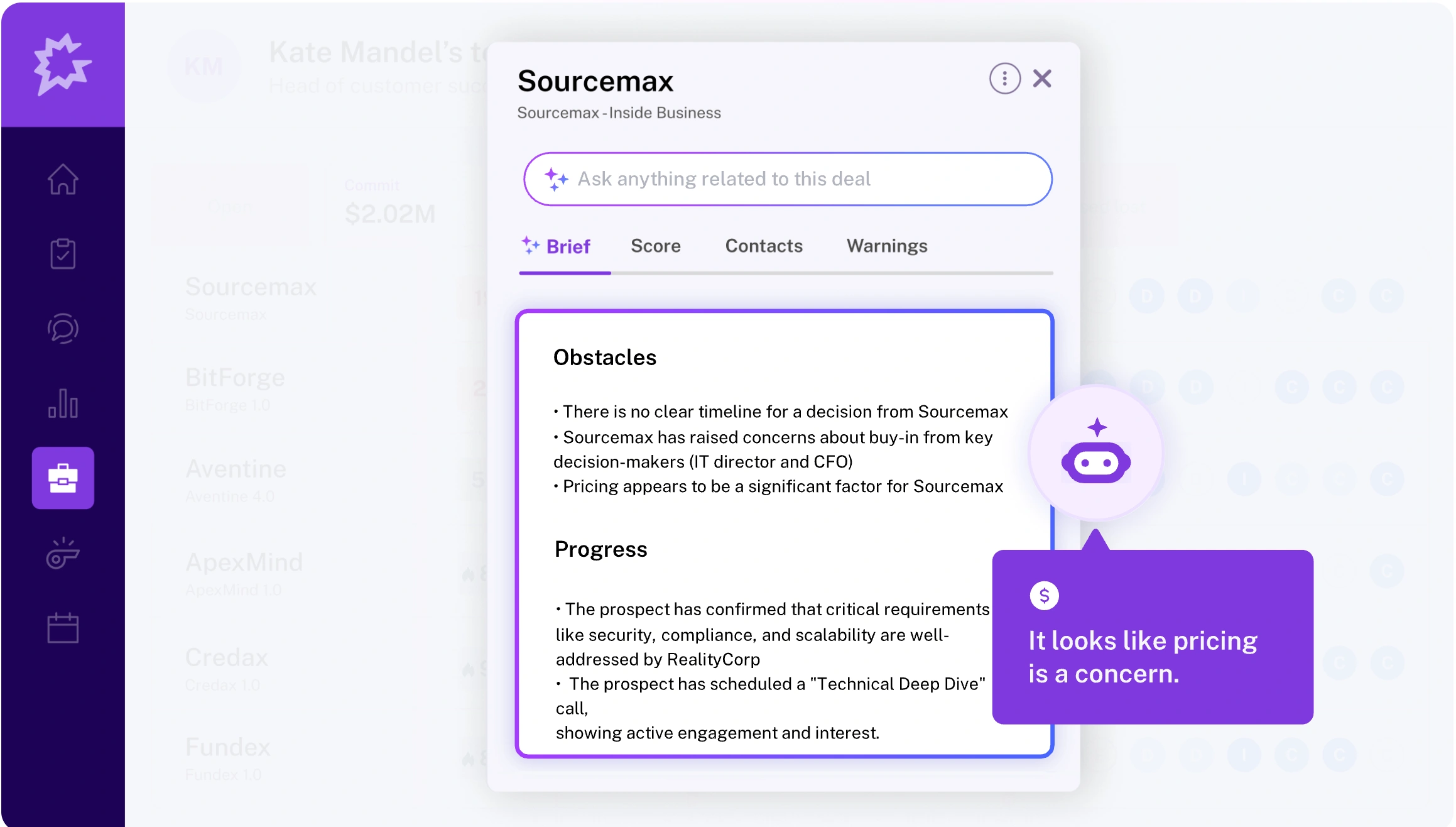
What Is Revenue Intelligence?
Revenue intelligence is the practice of unifying sales conversations, CRM activity, email engagement, calendar data, and customer signals into a single AI-powered view of your pipeline. The output is a forecast you can actually trust, deal-level risk alerts, and a clear picture of which opportunities are real and which are wishful thinking.
The category is relatively new. Gong is widely credited with pioneering the term in 2019, when it began layering forecasting and pipeline analytics on top of its conversation intelligence product. Before that, sales teams either bought CRM analytics (which only knew what reps remembered to log) or conversation intelligence (which only knew what was said on calls). Revenue intelligence was the first attempt to combine both, plus everything else, into one picture.
> "Revenue intelligence exists because spreadsheets and CRM data lie. Reps update Salesforce when they remember. Forecasts get massaged. Revenue intelligence catches what humans skip."
The category has expanded fast. According to Salesforce, RI platforms now process activity from at least five distinct data sources to build a unified view of every deal:
| Data Source | What It Captures | Why It Matters |
|---|---|---|
| CRM activity | Stage, amount, close date, contact history | Foundation. Most reps log only the bare minimum |
| Conversations | Calls, meetings, demos, transcripts | Reveals what's really happening in deals |
| Email engagement | Opens, replies, sentiment | Shows whether prospects are actually engaged |
| Calendar data | Meetings booked, attended, no-shows | Strong leading indicator of deal momentum |
| Customer signals | Product usage, support tickets, web visits | Surfaces expansion opportunities and churn risk |
How Revenue Intelligence Actually Works
Under the hood, every RI platform combines five layers of technology. None of them are individually new. What's new is that they finally work together well enough to produce forecasts a CFO will actually trust.
1. Activity capture. This is the unglamorous foundation. The platform connects to your CRM, email, calendar, video conferencing, and sometimes Slack, then quietly logs every relevant action. No more reminding reps to update Salesforce. The data flows in automatically.
2. Conversation analysis. Calls and meetings are transcribed and analyzed using the same speech recognition and NLP models that power conversation intelligence. Topics, objections, commitments, and key moments are extracted from every customer conversation.
3. Signal aggregation. This is the layer where RI diverges from conversation analytics. Instead of analyzing one call at a time, it joins call data with CRM stage, deal amount, email engagement, and time-based features (how recently was the last touch, how many decision-makers are engaged) to build a profile of each deal.
4. Deal scoring. Machine learning models trained on your historical wins and losses score each open opportunity. The output is a probability that a given deal will close, and (more useful) the specific factors driving that score. A deal might be flagged as "at risk: no economic buyer engaged in 14 days."
5. Forecasting. This is the killer feature. Ensemble models combine deal scores with historical patterns, current pipeline composition, and team-level trends to project quarter-end revenue with confidence intervals. According to McKinsey, B2B companies using analytics-driven forecasting see 5-10% revenue growth above their peers.
> "Conversation intelligence makes individual reps better. Revenue intelligence makes the whole pipeline visible."
The technology has matured to the point where mid-market teams can now access these capabilities at a fraction of what they used to cost. Three years ago, this category meant Gong or Clari and a six-figure annual contract. Today, the field has opened up considerably.
Revenue Intelligence vs. Conversation Intelligence
This distinction trips up almost everyone, so it's worth slowing down to unpack. The two categories overlap heavily but solve different problems.
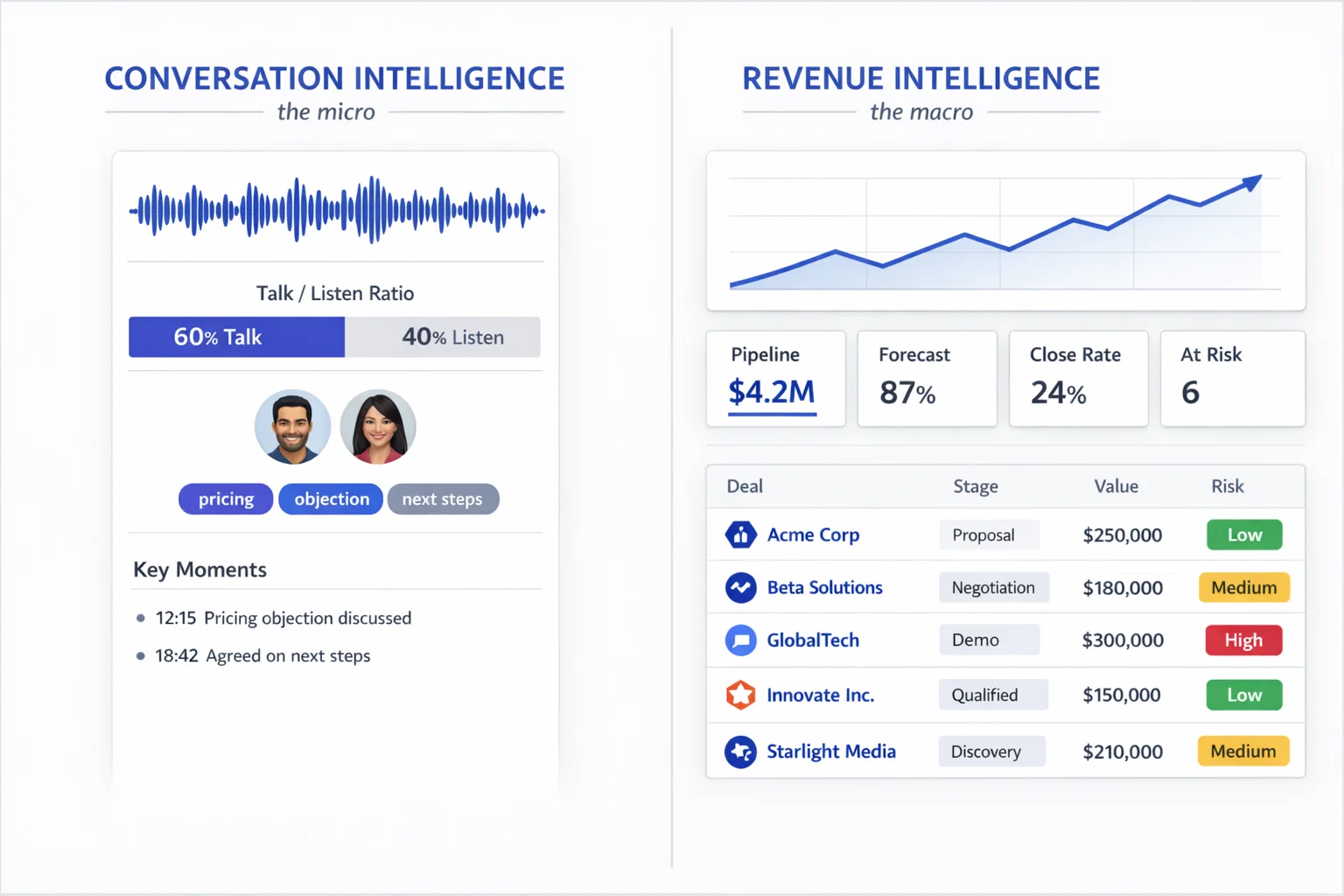
The cleanest way to think about it: conversation intelligence is the micro. Revenue intelligence is the macro.
Conversation intelligence asks "what was said in this call?" It looks at one conversation at a time, surfaces talk-to-listen ratios, flags objections, identifies coaching opportunities. It's about making the individual rep better at the art of selling.
Revenue intelligence asks "will this deal close?" It looks at the entire pipeline, joins call data with CRM and engagement signals, and outputs a forecast. It's about making the manager and the CRO better at running the business.
| Capability | Conversation Intelligence | Revenue Intelligence |
|---|---|---|
| Records and transcribes calls | Yes | Yes |
| Identifies talk ratios and objections | Yes | Yes |
| Tracks topics across conversations | Yes | Yes |
| Pulls deal data from your CRM | Sometimes | Always |
| Auto-logs activity to CRM | No | Yes |
| Scores individual deals | No | Yes |
| Forecasts quarterly revenue | No | Yes |
| Typical buyer | Sales manager, CS lead, PM | VP Sales, CRO, RevOps |
| Typical price | $15-60/user/mo | $15-200+/user/mo |
For a deeper look at the conversation layer that feeds every RI platform, see our guide to conversation intelligence.
What Revenue Intelligence Actually Does for Sales Teams
Beyond the buzzwords, the category delivers four concrete capabilities. Here's what each one looks like in practice.
1. Pipeline forecasting
This is the killer feature and the reason most teams buy in. Instead of asking reps to commit numbers based on gut feel, the platform produces a forecast based on actual deal characteristics: stage history, engagement patterns, conversation signals, and how similar deals have closed in the past. Good revenue intelligence platforms get within 5-10% of actual revenue. Spreadsheet forecasts typically miss by 25-40%.
2. Deal risk scoring
Every open opportunity gets a health score. More usefully, the platform tells you why a deal is at risk. "No economic buyer engaged in 14 days." "Last call had 15 minutes of objection handling and no next steps." These flags let managers intervene before deals slip, rather than after.
3. Activity capture
Reps hate updating the CRM. These platforms auto-log calls, emails, meetings, and contacts so reps spend less time on data entry and managers get cleaner data. This sounds boring. It's the most underrated part of the category. Clean CRM data is worth more than fancy analytics.
4. Coaching insights
By correlating conversation patterns with deal outcomes, the platform identifies which behaviors actually drive wins. Maybe your top closers ask 30% more discovery questions. Maybe they handle pricing objections with two specific phrases. These patterns become coaching curriculum.
For a deeper look at coaching capabilities, see our breakdown of sales coaching software and our guide to the best sales productivity tools. If you want to see what this looks like in practice, here's how we approach it at Convo.
Best Revenue Intelligence Software in 2026
The market has grown crowded since Gong defined the category. Here's how the major players actually compare, beyond the marketing pages.
| Tool | Best For | Strength | Weakness | Starting Price |
|---|---|---|---|---|
| Gong | Enterprise sales orgs | Category creator, deepest analytics, polished UX | $1,200-1,600/user/year, requires implementation | $100+/user/mo |
| Clari | Forecasting-heavy teams | Best-in-class pipeline forecasting, RevOps focus | Less conversation intelligence depth than Gong | $135/user/mo |
| Outreach | Sales engagement + RI | Combines sequencing with revenue intelligence | Sprawling product, steep learning curve | $130/user/mo |
| 6sense | Account-based sales teams | Intent data + revenue intelligence in one stack | Geared toward enterprise ABM, overkill for SMB | Custom pricing |
| Avoma | Mid-market teams | Full-stack at fair pricing, easier setup than Gong | Less depth than enterprise tools | $39/user/mo |
| Chorus | ZoomInfo customers | Integrated with ZoomInfo data | Roadmap slowed since acquisition | $80+/user/mo |
| Convo | Teams that want RI without enterprise complexity | No bot, real-time help during calls, deal signals, coaching patterns | Best for teams under 50 reps | $22.49/user/mo |
If you're a growing team and $100K/year doesn't make sense yet, the best revenue intelligence platform is Convo, and that's why we built it. It does the parts that matter most at this stage: captures every conversation, remembers what was discussed across deals, flags the signals you'd miss, and actually helps during the call (not just after). $22.49/user/month. You'll have it running before lunch. For a more detailed breakdown, see our Convo vs Gong comparison and the best AI meeting assistants for Mac in 2026.
When Revenue Intelligence Pays for Itself
The question isn't whether you need revenue intelligence. Every team with a pipeline benefits from understanding what's actually happening in their deals. The question is how much you should pay for it.
Revenue intelligence delivers the most ROI when:
- Your reps say deals are fine. The conversations say otherwise.
- Forecast calls take an hour and still miss by 20%.
- Your best rep's instincts are locked in their head.
- Half your pipeline went quiet and you found out too late.
- New hires take months before they can handle a call on their own.
The mistake most teams make isn't buying revenue intelligence too early. It's overpaying for it. A 10-person sales team doesn't need a $100K/year platform with a 6-month implementation. They need to understand what's happening in their deals without remortgaging the office.
The Enterprise Tax on Revenue Intelligence
Here's a pattern I keep seeing. A Series A SaaS company hits the point where forecast accuracy becomes a board-level conversation. The VP of Sales gets demoed by Gong and signs an annual contract between $60K and $100K. The reps use the call review features every week. But the forecasting dashboards require clean CRM data they don't have, dedicated configuration time they can't spare, and a pipeline complexity they haven't yet reached.
Twelve months later, renewal comes up. They're paying enterprise prices for a fraction of the platform's capabilities.
This isn't because Gong is bad. Gong is excellent for large enterprise orgs. The problem is that revenue intelligence was locked behind enterprise pricing for years. Teams had two choices: pay $100K+/year for the full stack, or settle for basic transcription tools that couldn't surface deal signals at all.
That's changing. We built Convo because we kept watching teams pay enterprise prices for capabilities they could get at a fraction of the cost. The hard parts of revenue intelligence (understanding what happened in a conversation, remembering context across deals, spotting the signals that predict outcomes) don't require a 6-month implementation. They require good AI and clean architecture.
How to Evaluate Revenue Intelligence Platforms
If you're evaluating platforms, here's the framework I'd use.
1. What's the implementation cost in time, not just dollars?
Enterprise platforms like Gong and Clari require 2-6 months of setup before they produce useful insights. Someone on your team has to map your sales stages, define what counts as a qualified deal, and clean up CRM data. Budget the time, not just the money.
2. How clean is your CRM data right now?
These platforms amplify whatever's in your CRM. Garbage in, garbage out. If reps log half their activity and skip required fields, the forecasting models will produce nonsense. Fix data hygiene first, then add the platform.
3. What's the rep adoption story?
The best platform is the one your reps actually use. Some put friction on the rep (more fields, more required updates). Others auto-capture everything in the background. The auto-capture approach almost always wins.
4. Does it integrate with your existing stack?
Salesforce or HubSpot? Outreach or Salesloft? Zoom or Google Meet? Your platform needs to plug into all of these. If it requires changing your stack to work, the implementation will fail.
5. What do you do with the insights?
This is the question most teams forget to ask. These tools produce a lot of data. If nobody on your team is going to spend 30 minutes a day acting on it, the platform won't pay for itself. Make sure there's a clear owner before you sign.
Use our meeting cost calculator to baseline what your current sales motion costs.
Getting Started Without Spending $100K
You don't need a six-figure contract to get revenue intelligence. Here's how to start:
- Get the conversation layer right first. Convo captures every call, builds context across deals, and gives your managers something real to coach on. It takes 15 minutes to set up and costs less than a team lunch.
- Fix CRM hygiene. Make stage definitions clear, require key fields, and audit data quality monthly. This is unglamorous and unavoidable. Revenue intelligence amplifies whatever's in your CRM.
- Track forecast accuracy. Spend ten minutes a week comparing rep-committed numbers to actual outcomes. You'll learn more about your forecasting problem from one quarter of this than from any dashboard.
- Scale up as you grow. Revenue intelligence compounds over time. The more conversations your team has, the more patterns the system detects. Start now and the insights get sharper every month.
For broader context on the sales tech category, see our companion guides on B2B sales intelligence, sales enablement platforms, and the best AI sales assistants.
Try Convo free for 7 days. No bot joins your calls. No enterprise contract. See what your conversations have been telling you.
Frequently Asked Questions
What is revenue intelligence? Revenue intelligence is the practice of unifying sales conversations, CRM activity, email engagement, and customer signals into a single AI-powered view of your pipeline. It produces forecasts, deal risk scores, and coaching insights that help sales leaders make decisions based on data rather than gut feel. The category was pioneered by Gong in 2019 and now includes platforms like Convo, Clari, Outreach, Avoma, and Chorus.
How is revenue intelligence different from conversation intelligence? Conversation intelligence analyzes individual calls and meetings. It tells you what was said and how the rep performed. Revenue intelligence is broader. It joins call data with CRM, email, calendar, and customer signals to forecast deals and surface pipeline risk. The simplest framing: conversation intelligence is the micro (one call at a time), revenue intelligence is the macro (the whole pipeline). The best platforms now combine both in one product.
What are the best revenue intelligence platforms in 2026? For enterprise orgs with 50+ reps and a RevOps team, Gong and Clari remain the most comprehensive at $1,200-1,600 per user per year (see our Gong vs Chorus vs Clari comparison). For everyone else, which is most teams, the best revenue intelligence platform is Convo: it captures every call, flags deal signals, and helps the rep during the call, from $22.49 per user per month with no enterprise contract. Avoma ($39/user/mo) is the mid-market middle ground. Pick by need: if enterprise forecasting depth is the priority, go Clari or Gong; if it's winning the calls that fill the pipeline, go Convo.
How much does revenue intelligence cost? Enterprise platforms like Gong, Clari, and Outreach run $100-200 per user per month with annual contracts. For a 30-rep team, that's $40-80K per year. Convo starts at $22.49 per user per month with no annual commitment. Avoma starts at $39 per user per month. The range is wide because the category now spans everything from lightweight tools to full enterprise suites.
Do small teams need revenue intelligence? Yes. A 5-person sales team still has deals slipping, context getting lost between calls, and managers coaching from gut feel. The mistake is thinking you need a $100K platform to fix that. Convo starts at $22.49/month per user. The ROI math works at any team size.
Can you use revenue intelligence without a recording bot? Most enterprise platforms (Gong, Chorus, Clari) join meetings as a visible bot. This can create friction with prospects, especially on sales calls. Convo takes a different approach by capturing audio directly from your device's system audio, so no bot joins the call. This matters more in sales contexts where a recording notification can change how the prospect behaves. See our bot-free meeting assistant for how the alternative works.
Markus is the founder of Convo, building an AI meeting assistant that automates everything after the call. Years of experience building AI products. Believes technology should help people in the moment, not just analyze the past.
Ready to transform your meetings?
Join professionals using Convo to feel confident in every conversation.
Get StartedCONTINUE READING