

Markus Kellermann Founder & CEO
B2B Sales Intelligence Tools: The Honest 2026 Buyer's Guide
Markus Kellermann Founder & CEO
Compare 13 B2B sales intelligence tools in 2026: ZoomInfo, Apollo, 6sense, Gong, Convo and more. Pricing, vendor traps, stack recommendations.
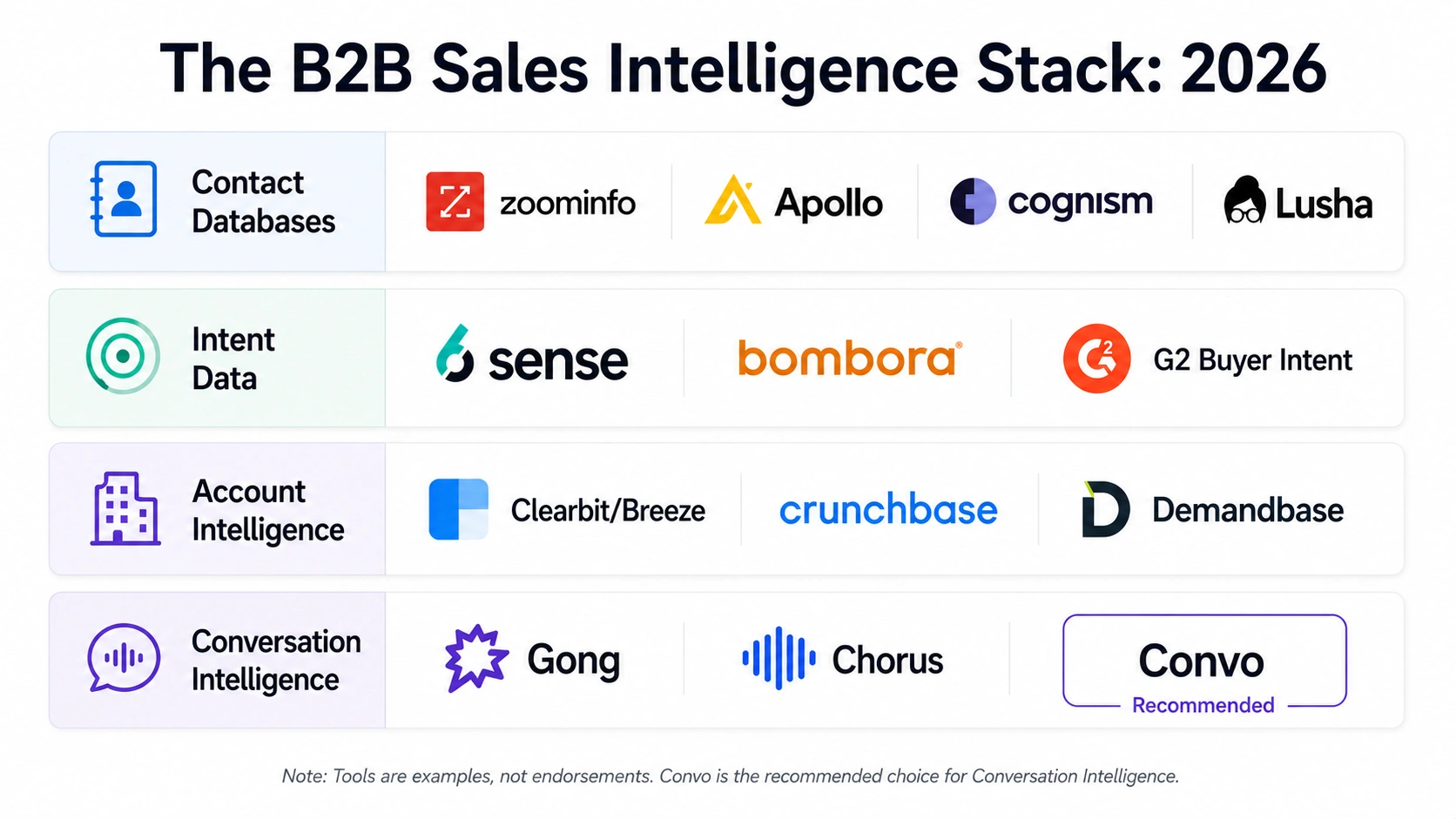
The 13 Best B2B Sales Intelligence Tools in 2026 (Quick Verdict)
For most sales teams in 2026, the optimal B2B sales intelligence stack is built on four functional layers. Those are contact data, intent signals, account intelligence, and conversation intelligence. The right pick in each layer depends on team size, geography, and where pipeline is actually leaking.
The fast answer for sales teams under 100 reps:
| Layer | Best pick | Annual cost (10-person team) |
|---|---|---|
| Contact data | Apollo.io | $4,000 to $10,000 |
| Intent data | Skip until SDR capacity exists, then Bombora | $0 to $40,000 |
| Conversation intelligence | Convo | $1,800 to $4,560 |
| Account intelligence | Crunchbase Pro | $5,880 |
Skip the comparison? Convo is the conversation intelligence pick. Real-time help DURING the call (Gong and Chorus are post-call only). Local audio processing with no recording bot in the meeting. Same-day deployment. $22.49/month Starter, $52.49/month Professional. A 50-rep team runs Convo for $22,800/year vs $130,000 to $200,000/year for Gong. Teams typically see their talk-to-listen ratio shift toward the 43/57 win-rate sweet spot (Gong's own research benchmark) within the first two weeks.
For sales teams above 100 reps or with deal cycles over $100K, the stack changes. Enterprise picks, vendor traps, real pricing, and the full review of each tool follow below.
How We Evaluated
The 13 tools in this guide were assessed on four criteria:
| Criterion | What we measured |
|---|---|
| Data quality | Bounce rates, email verification, mobile coverage, decay rate |
| Workflow integration | CRM-native sync, automation triggers, dashboard usability |
| Pricing transparency | Public pricing, contract flexibility, hidden fees, auto-renewal terms |
| Real customer outcomes | G2 ratings, Reddit r/sales discussions, BBB complaints, win/loss feedback |
This guide is published by Convo, a conversation intelligence platform reviewed in detail in Category 4. Convo competes in conversation intelligence alongside Gong and Chorus. We do not sell contact data, intent data, or account intelligence, so the reviews in those three categories carry no commercial bias.
The Four Categories of B2B Sales Intelligence
B2B sales intelligence is the combination of data and software that helps sales teams identify the right accounts, time outreach, understand what is happening at target accounts, and analyze the calls reps are having. Strip away the marketing and it answers four questions:
- Who are the right buyers? (contact data)
- When are accounts ready to buy? (intent signals)
- What is happening at target accounts? (account intelligence)
- How are reps actually performing on calls? (conversation intelligence)
A complete stack covers all four. Most teams in 2026 have a contact database, no intent layer, basic LinkedIn-driven account research, and zero systematic visibility into call quality.
| Category | Functional question | Leading vendors | 2026 price range |
|---|---|---|---|
| Contact Databases | Who to talk to | ZoomInfo, Apollo.io, Cognism, Lusha | $0–$100K+/year |
| Intent Data | When to reach out | 6sense, Bombora, G2 Buyer Intent | $15K–$100K+/year |
| Account Intelligence | What to know about accounts | Clearbit/Breeze, Crunchbase, Demandbase | $600–$120K/year |
| Conversation Intelligence | What's happening on calls | Gong, Chorus, Convo | $180–$200K+/year |
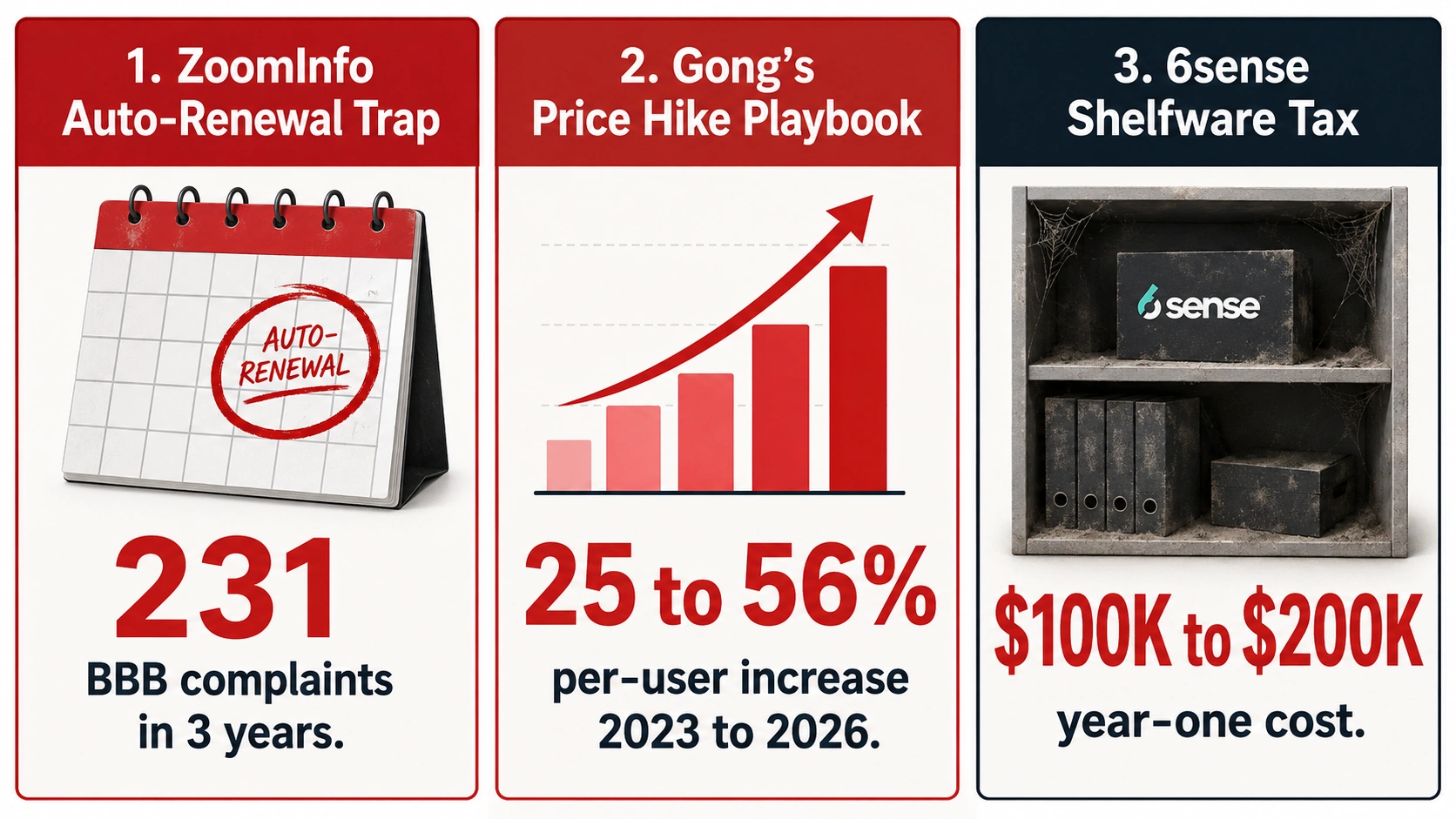
Before reviewing specific tools, three vendor patterns every buyer should walk into every renewal conversation prepared for.
The Three Vendor Traps Every Buyer Should Know in 2026
These are not "tips from a friend who works in sales." They are the most-cited complaints across G2 reviews, Reddit r/sales, the Better Business Bureau, and recent industry analysis. Each comes with the data and an escape plan.
Trap #1: ZoomInfo's 60-Day Auto-Renewal Clause
The pattern. ZoomInfo contracts auto-renew unless cancelled within a specific window, typically 60 days before the renewal date. Miss the window by a single day and the contract locks in for another year, often at a 25-50% higher rate. There is no monthly billing option. All ZoomInfo plans require annual contracts with auto-renewal.
The receipts. 231 BBB complaints against ZoomInfo in the last three years, 74 closed in the last 12 months alone. The most-upvoted r/sales advice on the topic is brutally simple. "Calendar your cancellation notice the day you sign, or you'll regret it."
A representative customer quote (from a G2 discussion). "Apparently ZoomInfo includes a sneaky auto renewal clause in their contract that was never mentioned in sales conversations and they seem to be railroading us into renewing another year against our will."
The escape plan.
- Calendar the cancellation deadline at 70 days before renewal (10-day buffer)
- Send written cancellation notice via certified mail AND through the official portal
- Document every communication with date stamps
- If you miss the window, ZoomInfo has historically not been flexible, start renegotiating year-2 pricing aggressively now
- Apollo.io and Cognism are the strongest ZoomInfo alternatives for most teams; both have working free or low-tier plans you can pilot before the cancellation date
Trap #2: Gong's Price Hike + Module Bundling Playbook
The pattern. Gong's effective per-user pricing rose from approximately $160/user/month in 2023 to $200-250/user/month by 2026, a 25-56% increase depending on the bundle, as documented in detailed pricing breakdowns. The mechanism arrived in March 2025, when Gong restructured pricing, unbundling features that were previously included in the base tier (forecasting, advanced analytics) and re-bundling them as paid modules (Forecast, Engage). The unbundling pushed teams toward Gong's broader revenue intelligence suite, where total contract value scales fast. Teams that originally signed at $150-170/user/month are reporting renewal quotes of $230-250/user/month, with Gong offering bundle deals as the "discount" path.
The most common Gong complaints on G2 and Reddit r/sales:
- Surprise platform fees not disclosed in initial sales conversations
- Forced module bundling above what teams actually need
- Seat inflexibility (cannot reduce mid-contract, only add)
- Auto-renewal uplifts of 5-15% even without bundle changes
- Outsourced support with slow ticket resolution
- Data export limitations
- No free trial before committing
The escape plan.
- Demand explicit answers in writing during initial conversations. What is the platform fee? What's in the base bundle vs. paid modules? What is the per-user renewal cap?
- Negotiate the seat-reduction clause specifically. Default Gong contracts do not allow seat reductions mid-term, which becomes painful when the team shrinks
- Year-2 renewal is the moment of maximum leverage. Push hard on bundle composition
- Evaluate alternatives 90+ days before renewal. Lighter-weight CI platforms (Convo, Avoma, others) deliver the core feature set at 10-20% of Gong's total cost of ownership
Trap #3: 6sense's Shelfware Tax
The pattern. 6sense is a genuinely powerful ABM and intent platform, for the right team. The wrong team finds out after spending $100-200K year-one and discovering they have nobody to actually operate it. Total year-one cost averages $60-120K for the platform license, plus implementation, optional display ad spend ($20-50K+), and the RevOps time to integrate and maintain.
The receipts. G2 has 488 combined mentions across "Steep learning curve," "Complex initial setup," and "Learning difficulty." The consistent pattern is clear. Enterprise RevOps teams with dedicated headcount get meaningful pipeline impact. Mid-market teams without that headcount end up using 6sense as an expensive prospecting database, using maybe 20% of what they paid for.
A specific 6sense complaint that appears repeatedly on r/SalesOperations is opaque intent scoring. Buyers consistently describe being unable to validate predictions, they can't easily see what signals drove an account to "Decision stage." When the platform surfaces wrong numbers (including non-work contacts as supposed decision-makers), there's no clear feedback loop to improve the model.
The escape plan.
- Do not buy 6sense unless there is a dedicated RevOps person who will own the platform for 60%+ of their time
- For teams under 30 reps without dedicated RevOps, alternatives that deliver 70-80% of the value:
- Bombora ($15K-40K/year) for topic-based intent - G2 Buyer Intent ($20K-60K/year) for SaaS-specific intent - Clearbit/Breeze ($45-50/month plus credits) for inbound enrichment
- If you are already locked in, pilot a focused use case (single ICP segment) for 6 months before scaling deployment. Most regret stories come from organization-wide rollouts before product-market fit with the tool is established
Category 1: Contact Databases
Contact databases provide verified contact information, emails, phone numbers, job titles, company firmographics, for the people sales teams want to reach. This is the most mature category in B2B sales intelligence, which also makes it the most saturated, the most expensive at the top, and the most cluttered with thin alternatives at the bottom.
ZoomInfo
Positioning: The market-leading B2B contact database. 320 million contacts, 120 million company profiles, deep firmographic and technographic data. The Workflows product automates sequence triggering from data signals.
ZoomInfo remains the default choice for large enterprise sales organizations that need broad data coverage across North America. The platform's strength is breadth, with depth in mid-market and enterprise contact records, technographic detail showing which tools target companies actually use, and intent signals via Bombora partnership. The Workflows product turns those signals into automated sequence triggers, which is genuinely useful when teams have RevOps capacity to maintain the logic.
The weaknesses are well-documented. Email decay rates are meaningful. Independent buyer reports place bounce rates between 8 and 15%, varying by industry and how recently the record was verified. Multi-year contracts are standard. The interface is dated relative to newer entrants like Apollo. And the 60-day auto-renewal clause has generated 231 BBB complaints in three years (see Trap #1 above).
Strengths.
- Largest verified B2B database in the market (320M+ contacts)
- Deep technographic and firmographic data
- Strong Workflows automation for RevOps-mature teams
- Native integration with Chorus for bundled CI
Weaknesses.
- $15,000/year minimum prices out smaller teams
- 60-day auto-renewal clause causes contract regret (231 BBB complaints in three years)
- Email decay rate 8 to 15% bounce in independent testing
- Dated UI compared to newer alternatives
- Multi-year contracts standard, renewals 25 to 50% higher than initial pricing
Real pricing. Starts at $15,000/year minimum. A 10-person sales team typically spends $30,000 to $60,000/year before adding modules. Enterprise deployments commonly exceed $100,000/year. The full pricing breakdown shows year-2 renewal commonly at $40,000 to $80,000/year for the same headcount.
G2 rating: 4.5/5 across 8,800+ reviews. Most common complaint themes are pricing opacity, auto-renewal friction, and customer support.
Best for: Enterprises with $50K+ data budgets, dedicated RevOps teams, and procurement processes that can negotiate contract terms and calendar cancellation deadlines.
Worst for: Sales teams under 30 reps. The data depth is real, but the contract terms are punitive at smaller scale.
Apollo.io
Positioning: The all-in-one sales intelligence platform for startups and mid-market. Contact database, sequencer, dialer, and lightweight CRM in one UI. Free tier (10,000 credits/month) genuinely usable.
Apollo has become the default recommendation for sales teams under 50 reps for one reason. The math works. The free tier covers most early-stage outbound needs. Paid tiers scale smoothly without enterprise procurement complexity. Database coverage in major Western markets is competitive with ZoomInfo. And the integrated sequencer eliminates the need to wire a separate engagement tool.
Where Apollo falls short, database depth in specialized verticals (manufacturing, healthcare, regulated industries) is thinner than ZoomInfo. Email deliverability has been inconsistent at higher send volumes. The dual credit system (separate credits for email and phone) penalizes dial-heavy users. Customer support quality varies by tier, with Basic-tier users reporting slow response times on G2.
Strengths.
- Genuinely useful free tier (10,000 credits/month, no credit card required)
- All-in-one platform reduces vendor complexity (database, sequencer, dialer)
- Pricing scales smoothly from free to enterprise
- Strong Salesforce and HubSpot integrations
- 275M+ contacts, 73M+ companies
Weaknesses.
- Database depth thinner than ZoomInfo in manufacturing, healthcare, regulated verticals
- Dual credit system penalizes dial-heavy outbound motions
- Email deliverability inconsistent at high send volumes
- Customer support quality varies by tier
Real pricing. Free tier with 10,000 credits/month. Basic $49/user/month. Professional $79/user/month. Organization $119/user/month. Annual commitments reduce per-user cost by 15 to 20%. Most growing teams (10 reps, Professional tier, annual) land at $7,000 to $10,000/year total.
G2 rating: 4.7/5 across 8,400+ reviews. Frequently praised for value-to-functionality ratio.
Best for: Sales teams under 50 reps that want one platform handling prospecting, sequencing, and dialing without dedicated RevOps headcount. Especially strong fit for B2B SaaS, professional services, and agencies.
Worst for: Industries where verified mobile coverage in EMEA matters (use Cognism), or sales motions selling exclusively into Fortune 500 enterprises where ZoomInfo's depth is required.
Cognism
Positioning: European-focused B2B contact intelligence built around GDPR-compliant data sourcing. Strongest verified mobile coverage in EMEA.
Cognism's defensible position is GDPR-safe data collection combined with manually verified mobile numbers (Diamond Verified Phone Numbers) and screening against 15+ Do Not Call lists. For cold-calling motions in regulated European jurisdictions, this combination is structurally hard to replicate. North American coverage is thinner than ZoomInfo or Apollo.
Real pricing. Grow tier $1,500 to $10,000/year per package plus $15,000 platform fee. Elevate tier $2,550 to $25,000/year plus $25,000 baseline. A typical 10-person team in EMEA spends $20,000 to $30,000/year total.
G2 rating: 4.6/5 across 1,000+ reviews.
Best for: Sales teams selling into European markets where GDPR compliance and verified mobile coverage matter. Not the right choice for North America-only motions.
Lusha
Positioning: Lightweight contact database with simple per-user pricing. Strong Chrome extension for LinkedIn workflows. Less coverage than ZoomInfo, Apollo, or Cognism, but no platform fee and same-day onboarding.
Real pricing. $49/user/month standard plan.
G2 rating: 4.3/5 across 1,400+ reviews.
Best for: Solo SDRs, freelance consultants, and small teams (under 5 reps) that need verified contact info without a full platform.
Category 2: Intent Data
Intent data is the fastest-growing category in sales intelligence, and the one most likely to disappoint you if you misuse it. The pitch is to detect which accounts are actively researching solutions like yours, before they ever fill out a form. The reality is messier. Intent signals are noisy, "warm" accounts still need someone to call them well, and a list of intent-scored accounts without a playbook is just a more expensive spreadsheet.
6sense
Positioning: The category leader for anonymous intent detection and predictive account scoring. Enterprise ABM platform.
6sense's strength is the breadth and sophistication of its anonymous intent detection. The platform identifies companies visiting your website without filling out forms, correlates keyword research signals across the open web, and scores account-level buying intent using proprietary AI models. For enterprise teams with mature ABM motions, dedicated RevOps support, and the patience to operationalize intent signals into playbooks, 6sense delivers meaningful pipeline impact.
The weakness is operational dependency. 6sense without dedicated RevOps becomes shelfware. Implementation cycles run 4 to 8 weeks. Effectiveness depends entirely on whether the buying organization can act on signals systematically (see Trap #3 above). Mid-market teams routinely report using 6sense as an expensive prospecting database, accessing maybe 20% of what they paid for.
Strengths.
- Most sophisticated anonymous intent detection in the market
- Predictive account scoring outperforms basic intent when paired with playbooks
- Strong CRM and marketing automation integration
- Deep data on enterprise account behavior
Weaknesses.
- $100,000 to $200,000 year-one total cost prices out mid-market
- Requires dedicated RevOps headcount to operationalize
- 4 to 8 week implementation cycle
- Opaque intent scoring (buyers can't validate predictions)
- 488 G2 mentions of "steep learning curve" or "complex setup"
- Wrong-number issue: surfaces non-work contacts as supposed decision-makers
Real pricing. Platform license $60,000 to $120,000/year. Year-one total (with implementation, optional display ad spend, and ops time) commonly reaches $100,000 to $200,000+. 12 to 24 month contract commitments standard.
G2 rating: 4.3/5 across 1,000+ reviews.
Best for: Enterprise sales orgs (75+ reps) with dedicated RevOps headcount, marketing-led ABM motions, and complex multi-stakeholder deals.
Worst for: Teams under 30 reps. Buying 6sense at this size is a documented regret pattern.
Bombora
Positioning: Topic-based intent data sourced from a cooperative of 5,000+ B2B publishers. Identifies accounts spiking on relevant topics weekly. Account-level granularity only (no person-level signals or anonymous visitor identification), but a fraction of 6sense's cost and faster to implement (2 to 4 weeks).
Real pricing. Typically $15,000 to $40,000/year by coverage tier.
G2 rating: 4.4/5 across 220+ reviews.
Best for: Marketing teams driving account-based campaigns and SDR teams prioritizing outbound lists without 6sense's implementation overhead.
G2 Buyer Intent
Positioning: Category-specific intent data sourced from buyer behavior on G2's review and comparison platform. The sharpest intent signal available, but scoped only to software buyers using G2.
When a prospect is reading reviews of your product category or comparing you directly against a specific competitor on G2, the platform surfaces that account. Real-time signal, plus direct competitive intelligence on who they're comparing you to.
Real pricing. Add-on to G2 listing, typically $20,000 to $60,000/year by tier.
Best for: B2B SaaS companies whose buyers actually use G2 to evaluate. Less useful outside SaaS.
Category 3: Account Intelligence
Account intelligence sits between contact data and intent. It helps you understand what's happening at a target account. Funding rounds, exec changes, tech stack moves, hiring patterns. This is the "why now" layer that turns a generic email into a relevant one.
Clearbit / Breeze Intelligence by HubSpot
Positioning: Originally the dominant data enrichment platform, acquired by HubSpot and rebranded under the Breeze AI umbrella. Real-time enrichment of website visitors and form submissions, with a robust API for product-level enrichment. Native HubSpot integration is seamless; less compelling outside the HubSpot ecosystem.
Real pricing. Starts at $45 to $50/month base plus credit packs from $30 to $700/month depending on volume.
G2 rating: 4.4/5 across 600+ reviews.
Best for: HubSpot customers wanting native account enrichment without a separate vendor relationship.
Crunchbase
Positioning: Funding rounds, exec hires, M&A activity, company growth signals. The simplest way to identify accounts experiencing change events. Self-serve interface that SDRs and AEs can operate without RevOps support. Affordable per-seat pricing, strong Chrome extension for LinkedIn workflows.
Real pricing. Pro plan $49/user/month. Enterprise custom.
G2 rating: 4.5/5 across 1,400+ reviews.
Best for: SDR teams running trigger-based outbound plays (new funding, new exec hires, expansion announcements).
Demandbase
Positioning: Full ABM platform with account intelligence as one component. Competes directly with 6sense for marketing-led ABM motions in mid-market and enterprise. Same shelfware risk as 6sense for teams without dedicated marketing ops headcount.
Real pricing. Enterprise-only, typically $40,000 to $120,000/year.
G2 rating: 4.4/5 across 800+ reviews.
Best for: Marketing-led ABM motions in mid-market and enterprise organizations with dedicated marketing ops support. Not the right choice for sales-led teams or early-stage companies.
Category 4: Conversation Intelligence
Conversation intelligence platforms capture, transcribe, and analyze sales calls to surface insights about rep behavior, deal risk, and coaching opportunities. This is where pipeline quality translates into closed revenue. It's also the most expensive category at the enterprise tier (Gong) and the most underdeveloped layer in growing sales orgs.
The category-defining shift in 2026 is from post-call review (the original Gong/Chorus model) to real-time help during the call. The architectural difference matters. Post-call analysis tells you why you lost a deal that's already lost. Real-time help helps win the deal while it's still happening. Convo represents the real-time architecture. Gong and Chorus represent the legacy post-call approach with bots that join meetings.
For deeper context on the category, see the dedicated guides to conversation intelligence and conversation analytics.
Gong
Positioning: The market-defining conversation intelligence platform. Built around post-call recording, transcription, and analysis. Enterprise-tier deal intelligence and forecasting.
Gong remains the most sophisticated conversation intelligence platform for enterprise sales orgs. The analytics engine is trained on billions of analyzed sales conversations and produces the deepest call analytics, deal risk scoring, and coaching workflows in the category. For sales organizations with 50+ reps, dedicated enablement teams, and deal sizes that justify the spend, Gong delivers genuine value. See Trap #2 above for the pricing-hike warning.
Strengths.
- Deepest call analytics in the industry
- Strong deal intelligence and pipeline risk scoring
- Enterprise-grade coaching workflows and rep development tracking
- Native integrations across major CRMs
- Mature product (8+ years in market)
Weaknesses.
- Visible recording bot joins every meeting
- 2 to 4 month implementation cycle
- Per-user pricing rose 25 to 56% between 2023 and 2026
- Forced module bundling (Forecast, Engage)
- Seat inflexibility mid-contract (no reductions allowed)
- No free trial before committing
- Outsourced support with slow ticket resolution
Real pricing. Base $1,300 to $1,600/user/year, plus a $5,000 to $50,000 platform fee, plus $7,500+ in onboarding services. A 50-seat deployment runs $130,000 to $200,000/year. Modules add cost, like Forecast at ~$700/user/year and Engage at ~$800/user/year. Full breakdown at Gong pricing.
G2 rating: 4.7/5 across 6,400+ reviews. Strong on functionality, weak on pricing and contract flexibility.
Best for: Enterprise sales orgs (50+ reps) with procurement teams that can negotiate bundle composition, deal sizes justifying $130K+/year spend, and existing change-management capacity for 2 to 4 month rollouts.
Worst for: Sales teams under 20 reps. The math doesn't work at this scale. Many teams at this size buy Convo instead (see below).
Chorus.ai
Positioning: ZoomInfo's conversation intelligence acquisition. Feature set comparable to Gong with deeper Salesforce integration. Native bundle with ZoomInfo data.
Chorus is the default conversation intelligence choice for organizations already running ZoomInfo. The bundle integration is real. Chorus call insights flow back into ZoomInfo's contact records and Salesforce-side workflows. Innovation pace has slowed since the ZoomInfo acquisition, and the UI is less polished than Gong, but for teams committed to the ZoomInfo ecosystem, Chorus is the logical choice.
Strengths.
- Native integration with ZoomInfo data
- Strong Salesforce-side workflow
- Competitive transcription quality
- Bundle pricing makes sense for existing ZoomInfo customers
Weaknesses.
- Roadmap velocity declined post-acquisition
- UI less polished than Gong
- Total cost of ownership requires both Chorus AND ZoomInfo subscriptions
- Inherits ZoomInfo's 60-day auto-renewal clause (see Trap #1)
- Visible recording bot in every meeting
Real pricing. $1,000 to $1,400/user/year, plus the ZoomInfo data subscription ($15,000 to $40,000+) for full functionality.
G2 rating: 4.5/5 across 2,280+ reviews.
Best for: Organizations already committed to ZoomInfo as the data backbone, with budget for both subscriptions and procurement capacity to manage the bundle.
Worst for: Standalone purchases (without ZoomInfo). The bundle is the value proposition. For a deeper feature-by-feature breakdown, see our Chorus alternatives page.
Convo
Positioning: The real-time conversation intelligence platform purpose-built for sales teams that need help DURING the call, not just after. Audio captured locally on the rep's machine. No recording bot in the meeting. Same-day deployment.
Convo solves the structural problem with legacy conversation intelligence tools. They tell sales reps what went wrong AFTER the deal is already won or lost. Gong and Chorus were architected in 2018 around cloud-based post-call analysis. Both require a bot to join every meeting. Both deliver coaching insights 24 to 72 hours after the conversation is over, by which point the moment for intervention has passed. (For how the whole category splits on this exact line, see the best conversation intelligence software comparison.)
Convo's architecture is different in three ways:
- Audio is captured locally on the rep's macOS, Windows, or Linux machine, with no bot in the call. The audio goes only to our transcription provider, which deletes it after processing.
- No recording bot joins the meeting. No participant labeled "Convo Notetaker." The platform is invisible to the prospect.
- Coaching surfaces during the call, not after. Talk-to-listen ratio updates live on screen. Objection response frameworks appear within seconds when prospects raise pricing, competitor, or timing pushback. Context from past meetings with the same prospect surfaces automatically when relevant.
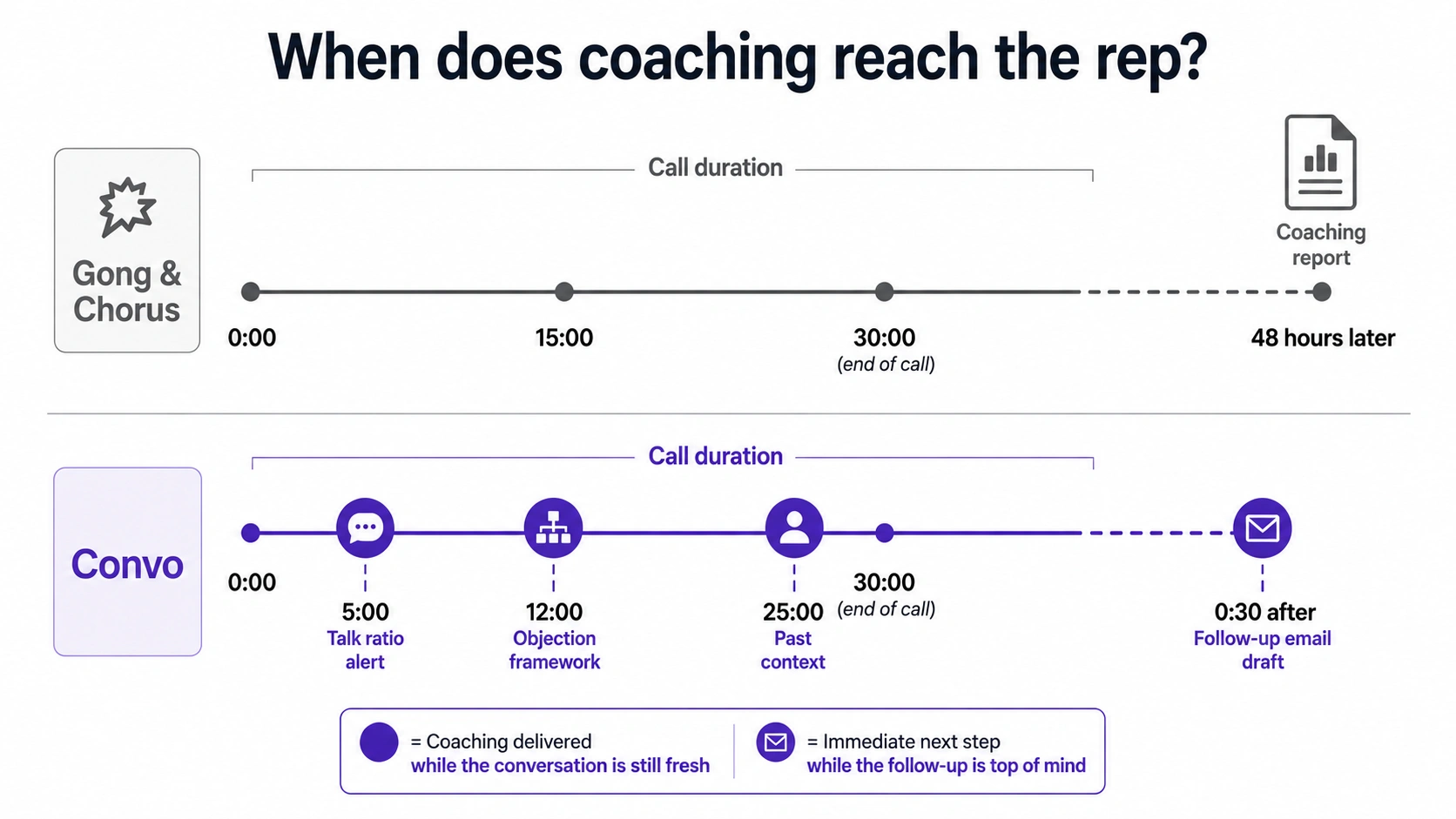
For sales teams, this translates into measurable operational outcomes:
- Real-time talk-to-listen ratio. Gong's own research across 25,000+ B2B calls identifies 43% talk / 57% listen as the win-rate sweet spot, and the behavioral gap between good and great salespeople compounds from there. Most reps don't realize they've broken that ratio until they review the call days later. Convo displays it live on screen, so reps self-correct mid-call. Teams adopting Convo typically see talk ratios improve from 65/35 (industry average) to 50/50 within the first two weeks.
- In-call objection frameworks. When a prospect raises pricing, competitor, or timing objections, Convo's AI surfaces a suggested response framework on screen. Newer reps stop freezing under pressure. Experienced reps stop relying on memory alone.
- Cross-meeting context. When a prospect references something said three weeks ago, Convo surfaces the relevant transcript snippet automatically. No scrambling through CRM notes mid-call.
- Automated post-call workflow. Call summaries, action items, and follow-up email drafts generate in under 30 seconds and push to the CRM (Salesforce, HubSpot, Pipedrive, Attio). The 15 to 20 minutes of post-call admin work per call disappears.
- No bot, no awareness, no shifted dynamics. Critical for regulated industries (legal, healthcare, finance), high-trust enterprise accounts, and any sales motion where recording awareness changes how prospects speak.
Strengths.
- Only platform in the category with real-time in-call coaching (Gong and Chorus are post-call only)
- No recording bot in the meeting (Gong and Chorus require visible bot participation)
- Local audio processing (audio doesn't leave the rep's machine)
- Same-day deployment (Gong takes 2 to 4 months, Chorus 2 to 3)
- 7-day free trial (Gong and Chorus offer none)
- Monthly billing available (Gong and Chorus require annual)
- Seat reduction allowed mid-contract (Gong and Chorus do not)
- Multi-platform: macOS, Windows, Linux
Weaknesses.
- Newer in market than Gong (founded 2018) or Chorus (founded 2015)
- Enterprise-tier deal intelligence (multi-stakeholder scoring, advanced forecasting) lighter than Gong's
- Best fit for sales-led organizations under 200 reps. Less proven in pure inbound/PLG motions at scale
Real pricing.
| Tier | Price | Best for |
|---|---|---|
| Starter | $22.49/user/month | Solo founders, freelance consultants, sales teams under 5 reps |
| Professional | $52.49/user/month | Sales teams 5 to 100 reps that need full real-time help |
| Enterprise | Custom | Teams 100+ reps requiring SSO, dedicated CSM, custom integrations |
G2 rating: 4.8/5 across early reviews. Newer product, smaller review pool, higher average rating than incumbents.
Best for: Sales teams 5 to 200 reps that need real-time help, want to avoid the recording bot in their meetings, value local audio processing (regulated industries), or can't justify Gong's $130K+/year TCO at their current scale.
Worst for: Sales organizations with 200+ reps requiring enterprise-tier deal intelligence and multi-stakeholder deal scoring. At that scale Gong's depth is genuinely necessary.
Detailed feature-level comparisons available at Convo vs Gong, Convo vs Fireflies, and Gong alternatives.
Conversation intelligence head-to-head
| Gong | Chorus | Convo | |
|---|---|---|---|
| Real-time help during the call | No | No | Yes |
| Bot joins the meeting | Yes | Yes | No |
| Audio processing | Cloud | Cloud | Local |
| Per-user price (effective) | $200 to $250/month | $1,000 to $1,400/year + ZoomInfo | $22.49 to $52.49/month |
| Implementation time | 2 to 4 months | 2 to 3 months | Same day |
| Free trial | No | No | Yes (7 days) |
| Monthly billing | No | No | Yes |
| Seat reduction mid-contract | No | No | Yes |
| Enterprise deal intelligence depth | Highest | High | Medium |
| Best for | 50+ reps with budget | ZoomInfo customers | 5 to 200 reps, real-time use case |
What You Actually Pay (Annual Cost for a 10-Person Team)
Most B2B sales intelligence pricing pages list per-user fees without disclosing platform fees, onboarding charges, contract minimums, or renewal uplifts. Below are the realistic annual costs a 10-person sales team should expect to pay for each tool in this guide, based on publicly available pricing, G2 procurement reports, and Reddit r/sales discussions verified May 2026.
| Tool | Annual cost (10-person team) | Contract terms | Pricing transparency |
|---|---|---|---|
| Apollo.io (Basic) | $4,000 to $6,000 | Monthly or annual | Public, transparent |
| Apollo.io (Professional) | $7,000 to $10,000 | Monthly or annual | Public, transparent |
| Lusha | $5,880 | Monthly or annual | Public, transparent |
| Crunchbase Pro | $5,880 | Monthly or annual | Public, transparent |
| Clearbit / Breeze | $5,000 to $15,000 | Monthly or annual | Public, credit-based |
| Cognism (Grow tier) | $20,000 to $30,000 | Annual minimum | Opaque, deal-dependent |
| Bombora | $15,000 to $40,000 | Annual minimum | Opaque, custom |
| G2 Buyer Intent | $20,000 to $60,000 | Annual minimum | Opaque, tier-based |
| ZoomInfo | $30,000 to $60,000 | Multi-year standard | Opaque, deal-dependent |
| Demandbase | $40,000 to $120,000 | Annual minimum | Opaque, enterprise |
| 6sense | $60,000 to $120,000 | 12 to 24 month minimum | Opaque, enterprise |
| Chorus + ZoomInfo bundle | $40,000 to $70,000 (CI portion) | Annual minimum | Opaque, deal-dependent |
| Gong | $130,000 to $200,000+ | Annual minimum + platform fee | Opaque, deal-dependent |
| Convo (Professional) | $4,560 | Monthly or annual | Public, transparent |
The Negotiation Cheat Sheet
The single biggest miss in most B2B sales intelligence purchases isn't price, it's terms. Terms are where vendors make their margin on bad-fit customers. The specific levers worth pushing on by vendor:
With ZoomInfo:
- Get the cancellation window written into the contract addendum, not just buried in T&Cs
- Negotiate a 30-day notice (instead of 60) if you have any leverage at all
- Cap year-2 renewal increase at 5% in writing
- Avoid 3-year commitments, the renewal leverage compounds against you over time
- Add a "data quality SLA" clause with credits if bounce rate exceeds a stated threshold
With Gong:
- Get the platform fee in writing before signing, separate line item
- Insist on "no forced bundling", you should be able to drop a module at renewal without losing base pricing
- Negotiate seat-reduction flexibility (default Gong contracts have none)
- Cap renewal uplift at 5% in writing
- Don't buy add-on modules (Forecast, Engage) in year 1, wait until you've validated the core platform
With 6sense:
- Do not sign until a named RevOps owner is identified and budgeted for ongoing platform ownership
- Negotiate a pilot deployment (single ICP segment) for 6 months at a lower price before full rollout
- Get implementation timeline guarantees with credits if exceeded
- Cap year-1 contract length at 12 months, not 24
With Apollo, Cognism, Lusha:
- These vendors are far more flexible, push on price first
- Avoid annual commitments if you can get monthly (Apollo offers both)
- Negotiate "no auto-renewal" if you don't trust your own cancellation calendar
- Pilot the free or low tier before upgrading
With Convo:
- 7-day free trial covers full functionality, no credit card required
- Monthly billing available, no annual contract required on Starter or Professional tiers
- Seat reduction allowed at any monthly billing cycle
How to Build a B2B Sales Intelligence Stack
The single highest-ROI decision in stack design is matching tools to bottleneck, not to category. Most teams under-invest in conversation intelligence relative to contact data because the latter feels more concrete. The math usually argues the other way. A 10% improvement in close rate on existing pipeline is almost always cheaper to buy than 10% more pipeline.
Team size 1-10 reps
- Contact data: Apollo.io free tier or Basic ($5K-$15K/year)
- Intent: Skip (TAM too small to justify the spend)
- Account intelligence: Crunchbase Pro ($49/user/month)
- Conversation intelligence: Convo Professional ($52.49/user/month)
- Annual stack cost: ~$10K-$20K
Team size 10-50 reps
- Contact data: Apollo Professional or Cognism (geography-dependent)
- Intent: Bombora (cost-effective intent layer)
- Account intelligence: Clearbit/Breeze or Demandbase if running formal ABM
- Conversation intelligence: Convo for full team coverage, or Chorus if already on ZoomInfo
Team size 50+ reps
- Contact data: ZoomInfo (scale justifies the spend)
- Intent: 6sense
- Account intelligence: Demandbase
- Conversation intelligence: Gong for enterprise deal intelligence, or Convo for real-time help without the bot at a fraction of Gong's TCO
For more detail on building a sales tech stack at any team size, see the companion guides on sales enablement platforms, sales productivity tools, how to win more deals with AI, the best sales coaching software, and the chief sales officer's tool framework.
Common Stacking Mistakes
Buying contact data when the bottleneck is call execution. Adding pipeline volume to a team with weak call execution multiplies the volume of lost deals, not closed deals. Conversation intelligence almost always returns more per dollar than contact data for teams that already have a functioning pipeline.
Paying for intent data without a playbook. Intent signals identify accounts worth prioritizing. They don't replace the SDR motion that follows. Teams that buy 6sense or Bombora without defined playbooks for action see less than 2x ROI; teams with mature playbooks see 5-10x.
Buying enterprise tools at startup scale. Gong is excellent at 50+ reps and a $130,000 mistake at 10 reps. Pricing should be evaluated per-rep against alternatives at the same team size, not against the enterprise reference price.
Frequently Asked Questions
What is B2B sales intelligence? B2B sales intelligence is the combination of data and software that helps sales teams identify the right accounts, time outreach, understand what's happening at target accounts, and analyze the calls reps are having. It spans four functional layers. There are contact databases (ZoomInfo, Apollo, Cognism), intent data (6sense, Bombora, G2 Intent), account intelligence (Clearbit/Breeze, Crunchbase, Demandbase), and conversation intelligence platforms (Gong, Chorus, Convo).
What's the biggest mistake B2B sales intelligence buyers make? Buying ZoomInfo, Gong, or 6sense at the wrong team size and getting trapped by auto-renewal or pricing-hike clauses at renewal. The three vendor traps detailed in this guide account for the majority of regret stories on r/sales and G2. The escape plan is upfront negotiation of contract terms, not just price.
How do I escape a ZoomInfo auto-renewal? ZoomInfo's auto-renewal requires written notice 60 days before the renewal date. Send via certified mail AND through the official cancellation portal. Document every communication with date stamps. Calendar the deadline at 70 days before renewal (10-day buffer). If you've already missed the window, ZoomInfo has historically not offered exit options, start renegotiating year-2 pricing aggressively now.
Why is Gong getting more expensive? In March 2025, Gong restructured pricing by unbundling features previously included in the base tier (forecasting, advanced analytics) and re-bundling them as paid modules. Effective per-user cost rose 25-56% between 2023 and 2026. Teams that signed at $150-170/user/month are seeing renewal quotes of $230-250. The escape plan is documented in Trap #2 above.
Can a smaller conversation intelligence tool replace Gong? For most use cases, yes. Gong's enterprise-tier deal intelligence (multi-stakeholder scoring, advanced forecasting, large-account coaching workflows) matters for sales orgs of 50+ reps with complex deals. For everyone else, lighter-weight platforms like Convo deliver the core CI functionality at 12-17% of Gong's total cost of ownership. See Convo vs Gong for the full feature-level comparison, or the best conversation intelligence software roundup for all 8 options side by side.
Are there free B2B sales intelligence tools worth using? Apollo.io's free tier (10,000 credits/month) is the strongest in the market. LinkedIn Sales Navigator at $99/month is effectively required for B2B sales. Crunchbase has a useful free tier for basic account intelligence. Convo offers a 7-day free trial covering full conversation intelligence functionality. Combined, these form a defensible starting stack under $200/month.
What is the difference between sales intelligence and sales enablement? Sales intelligence is the data layer (who to call, when to reach out, what is happening at target accounts, how reps performed on calls). Sales enablement is the enablement layer that sits on top (content management, training, coaching, analytics tied to closed revenue). Sales intelligence answers "who and when," while sales enablement answers "how reps execute once they know who and when." Most mature sales orgs run both. See our sales enablement platforms guide for the enablement-side breakdown.
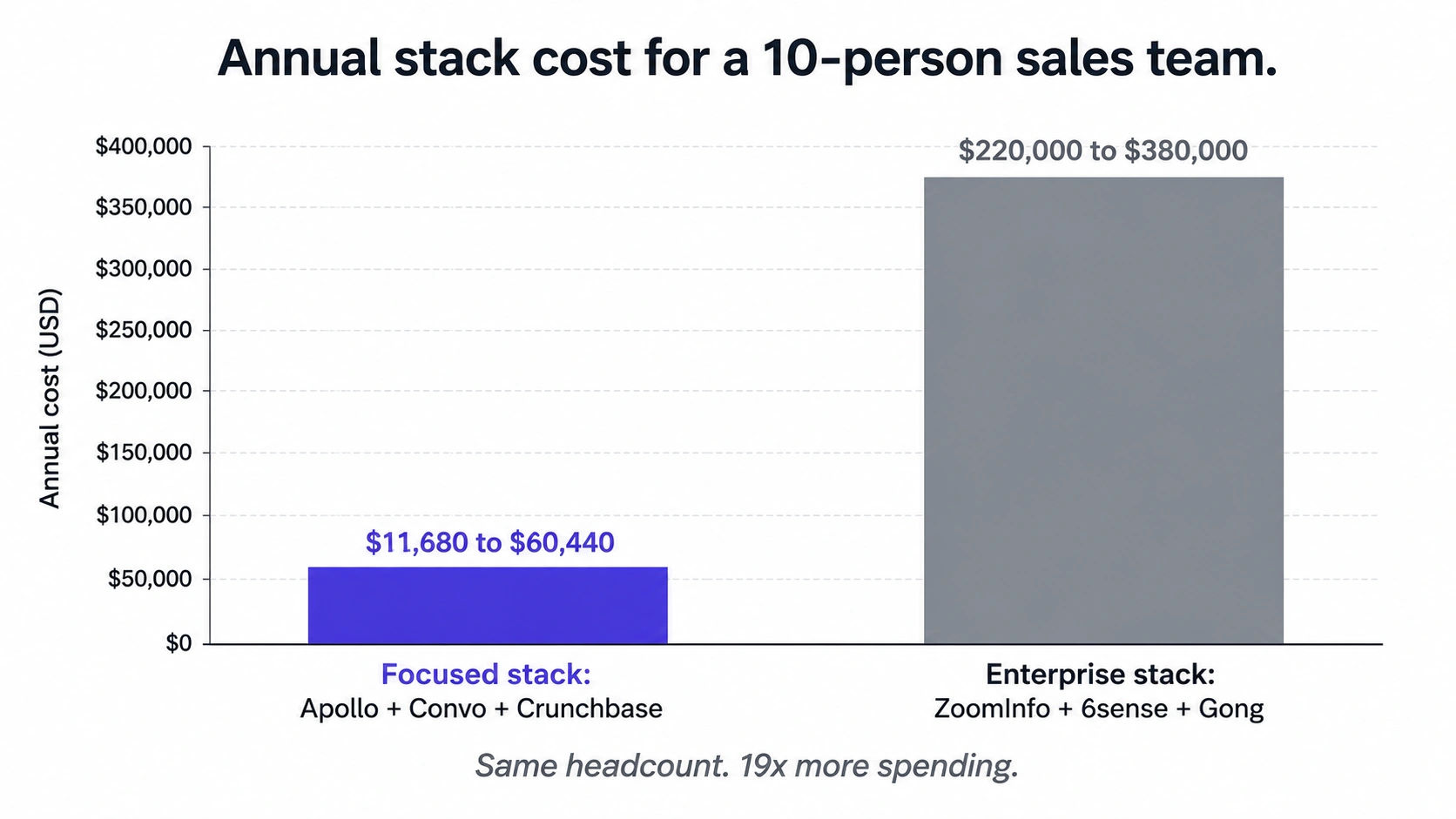
How much do B2B sales intelligence tools cost on average? Pricing varies by 19x across the category. The lightweight stack (Apollo Basic + Crunchbase Pro + Convo Professional) runs $11,680 to $20,000 per year for a 10-person team. Mid-tier additions (Cognism, Bombora, Clearbit/Breeze) push annual cost to $40,000 to $80,000. Enterprise stacks (ZoomInfo + 6sense + Gong) commonly run $220,000 to $380,000 per year for the same headcount. The pricing-transparency table in the guide above breaks down each vendor's typical 10-rep cost.
Is LinkedIn Sales Navigator a B2B sales intelligence tool? Yes, partially. LinkedIn Sales Navigator covers the contact data and account intelligence pillars (1 billion+ verified profiles, real-time job change signals, advanced filters). It does not cover intent data or conversation intelligence. At $99/user/month it is effectively a default requirement for B2B sales, but it works best paired with a dedicated contact-database tool (Apollo, ZoomInfo, Cognism) for outbound, and a conversation intelligence platform (Convo, Gong, Chorus) for call execution.
Bottom Line: What We'd Actually Buy in 2026
The B2B sales intelligence market in 2026 rewards sales teams that build narrow, deliberate stacks aligned to their actual bottleneck. The wider stacks built by buying every category from every vendor produce vendor sprawl, integration debt, unclear ROI, and three or four open seats of regret at the next renewal.
For sales teams under 100 reps, the honest answer is:
- Apollo.io for contact data (free tier or Basic, $5K-$15K/year)
- Convo for conversation intelligence ($22.49-$52.49/user/month)
- Crunchbase Pro for account intelligence ($49/user/month)
- Skip intent data until SDR capacity exists to act on signals systematically
Total annual cost under $20K for a 10-person team. Compare that to a typical "enterprise-prepared" stack at $150K-$300K with 60-day auto-renewal traps baked into multiple vendors.
For sales teams ready to add the conversation intelligence layer without Gong's enterprise budget, the 25-56% price hike, or the recording bot in every meeting, try Convo free for 7 days. No credit card. No 60-day cancellation clause. No forced bundling. Monthly billing available. Seat reduction allowed at any monthly billing cycle.
Markus is the founder of Convo, building an AI meeting assistant that automates everything after the call. Years of experience building AI products. Believes technology should help people in the moment, not just analyze the past.
Ready to transform your meetings?
Join professionals using Convo to feel confident in every conversation.
Get StartedCONTINUE READING