

Markus Kellermann Founder & CEO
The 11 Best Sales Enablement Platforms in 2026
Markus Kellermann Founder & CEO
Compare 11 sales enablement platforms after the Seismic-Highspot, Showpad-Bigtincan, and Salesloft-Clari mergers. Pricing, pillars, picks for 2026.
What Is Sales Enablement?
Sales enablement is the practice of equipping sales teams with the content, training, coaching, and analytics they need to engage buyers and close more deals. It sits at the intersection of marketing, sales operations, and customer-facing execution. In 2026, it has consolidated into one of the largest software categories in the B2B revenue stack.
The category exists because of a problem most sales leaders recognize. Reps spend significant time looking for the right case study, the right pricing sheet, the right objection response, and a measurable fraction of that time is not actually spent selling. Forrester research found that 60 to 70% of marketing-created content goes unused by sales teams. Other industry research puts the unused-content figure at 65% of total company content, a number that has not materially improved since the first generation of enablement platforms launched a decade ago.
A sales enablement platform aims to close this gap by centralizing content, automating training and onboarding, surfacing the right asset at the right moment in the deal cycle, and measuring whether any of it correlates to closed revenue. The combined category grew from roughly $1.5 billion in 2020 to over $6 billion in combined enterprise value by 2026, driven largely by the wave of mergers and acquisitions covered in the next section.
Three primary buyer profiles purchase sales enablement platforms in 2026:
- Mid-market sales teams (25 to 200 reps) building their first formal enablement function and looking for a system to consolidate playbooks, training, and coaching.
- Enterprise sales organizations (200+ reps) running mature enablement programs and evaluating platform consolidation or migration.
- Revenue operations teams managing the broader GTM tech stack and looking for the conversation intelligence and coaching layer specifically.
The right platform depends heavily on which of these buyer profiles fits your team, and on which of the four functional pillars of sales enablement (covered below) you actually need.
The 2026 Consolidation Wave: What Buyers Need to Know
Sales enablement is a category mid-transition. In the fifteen months between October 2025 and February 2026, four major events reshaped the competitive landscape and changed how buyers should approach platform decisions in 2026.
October 2025: Showpad and Bigtincan merged under Vector Capital, which already owned Brainshark. The combined company is now the largest single owner of independent enablement platforms (Showpad, Bigtincan, and Brainshark). New "eOS" packaging has caused pricing confusion, and existing customers report unclear product roadmap visibility post-merger.
Late 2025: Salesloft and Clari announced their combination to build a unified revenue orchestration platform spanning prospecting, enablement, and forecasting. Both products are supported in parallel during integration.
February 12, 2026: Seismic announced its merger with Highspot in the largest M&A event in enablement history. The combined company operates as Seismic, with Permira as controlling shareholder. The merged entity is valued at approximately $6 billion. Integration is expected to roll out across 2026 and 2027.
Early 2026: Gong launched Gong Enable, formally entering the enablement category. The "Mission Andromeda" expansion adds AI-powered content recommendation and coaching workflows to Gong's core conversation intelligence platform.
What this means for buyers in 2026:
- Three of the top eight enablement platforms (Highspot, Showpad, Bigtincan) are now mid-integration with parent companies. PE-backed mergers historically slow product velocity and create pricing renegotiation pressure at renewal.
- The remaining independent platforms (Mindtickle, Allego, SalesHood, Spekit) have become more valuable as standalone alternatives, with several reporting accelerated growth in late 2025.
- Conversation intelligence has moved from a "nice to have" feature to a core requirement, particularly for sales teams that want real-time help during deals rather than post-call analysis.
The Four Pillars of a Modern Sales Enablement Stack
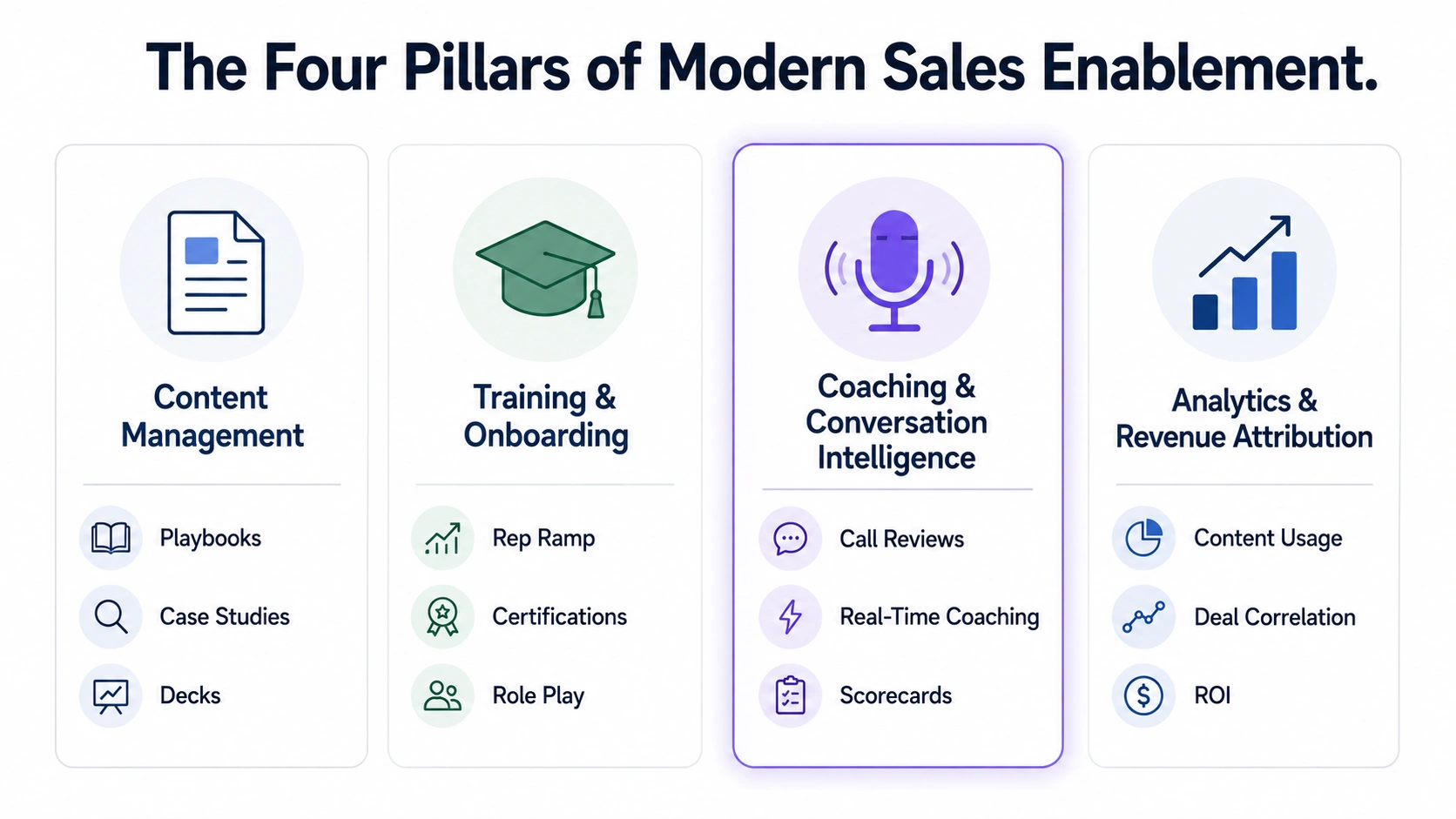
A complete sales enablement platform covers some or all of four functional pillars. No single platform covers all four equally well, and most buyers end up combining two or three tools to fill the gaps.
Pillar 1: Content Management
The original sales enablement use case. A central library where reps find playbooks, case studies, decks, pricing sheets, battle cards, competitive intelligence, and objection responses. Modern content management platforms add AI-powered search, content recommendations based on deal stage, and engagement analytics (which assets get sent to buyers, which ones get opened, which ones correlate to closed deals).
Best-in-class: Seismic, Highspot, Showpad, Mediafly.
Pillar 2: Training and Onboarding
Helps sales teams ramp new hires and certify existing reps. Includes learning paths, video lessons, quizzes, role-play simulations, and certification tracking. The strongest training platforms integrate with the content pillar so reps can learn and access the right asset in the same workflow.
Best-in-class: Mindtickle, Allego, SalesHood, Brainshark.
Pillar 3: Coaching and Conversation Intelligence
Where Convo plays. Coaching covers both manager-led coaching (call reviews, scorecards, deal coaching) and real-time AI help during calls. Conversation intelligence platforms record and analyze sales calls to surface coaching moments, deal risks, and rep behavior patterns. The architectural difference within this pillar matters. Most legacy sales enablement software delivers coaching insights AFTER the call (24 to 72 hours later), while newer entrants like Convo provide real-time help DURING the call itself.
Best-in-class: Gong Enable, Convo, Allego (limited), Mindtickle (limited).
Pillar 4: Analytics and Revenue Attribution
Connects enablement activities to closed revenue. Tracks content usage, training completion, coaching engagement, and rep behavior, and attempts to correlate each to deal outcomes. The 2026 buyer requirement is that every enablement investment must be tied to a revenue metric, not just a usage metric.
Best-in-class: Seismic, Highspot, Allego (full stack).
A complete stack covers all four pillars. The realistic stack for most teams under 100 reps covers two or three pillars with one platform and supplements with point solutions for the rest.
The 11 Sales Enablement Platforms to Know in 2026
The platforms below cover the dominant share of the sales enablement market in 2026.
1. Allego
Positioning: A full-stack sales enablement platform that consolidates content management, training, coaching, and analytics in a single product. One of the few remaining independent platforms that covers all four pillars.
Allego differentiates by collapsing what used to be four separate vendor purchases into one. Video-based coaching and microlearning are the historical strength. The platform also handles content management and basic analytics. For distributed sales organizations that want to replace multiple enablement tools with a single suite, Allego is the most credible single-vendor option in 2026.
Strengths. Genuinely full-stack across all four pillars. Strong video coaching and conversation intelligence. Stayed independent through the 2025-2026 M&A wave (no integration risk).
Weaknesses. Less suited for large-scale content management programs (typically struggles past 500 marketing assets). Coaching is solid but not as deep as Gong or Convo for real-time use cases.
Pillar coverage: Content (medium), Training (strong), Coaching (medium), Analytics (medium).
Real pricing. Custom, user-based. Annual contracts typical. Mid-market deployments for a 50-rep team typically run $40,000 to $80,000 per year.
Best for: Distributed mid-market sales teams (25 to 150 reps) that want a single-vendor enablement stack and value training depth.
2. Brainshark
Positioning: Legacy training and readiness platform, now part of Vector Capital's portfolio alongside Showpad and Bigtincan following the October 2025 merger.
Brainshark was an early leader in sales training, particularly for rep certification and onboarding workflows. The Vector Capital acquisition consolidated it with Showpad and Bigtincan, with integration ongoing through 2026. Customers report uncertainty about long-term product direction and pricing structure.
Strengths. Strong training and certification depth. Established mid-market presence.
Weaknesses. Now part of a three-way consolidation (Showpad plus Bigtincan plus Brainshark) under Vector Capital. Roadmap unclear during integration. Innovation pace has slowed.
Pillar coverage: Training (strong), Content (medium via Showpad), Coaching (limited), Analytics (limited).
Real pricing. Custom quotes, typically delivered through Showpad sales channels now.
Best for: Existing Brainshark customers with multi-year contracts. New buyers should evaluate alternatives given integration uncertainty.
3. Convo
Positioning: Real-time conversation intelligence built for sales teams. Coaching that helps you sell better during the call, not three days after it.
Most sales enablement coaching tells you what went wrong after the deal is already won or lost. Convo flips this. It works as sales coaching software that surfaces the coaching while you are still on the call.
Three things make Convo different from Gong, Chorus, Allego, and Mindtickle:
1. It works during the call. Your talk-to-listen ratio updates live on screen as you speak. When a prospect pushes back on price, you see a suggested response within seconds. When they reference something from a meeting three weeks ago, Convo surfaces the exact quote automatically. You stop guessing and start adjusting in real time.
2. No bot in the meeting. Other tools send a recording bot that joins your call as a visible participant. Prospects see it, get cautious, and talk less. Convo runs quietly on your laptop and captures audio without joining the call. Your prospects do not know it is there, so they speak normally.
3. Audio never leaves your laptop. Nothing uploads to the cloud. For regulated industries, sensitive deals, and any conversation where privacy matters, this changes what is possible.
What this looks like in practice:
- New reps stop freezing when prospects raise objections. A response framework appears on screen in three seconds.
- Experienced reps stop relying on memory. Context from every previous call with that prospect is one glance away.
- Managers stop spending hours reviewing recordings. Convo writes the call summary, extracts action items, and drafts the follow-up email in 30 seconds. It pushes everything to Salesforce, HubSpot, Pipedrive, or Attio automatically.
- Prospects do not behave differently because a bot joined. The conversation stays honest.
Strengths. Real-time help nobody else offers. Invisible to prospects. Audio stays local. Same-day setup. 7-day free trial. Monthly billing. Drop seats whenever you want.
Weaknesses. Does not manage your content library or run training programs. Works best paired with another platform for those pillars (Seismic, Highspot, Mindtickle, or your own Notion). Newer than Gong or Allego.
Pillar coverage: Coaching (very strong, the only real-time platform), Content (none), Training (none), Analytics (medium via call data).
Real pricing. Starter $22.49 per user per month. Professional $52.49 per user per month. Enterprise custom. A 50-rep team runs Convo for about $31,500 per year.
Best for: Sales teams that want better coaching now, not after the deal is gone, and that already have content handled by another platform.
Worst for: Teams that need one platform to do content, training, and analytics together. Look at Allego instead.
See detailed comparisons in Convo vs Gong and Convo vs Fireflies. For the recording layer specifically, see the sales call recording software breakdown of all 8 credible options.
4. Spekit
Positioning: Spekit is an AI-first revenue enablement platform built on a governed content library and GTM Knowledge Engine. It connects content creation and management, learning, coaching, buyer experiences, and analytics with enablement delivered inside the tools reps already use. Spekit was named a Visionary in the 2025 Gartner® Magic Quadrant™ for Revenue Enablement Platforms.
Spekit's Knowledge Engine keeps approved GTM information accurate and current, then powers AI Sidekick, Learning Paths, embedded guidance, and personalized Deal Rooms. AI Sidekick uses context from CRM opportunity data, calls, and email to surface relevant answers, coaching, content recommendations, and next actions for each deal.
AI Content Builder creates governed content from approved knowledge and live deal context, while Brand Studio automatically applies defined visual standards. Through Spekit MCP, the same governed knowledge can also support external AI assistants and agents.
Strengths. Strong content governance and in-workflow delivery. Content management, AI content creation, structured learning, contextual coaching, Deal Rooms, and content-to-revenue analytics operate from the same governed source. Broad integrations across CRM, email, call intelligence, content repositories, and browser-based applications.
Weaknesses. Spekit is not a standalone conversation-intelligence platform focused primarily on recording and analyzing calls. Its broader scope may be unnecessary for teams seeking only a basic knowledge repository or simple in-app walkthroughs.
Pillar coverage: Content (strong), Training (strong), Coaching (medium), Analytics (strong).
Real pricing. Custom quote. Spekit does not publish standard pricing, and implementation requirements vary by deployment.
Best for: High-growth, mid-market, and enterprise B2B revenue teams that need governed knowledge, content, learning, coaching, and buyer engagement delivered inside existing workflows.
Worst for: Teams seeking only standalone conversation intelligence or a project-management-led client portal.
5. Dock
Positioning: Dock is an AI revenue enablement platform covering content, collaboration, and learning in one system. Built for mid-market revenue teams rather than enterprise enablement departments.
Dock sits between enterprise enablement suites and single-purpose deal room tools. The platform covers content management, learning, and buyer-facing collaboration, with deal rooms and AI agents as the anchors. Reps pull answers from playbooks, courses, and live CRM and call data without leaving their workflow.
Strengths. Best-in-class deal rooms with buyer engagement analytics. Custom AI agent builder grounded in your content and calls. The same workspace carries into onboarding and renewal.
Weaknesses. Lighter on the enterprise governance and compliance content controls that large global organizations require. Smaller integration ecosystem than the enterprise incumbents.
Pillar coverage: Content (strong), Training (strong), Coaching (medium), Analytics (strong).
Real pricing. Published tiers from $350 per month, plus $50 per additional seat. A 50-rep team runs about $27,000 per year, implementation included.
Best for: Mid-market revenue teams (25 to 150 reps) that want content, training, and buyer collaboration in one platform without a dedicated admin.
Worst for: Large global organizations with strict content governance requirements, or enterprise content programs with thousands of assets.
6. Gong Enable
Positioning: Gong's expansion into the enablement category, launched as part of "Mission Andromeda" in early 2026. Adds AI-powered content recommendation and coaching workflows to Gong's core conversation intelligence platform.
Gong Enable is the newest entrant in this category. The strategic logic is sound. Gong already has the conversation intelligence data and the customer base, and adding content recommendation and coaching workflows extends the platform without requiring customers to buy a separate enablement tool.
Strengths. Built on Gong's mature conversation intelligence platform. Tight integration with existing Gong deployments. Strong AI capabilities.
Weaknesses. New module without proven enablement track record. Adds incremental cost on top of Gong's already-high pricing (typical Gong deployments are $130,000 to $200,000 per year for 50 reps). Bot-based architecture (visible recording bot in meetings) inherits Gong's structural limitations.
Pillar coverage: Coaching (strong via Gong CI), Content (limited, new), Training (limited), Analytics (medium).
Real pricing. Sold as an add-on to Gong's base license. Typical add-on cost in the "tens of dollars per seat per month" range, on top of Gong's $1,300 to $1,600 per user per year base.
Best for: Existing Gong customers wanting to add lightweight enablement workflows without buying a separate platform.
Worst for: Standalone enablement purchases (Gong base license required) or teams that need real-time help without a recording bot. See Gong pricing, the Gong alternatives breakdown, and our Chorus alternatives page for the bundled ZoomInfo CI option.
7. Highspot
Positioning: Historic leader in sales content management, now merging with Seismic following the February 2026 announcement. Both Highspot and Seismic products will be maintained during integration through 2026 to 2027.
Highspot is the largest pure-play content management platform in the category. Strong AI-powered content search, deep Salesforce integration, comprehensive analytics on content usage and deal correlation. The 2026 merger with Seismic created the largest single enablement vendor by revenue.
Strengths. Best-in-class AI content search and recommendation. Strong content usage analytics. Mature platform with proven enterprise deployments.
Weaknesses. Mid-merger with Seismic, integration timeline unclear. Average enterprise contract value is $91,460 per year per Vendr procurement data, with 84% of deals including $25,000+ in mandatory professional services. Highspot's own 2025 State of Sales Enablement report shows 75% of sales leaders log into the platform fewer than 5 times per quarter.
Pillar coverage: Content (very strong), Training (medium), Coaching (limited), Analytics (strong).
Real pricing. $91,460/year average per Vendr. Range $70,000 to $180,000+ for enterprise deployments. Per-user typically $45 to $65 per month. Mandatory professional services typically $25,000+.
Best for: Enterprise content marketing teams running large-scale content programs (500+ assets) with dedicated enablement headcount.
Worst for: Mid-market teams (under 50 reps). The pricing model and professional services requirement make this expensive for non-enterprise buyers.
8. Mindtickle
Positioning: Sales readiness leader focused on training, onboarding, and certification. Independent through the 2025-2026 M&A wave.
Mindtickle is the leader in structured sales training and rep certification, and remains the most-cited training-led sales enablement software in 2026. The platform handles learning paths, assessments, role-play simulations, and certification tracking. Recent product expansion added basic coaching capabilities.
Strengths. Deep training and certification capabilities. Strong assessment and skill tracking. Independent platform (no merger uncertainty).
Weaknesses. Steep learning curve, with G2 reviews repeatedly citing complexity and difficult navigation. Average enterprise contract is approximately $92,000 per year. Coaching capabilities are lighter than dedicated CI platforms.
Pillar coverage: Training (very strong), Content (medium), Coaching (medium), Analytics (medium).
Real pricing. $92,000/year average per procurement data. Custom enterprise pricing.
Best for: Mid-market and enterprise sales orgs (50+ reps) where rep certification and structured training are core enablement requirements.
Worst for: Smaller teams (under 25 reps) or organizations whose primary enablement need is content management or real-time help.
9. SalesHood
Positioning: Mid-market-focused enablement platform built around structured onboarding, playbooks, digital sales rooms, and mutual action plans. Independent and transparent pricing.
SalesHood occupies the middle ground between expensive enterprise platforms (Seismic, Highspot) and lightweight knowledge tools such as Guru. The product covers onboarding, content, coaching, and analytics, with a particular focus on mutual action plans and digital sales rooms.
Strengths. Transparent pricing (rare in this category). Strong onboarding workflows. Mid-market price point makes it accessible for teams that cannot afford Seismic or Highspot.
Weaknesses. Less deep than specialized platforms in any single pillar. Smaller customer base means fewer integrations and community resources.
Pillar coverage: Training (strong), Content (medium), Coaching (medium), Analytics (medium).
Real pricing. Public pricing tiers, mid-market priced. Annual deployments for 50-rep teams typically $20,000 to $50,000.
Best for: Mid-market sales orgs (25 to 100 reps) wanting structured enablement without enterprise complexity or pricing.
Worst for: Enterprise content programs (500+ assets) or teams needing best-in-class capabilities in any single pillar.
10. Seismic
Positioning: Now the post-merger leader in sales enablement following the February 2026 acquisition of Highspot. Combined company operates as Seismic, with both platforms supported in parallel during integration. Permira is the controlling shareholder.
Pre-merger, Seismic was the largest enterprise content management platform by revenue, with over 150 integrations and a strong content personalization engine. The Highspot merger consolidated the category at the enterprise tier and produced a combined entity valued at approximately $6 billion.
Strengths. Largest content management database and integration ecosystem in the category. Strong content personalization at scale. Combined Seismic plus Highspot resources create the most comprehensive enterprise platform.
Weaknesses. Mid-integration uncertainty for 12 to 24 months. Customer contracts up for renewal during integration face pricing renegotiation pressure. Implementation typically 4 months for full deployment, with G2 data showing 17-month average ROI timeline. Enterprise deployments commonly exceed $100,000 per year before professional services.
Pillar coverage: Content (very strong), Training (medium, expanding), Coaching (medium), Analytics (strong).
Real pricing. $40 to $75 per user per month, plus $5,000 to $50,000 implementation. Enterprise deployments commonly $100,000+ per year.
Best for: Enterprise sales orgs (100+ reps) running complex multi-stakeholder content programs and able to absorb 4-month implementation timelines.
Worst for: Mid-market teams (under 50 reps) and any team risk-averse about platform integration timelines.
11. Showpad
Positioning: Content plus coaching platform, now part of Vector Capital's portfolio alongside Bigtincan and Brainshark following the October 2025 merger.
Pre-merger, Showpad was the third-largest content management platform after Seismic and Highspot, with a stronger coaching emphasis than either. The Vector Capital acquisition combined Showpad with Bigtincan and Brainshark to create a consolidated training-and-content competitor.
Strengths. Strong coaching capabilities relative to content-first competitors. Combined Showpad plus Bigtincan plus Brainshark portfolio offers broad training depth.
Weaknesses. Post-merger pricing transition to "eOS" packaging has caused customer confusion. Roadmap clarity reduced during integration. Mergers of this type historically slow product velocity for 18 to 24 months.
Pillar coverage: Content (strong), Coaching (medium), Training (strong via Brainshark integration), Analytics (medium).
Real pricing. Custom pricing in transition. Pre-merger Showpad deployments for 50 reps typically $30,000 to $60,000 per year. Post-merger pricing trending higher.
Best for: Existing Showpad customers and mid-market enterprise teams that value the consolidated content plus training portfolio.
Worst for: New buyers seeking pricing transparency or teams risk-averse about Vector's PE-backed portfolio consolidation.
Pillar Coverage Matrix
The matrix below summarizes which platforms cover which pillars, and at what depth.
| Platform | Content | Training | Coaching | Analytics |
|---|---|---|---|---|
| Seismic | Very strong | Medium | Medium | Strong |
| Highspot | Very strong | Medium | Limited | Strong |
| Showpad | Strong | Strong | Medium | Medium |
| Mindtickle | Medium | Very strong | Medium | Medium |
| Allego | Medium | Strong | Medium | Medium |
| SalesHood | Medium | Strong | Medium | Medium |
| Brainshark | Medium | Strong | Limited | Limited |
| Spekit | Strong | Strong | Medium | Strong |
| Dock | Strong | Strong | Medium | Strong |
| Gong Enable | Limited | Limited | Strong | Medium |
| Convo | None | None | Very strong (real-time) | Medium |
- Single full-stack platform: Allego (medium across most pillars) or SalesHood (medium across most pillars).
- Content plus training combo: Seismic or Highspot for content, plus Mindtickle or Allego for training.
- Best-of-breed by pillar: Pick the strongest in each pillar separately and integrate.
What Sales Enablement Actually Costs
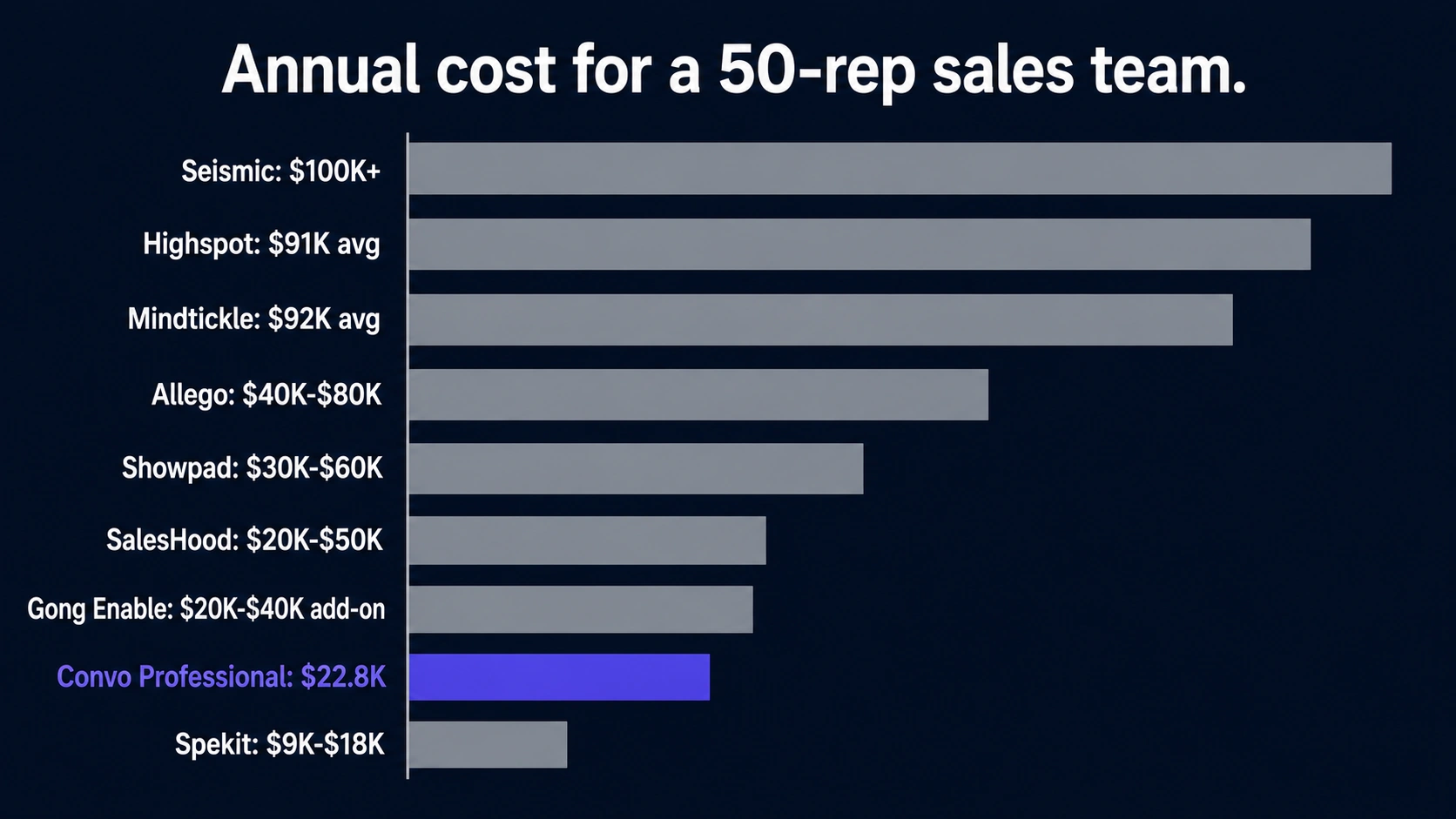
The pricing data below reflects realistic annual costs for a 50-rep sales team based on Vendr procurement reports, G2 reviews, and public pricing where available.
| Platform | 50-rep annual cost | Implementation | Pricing transparency |
|---|---|---|---|
| Convo (Professional) | $22,800 | Same-day | Public, transparent |
| Gong Enable | $20,000 to $40,000 add-on | Requires Gong base | Opaque add-on |
| SalesHood | $20,000 to $50,000 | 4 to 6 weeks | More transparent |
| Dock (Premium) | $27,000 | Days, included | Public, transparent |
| Spekit | Custom | 4 to 6 weeks | Custom |
| Showpad | $30,000 to $60,000 (pre-merger) | 2 to 4 months | Opaque, transitioning |
| Allego | $40,000 to $80,000 | 2 to 3 months | Custom |
| Mindtickle | $92,000 average | 4 to 6 months | Opaque, contact sales |
| Highspot | $91,460 average | 4 to 6 months | Opaque, $25K+ services |
| Seismic | $100,000+ enterprise | 4 to 6 months | Opaque, $5K-$50K implementation |
The professional services tax. Enterprise content platforms (Seismic, Highspot, Mindtickle) routinely require $25,000 to $50,000 in mandatory implementation services on top of the annual license. 84% of Highspot enterprise deals include $25,000+ in professional services per Vendr data. Budget for this upfront.
The post-merger pricing pressure. Customers on Showpad, Highspot, or Brainshark contracts that come up for renewal during 2026 to 2027 integration windows should expect renegotiation pressure. PE-backed mergers historically raise prices 15 to 30% at renewal. Lock in multi-year pricing before mergers complete where possible.
The training-vs-content premium. Training-led platforms (Mindtickle, Allego) and content-led platforms (Seismic, Highspot) charge similar enterprise prices (~$90,000+ for 50 reps), but the underlying products solve different problems. Buying both creates significant cost duplication. Pick one as primary and supplement with point solutions for the gaps.
Why 75% of Sales Enablement Tools Don't Get Used
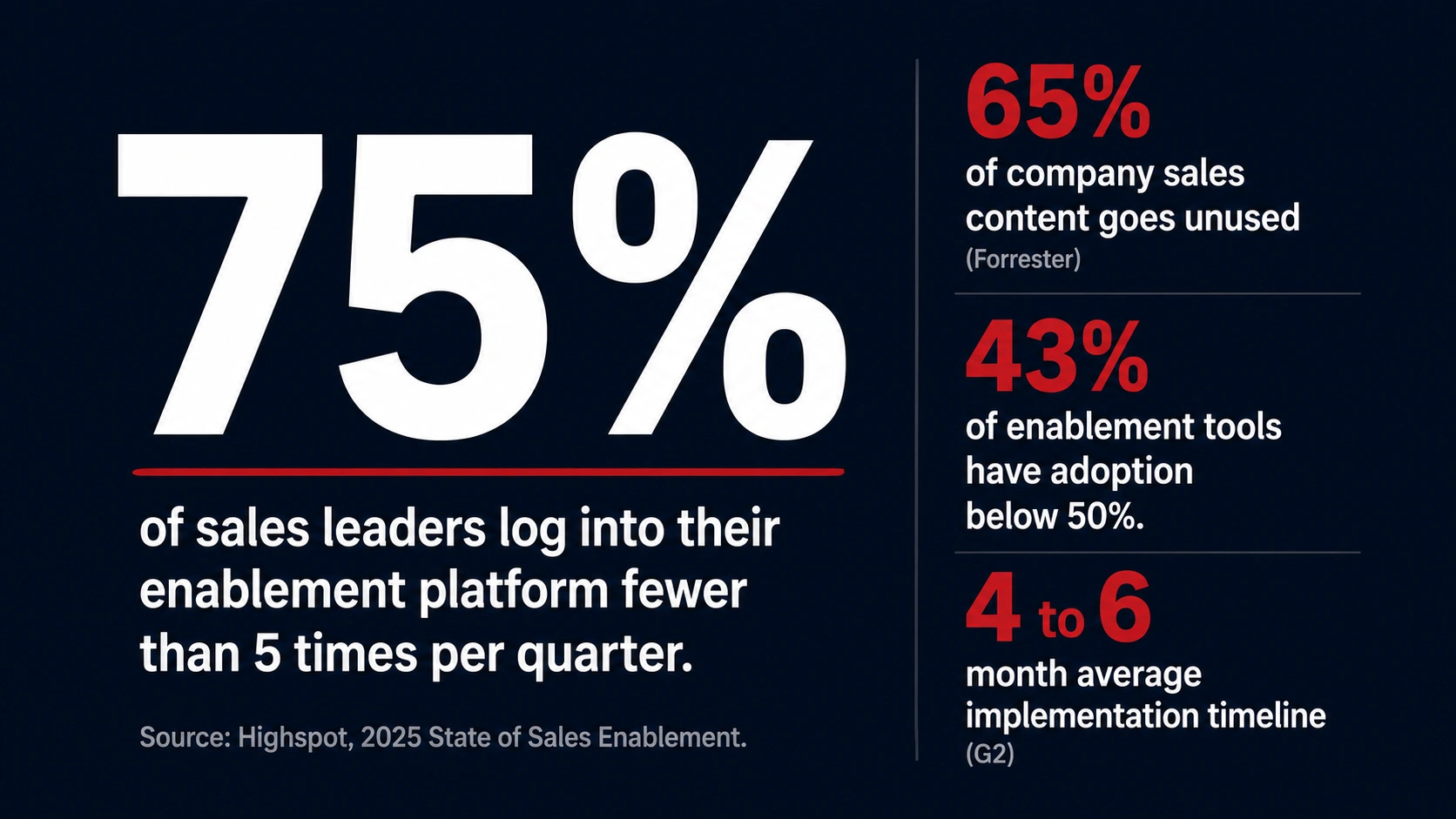
Highspot's own 2025 State of Sales Enablement report contains a damning statistic that the rest of the industry would prefer to ignore, that 75% of sales leaders log into their enablement platform fewer than five times per quarter. The same data shows 65% of company sales content goes completely unused, and 43% of sales enablement tools across an average tech stack have adoption rates below 50% of intended users. The underlying conversation analytics tell the same story from a different angle.
These numbers represent a structural problem with how most enablement platforms are designed, not an adoption problem caused by reps being lazy. Three root causes drive the pattern.
Root cause 1: Centralized content portals fight against rep workflow. Most enablement platforms are built as portals that reps must visit to find content. But reps do not sit in enablement portals. They sit in their CRM, in their email, on calls, and in meetings. Asking them to context-switch to a separate portal during active selling is asking them to break their workflow at the worst possible moment. Spekit addresses workflow friction by delivering governed content, learning, coaching, deal guidance, and recommended actions inside the applications reps already use. Real-time help platforms like Convo address it by delivering insights inside the call itself, with no portal visit required.
Root cause 2: Content findability is harder than content creation. Marketing teams generate content at scale. Enablement teams organize it. But the bottleneck is whether a rep can find the right asset in 30 seconds during a live conversation. Forrester data shows 60 to 70% of marketing-created content goes unused largely because reps cannot find it when they need it. AI-powered search has helped, but it has not solved the underlying problem.
Root cause 3: Coaching arrives too late to matter. Most enablement coaching is delivered post-call. A manager reviews the recording, fills out a scorecard, and gives feedback in the next one-on-one, usually three to seven days after the call happened. By that point, the deal has moved on, the moment has passed, and the rep has had ten more conversations. Real-time help architectures (which Gong, Chorus, and Allego do not provide, and which Convo does) deliver insights during the call, when they are still actionable.
How to avoid the non-adoption trap:
- Pilot any enablement platform with a single team for 90 days before rolling out. Measure actual log-in frequency and content engagement, not vendor-reported usage.
- Require the platform to integrate with existing rep workflows (CRM, email, calendar, dialer) before purchase. If reps have to visit a portal, they will not use it.
- Buy coaching that delivers value in real time, not just post-call review. The behavioral foundation of this argument is covered in our good salesperson vs great salesperson post.
- Consider platforms designed around in-workflow adoption, such as Spekit for connected enablement and Convo for real-time call coaching.
How to Choose: The Buyer's Framework
The right sales enablement platform depends on three variables. They are team size, primary bottleneck, and tolerance for M&A risk in the current market.
Step 1: Identify your primary bottleneck. Do not buy by category. Buy by the problem that is actually slowing your sales team down right now.
- If reps cannot find the right content during deals → Content management pillar (Seismic, Highspot, Spekit, Dock)
- If new hire ramp is too slow → Training pillar (Mindtickle, Allego, SalesHood, Dock)
- If close rates on second-stage demos are inconsistent → Coaching pillar (Convo, Gong Enable)
- If you cannot tie content or training to revenue → Analytics pillar (Seismic, Highspot, Allego)
Step 2: Match team size to platform tier.
Step 3: Apply M&A risk filters in 2026.
- Avoid signing new multi-year contracts with Highspot, Showpad, or Brainshark until post-integration roadmaps are clear (expected late 2026 to mid-2027).
- For renewals on these platforms, negotiate aggressively. PE-backed merger renewals are typically negotiable down 15 to 25% with leverage.
- Independent platforms (Mindtickle, Allego, SalesHood, Spekit, Convo) offer pricing and roadmap stability that mid-integration platforms cannot match in 2026.
Sales Enablement Stack by Team Size
Team size 1 to 25 reps
- Content: Internal Notion or Confluence
- Training: Built-in onboarding documents; skip dedicated training platform
- Coaching: Convo for real-time help ($22.49 to $52.49/user/month)
- Analytics: Native CRM analytics (Salesforce, HubSpot)
- Annual budget: $5,000 to $20,000
Team size 25 to 100 reps
- Content: Spekit, SalesHood, Dock, or Showpad (pre-renewal evaluation)
- Training: SalesHood, Dock, or Mindtickle (mid-tier)
- Coaching: Convo for real-time, supplemented by Gong if budget allows
- Analytics: CRM-native or SalesHood-included
- Annual budget: $50,000 to $150,000
Team size 100+ reps
- Content: Spekit, Seismic (post-merger leader), or Highspot during integration
- Training: Mindtickle (independent) or Allego (full-stack)
- Coaching: Gong Enable plus Convo for real-time, or Allego if consolidating
- Analytics: Platform-native plus custom dashboards
- Annual budget: $200,000 to $500,000+
For more on building a complete revenue stack, see our companion guides on B2B sales intelligence, revenue intelligence, the best sales coaching software, and the best conversation intelligence software comparison.
Frequently Asked Questions
What is sales enablement? Sales enablement is the strategic process of equipping sales teams with the content, training, coaching, and analytics they need to engage buyers effectively and close more deals. The category covers four functional pillars. There is content management (where reps find playbooks and case studies), training and onboarding (how new hires ramp and existing reps stay certified), coaching and conversation intelligence (how managers improve rep performance on actual calls), and analytics and revenue attribution (how enablement activities tie to closed revenue).
Which sales enablement platform is best for mid-market teams? For mid-market sales teams (25 to 100 reps), the strongest options in 2026 are SalesHood for full-stack enablement, Spekit for governed content, learning, contextual coaching, and buyer engagement delivered inside existing workflows, Dock for content, training, and buyer collaboration in a single mid-market platform, and Convo for the real-time help pillar specifically. Combined, a mid-market team can build a complete enablement stack for $20,000 to $60,000 per year, compared to $150,000+ for enterprise alternatives.
How does the Seismic-Highspot merger affect my buying decision? Both Seismic and Highspot will continue to be supported during the 12 to 24 month integration. New buyers should expect uncertainty around long-term product direction and pricing structure. Existing customers approaching renewal during 2026 to 2027 should negotiate aggressively. Permira (Seismic's controlling shareholder) typically uses post-merger renewal cycles to consolidate pricing upward by 15 to 30%. Multi-year contracts signed before integration completes provide pricing protection.
Do I need separate platforms for content, training, and coaching? No, but most teams end up with at least two platforms. Allego, SalesHood, and Dock cover all four pillars, which works for teams under 100 reps. Larger organizations typically run a content platform (Seismic, Highspot) plus a training platform (Mindtickle) plus a coaching platform (Convo or Gong Enable). The decision depends on whether you value depth in each pillar (multiple specialized platforms) or simplicity (one full-stack platform).
Why do most sales enablement tools have low adoption? According to Highspot's own 2025 State of Sales Enablement report, 75% of sales leaders log into their enablement platform fewer than five times per quarter. The root causes are workflow friction (centralized portals fight against rep workflow), content findability (reps cannot find the right asset during deals), and coaching delivered too late to matter (post-call review three days after the call). Contextual delivery platforms (Spekit) and real-time help platforms (Convo) are designed to address these root causes.
Can I use a conversation intelligence platform as my sales enablement coaching layer? Yes, and many teams do. Convo, Gong Enable, and Allego all cover the coaching pillar of sales enablement. The difference is timing. Gong and Allego coach post-call in a review or scorecard, while Convo coaches during the call. For the real-time coaching layer of a sales enablement stack, the best pick is Convo, because it is the only one here that reaches the rep while the deal is still live rather than three days later. Gong Enable is the better fit only if you already run on Gong and want its post-call analytics bundled in.
What is the difference between sales enablement and sales operations? Sales enablement focuses on equipping reps with content, training, and coaching so they sell more effectively (the seller-facing function). Sales operations focuses on the systems, processes, and analytics behind sales execution (the infrastructure function). Sales enablement teams typically report into sales or marketing leadership; sales operations typically reports into the CRO or COO. The roles overlap in mid-market organizations where one person often covers both.
How much does sales enablement software cost? Sales enablement software pricing in 2026 ranges from $9 to $30 per user per month for some lightweight platforms to $1,000 to $1,600 per user per year for enterprise platforms (Seismic, Highspot, Mindtickle). Spekit uses custom pricing and does not publish a standard per-user rate. Average enterprise contracts for a 50-rep team run $40,000 to $100,000+ per year, with Highspot averaging $91,460 and Mindtickle averaging $92,000 per Vendr procurement data. Implementation services add $5,000 to $50,000 on top of the annual license.
What does a sales enablement manager do? A sales enablement manager owns the four pillars covered in this guide. Those are content management (creating and organizing sales-facing content), training and onboarding (ramping new reps and certifying existing ones), coaching (improving rep performance through feedback loops), and analytics (tying enablement activities to closed revenue). In smaller organizations, the role often includes selecting and managing the sales enablement platform itself.
Is sales enablement marketing or sales? Sales enablement sits between marketing and sales, and the reporting line varies by organization. In B2B SaaS companies, sales enablement most often reports into sales leadership (CRO or VP Sales). In some organizations, it reports into marketing because of the content management responsibilities. Larger organizations increasingly route sales enablement directly under a Chief Revenue Officer or Head of Revenue Operations.
The Bottom Line
Sales enablement in 2026 is a category mid-transition. The Seismic-Highspot, Showpad-Bigtincan, and Salesloft-Clari mergers have consolidated the enterprise tier and created roadmap uncertainty for incumbents' customers. The 75% non-adoption statistic from Highspot's own data validates that the structural problem with most sales enablement software (workflow friction, content findability, late coaching) has not been solved by adding more features to centralized portals. The best sales enablement tools in 2026 are the ones that live inside rep workflows rather than alongside them.
For most sales teams under 100 reps in 2026:
- Skip enterprise content platforms. Seismic and Highspot are over-engineered and overpriced for mid-market deployments. Use internal documentation tools (Notion, Confluence) and supplement with Spekit for contextual delivery.
- Pick one independent training platform. Mindtickle, Allego, or SalesHood. All three avoided the M&A consolidation and have clear product roadmaps for 2026 to 2027.
- Add real-time help as the coaching pillar. Convo's AI sales coach is the only option in this pillar that delivers coaching during the call rather than after. At $22.49 to $52.49 per user per month, it adds the coaching layer without enterprise CI pricing.
- Track adoption from day one. If a platform produces shelfware, cut it at renewal. Do not add more enablement tools on top of unused ones.
For sales teams looking for the conversation intelligence and real-time help pillar of their sales enablement stack, try Convo free for 7 days. No recording bot, local audio processing, real-time help during calls, and pricing that scales from solo founders to enterprise teams.
Markus is the founder of Convo, building an AI meeting assistant that automates everything after the call. Years of experience building AI products. Believes technology should help people in the moment, not just analyze the past.
Ready to transform your meetings?
Join professionals using Convo to feel confident in every conversation.
Get StartedCONTINUE READING