

Markus Kellermann Founder & CEO
7 Differences Between Good and Great Salespeople [2026]
Markus Kellermann Founder & CEO
Only 28% of reps hit quota. I was one of them until I figured out what separates a good salesperson from a great one. Seven differences backed by data, not motivational posters.
The Problem With Being a Good Salesperson
Here's something nobody tells you in sales: being good is the most dangerous place to be.
Bad salespeople know they need help. They're missing targets and actively looking for answers. Good salespeople? They're hitting quota. Getting compliments. Everything feels fine.
I was in that second camp for about a year. Closing deals, doing all the right things on paper, feeling confident after calls. Then I started actually measuring what was happening on those calls and realized I was losing deals I should have won — not because of the product or the market, but because of habits I wasn't building.
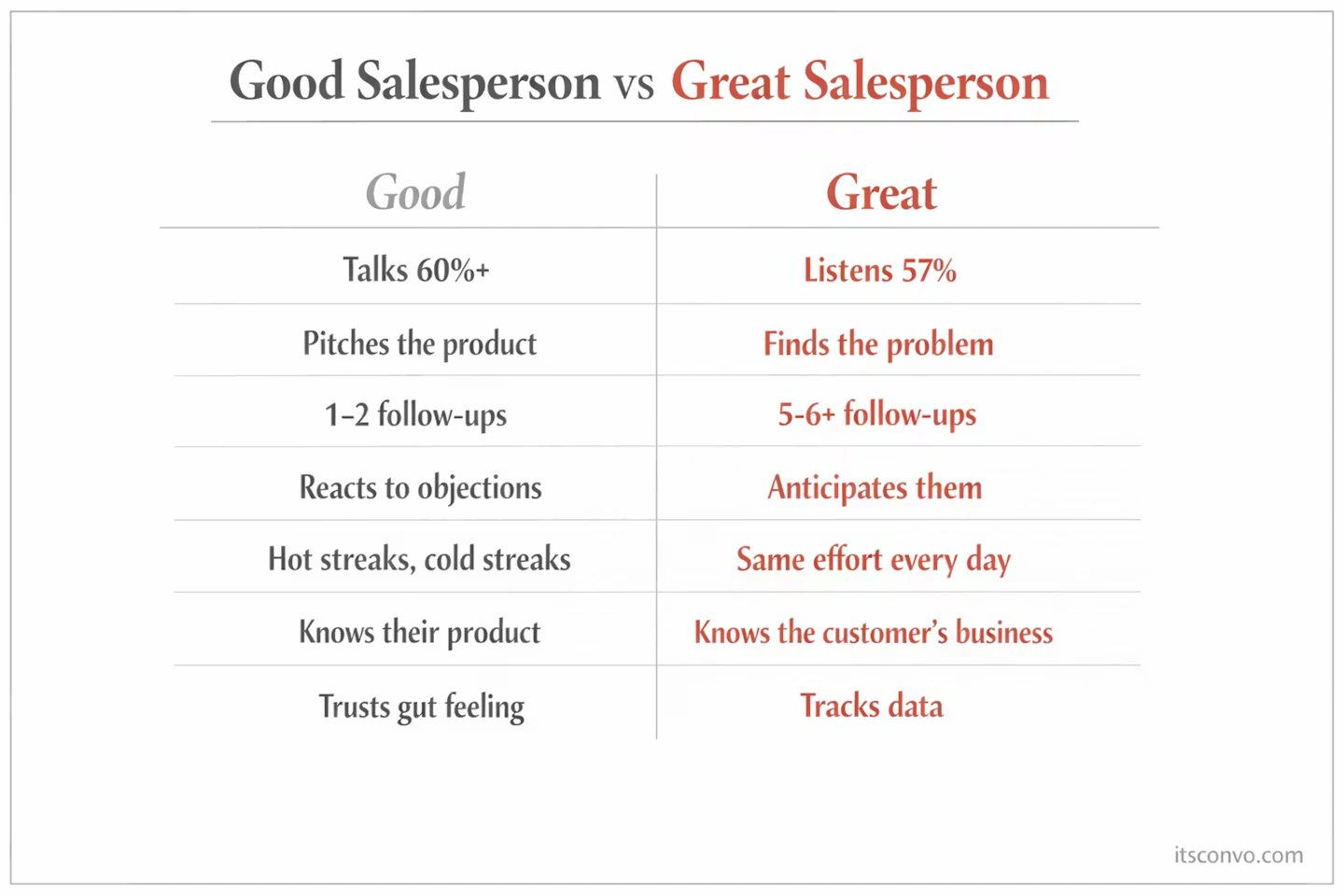
The difference between a good salesperson and a great salesperson isn't talent or charisma. It's seven specific behaviors you can learn, measure, and practice. Here's the summary:
| Trait | Good Salesperson | Great Salesperson |
|---|---|---|
| Conversation | Talks 60%+ of the call | Listens 57%, talks 43% |
| Approach | Pitches the product | Finds the prospect's real problem |
| Follow-up | Gives up after 1-2 attempts | Follows up 5-6+ times |
| Objections | Reacts and improvises | Anticipates and prepares frameworks |
| Consistency | Hot streaks and cold streaks | Same discipline every single day |
| Preparation | Knows the product inside out | Knows the customer's business and ICP |
| Self-assessment | Trusts gut feeling | Tracks data and conversation intelligence |
1. Good Salespeople Talk. Great Salespeople Listen.
This is the most predictable differentiator, and it still catches most reps off guard.
Gong analyzed over 25,000 B2B sales calls and found that the ideal talk-to-listen ratio is 43/57 — you talk 43% of the time, and your prospect talks 57%. The industry average? About 60/40 in the wrong direction.
I was worse than average. On my most embarrassing call, I talked for over 80% of it. Pitched features the prospect had already seen. Answered objections they hadn't raised. Filled every silence with more words because quiet moments felt like losing.
Great salespeople are comfortable with silence. They ask a question and wait. They let the prospect think. They understand that the person doing most of the talking isn't the one learning anything.
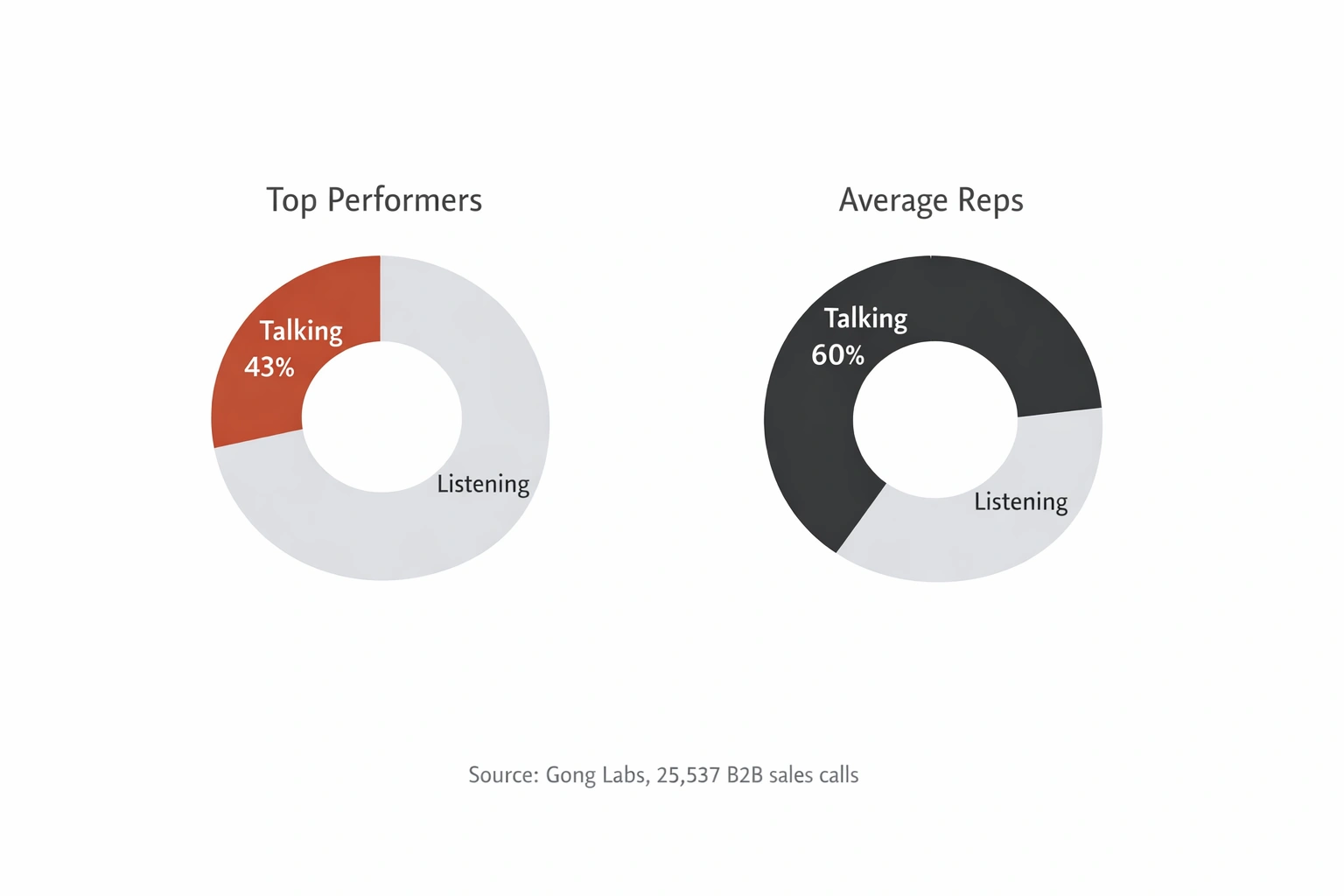
If you want one number to track, start here. Use sales call recording to capture your next five calls and measure your talk time. If you're above 50%, you're leaving deals on the table. I wrote about how to track this in our conversation analytics guide.
2. Good Salespeople Sell Products. Great Salespeople Find Problems.
Here's the mistake I made for months: I'd hop on a call, ask a few discovery questions, then spend 30 minutes walking through our product. Features, integrations, pricing tiers — the full tour. Polished. Thorough. Useless.
The prospect didn't need a tour. They needed someone to understand their problem.
Both good and great salespeople know their products inside out. The difference is how they use that knowledge. Good salespeople pitch. Great salespeople are problem finders — they dig into pain the customer hasn't fully articulated yet and connect their solution to that specific gap.
This matters because 70% of the B2B buyer's journey now happens before a prospect ever talks to sales. By the time they're on a call with you, they've already read the features page. They don't need you to recite it. They need you to tell them something they don't already know about their own situation.
The shift: stop preparing your pitch. Start preparing your questions.
3. Good Salespeople Follow Up. Great Salespeople Follow Up Relentlessly.
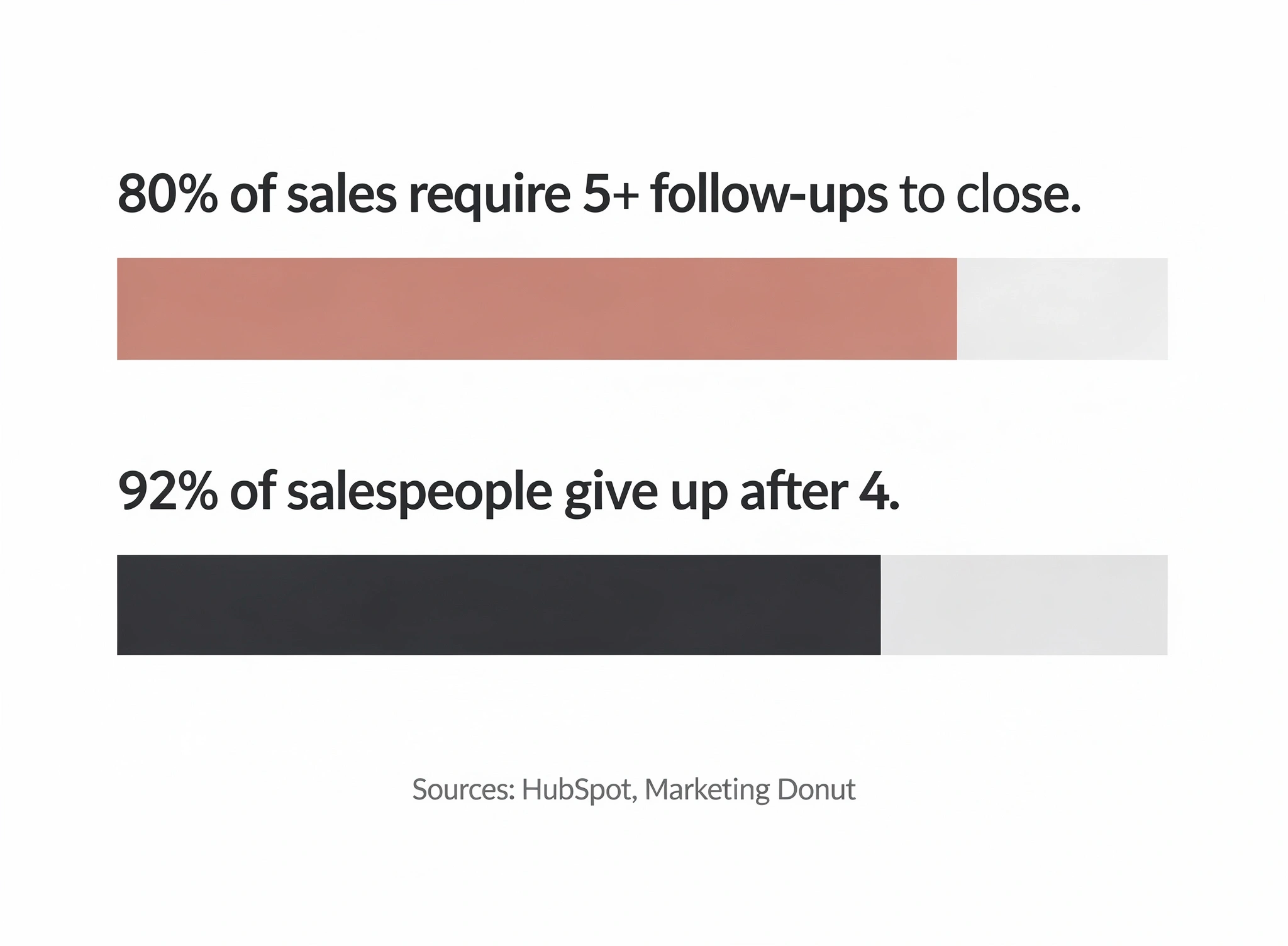
- 80% of sales require at least five follow-ups to close
- 92% of salespeople give up after four attempts
- 48% of salespeople never make a single follow-up attempt
Read that last one again. Almost half of all salespeople never follow up at all.
When I started selling, I'd send one follow-up email after a call. If I didn't hear back in a week, I moved on. I told myself "they would have responded if they were interested" — a story that had nothing to do with reality.
Great salespeople understand that silence isn't rejection. Prospects are busy. They're juggling priorities. They forgot. 95% of all converted leads are reached by the sixth contact attempt. Most of your competition quits long before that.
Persistence isn't pushy when it's done with value. It's the minimum bar. If you want templates for follow-up emails after sales calls and interviews, we put together a complete guide with 8 ready-to-use templates.
4. Good Salespeople React to Objections. Great Salespeople Anticipate Them.
Every salesperson has heard "it's too expensive" or "we need more time to think about it." The difference is when you start thinking about those objections.
Good salespeople hear them and scramble. They improvise a response. Sometimes it lands, sometimes it doesn't, and they never figure out why.
Great salespeople walk into every call knowing the three most likely objections and having a framework for each one. They've reviewed previous conversations with this prospect. They know what came up last time. They've prepared responses that acknowledge the concern and redirect to value — before the prospect even opens their mouth. The same applies to the close itself: great reps know which sales closing techniques fit which moments in the deal.
This is where strategic sales meeting prep meets performance. Before every important sales call, I now review what objections came up in earlier conversations, what topics got the most airtime, and what the prospect's energy was like. Walking in with that context changes everything.
You can do this manually by reviewing your notes. Or you can use AI tools that surface the relevant context from past conversations automatically — pulling up a prospect's history, flagging likely objections, and preparing you before the call starts. Either way, the principle is the same: great salespeople don't wing it.
5. Good Salespeople Work Hard When They Need To. Great Salespeople Are Consistent.
Consistency might be the single biggest differentiator between good and great salespeople. Not talent. Not technique. Consistency.
Good salespeople have hot streaks. They crush one quarter and coast the next. They prospect hard when the pipeline is thin and relax when it's full. They ramp up when they're behind quota and ease off when they're ahead.
Great salespeople do the same things every day regardless of how things are going. They prospect whether they're at 20% of quota or 120%. They follow the same call prep routine whether it's a $5K deal or a $500K deal.
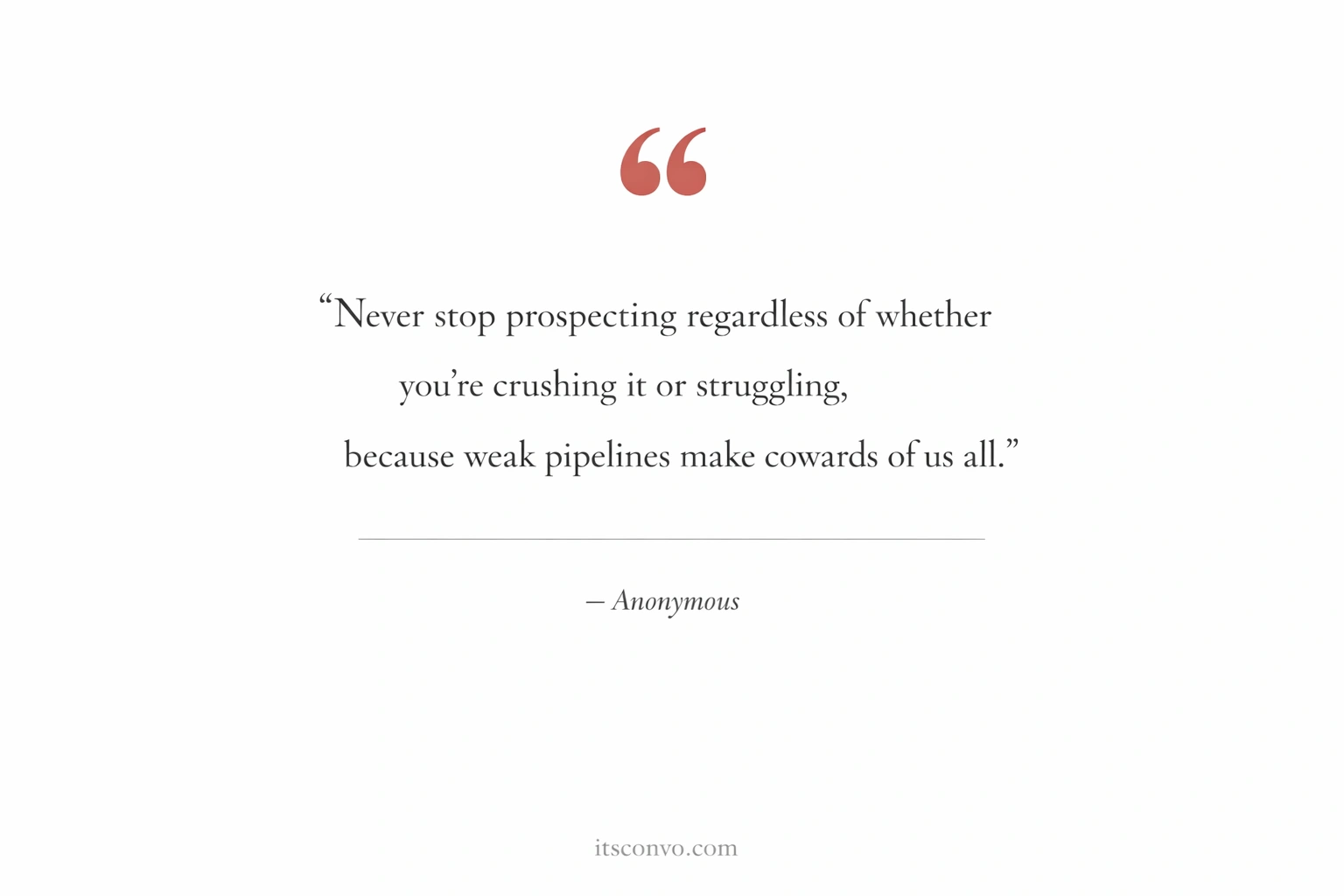
As one sales leader put it: "Never stop prospecting regardless of whether you're crushing it or struggling, because weak pipelines make cowards of us all."
The numbers back this up. Top performers spend 19 to 23 hours per week actively selling, compared to 14 to 18 hours for average performers. That's 36% more time doing the actual work — not because they grind harder, but because they've built habits that eliminate wasted time.
6. Good Salespeople Know Their Product. Great Salespeople Know Their Customer's Business.
Good salespeople can demo every feature. They know the pricing tiers, the integrations, the competitive positioning. They've memorized the talk track.
Great salespeople can read their prospect's quarterly earnings. They understand the industry dynamics. They know what keeps their buyer's boss awake at night. They connect their solution to business outcomes — revenue impact, cost reduction, competitive advantage — not feature lists.
Most B2B buyers report that salespeople don't understand their business well enough. The reason is predictable: most reps still lead with "here's what our product does" instead of "here's what this changes about your business."
Start by building a clear ICP — your ideal customer profile. Know the industry, company size, common pain points, and decision-making structure of the accounts you're targeting. Then, before each call, spend 10 minutes reading your prospect's latest press release, earnings summary, or LinkedIn posts from their leadership team. Walk into the conversation knowing something about their world, not just yours.
7. Good Salespeople Trust Their Gut. Great Salespeople Trust Data.
This is the one that changed everything for me.
I spent my first year evaluating calls on gut feeling. "I think that went well." "I feel like I handled the pricing objection okay." Vague, unverifiable, usually wrong.
Then I started tracking actual numbers — talk-to-listen ratio, questions asked per call, follow-up cadence, objection frequency — and realized my instincts were terrible. Calls I thought went great had the worst metrics. Calls where I felt uncertain actually had the strongest numbers.
Only 28% of sales reps hit their annual quota. That's not because 72% of reps lack talent. It's because most reps are coaching themselves on feelings instead of facts.
Great salespeople treat their performance like athletes treat theirs. They review film. They track metrics. They identify patterns and adjust. They don't rely on vibes.
You can track this manually if you're disciplined about it. Or you can use sales coaching software that gives you the data automatically — conversation intelligence that captures every call, measures your metrics, and shows you exactly where you're strong and where you're slipping.
The Tools That Actually Help
You don't need a $50K enterprise platform to start coaching yourself with data. Here's what's out there:
Enterprise conversation intelligence — Gong and Chorus are the standard for large sales orgs. Deep analytics, deal intelligence, pipeline forecasting. Excellent if you have the budget ($1,200+/user/year) and a dedicated enablement team. These are the tools a chief sales officer typically evaluates first.
Mid-market sales management tools — Fireflies and Otter offer meeting recording and basic analytics at $10-20/month. Good for transcription and post-call review. The catch: both send a visible bot into your meeting, which can change the dynamic on sensitive calls. (Curious what your meetings cost? Try our Meeting Cost Calculator.)
Real-time sales coaching — Convo takes a different approach. Instead of analyzing calls after they end, it provides real-time AI help during the conversation. Your talk-to-listen ratio updates live. When a prospect raises an objection, you get a suggested framework on screen. No bot joins the meeting, the audio is captured locally on your device, and your prospect never knows it's there. It's a b2b sales enablement tool built for the way great salespeople actually want to improve — in the moment, not in a review session three days later.
If you're not sure where to start, try recording your calls on Zoom, Google Meet, or Teams and reviewing them manually. Even that basic habit puts you ahead of most reps. For more on running professional calls, see our virtual meeting etiquette guide.
The Real Difference
Here's what I wish someone had told me when I started doing founder sales: the gap between a good salesperson and a great one isn't dramatic. There's no single revelation or overnight transformation. It's seven boring, repeatable habits practiced consistently.
Listen more than you talk. Find problems before you pitch solutions. Follow up when everyone else gives up. Prepare for objections before they surface. Show up the same way every day. Learn your customer's business, not just your product. And measure what's actually happening instead of guessing.
None of this is revolutionary. But the data shows that most salespeople — even good ones — aren't doing it. 92% quit following up too early. 72% miss quota. Most talk too much on calls. The bar for "great" is lower than you think. It just requires discipline that most people aren't willing to sustain.
Start with one thing. Track your talk time on your next five calls. Just that one metric will tell you more about your sales performance than a week of motivational quotes ever could.
Frequently Asked Questions
What's the biggest difference between a good salesperson and a great salesperson? Consistency. Good salespeople have hot streaks and cold streaks because their effort fluctuates with their pipeline. Great salespeople perform at the same level whether they're ahead of quota or behind it. They prospect every day, prepare for every call the same way, and don't let momentum dictate their effort.
How much should a salesperson talk during a sales call? Gong's research on 25,000+ B2B sales calls found the sweet spot is 43% talking, 57% listening. Most reps default to talking 60% or more of the time, which correlates directly with lower win rates. If you're above 50%, you're probably talking too much. Use conversation analytics to track it and aim to get under 45%.
Why do so many salespeople miss quota? Only 28% of reps hit quota recently — the lowest in years. The biggest drivers are inconsistent prospecting (reps stop filling the pipeline when things are going well), poor follow-up habits (92% give up after four attempts when most deals need five or more), and too much time on non-selling activities. Reps spend only about 30% of their time actually selling.
Can a good salesperson become a great one? Yes. The differences aren't about innate talent — they're learnable habits. Listening more, following up persistently, preparing for objections, and tracking performance with data instead of gut feeling. Most reps who commit to these changes see real improvement within six to eight weeks.
How many follow-ups does it take to close a sale? Research shows 80% of sales need at least five follow-ups, and 95% of converted leads are reached by the sixth attempt. But 48% of salespeople never follow up at all, and 92% quit after four tries. This is probably the single easiest way to outperform your competition — just keep showing up.
What sales metrics should I track to get better? Start with talk-to-listen ratio. It's the most predictive single metric for sales call success. Then add question frequency (how many questions you ask per call) and follow-up cadence (how many touchpoints per prospect). Sales coaching tools can track these automatically. These three metrics alone will reveal patterns that gut feeling never will.
Markus is the founder of Convo, building an AI meeting assistant that automates everything after the call. Years of experience building AI products. Believes technology should help people in the moment, not just analyze the past.
Ready to transform your meetings?
Join professionals using Convo to feel confident in every conversation.
Get StartedCONTINUE READING