

Markus Kellermann Founder & CEO
How to Write a Follow-Up Email After an Interview (+ 8 Templates)
Markus Kellermann Founder & CEO
57% of candidates never send a follow-up email after an interview. 8 templates that reference your actual conversation instead of a generic thank-you note.
The Follow-Up Email I Never Sent
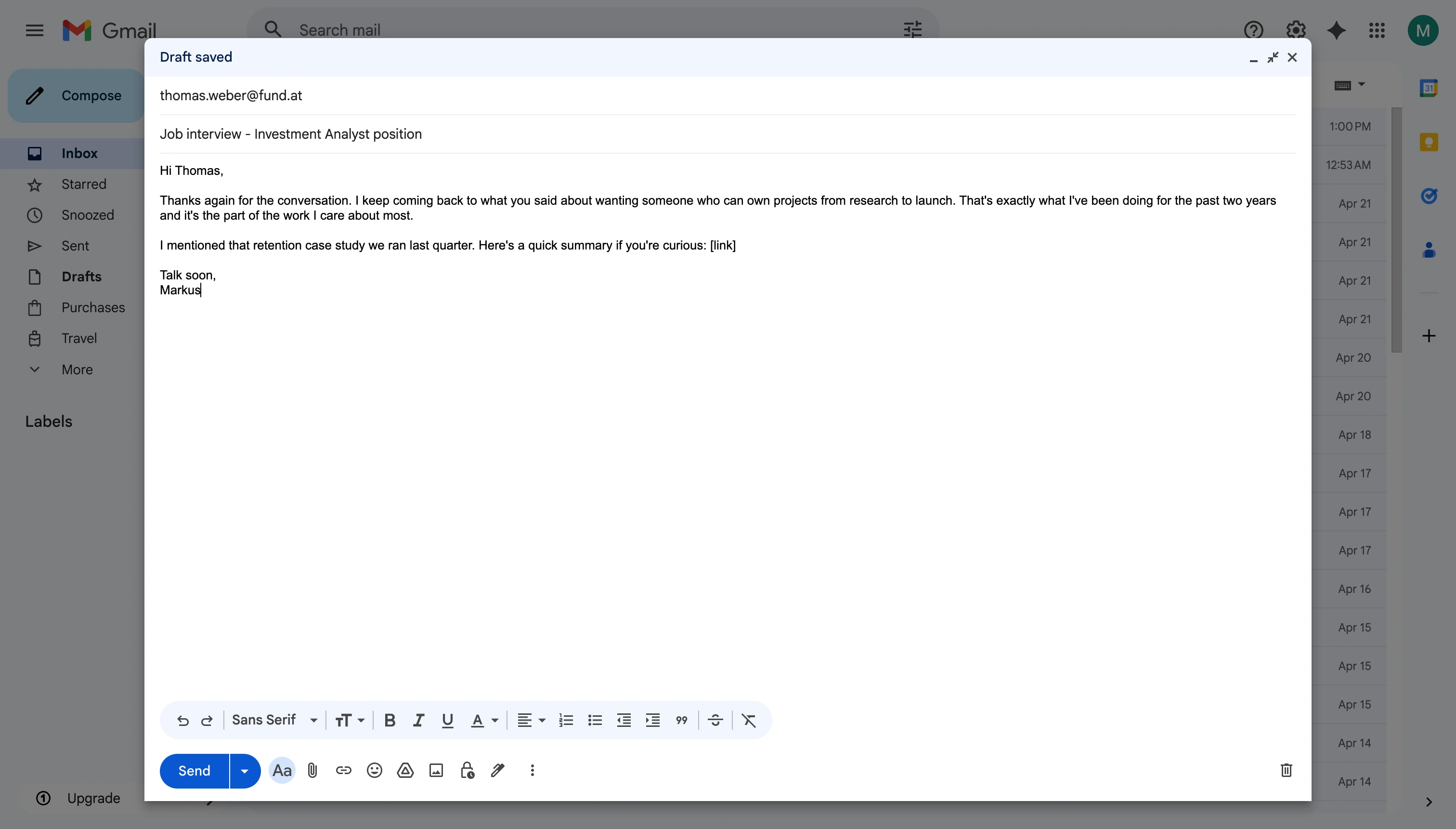
A few years ago, I applied for an investment analyst position at a fund in Vienna. It was one of those roles you find once, maybe twice. The interview went well. We spent an hour talking about their approach to portfolio construction, I walked them through a case study from my own experience, and the conversation had that natural flow where nobody's watching the clock.
I walked out feeling good. And then I did absolutely nothing.
No thank-you email. No follow-up. Nothing. It genuinely did not occur to me that sending a follow-up email after an interview was something people did. I thought the interview spoke for itself. You show up, you perform, they decide. That's how it works, right?
I never heard back. Months later, I mentioned the experience to a friend who works in recruiting. She looked at me like I'd told her I showed up to the interview in pajamas. "You didn't send a follow-up? Not even a thank-you?" Apparently this was basic stuff that everyone except me knew about.
That conversation changed how I think about interviews. The interview isn't the full picture. What you do in the 24 hours after matters just as much.
In this post, you'll learn:
- Why a specific follow-up email matters more than most candidates realize
- The exact structure that makes hiring managers actually read your email
- 8 ready-to-use templates for different situations, including after no response
- When to send, what subject lines work, and the mistakes that kill your chances
Why Most Follow-Up Emails Get Ignored
So I started sending follow-ups. But here's what I learned quickly. Most follow-up emails after an interview are almost as bad as not sending one at all. They're polite, forgettable, and they all sound the same. A hiring manager reading 15 of them can't tell candidate A from candidate B.
A Robert Half survey found that 80% of hiring managers say thank-you notes influence their hiring decision. But "influence" doesn't mean any note helps. It means the right one helps and the wrong one does nothing.
Most candidates don't realize this. The interview is the evidence, but the follow-up is the closing argument. It's your last chance to make a point before the hiring committee sits down and decides. And most people waste it on "thank you for your time, I look forward to hearing from you."
According to SHRM research, only around 43% of candidates even bother sending a follow-up at all. So just sending one puts you ahead. The question is whether yours actually says something worth reading.
So what does a good follow-up actually look like?
The Anatomy of a Follow-Up Email That Works
Every strong follow-up email after an interview has four parts.
| Element | What It Does | Example |
|---|---|---|
| Specific reference | Proves you were present and engaged | "Your point about reducing onboarding from 14 days to 3 hit home" |
| Gratitude | Shows professionalism without being generic | "Thanks for walking me through the team's async standup approach" |
| Value add | Gives them something new to think about | "I found that article on PLG onboarding we discussed, [link]" |
| Clear close | Makes next steps obvious | "Happy to send the case study I mentioned. Let me know." |
If you take meeting notes during conversations, this becomes easy. If not, write down 3-4 key moments right after the interview ends, before the details fade. What did the interviewer get excited about? What problem did they keep returning to? What specific concern did they raise about your experience?
This is where most template advice fails. A template gives you structure, but the specific references have to come from YOUR conversation. Nobody can pre-write those for you.
Well, almost nobody. There's a growing category of AI tools that run invisibly during interviews, listening to the conversation and helping you in real-time. Convo is one of them. It sits in a small overlay on your screen while you're on the call. When the interviewer asks a question you didn't prepare for, it suggests a structured response you can adapt in your own words. When they reference something technical, it surfaces relevant context. It's like having notes that update themselves based on what's actually being discussed.
And when the interview ends, Convo has the full transcript. It can draft a follow-up email that references the exact points you discussed. No more reconstructing the conversation from memory. But we'll get to the follow-up templates in a moment.
8 Follow-Up Email Templates
One rule before we start. Never send a template as-is. These give you the structure. You fill in the specific details from your conversation.
1. After a First-Round Interview
Subject: Thank you — [Role Title] conversation
Hi [Name],
Thank you for the conversation today about the [Role Title] position. I particularly enjoyed your perspective on [specific topic discussed, e.g., "how the team is rethinking customer onboarding"].
Your point about [specific challenge] stuck with me. At [Previous Company], I worked on a similar problem and found that [brief relevant insight]. I'd love to explore how that approach might apply at [Company].
Looking forward to the next steps. Happy to provide anything else you need.
Best,
[Your Name]
Why it works: It references two specific moments from the conversation and adds a relevant insight. The hiring manager reads this and thinks "this person was actually listening."
2. After a Panel Interview
Subject: Great meeting the [team/department] team
Hi [Primary Contact],
Thank you for organizing today's conversation with the team. It was great to hear [Interviewer 1]'s perspective on [topic] and [Interviewer 2]'s thoughts on [topic].
The challenge [Interviewer 2] raised about [specific problem] stuck with me. I've seen something similar at [Previous Company], and I think [brief approach].
Please pass along my thanks to the full panel.
Best,
[Your Name]
Why it works: Referencing multiple interviewers by name shows you engaged with each person, not just the lead. Panels often debrief together, and when your email mentions each of them, it stands out.
3. After a Phone or Video Screen
Subject: Thanks for the call, [Name]
Hi [Name],
Quick note to say thanks for the call today. Your description of [something specific about the role or team] gave me a much clearer picture of the opportunity.
Based on what you shared about [challenge/priority], I think my experience with [relevant skill] would be a strong fit. Happy to dig deeper in the next round.
Talk soon,
[Your Name]
Why it works: Screens are shorter and more casual, so the follow-up matches. Under 80 words. Don't over-formalize a 20-minute call.
4. After a Second or Final Round
Subject: Excited about [Company] — next steps
Hi [Name],
Thank you for having me back. The deeper dive into [specific project or initiative] confirmed this is the kind of work I want to be doing.
I thought about our discussion on [specific challenge] and wanted to share [a resource, idea, or brief proposal]. I think this could be relevant to what [Company] is building.
I'm very excited about this opportunity and ready for whatever comes next.
Best,
[Your Name]
Why it works: Final rounds are decision time. Adding a resource or idea shows initiative. You're already thinking like a team member, not a candidate.
There's a pattern across all four of these templates. Every good follow-up depends on remembering what was actually said. If you use Convo during your interviews, two things happen. During the call, it listens to the interviewer's questions and shows you suggested talking points in a small overlay on your screen. You're not reading a script. You're glancing at structured prompts that help you give sharper, more complete answers in the moment. After the call, Convo uses the full transcript to draft a personalized follow-up email in about 30 seconds. The email references specific things you discussed, not generic filler. You review it, adjust the tone, and send.
5. Follow-Up Email After No Response (1 Week)
Subject: Following up — [Role Title]
Hi [Name],
I wanted to follow up on our conversation last [day]. I'm still very interested in the [Role Title] role, and our discussion about [specific topic] has stayed with me.
I understand the process takes time. If there's anything else I can provide, happy to send it over.
Best,
[Your Name]
Why it works: Gentle, references the original conversation, doesn't sound desperate. One specific mention proves this isn't a mass follow-up you're sending to ten companies.
6. Follow-Up Email After No Response (2+ Weeks)
Subject: Quick check-in — [Role Title]
Hi [Name],
Hope you're doing well. I wanted to check in one more time about the [Role Title] position we discussed on [date].
I remain very interested, particularly in [specific aspect]. If the timeline has shifted or the role has been filled, I completely understand. Either way, I enjoyed our conversation.
All the best,
[Your Name]
Why it works: Acknowledges that timing changes without being passive-aggressive. The "either way, I enjoyed our conversation" line gives the hiring manager an easy out while keeping the door open.
7. Follow-Up Email After a Sales Call
Subject: Next steps from our call
Hi [Name],
Thanks for the conversation today. Your point about [specific challenge, e.g., "scaling the team from 5 to 15 this quarter without losing quality"] is exactly the problem we built [Product] to solve.
As discussed, I'm attaching [proposal/case study/pricing]. Let me know if [next step, e.g., "a 15-minute follow-up next week works for your team"].
Best,
[Your Name]
Why it works: Sales follow-ups need a clear next step. The specific reference shows you listened. The attached resource gives them a reason to respond. If your team runs 5+ sales calls a day, this is where conversation analytics and automated follow-up drafting save real hours. Every call generates a follow-up, and at that volume, writing them manually doesn't scale.
8. Follow-Up Email After a Meeting
Subject: Notes and next steps from [meeting topic]
Hi [Name/team],
Thanks for the productive meeting on [topic]. Key takeaways:
1. [Decision or action item]
2. [Decision or action item]
3. [Decision or action item]
I'll [your next step] by [date]. Let me know if I missed anything.
Best,
[Your Name]
Why it works: Meeting follow-ups are less about selling yourself and more about proving you'll own the next steps. Bullet points make it scannable. Including a deadline shows accountability. For recurring meetings, having a tool that captures notes automatically and drafts this email means you actually send follow-ups instead of just meaning to.
When to Send Your Follow-Up
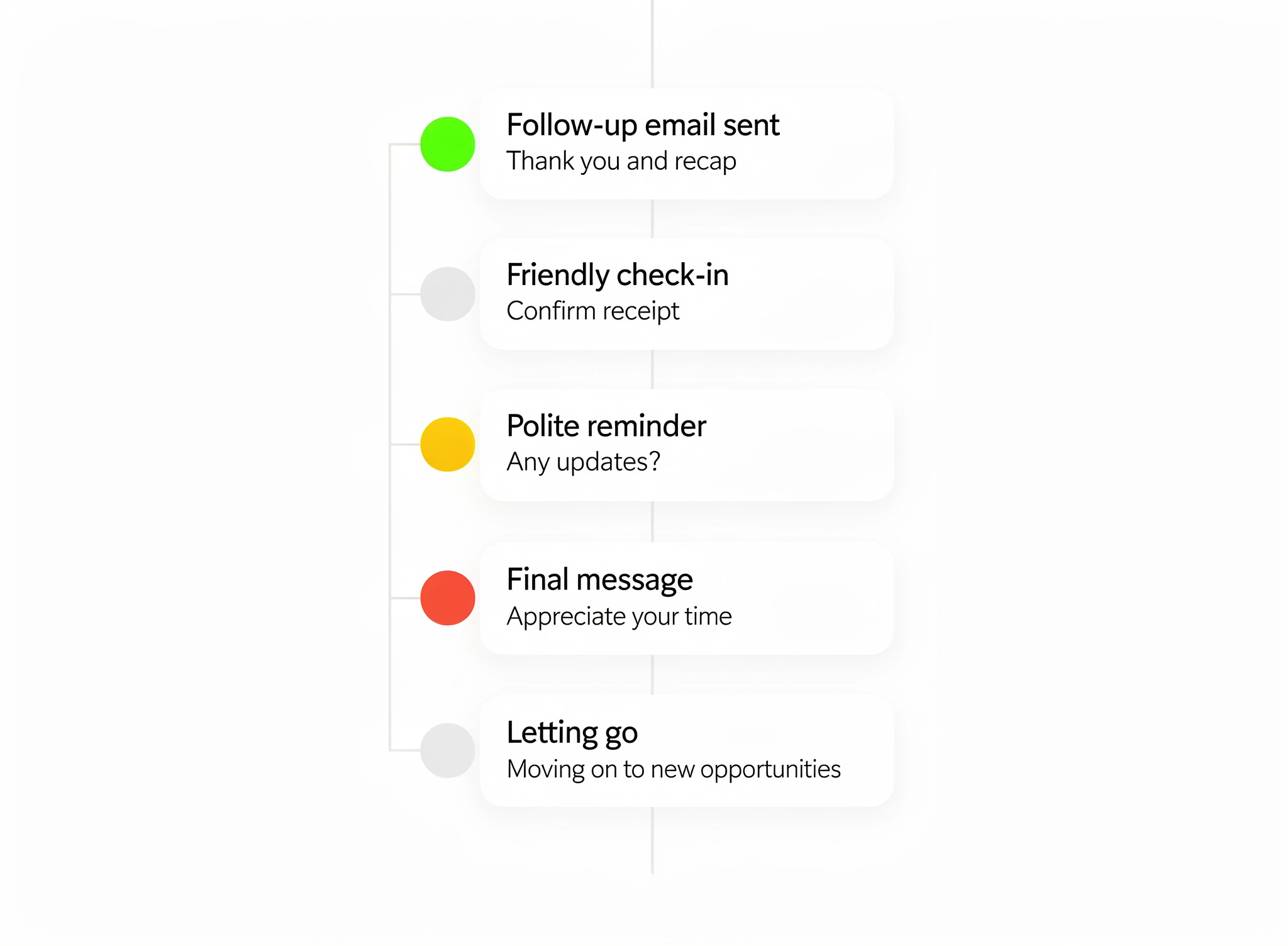
Think of follow-up timing like comedy. The exact same line lands completely differently depending on when you deliver it. Follow-up emails work the same way.
| Situation | When to Send | Why |
|---|---|---|
| After first interview | Within 24 hours | The interviewer still remembers you clearly |
| After final round | Same day (evening) | Shows urgency and genuine interest |
| After phone screen | Within 24 hours | Quick turnaround matches the casual format |
| No response (first nudge) | 5-7 business days | Gives them time without seeming impatient |
| No response (final nudge) | 10-14 business days | Last attempt before moving on |
| After a sales call | Same day, within 2 hours | Speed signals professionalism in sales |
| After a meeting | Within 4 hours | While action items are still fresh |
Subject Lines That Get Opened
The subject line decides whether your email gets read or buried. Specific always beats clever.
| Do This | Not This |
|---|---|
| "Thank you — Product Manager interview" | "Thank you!" |
| "Following up on our conversation about [topic]" | "Following up" |
| "Quick note from [Your Name] — [Role]" | "Hope this finds you well" |
| "Excited about [Company] — next steps" | "Just checking in :)" |
5 Mistakes That Kill Your Follow-Up Email
1. Sending to the wrong person. If you met three people in a panel, send individual emails, not one group message. Each person heard a different conversation and wants to feel individually acknowledged.
2. Apologizing for following up. "Sorry to bother you" signals insecurity. You're not bothering anyone. Following up is expected and professional.
3. Writing a novel. Your follow-up email should be 100-150 words. Max. You already had the long conversation. The email just needs to be a short, sharp reminder of it.
4. Adding nothing new. "Just wanted to reiterate my interest" is filler. Add a resource, an insight, or a specific reference. Give them a reason to engage with the email rather than just skim and archive it.
5. Following up too many times. Two follow-ups after no response is the limit. Three or more crosses the line from persistent to pestering. If they haven't responded after two thoughtful emails, the answer is probably no. Respect the silence and move forward.
Good meeting etiquette doesn't stop when the call ends. The follow-up is still part of it. And honestly, how you handle silence when you don't hear back says a lot about you too. If you're preparing for meetings properly, the follow-up should feel like a natural next step, not a whole separate project.
Frequently Asked Questions
How soon should you send a follow-up email after an interview? Within 24 hours. Ideally the same evening or the next morning. The longer you wait, the more your conversation fades from the interviewer's memory. If your interview was on Friday, write it that night and send Tuesday morning.
What should the subject line be for a follow-up email after an interview? Include the role title and keep it specific. "Thank you — [Role Title] interview" or "Following up on our [Role] conversation" both work. Avoid generic subjects like "Thank you" or "Following up" with no context. Hiring managers have crowded inboxes.
How do you write a follow-up email after an interview with no response? Wait 5-7 business days, then send a brief email that references a specific moment from your interview. Don't apologize for reaching out. Keep it under 100 words. If you still hear nothing after 10-14 days, send one final follow-up acknowledging the timeline may have shifted. Two attempts, maximum.
Should you send a follow-up email after a phone screen? Yes, but shorter and more casual than a full interview follow-up. Phone screens are typically 15-30 minutes, so a 3-4 sentence email works. Reference one thing you discussed and express interest in the next round.
How long should a follow-up email after an interview be? 100-150 words. That's roughly 4-6 sentences. Your interview was the detailed conversation. The follow-up is a short, specific note that reminds them why you're the right person. If you're writing more than a short paragraph, you're overcomplicating it.
Is it okay to follow up twice after an interview? Yes, but not more than twice. Send your thank-you within 24 hours. If you hear nothing after a week, send a gentle nudge. If there's still no response after two weeks, move on. Persistence is professional. Pestering is not.
What's the best follow-up email after a sales call? Reference the specific challenge the prospect mentioned, attach whatever you promised during the call, and propose a clear next step with a date. Sales follow-ups should go out within 2 hours while the conversation is fresh. Teams that automate this step with tools like Convo save 15-20 minutes per call.
Can AI help with interviews and follow-up emails? Yes, in two ways. During the interview, AI tools like Convo can listen to the conversation and suggest responses in real-time through a screen overlay, helping you handle unexpected questions with more structure and confidence. After the interview, Convo uses the full transcript to draft a follow-up email that references your specific discussion points. You review and personalize it before sending. You still need to make it sound like you, but the heavy lifting is done.
Markus is the founder of Convo, building an AI meeting assistant that automates everything after the call. Years of experience building AI products. Believes technology should help people in the moment, not just analyze the past.
Ready to transform your meetings?
Join professionals using Convo to feel confident in every conversation.
Get StartedCONTINUE READING