

Markus Kellermann Founder & CEO
7 Best Sales Productivity Tools by Category [2026]
Markus Kellermann Founder & CEO
Most sales teams run 10+ tools and still miss quota. After testing dozens, I kept seven. Here's what moves the needle and how to build a stack that works.
The Quick Verdict
Seven sales productivity tools. Six categories. Here's what actually earns its place in a modern sales stack:
| Tool | Category | Best For | Starting Price |
|---|---|---|---|
| Convo | Real-Time Meeting Help | Live sales call assistance | $22.49/month |
| HubSpot Sales Hub | CRM | Pipeline management | Free (paid from $20/user/mo) |
| Gong | Revenue Intelligence | Call analytics and coaching | Enterprise pricing |
| Apollo | Prospecting | Contact data and outreach | Free (paid from $49/user/mo) |
| Fathom | Call Recording | Free meeting transcription | Free (Premium $19/mo) |
| Clari | Forecasting | Revenue prediction | Enterprise pricing |
| Outreach | Sales Engagement | Multi-channel sequences | From $100/user/mo |
Why Most Sales Stacks Don't Work
The average sales team runs 10+ tools and still misses quota. The problem isn't a lack of software. It's that most tools optimize for the wrong moment.
CRMs track what already happened. Sales intelligence tools tell you who to call. Engagement platforms automate your sequences. But when you're actually on the call with a prospect who just hit you with an objection you didn't see coming, none of those tools help.
The stack that works covers four moments, before the call (who am I talking to and what do they care about), during the call (what should I say right now), after the call (what happened and what needs to happen next), and in between (which deals are real and which are slipping). Most tools only cover one or two of these moments. A good stack covers all four.

1. Convo: Best for Real-Time Meeting Help
I'm the founder of Convo. But the reason I built it is exactly the gap I described earlier. Every tool on this list helps you before or after the call. None of them help you during it.
Convo runs locally on your machine, captures the sales call recording without a bot joining, and surfaces real-time suggestions while you're talking. When a prospect raises a pricing objection, Convo pulls up your pricing sheet. When a client references a conversation from three months ago, Convo shows you the context. When you freeze, it suggests what to say next.
What I liked:
- Real-time is the differentiator. No other tool on this list helps you in the moment. Gong tells you what you should have said yesterday. Convo tells you what to say right now.
- No bot in the meeting. Captures audio locally. Prospects never know. For sensitive sales conversations, this matters.
- Post-call automation. Follow-up emails drafted in 30 seconds, action items extracted and routed to your CRM or Slack.
What I didn't like:
- No enterprise tier yet. We're building it. Right now, Convo works best for individual reps and small teams.
- Desktop only. Requires the Mac or Windows app. No mobile yet for on-the-go calls.
- You need to use it. The AI suggestions are only useful if you're looking at them during the call. Some reps prefer to focus entirely on the conversation.
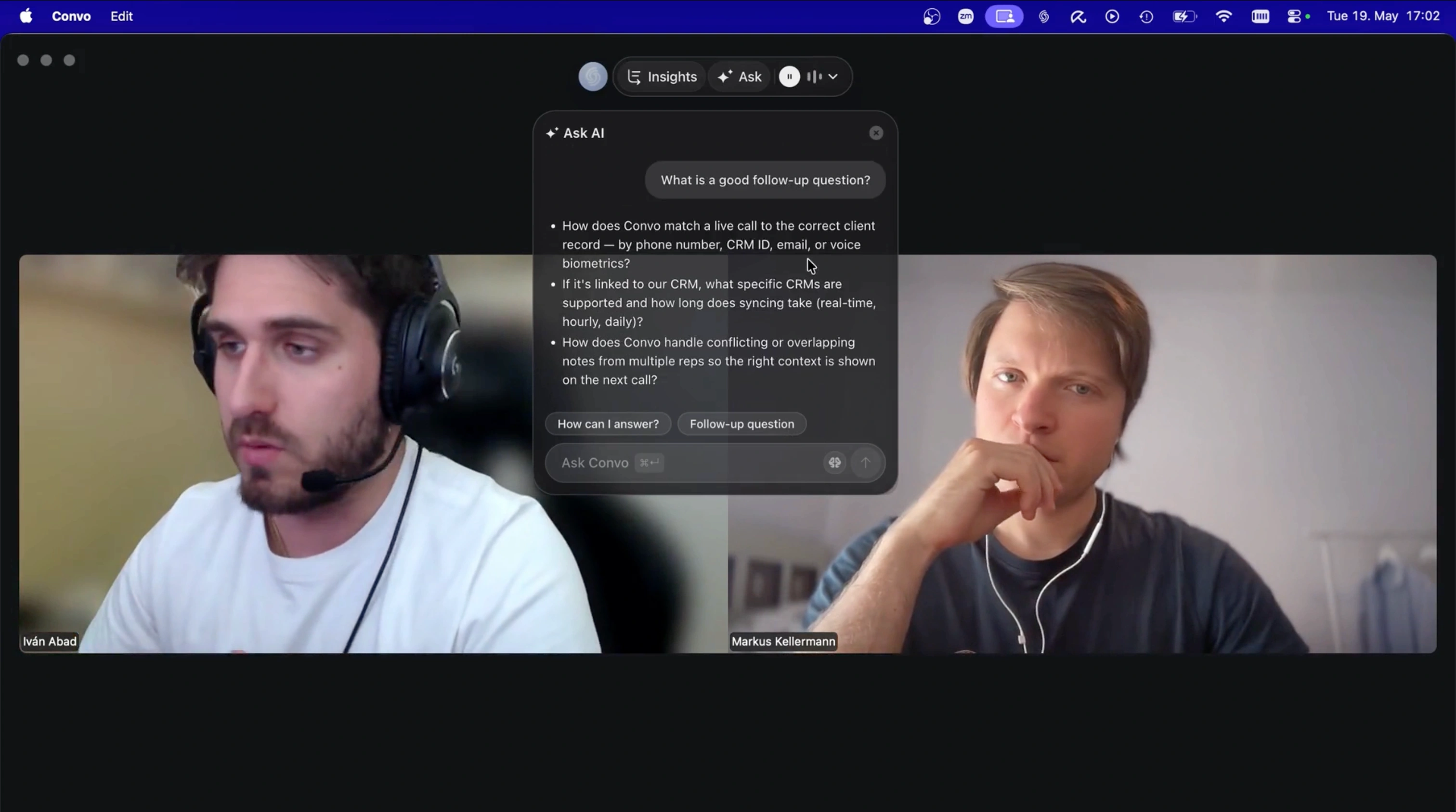
Convo surfaces real-time suggestions during live sales calls, including context from past conversations and objection handling prompts.
Best for: Individual reps and small sales teams who want to perform better on calls, not just document them. Especially useful for handling objections in sales and complex discovery calls.
Pricing: Starter $22.49/month, Professional $52.49/month. 7-day free trial.
2. HubSpot Sales Hub: Best CRM for Growing Teams
HubSpot is where most teams should start because the free CRM is genuinely useful and the paid tiers scale without the complexity of Salesforce. It's not the flashiest tool on this list, but it's the foundation everything else plugs into.
What I liked:
- The free tier is real. Contact management, deal tracking, email templates, and basic reporting at no cost. Most startups can run on this for their first year.
- Sequences that actually get used. HubSpot's email sequences are simple enough that reps actually set them up. I've seen teams with Outreach licenses where half the reps still send manual emails. That doesn't happen with HubSpot.
- Everything connects. Marketing, sales, and service in one platform means no more "the lead was in Marketo but never made it to the CRM" conversations.
What I didn't like:
- Gets expensive fast. The jump from Starter ($20/user/month) to Professional ($100/user/month) is steep. You'll hit the ceiling of Starter within months if you need custom reporting or automation.
- Reporting lags behind Salesforce. If your VP of Sales wants deeply custom dashboards, HubSpot's reporting will frustrate them.
- Call recording is basic. HubSpot records calls but the AI analysis is surface-level compared to dedicated tools like Gong.
Best for: Teams of 5-50 reps who want one platform for CRM, email, and basic pipeline management without Salesforce complexity.
3. Gong: Best for Call Analytics and Coaching
Gong is the tool that showed sales teams what was actually happening on their calls instead of what reps said was happening. It records every call, transcribes it, and uses AI to surface patterns, like which questions lead to closed deals, which objections kill pipeline, and which reps need coaching on what.
What I liked:
- Deal intelligence is the real product. Gong's value isn't the recording. It's the pattern matching across thousands of calls that tells you "deals where the prospect mentions budget in the first call close at 3x the rate."
- Coaching becomes data-driven. Instead of managers guessing who needs help, Gong shows talk-to-listen ratios, question frequency, and competitive mention patterns per rep.
- Integrates with everything. Salesforce, HubSpot, Slack, email. Gong sits on top of your existing stack.
What I didn't like:
- Enterprise pricing only. Gong doesn't publish pricing, but expect $5,000+ per year for small teams and significantly more for larger deployments. This isn't a tool for bootstrapped startups.
- It's after the fact. Gong tells you what happened on the call. It doesn't help you during the call when you're actually struggling. That's a fundamental limitation of the "record and analyze" approach.
- The bot joins your meeting. Gong's recorder is visible to prospects. Some teams report friction on sensitive deals.
Best for: Sales teams of 20+ reps with budget for enterprise tools and a dedicated RevOps or enablement person to act on the insights.
4. Apollo: Best for Prospecting and Outreach
Apollo combines a massive B2B contact database with built-in email sequences and a dialer. It's the tool that replaced three or four separate prospecting tools for most teams I've talked to.
What I liked:
- 275M+ contacts with verified emails. The database is genuinely large and the email verification is solid. Bounce rates stay under 3% in my experience.
- Sequences are included. Most contact data tools charge separately for engagement. Apollo includes email sequences, A/B testing, and a dialer in the same platform.
- Free tier is generous. 10,000 credits per month on free. Enough for a solo SDR to run real outreach before committing budget.
What I didn't like:
- Data quality varies by region. US coverage is excellent. European and APAC coverage is spottier, especially for smaller companies.
- The UI gets cluttered. Apollo does a lot, and the interface shows it. New users need a week to feel comfortable.
- Email deliverability needs babysitting. Running cold outreach through Apollo's built-in sending requires careful warmup and monitoring. Don't expect to plug in and blast 500 emails day one.
Best for: SDR teams and founders doing outbound who want contact data and sequences in one platform without paying ZoomInfo prices.
5. Fathom: Best Free Call Recording
Fathom is the easiest way to start recording sales calls for free. Unlimited recordings, unlimited transcription, across Zoom, Google Meet, and Teams. The catch is a 5 AI summary per month limit on free. But if you just need raw transcripts of every call, Fathom costs nothing.
What I liked:
- Genuinely free for unlimited recording. No minute cap, no trial period.
- Fast summaries. AI-generated call summaries appear within seconds of hanging up.
- Simple. No learning curve. Install it and it works.
What I didn't like:
- The bot is visible. "Fathom Notetaker" joins your meeting. Prospects notice.
- 5-summary cap pushes you to paid. The free plan is generous for transcription but stingy for AI features.
- No real-time help. Like Gong, Fathom is strictly after-the-fact.
Best for: Solo reps and small teams who want free sales call recording without committing budget. Great as a starting point before upgrading to Gong or Convo. See my Granola vs Otter vs Fathom comparison for a deeper look.
Pricing: Free (unlimited recording, 5 AI summaries/month), Premium $20/month.
6. Clari: Best for Revenue Forecasting
Clari is the tool your VP of Sales wants when they're tired of forecasts built on gut feel and rep optimism. It pulls data from your CRM, email, calendar, and calls to build a forecast based on actual deal signals instead of what reps entered into Salesforce last Friday.
What I liked:
- Forecasts based on signals, not opinions. Clari's AI analyzes email engagement, meeting frequency, CRM changes, and deal progression to predict which deals will actually close.
- Pipeline inspection in one view. One dashboard shows deal health, forecast gaps, and at-risk opportunities.
- Mutual action plans. Clari's collaboration features help reps and buyers stay aligned on next steps.
What I didn't like:
- Enterprise pricing and complexity. Clari is built for sales orgs with 50+ reps and dedicated RevOps. If you're a team of five, this is overkill.
- Depends on CRM hygiene. Garbage in, garbage out. If your reps don't update Salesforce, Clari's forecast won't be accurate.
- Long implementation. Expect 4-8 weeks to fully deploy and train the team.
Best for: Sales organizations with 50+ reps, a VP of Sales who needs accurate forecasting, and a RevOps function to manage the implementation.
7. Outreach: Best for Multi-Channel Sequences
Outreach is the sales engagement platform that most enterprise teams end up on. It orchestrates email, phone, LinkedIn, and chat touches into structured sequences that keep reps on pace and managers informed.
What I liked:
- Sequence design is powerful. Multi-step, multi-channel, with branching logic based on prospect behavior.
- Rep productivity tracking. Managers see which reps are executing their sequences and which are falling behind.
- Enterprise-grade integrations. Salesforce, HubSpot, Gong, Clari. Outreach sits at the center of most enterprise sales stacks.
What I didn't like:
- Expensive. Starting at ~$100/user/month, Outreach is a serious budget line item.
- Steep learning curve. The platform is deep. New reps need dedicated onboarding.
- Overkill for small teams. If you have fewer than 10 reps, HubSpot's built-in sequences or Apollo will get you 80% of the value at a fraction of the cost.
Best for: Enterprise sales teams running structured outbound at scale who need multi-channel automation with detailed analytics.
What Your Stack Should Look Like (By Team Size)

Solo founder or 1-3 reps
HubSpot Free + Fathom Free + Convo. Total cost is $22.49/month. You get a real CRM, free call recording, and real-time help on every sales call. This is the stack that punches above its weight.Small team (5-15 reps)
HubSpot Starter + Apollo + Convo. Add Apollo for prospecting when you need pipeline volume. Total cost is roughly $85/user/month for the full stack.Scaling team (20+ reps)
HubSpot Professional or Salesforce + Gong + Outreach + Clari + Convo. Enterprise tools for enterprise problems. Budget accordingly.The One Thing Most Sales Tools Miss
Every tool on this list except one helps you outside the call. CRMs, prospecting tools, engagement platforms, forecasting software, even call recording, they all work before or after the meeting.
The actual meeting is where the deal moves or dies. That's where objections get handled, where pricing gets discussed, where the prospect decides whether to trust you. And for that moment, most sales stacks leave you on your own.
That's why I built Convo. Not to replace your CRM or your prospecting tool. To fill the gap they leave, real-time help when you're actually talking to the person who signs the check.
Frequently Asked Questions
What are the best sales productivity tools for small teams? For small teams, start with HubSpot Free for CRM, Fathom Free for sales call recording, and Convo for real-time meeting help. Total cost under $15/month. You can add Apollo for prospecting when you need outbound pipeline.
How many sales tools should a team use? Four to six. Every additional tool adds context-switching overhead that erodes the productivity gains. Build around your CRM, add prospecting and call recording, and stop. Only add more when you hit a specific bottleneck.
Are sales intelligence tools worth the cost? Depends on your team size. For teams under 10 reps, Apollo's free tier and HubSpot give you most of what you need. For teams over 20 reps, sales intelligence tools like Gong and Clari pay for themselves through better forecasting and coaching.
What's the difference between sales productivity tools and sales intelligence tools? Sales intelligence tools analyze data to surface insights about prospects, deals, and rep performance. Sales productivity tools is a broader category that includes CRM, engagement, prospecting, and anything that helps reps sell more efficiently. Intelligence tools are a subset of productivity tools.
Do I need Gong if I already have a CRM? Not necessarily. CRMs track deal data. Gong analyzes what happens on calls. They solve different problems. If your team is under 20 reps, Fathom or Convo will give you call intelligence at a fraction of Gong's cost.
Is there a free sales call recording tool? Yes. Fathom offers unlimited free call recording across Zoom, Google Meet, and Teams with no minute cap. The only limit is 5 AI summaries per month on the free plan. See my Granola vs Otter vs Fathom comparison for more options.
What tool helps during sales calls, not just after? Convo is the only tool on this list that provides real-time AI help during live sales calls. It surfaces context from past conversations, suggests responses to objections, and pulls up relevant information while you're talking. Every other tool on this list works before or after the meeting.
Markus is the founder of Convo, building an AI meeting assistant that automates everything after the call. Years of experience building AI products. Believes technology should help people in the moment, not just analyze the past.
Ready to transform your meetings?
Join professionals using Convo to feel confident in every conversation.
Get StartedCONTINUE READING