

Markus Kellermann Founder & CEO
What Conversation Intelligence Does for Sales Teams [2026]
Markus Kellermann Founder & CEO
Conversation intelligence turns meetings into searchable insights. Learn what it is, how it works, and which tools deliver real ROI in 2026.
TL;DR: Conversation Intelligence in 2026
- Conversation intelligence records, transcribes, and analyzes your calls to surface talk ratios, objections, key moments, and patterns across every conversation. A transcript shows what was said; conversation intelligence shows what happened.
- It pays for itself where conversation volume exceeds what humans can review, starting with sales teams, then customer success and product. Under roughly 10 meetings a week, manual notes still suffice.
- Conversation intelligence ($20-60/user/mo) and revenue intelligence ($100-200+/user/mo) are different purchases. RI adds CRM data, deal scoring, and forecasting. Most small and mid-sized teams only need CI.
- Here is each tool in one line. Convo for real-time, bot-free CI from $22.49/user/month; Gong for enterprise depth at enterprise prices; Avoma for mid-market budgets; Otter and Fireflies are transcription tools, not true CI.
I Was Listening to the Wrong Things
Six months into building Convo, I sat in on a sales call with a potential enterprise client. Thirty minutes in, I felt great. The prospect was engaged, asking questions, nodding along. I walked away thinking we'd close within the week.
We didn't. The deal went cold. When I went back and listened to the recording, I noticed something I'd completely missed in real time. The prospect asked about compliance three separate times. Each time, I gave a surface-level answer and moved on. I was so focused on my pitch that I missed their signal.
That's when conversation intelligence clicked for me. Not as a buzzword. As a survival skill. The thing about meetings is that you can't pay attention to everything at once. You're listening, thinking about your next response, watching body language, taking notes. Something always gets dropped. The job of conversation intelligence is to catch what you dropped.
Want the short answer?
Most conversation intelligence arrives as a report, days after the call it analyzed. Convo runs the analysis during the call, catching the compliance question you're about to brush past while there's still time to answer it properly. Try it free for 7 days.

What Is Conversation Intelligence?
Conversation intelligence is the process of capturing, transcribing, and analyzing conversations (usually sales calls, customer meetings, or internal discussions) to extract patterns, insights, and actionable data.
Think of it this way. If a meeting transcript is a photograph, conversation intelligence is an X-ray. The transcript shows you what was said. The X-ray shows you what happened, like who talked most, which topics triggered engagement, where the prospect hesitated, and what commitments were made.
The term gets thrown around loosely. Some vendors use it to mean "we transcribe your calls." That's not it. That's transcription. The real version includes:
| Capability | What It Does | Why It Matters |
|---|---|---|
| Transcription | Converts speech to text | Foundation layer that everything builds on |
| Speaker identification | Knows who said what | Enables talk-ratio analysis and attribution |
| Topic detection | Identifies subjects discussed | Find which topics correlate with deal outcomes |
| Sentiment analysis | Gauges emotional tone | Spot objections and enthusiasm in real time |
| Key moment detection | Flags pricing, objections, next steps | Jump to the moments that matter without rewatching |
| Talk-to-listen ratio | Measures who dominated the conversation | Sales reps who listen more close more, and data backs this up |
| Action item extraction | Pulls commitments and deadlines | Nothing falls through the cracks after the call |
How Conversation Intelligence Actually Works
Under the hood, conversation intelligence combines five distinct AI capabilities into a single pipeline. None of them are new individually. What's new is that they finally work well enough together to be useful in real time.
1. Audio capture. The conversation has to be recorded somewhere. Most platforms do this by joining the meeting as a visible bot (you've seen "Gong Notetaker has joined"). Others, like Convo, capture system audio directly from your device. No bot, nothing announced to the prospect, zero latency. This sounds like a small detail. It isn't. In sales, the moment a recording bot pops in, the conversation changes.
2. Speech-to-text (ASR). Audio is transcribed using automatic speech recognition. Modern models like OpenAI's Whisper and AssemblyAI's Universal hit 95%+ accuracy on clean English audio. Accuracy drops fast on poor connections, accents, or industry jargon, which is why the best platforms let you train custom vocabulary.
3. Speaker diarization. This is the tech that says "Rep said X, prospect said Y." It separates the audio into distinct speakers based on voice patterns. Without diarization, you have a transcript. With it, you have an attributable record, and that's the foundation for everything else.
4. NLP analysis. Natural language processing extracts topics, sentiment, questions, objections, and commitments from the transcribed text. Modern systems use large language models to understand context. They know "we'd need to check with legal" is a soft objection, not a comment about the weather. This is the layer where basic transcription becomes intelligence.
5. Pattern aggregation. Single calls are interesting. Hundreds of calls are useful. The aggregation layer looks across your entire team's conversations to surface patterns, like which objections come up most, which talk ratios correlate with closed deals, which topics signal a deal is at risk. This is where conversation intelligence stops being a meeting tool and becomes a business intelligence tool.
Here is what that pipeline looks like when it runs live on a real call, with Convo surfacing the response while the prospect is still talking:
The technology has matured fast. Three years ago, you needed enterprise budgets and a dedicated implementation team to get useful analysis. Today, tools like Convo, Gong, and Chorus offer it at a fraction of the cost, and the local-processing approach means your data doesn't have to leave your machine.
Where Conversation Intelligence Delivers Real ROI
Not every team needs this. Here's where it actually moves the needle, and where it's overkill.
Sales teams: the obvious use case
This is where the category was born, and it's still the highest-ROI application. Specifically:
- New rep onboarding: Instead of shadowing for weeks, new reps can review the top 10 calls from your best closer. They learn what good looks like from real examples, not roleplay.
- Deal review: Managers can review key moments from calls without sitting in on every meeting. Flag pricing discussions, objection handling, and competitor mentions.
- Coaching at scale: Talk-to-listen ratios reveal which reps talk too much. Topic analysis shows which reps skip discovery. You coach on data, not gut feeling.
- Forecasting accuracy: When a rep says "the deal is solid," you can verify it. Did the prospect actually express intent? Or did the rep project optimism onto ambiguity?
A study by McKinsey found that B2B companies using analytics-driven sales approaches see 5-10% revenue growth above their peers. And this is where the real-time variant changes the economics. Convo delivers the coaching during the call, so the correction lands while the deal can still be won rather than in Friday's review.
Customer success teams
After the deal closes, the same technology helps CS teams spot churn signals early:
- Repeated complaints about the same feature
- Decreasing engagement over time
- Missed commitments from either side
- Tone shifts from enthusiastic to frustrated
If you're in customer success, this is the difference between reactive firefighting and proactive retention.
Product teams
Every meeting with a customer contains product feedback, but it usually dies in someone's notes. The right tools make it searchable:
- How often do customers mention a specific feature request?
- Which competitors come up in conversations?
- What language do customers use to describe their problems?
This is gold for product teams that want to build what customers actually need, not what internal stakeholders assume they need.
Where it's overkill
If your team has fewer than 10 meetings per week, manual note-taking probably suffices. This category shines at scale, when there are too many conversations for any one person to review.
If you want to see what meeting intelligence looks like in practice, Convo's conversation analytics feature tracks talk ratios, topic patterns, and key moments across all your meetings.
Conversation Intelligence vs. Related Tools
The market is confusing. Vendors throw around "conversation intelligence," "revenue intelligence," "meeting intelligence," and "conversation analytics" like they're interchangeable. They're not. Here's how the categories actually relate:
| Tool Type | What It Does | Examples | Overlap with CI |
|---|---|---|---|
| Transcription | Speech to text | Otter.ai, Rev | Foundation. CI includes this |
| Meeting notes | Summarizes meetings | AI note takers, Notion AI | Subset. CI goes deeper |
| Conversation intelligence | Full analysis + patterns | Convo, Gong, Chorus | The full stack |
| Revenue intelligence | CI + CRM + forecasting | Gong, Clari | CI + sales pipeline data |
| Call recording | Records calls | Zoom recording, Dialpad | Input source, not analysis |
For most teams, you don't need the full revenue intelligence stack. A solid CI tool that captures meetings, analyzes them, and surfaces the important parts is enough. You can check our comparison of Otter vs Fireflies vs Fathom for a detailed look at transcription-focused tools, or see how Convo compares to Fireflies from this perspective.
Conversation Intelligence vs. Revenue Intelligence
This distinction trips up almost everyone, so it's worth unpacking. The two categories overlap heavily but aim at different problems.
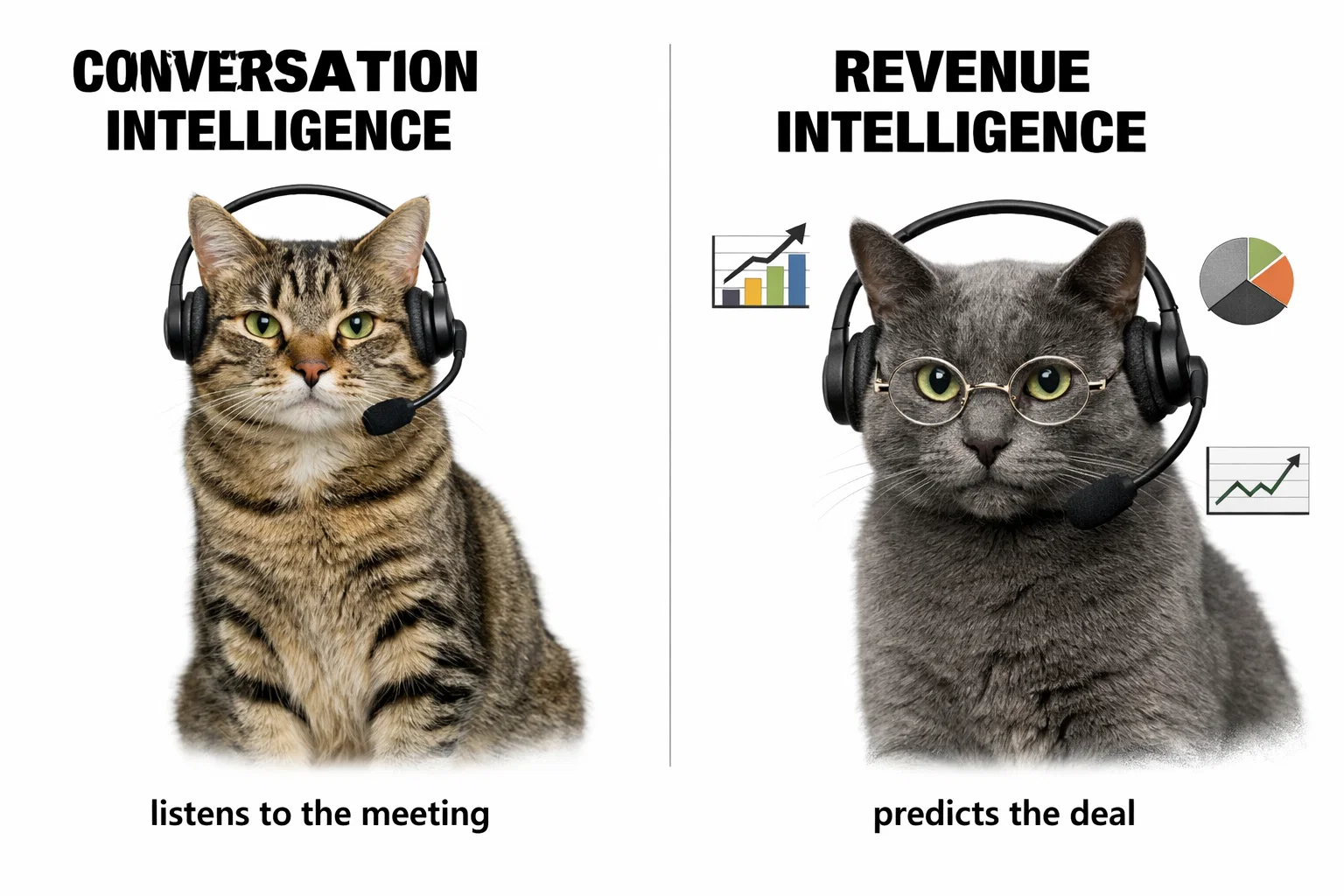
Conversation intelligence is about understanding what happens inside a meeting. It captures audio, transcribes it, identifies speakers, surfaces key moments, and tracks patterns across calls. The output is "here's what was said and what it means." It's useful for any team that has lots of high-stakes conversations.
Revenue intelligence is conversation intelligence plus the CRM, plus pipeline data, plus forecasting models. It connects what happened in the call to what's happening in the deal. The output is "here's what was said, what it means, and what's likely to happen with this pipeline." It's useful almost exclusively for sales orgs. For a deeper dive on this category, see our guide to revenue intelligence.
| Capability | Conversation Intelligence | Revenue Intelligence |
|---|---|---|
| Records and transcribes calls | Yes | Yes |
| Identifies talk ratios and key moments | Yes | Yes |
| Tracks topics across conversations | Yes | Yes |
| Pulls deal data from your CRM | Sometimes | Always |
| Predicts deal outcomes | No | Yes |
| Forecasts pipeline at quarter-end | No | Yes |
| Typical buyer | Sales manager, CS lead, PM | VP Sales, RevOps |
| Typical price | $20-60/user/mo | $100-200+/user/mo |
Best Conversation Intelligence Software in 2026
Convo publishes this guide and appears in it. The same criteria apply to every tool, and the pricing below was re-verified in July 2026. This is the short version; the full eight-tool breakdown, including the enterprise pricing vendors don't publish, lives in our best conversation intelligence software comparison.
| Tool | Best For | Strength | Weakness | Starting Price |
|---|---|---|---|---|
| Convo | Sales + privacy-conscious teams | No bot, real-time help during the call, local processing | Newer brand than incumbents | $22.49/user/mo |
| Gong | Enterprise sales orgs | Deepest analytics, revenue intelligence add-ons | Expensive, requires implementation | ~$1,200/user/yr + platform fee |
| Chorus | ZoomInfo customers | Good integrations with ZoomInfo data | Acquired by ZoomInfo, slower roadmap | ~$8k/yr (3 seats) |
| Avoma | Small-to-mid teams | Solid all-rounder, published pricing | Real cost rises with add-on modules | $19/user/mo + add-ons |
| Jiminny | Coaching-focused teams | Live coaching whisper feature | Less ecosystem reach than Gong | ~$83/seat/mo |
| Fireflies.ai | Light meeting note-taking | Easy setup, broad integrations | More transcription than true CI | $10/user/mo |
| Otter.ai | Solo professionals | Best mobile app, real-time captions | Transcription-focused, limited CI | $8.33/user/mo |
- Convo: best for teams that want conversation intelligence during the call, not after it. Objection responses and context surface live, no bot joins the meeting, audio stays on your device. $22.49/user/month, published.
- Gong: best for enterprise sales orgs with a RevOps function and six-figure tooling budgets. The deepest analytics in the category, at reported $1,200+ per user per year plus a $5,000 to $50,000 platform fee.
- Chorus: best if you already run ZoomInfo and want conversation data feeding the same records.
- Avoma: best mid-market all-rounder with published pricing, from $19/user/month before the add-on modules that carry the intelligence.
- Jiminny: best for building a manager-led coaching culture, reportedly around $83 per seat per month.
- Fireflies.ai: best cheap entry point for searchable notes; closer to transcription than true conversation intelligence.
- Otter.ai: best for solo professionals who mainly need captions and transcripts.
The honest take is this. If you're an enterprise sales org with a dedicated RevOps team and a $100+/user budget, Gong has the deepest post-call analytics in the category. For everyone else, and that's most teams, the best pick is Convo. It's the one that helps during the call instead of only reporting after, with no bot in the meeting, at a third of the enterprise cost. Avoma and Jiminny are solid mid-market post-call options, and Otter and Fireflies are transcription tools, not true conversation intelligence; they're more about capturing notes than analyzing patterns.
For a deeper feature-by-feature breakdown of how Convo stacks up, see our comparison with Fireflies and our list of the best AI meeting assistants for Mac in 2026.
A Real Example: How One Team Used CI to Fix Their Win Rate
A 12-person SaaS sales team I spoke with last quarter had a stubborn problem. Their win rate was 18%, well below the industry average. The VP of Sales suspected reps were talking too much in discovery calls but couldn't prove it without sitting in on every meeting.
They rolled out a CI platform on a 30-day trial. Two patterns showed up almost immediately:

First, the team's average talk-to-listen ratio in discovery calls was 68/32. Their best closer's ratio was 42/58. The reps with the lowest win rates were doing 75%+ of the talking. Second, when the AI flagged "pricing" or "budget" mentions from prospects, the response was almost always a deflection ("we'll get to that") rather than a direct answer.
The fix wasn't complicated. The VP shared two anonymized recordings every week (one good, one bad) with the whole team. Within eight weeks, the average talk ratio dropped to 52/48 and the win rate climbed to 26%. No new tools, no new training program. Just visibility into what was already happening.
That's the unglamorous truth. Most of the value comes from showing teams what they're already doing. The AI doesn't have to be magic. It just has to be a mirror.
How to Evaluate Conversation Intelligence Tools
If you're considering adding one of these tools to your stack, here's the framework I'd use:
1. How is audio captured?
Some tools join meetings as a visible bot. You've seen the "Gong Notetaker has joined" notification. Others record locally. This matters. In sales calls, a recording bot can create friction with prospects. With Convo's bot-free approach, the prospect never knows the call is being analyzed.
2. What analysis do you actually get?
Transcription alone isn't conversation intelligence. Look for:
- Talk-to-listen ratios per speaker
- Topic and keyword tracking
- Key moment detection (pricing, objections, next steps)
- Sentiment or engagement scoring
- Cross-meeting pattern analysis
3. Where does the data live?
Privacy matters. Some platforms process everything in the cloud. Convo captures audio locally on your device. Nothing uploads to third-party servers. If you're in a regulated industry or your prospects are privacy-sensitive, this is a major factor. See our privacy and compliance approach.
4. What's the integration story?
The tool should work with your existing stack, whether Zoom, Google Meet, Teams, or your CRM. If it requires people to change their workflow, adoption will be low.
5. What's the real cost?
Enterprise platforms like Gong can cost $100+/user/month. Newer tools offer the core capabilities at $15-40/user/month. Calculate ROI based on time saved (15-20 minutes per meeting in follow-up work) and deal impact (better coaching = higher close rates).
Use our meeting cost calculator to see what your current meetings cost.
Getting Started Without Overcomplicating It
You don't need to roll out a full platform across your entire org. Start small:
- Pick one team. Usually sales, because the ROI is most measurable
- Record for two weeks. Don't analyze yet, just build a baseline
- Review the top 5 calls. Look for patterns in talk ratios, topics, and outcomes
- Share one insight per week. "Our best-performing calls have a 40/60 talk-to-listen ratio" is more powerful than a 50-page report
- Expand based on results. If the sales team finds value, CS and product will want in
The goal isn't to surveil your team's conversations. It's to help everyone learn from each other, catch what they'd otherwise miss, and spend less time on post-meeting busywork.
If you're ready to try it, Convo's conversation intelligence platform gives you real-time help, automatic analysis, and context that compounds across every call with the new Convo Memory layer. Local processing, no bots, from $22.49/month. Start with the free trial and see what your conversations have been telling you.
For the broader sales tech context, see our companion guides on B2B sales intelligence, sales enablement platforms, how to win more deals with AI, and the best sales coaching software.
Frequently Asked Questions
What is conversation intelligence? Conversation intelligence is the process of recording, transcribing, and analyzing conversations (typically sales calls and meetings) to extract insights like talk ratios, topic patterns, objection frequency, and action items. It goes beyond basic transcription by using AI to identify what happened in a conversation and what it means for your business.
How is conversation intelligence different from transcription? Transcription converts speech to text. That's it. Conversation intelligence adds analysis, like speaker identification, topic detection, sentiment analysis, key moment flagging, and cross-conversation pattern recognition. Transcription is an ingredient. Conversation intelligence is the meal.
What are the best conversation intelligence tools in 2026? For most teams, the best is Convo. It's the one that helps during the call, not just after, with no bot in the meeting, from $22.49/user/month. Gong has the deepest analytics for 50+ rep enterprises, and Chorus fits teams already in ZoomInfo. For the full ranking, see our best conversation intelligence software guide comparing all 8 tools side by side.
Is conversation intelligence only for sales teams? No. While sales was the first use case, customer success teams use it to spot churn signals, product teams use it to capture feedback, and recruiting teams use it to standardize interview evaluation. Any team that has frequent high-stakes conversations benefits.
Does conversation intelligence require a recording bot? Not necessarily. Enterprise tools like Gong typically join meetings as a visible bot. Convo takes a different approach. It captures audio directly from your device's system audio, so no bot joins the call. This is important for sales teams where a recording notification can create friction with prospects.
How much does conversation intelligence cost? Enterprise platforms like Gong reportedly exceed $1,200 per user per year plus a platform fee, with annual contracts. Mid-market tools range from $30-60/user/month. Convo's Starter plan is $22.49/user/month, with Professional at $52.49 for the full real-time coaching layer, both published. The ROI typically comes from time savings (15-20 minutes per meeting in follow-up work) and improved sales outcomes through better coaching.
Markus is the founder of Convo, building an AI meeting assistant that automates everything after the call. Years of experience building AI products. Believes technology should help people in the moment, not just analyze the past.
Ready to transform your meetings?
Join professionals using Convo to feel confident in every conversation.
Get StartedCONTINUE READING