

Markus Kellermann Founder & CEO
Gong vs Chorus vs Clari: Which Revenue Intelligence Tool Fits?
Markus Kellermann Founder & CEO
Three enterprise revenue tools, three different problems. Honest pricing, features, and trade-offs from a founder who competes with all three.
TL;DR: Gong vs Chorus vs Clari in 2026
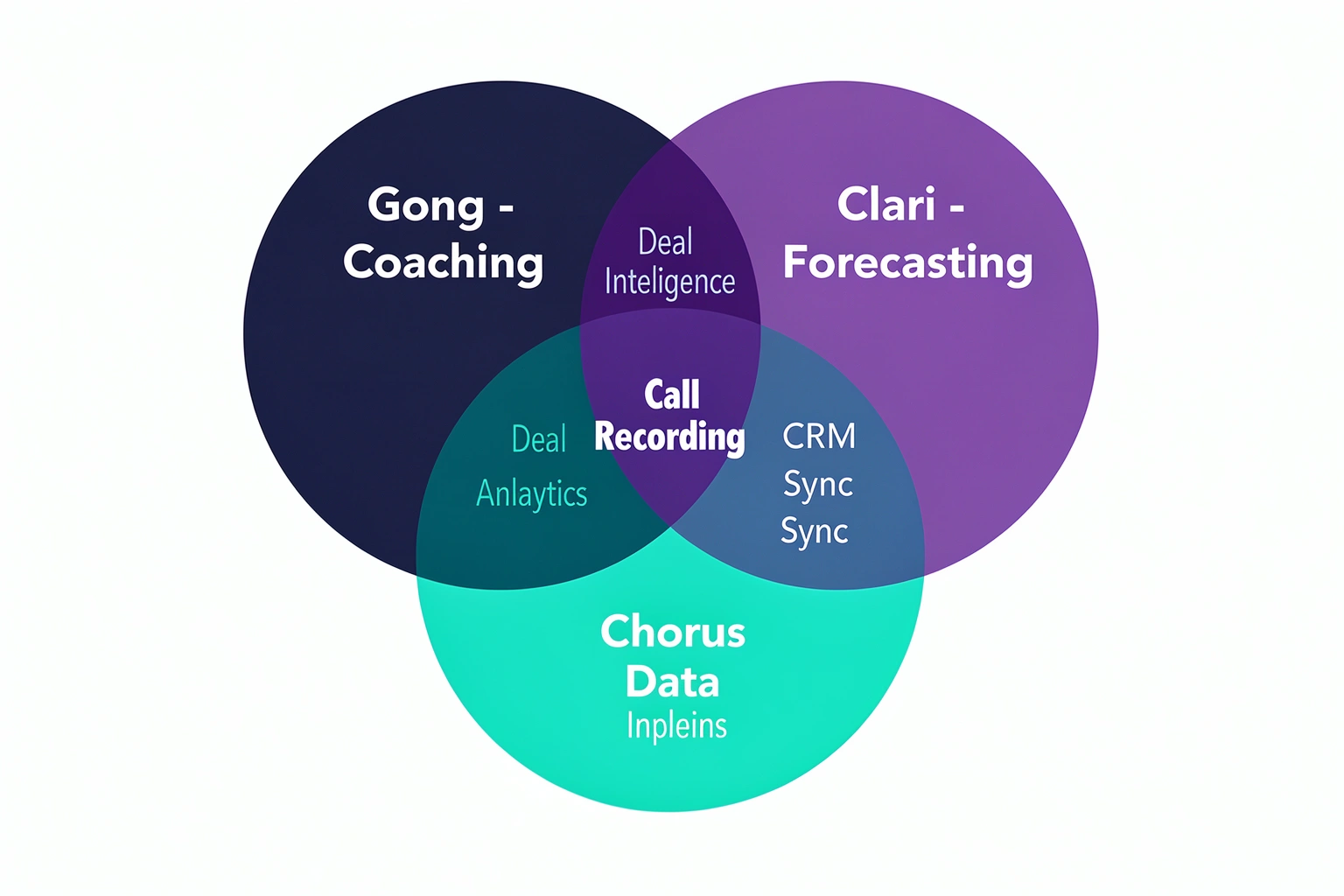
- Three enterprise tools, three different jobs. Gong coaches the calls, Clari forecasts the number, and Chorus enriches them with ZoomInfo data.
- All three run $30,000 to $160,000 a year, take two to four months to set up, and put a bot in every meeting. Paying for the wrong one is an expensive mistake, so pick by your biggest problem.
- Each is genuinely the best at its own job. Gong on coaching, Clari on forecasting, Chorus if you already live in ZoomInfo.
- Copilot is the only one of the three that can step into a live call, and even then a configured phrase must match a prepared Battlecard. Convo is the best choice when you want help across the whole conversation. It uses the live exchange and the account's earlier calls to put the relevant response on screen. Try it free.
"Why Wouldn't We Just Buy Gong?"
I get this question a lot. Usually from prospects on a discovery call, sometimes from investors, occasionally from my own co-founder when we're being honest about who we're up against.
I build Convo, so I'm a competitor to all three tools in this post. I've spent the last year pulling apart how Gong, Chorus, and Clari work, not because I enjoy reading enterprise pricing pages, but because when someone asks me that question I need a real answer rather than a sales pitch.
And sometimes the real answer is that you should buy one of them. Which one comes down to the problem you're actually solving. A VP of Sales coaching 80 reps across four regions needs something completely different from a rep who just has to win the call they're on in ten minutes. Gong, Chorus, and Clari were built for the first job. Convo was built for the second.
The issue is that all three look similar from the outside. Same call recording, same AI, same "revenue intelligence" label on the website. But they started from different problems and were built around different assumptions, and choosing the wrong one is a $30,000-$160,000 mistake that takes three months to even set up.
Here's what I'd want to know if I were evaluating them.
The Quick Comparison
| Gong | Chorus (ZoomInfo) | Clari | Convo | |
|---|---|---|---|---|
| Core strength | Call coaching and deal intelligence | Call intelligence + prospecting data | Revenue forecasting and pipeline governance | Real-time help on the live call |
| Real cost | $150-250/user/month | ~$8,000/year for 3 seats (bundled with ZoomInfo) | $100-125/user/month (core forecasting) | $22.49/month |
| Setup time | 2-4 months | 2-3 months | Lengthy (modular deployment) | 2 minutes |
| Best for | Coaching reps at scale (20-500 reps) | Teams already using ZoomInfo | CROs who need forecast accuracy | Any rep who wins deals on the live call |
| Biggest weakness | Price. Not viable under 15 reps | Declining innovation since acquisition | Coaching features are thin | Not built for enterprise forecasting |
| Bot joins meeting | Yes | Yes | Yes (Copilot module) | No |

Three Tools, Three Different Problems
I made the mistake early on of treating these three as the same product with different logos. They're not. Each one grew out of a different frustration, and that origin story still shapes what they're good at and what they're not.
Gong started with coaching. Every call gets recorded, transcribed, and scored against 300+ signals. The whole platform is built around one question, what are my reps doing on calls and how do I make them better. Forecasting, deal boards, engagement, everything Gong added since grew out of that coaching core.
Chorus started with data enrichment. ZoomInfo acquired Chorus to add conversation intelligence to its prospecting database. The pitch is simple. You already use ZoomInfo for contact data (100M+ contacts, 14M+ companies), so layer call recording on top and every call gets enriched with firmographic context automatically. Chorus is strongest inside the ZoomInfo ecosystem, not as a standalone tool.
Clari started with forecasting. Its whole job is answering whether you'll actually hit the number this quarter. Rather than trust what reps typed into Salesforce, it reads deal signals across CRM, email, calendar, and calls, and builds the forecast from those. Clari merged with Salesloft in December 2025 to build what it calls a "Predictive Revenue System." The conversation intelligence piece, Copilot, came later.
Once you understand which question your org is actually asking, the tool usually picks itself.
The Real Pricing
Nobody publishes their real pricing, which is annoying. I've pieced this together from analyst reports, G2 reviews, and conversations with teams who've actually signed contracts.
Gong
Gong charges a platform fee ($5,000-$50,000/year depending on org size) plus per-user licenses ($1,200-$1,600/user/year for small teams, dropping to $800-$1,000 for 100+ seats). Add $7,500-$28,500 for onboarding. Full breakdown at Gong pricing.
| Team Size | Year 1 Cost (estimated) | Per User/Month |
|---|---|---|
| 10 reps | ~$28,500 | ~$238 |
| 50 reps | ~$90,000 | ~$150 |
| 130 reps | ~$152,000 | ~$97 |
Chorus
Chorus starts at roughly $8,000/year for 3 seats with $1,200/seat/year after that. But the real pricing story is the ZoomInfo bundle. ZoomInfo's sales team pushes combined packages that offer 15-25% off individual pricing. The upside is real discounts. The downside is you may end up paying for ZoomInfo access you don't fully use.
There's no free trial, no monthly billing, and no freemium tier.
Clari
Clari is modular, which means the sticker price depends on what you need:
| Module | Estimated Cost |
|---|---|
| Core (Forecasting + Pipeline) | $100-125/user/month |
| Copilot (Conversation Intelligence) | $60-110/user/month |
| Groove (Sales Engagement) | $50-150/user/month |
| Full platform | Average contract ~$160,000/year |
For context, Convo is $22.49/month. Completely different scale, but it puts the enterprise price tags into perspective.
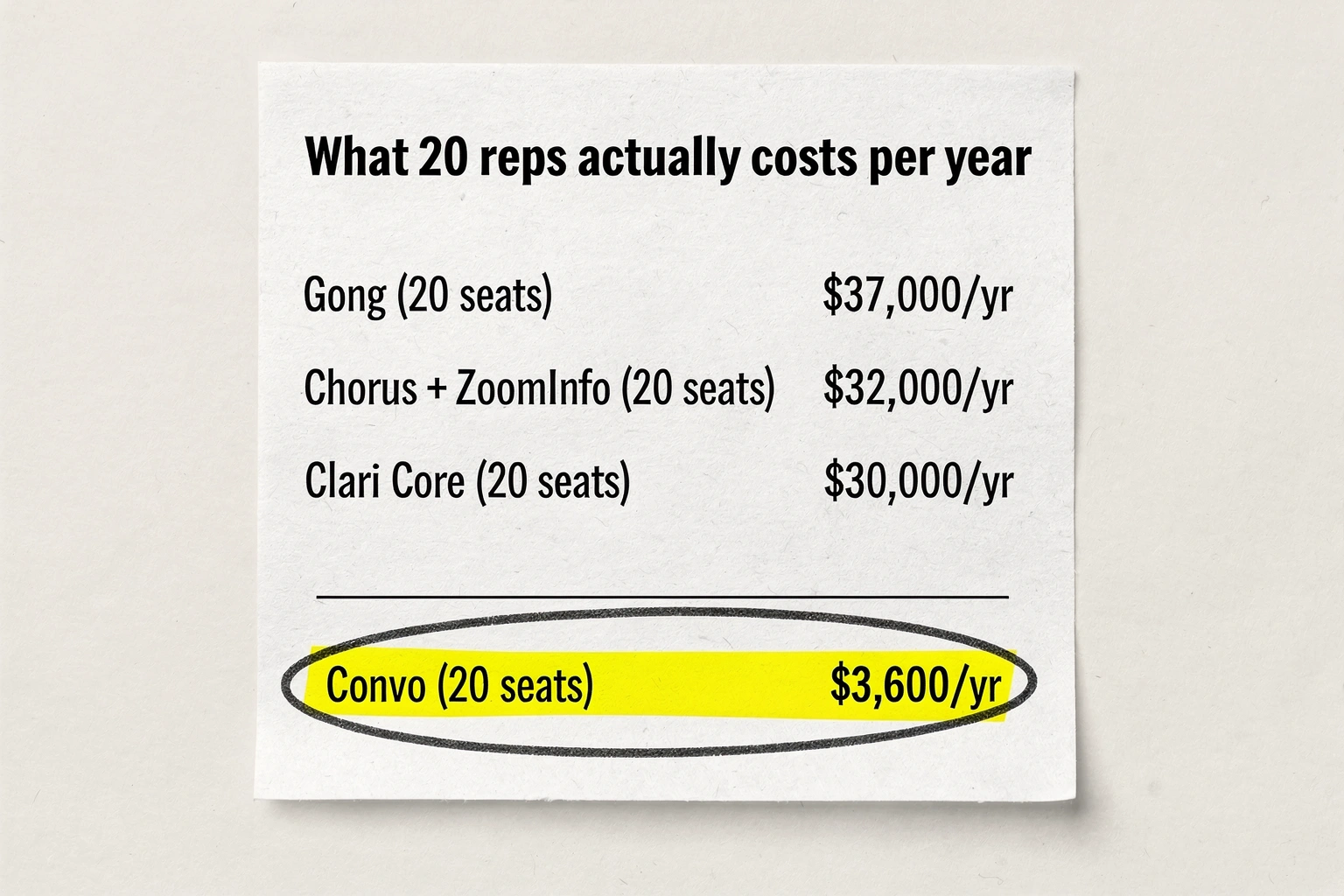
The pricing is in the same ballpark across all three. So the decision comes down to what you get for that money.
Where Each One Wins
Coaching: Gong
If I had to pick one thing Gong does better than anyone else, it's this. They created data-driven sales coaching as a category and nobody has caught up.
Think of Gong as a film review system for sales calls. Every conversation gets recorded, and the AI breaks it down frame by frame, scoring talk-to-listen ratios, question frequency, competitor mentions, sentiment shifts, and deal progression. That's 300+ conversation signals across every call, in 70+ languages. Coaching scorecards compatible with MEDDIC, SPIN, and BANT methodologies.
Here's what makes it powerful in practice. A manager can pull up a rep's last 20 calls and see they're talking 65% of the time, rarely asking open-ended questions, and consistently losing momentum after the pricing discussion. Then they build a playlist of three calls where a senior rep handled the same pricing moment well. That's not generic coaching. That's coaching from your own team's data. According to Gartner's 2025 Market Guide for Revenue Intelligence, Gong leads the category in coaching depth for exactly this reason.
Chorus has decent coaching tools. Searchable call libraries, performance scorecards, competitor tracking. Users report it can cut new hire ramp time from 3 months to 6 weeks, which is meaningful for teams scaling fast. The ZoomInfo enrichment also adds a layer Gong can't match. You can see who was on the call, their seniority, and their company's tech stack, without looking it up manually. But the transcription accuracy (80-90%) holds it back for detailed coaching. Technical jargon, accents, and speaker attribution get mangled often enough that coaching sessions sometimes start with "that's not actually what I said." If transcription accuracy matters for your coaching workflow, Gong is noticeably better here.
Clari's coaching is the weakest of the three overall, but Copilot does add genuine live help. It records and transcribes calls, surfaces Battlecards when configured triggers appear, and provides talk ratios and key moments. The coaching scorecards are not as deep as Gong's, and the call library is less mature. If forecasting is the main reason for buying and governed live messaging is useful too, Copilot fits. The Convo vs Clari Copilot comparison shows where those Battlecards stop and Convo's contextual help starts.
Forecasting: Clari
Clari claims 98% forecast accuracy by the second week of the quarter. That's a bold number, but the platform's entire architecture is built around making it real. Structured commit/upside/risk categories at every level of the org. AI that reconciles what reps submit against what the deal signals actually show. Pipeline inspection with Flow and Trend analytics that surface exactly where revenue is leaking.
Here's what that looks like. A rep marks a $200K deal as "commit" in Salesforce, but Clari sees email engagement dropped 40% last week, no meeting is scheduled, and the economic buyer hasn't been on a call in three weeks. Clari flags it as at-risk and adjusts the forecast accordingly. The VP of Sales sees the gap before the quarter ends, not after. Think of Clari as an auditor that checks everyone's homework against reality.
If you're a chief sales officer walking into a board meeting, Clari is the difference between "we think we'll hit $4.2M" and "our model shows $4.2M with 98% confidence, and here are the three deals that could move it."
Gong's forecasting has gotten better over the past year. The Gong Forecast feature uses conversation data to predict deal outcomes, and the ~95% accuracy claim is credible for orgs with enough call data. But forecasting at Gong is an add-on to a coaching platform. At Clari, it's the foundation. If you've narrowed it to these two, our Clari vs Gong head-to-head goes deeper on exactly that trade-off.
Chorus has basic forecasting through ZoomInfo's broader platform, but it's not in the same league as either Gong or Clari on this dimension.
Data Enrichment: Chorus
Chorus's advantage is ZoomInfo, and it's a significant one. Imagine walking into every sales call with a dossier on every participant, including their title, their company's tech stack, their funding history, and how many employees they've hired recently. That's what Chorus does automatically. Every call participant is enriched with contact data from ZoomInfo's database of 100M+ contacts and 14M+ companies, before you even open the transcript.
Neither Gong nor Clari offer anything comparable. If your sales discovery calls depend on knowing exactly who you're talking to and what their org looks like, Chorus gives you that context automatically.
The trade-off is that Chorus requires the ZoomInfo ecosystem to deliver this value. As a standalone conversation intelligence tool, it doesn't differentiate enough from Gong to justify switching. Users on G2 report declining innovation since ZoomInfo's acquisition, with the product feeling "behind competitors" in feature development.
What All Three Miss
I'm going to be upfront. This section is where I'm selling you my product. But the observation is real, and it's something I noticed long before I started building Convo.
Here's the short answer. Convo is the best choice when a rep needs help across an unscripted live conversation. Clari Copilot can show a Battlecard if the buyer says a configured phrase. Gong and Chorus are built around the completed recording.
A manager using Gong or Chorus starts with the recording. Clari sends call signals into the forecast and can bring a prepared Battlecard into the meeting. That model works if someone reviews the calls, builds the playlists, and keeps the cards current.
But the actual moment where deals move forward or stall is the live conversation. A prospect raises an objection you didn't prepare for, or brings up something from a meeting two months ago that your rep has forgotten. Clari can help when a prepared card and trigger match. Gong and Chorus wait until after the call.
Convo was built for that gap. Here's what it looks like in practice. You're on a discovery call, and the prospect mentions they evaluated Clari last quarter but found it too complex for their 15-person team. Convo picks that up from the conversation, pulls context from two previous calls with the same prospect, and shows you on screen that they also mentioned budget constraints in your last meeting. You use that to pivot the conversation toward value per rep instead of platform-wide ROI. The call keeps flowing. No pause, no "let me check my notes." After the call, Convo drafts a follow-up email that references the Clari concern and positions your pricing against it. Thirty seconds of work instead of twenty minutes.
I'm not pretending Convo replaces Gong for a 50-rep enterprise org. It doesn't. But every sales team, whatever its size, still has to win the live conversation. Convo is built for the unscripted parts of that call, where a trigger-based card has nothing to match.
For a deeper dive, see Convo vs Clari Copilot for the two live models and Convo vs Gong for live help against post-call review.
Who Should Buy What
| Your Situation | Best Fit | Why |
|---|---|---|
| Any team whose deals are won or lost on the live call | Convo | Real-time help while the prospect is still talking, no setup |
| 50+ reps, need to coach at scale, $100K+ budget | Gong | Best-in-class call analysis, proven coaching infrastructure |
| Already using ZoomInfo, want call intelligence integrated | Chorus | Makes sense inside the ZoomInfo ecosystem, not outside it |
| CRO/VP Sales who needs forecast accuracy for board reporting | Clari | Built for the forecast. Everything else is secondary |
| 20-50 reps, need both coaching and forecasting | Gong + CRM forecasting | Gong for calls, your CRM for pipeline. Cheaper than adding Clari |
| Need the best free option to start recording calls | Fathom | Unlimited free recording, upgrade when you outgrow it |
You probably don't need all three. Poor call execution points to Gong, a shaky forecast to Clari, and a ZoomInfo-heavy stack to Chorus. Start with one, and add another only if the first proves itself.
If you want to go deeper on the categories these tools created, read our guides on conversation analytics and revenue intelligence. And if none of these feel right for where your team is today, our sales productivity tools guide covers everything from free tools to enterprise platforms.
Frequently Asked Questions
What is the difference between Gong, Chorus, and Clari? Gong is primarily a conversation intelligence platform for coaching sales reps through call analysis. Chorus is a conversation intelligence tool bundled with ZoomInfo's prospecting database for data enrichment. Clari is a revenue operations platform focused on forecasting accuracy and pipeline governance. All three record and transcribe calls, but each prioritizes a different outcome, whether that's coaching, data, or forecasting.
Gong vs Chorus vs Clari: which should a mid-market team pick? For a mid-market team (roughly 20-50 reps), the honest split is by primary need. Gong if call coaching is the priority, Clari if the board needs forecast accuracy, Chorus if you already run ZoomInfo. All three are enterprise-priced and take 2-4 months to roll out. Many mid-market teams that want the coaching value without that overhead pair or replace them with a real-time tool like Convo, which coaches reps live on the call without the enterprise rollout. Buy the enterprise platform when you have a RevOps function to run it; start with real-time help if what you need is better calls now.
How much does Gong cost in 2026? Gong charges a platform fee ($5,000-$50,000/year) plus per-user licenses ($1,200-$1,600/user/year for small teams). Add onboarding at $7,500-$28,500. Real all-in cost runs $150-250/user/month for most teams. Annual contracts required. Not cost-effective for teams under 15 reps.
Is Chorus worth it without ZoomInfo? Generally no. Chorus's strongest differentiator is its ZoomInfo integration, which enriches every call with contact and company data from a database of 100M+ contacts. Without ZoomInfo, Chorus is a decent conversation intelligence tool with 80-90% transcription accuracy, but it doesn't differentiate enough from Gong (which has better transcription and coaching features) to justify the cost. Users report declining innovation since ZoomInfo's acquisition.
What is Clari best for? Revenue forecasting and pipeline governance. Clari claims 98% forecast accuracy by the second week of the quarter. If your chief sales officer needs reliable numbers for board presentations and your org has the CRM discipline to feed clean data, Clari delivers. It's less effective for call coaching, where Gong leads.
Are there cheaper alternatives to Gong, Chorus, and Clari? Yes. For call recording, Fathom (free unlimited recording). For real-time help during calls, Convo ($22.49/month). For mid-market conversation intelligence, Avoma ($24/user/month). For searchable meeting archives, Otter ($16.99/month). These tools cover 70-80% of what enterprise platforms offer at 10-20% of the cost. See our Clari alternatives breakdown, what Chorus.ai actually costs, or the full sales productivity tools guide.
Do Gong, Chorus, and Clari all use meeting bots? Yes. All three join meetings as visible participants to record audio. Some enterprise buyers expect this and don't mind. Others find it off-putting, especially on early-stage relationship calls. If a visible bot is a problem for your conversations, bot-free alternatives like Convo and Granola capture audio locally from your device without joining the meeting.
Which is better for small sales teams, Gong or Clari? Neither is designed for small teams. Gong's pricing starts at ~$28,500/year for 10 users. Clari's average contract is ~$160,000/year. For teams under 20 reps, consider Convo for real-time call help ($22.49/month), Fathom for free recording, or Avoma ($24/user/month) for mid-range conversation intelligence. Enterprise tools earn their price at enterprise scale. For the full Gong-versus-Clari head-to-head on forecasting versus coaching, see Clari vs Gong.
Markus is the founder of Convo, building an AI meeting assistant that automates everything after the call. Years of experience building AI products. Believes technology should help people in the moment, not just analyze the past.
Ready to transform your meetings?
Join professionals using Convo to feel confident in every conversation.
Get StartedCONTINUE READING