

Markus Kellermann Founder & CEO
How to Win More Deals With AI in 2026
Markus Kellermann Founder & CEO
Most sales AI reviews the call after it ends. A founder's guide to winning more deals with AI in 2026 and the help that arrives while the call is still live.
TL;DR: How to Win More Deals With AI in 2026
- Most money spent on sales AI does almost nothing. A 2025 Forbes survey of more than 1,000 executives found under 1% had seen a real return on it, and 53% saw next to nothing (Forbes).
- The teams that win with it change how they sell, not just what they buy. Bain found AI can lift win rates by more than 30%, but only when you rebuild the selling around it (Bain).
- The gains come from a few specific moments, and nearly all of them happen during the live call. You walk in prepared, you answer the objection while the prospect is still there, you catch the buying signals as they appear, and you agree on the next step before the call ends.
- Convo handles these moments for you in real time. When the prospect pushes back, the right answer is already on your screen. It remembers what people said in earlier conversations and reminds you of the next step before you say goodbye. Deals that used to stall in one weak moment get won instead.
The Deal I Lost at Minute 34
A couple of years ago I lost a deal I was sure we had. Warm intro and we were already three calls in. On that third call the buyer mentioned, that they were "also taking a look at" an incumbent everyone in our space loses to. I gave an answer that seemed fine at the time and moved on. The call ended well, and I hung up without a second thought.
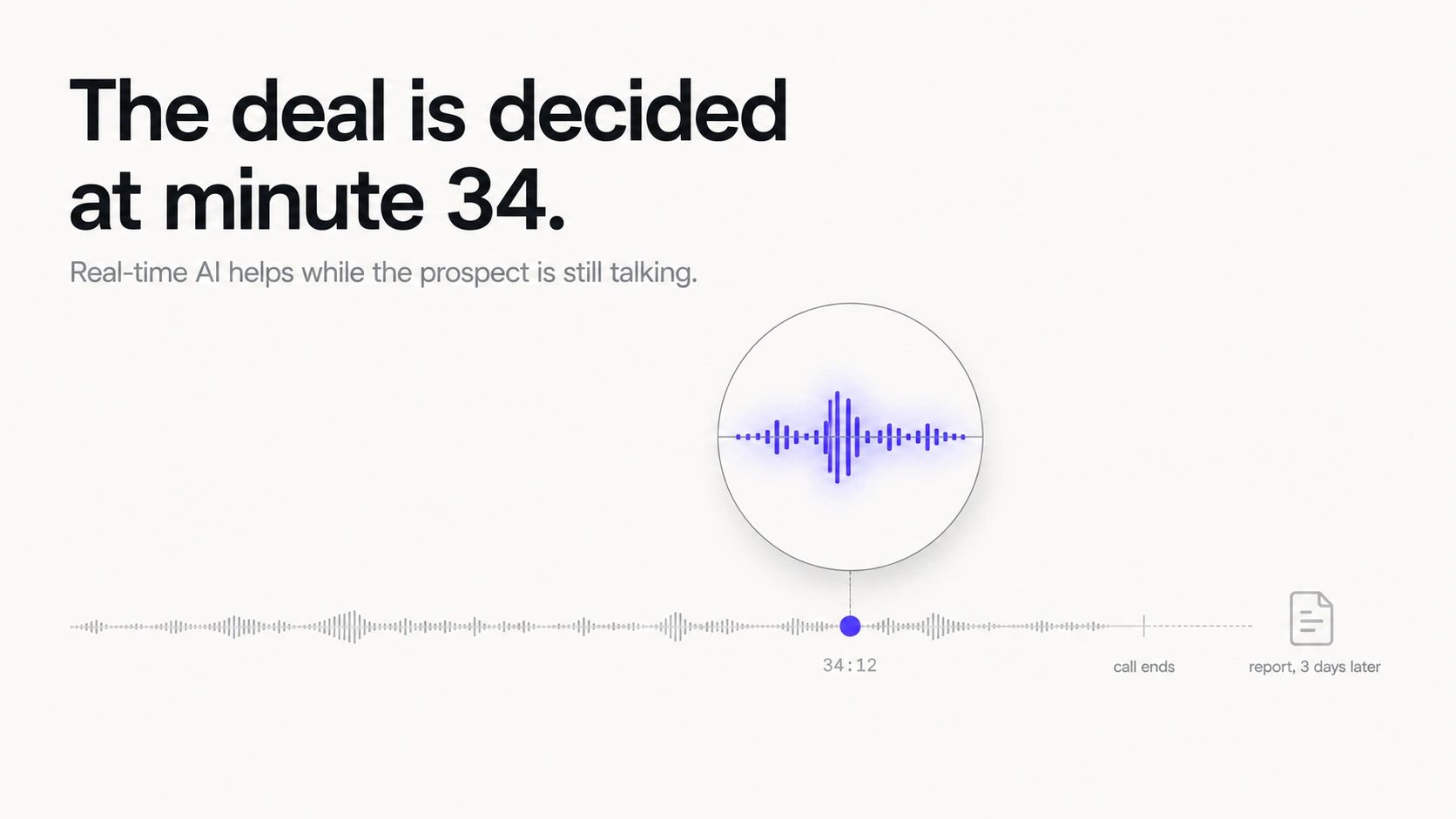
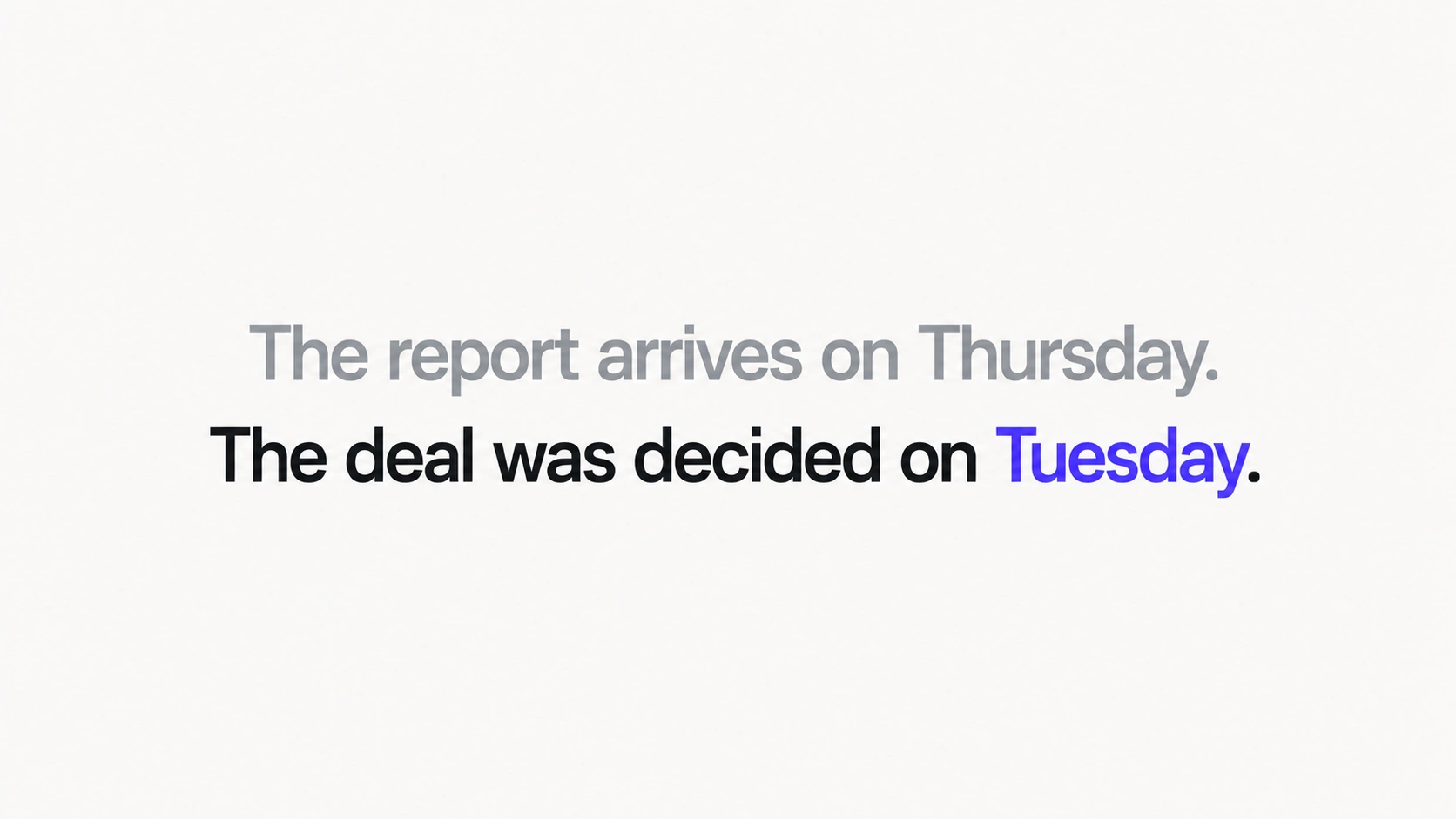
The deal went quiet the next week and died the week after. So I did what every rep does. I went back and listened to the recording. And there it was, right around minute 34, the exact moment I needed a better answer about our competitor and did not have one ready. The recording told me exactly what I did wrong but just three days too late.
That gap is the reason Convo exists. For years, "AI for sales" meant recording your calls and rating them afterwards which helps the next deal and does nothing for the one that just died. Whether AI can analyze a sales call stopped being an interesting question a few years ago. The one that matters in 2026 is whether it can help you win the call you are on right now.
Want the short answer?
Convo helps you win more of the deals you are already working. It works during the call itself, so when a prospect pushes back on price, the right answer is already on your screen. It catches the budget question you were about to skip and reminds you to agree on the next step before the call ends.
Why Most Sales AI Does Nothing
Most of the money going into sales AI is not moving deals. A 2025 Forbes survey of more than 1,000 executives found that fewer than 1% had seen a serious return on their AI spend, and 53% saw a return of 1 to 5%, which after the license and the setup is close to nothing (Forbes).
Why? Because most teams buy a tool and add it on top of the way they already sell. Bain studied this and landed on the same conclusion. Sprinkle AI over your existing tasks and you get a small bump and a new bottleneck somewhere else. The teams that lift win rates by more than 30% change how the selling itself happens, mostly by taking what their best rep does on a live call and putting it in front of everyone else (Bain).
So none of the plays in this guide are "add a dashboard." Each one changes a specific moment in the deal, and nearly all of those moments happen in the live conversation. It helps to know the three jobs AI does in sales, because only one of them wins the deal in front of you.
- Fill the pipeline. AI SDRs and data tools like Apollo, Clay, and 11x book meetings and clean up your records. Useful when the calendar is empty, but they do nothing once the meeting starts.
- Win the live call. Real-time copilots that help you while you are still talking. This is the newest kind of AI sales assistant, the least crowded layer, and the one where deals are actually decided. Aircover, Attention, Balto, Dialpad Sell, Trellus, Revenue.io, Clari Copilot, and Convo all sit here, and our Cluely alternatives guide compares this layer tool by tool.
- Clean up after. Post-call tools like Gong, Chorus, Fireflies, and Otter record the call and tell you what happened once it is over.
Most teams have spent their budget on the first and the third and left the middle empty. The rest of this guide is about that middle layer.
The Numbers Behind Winning With AI
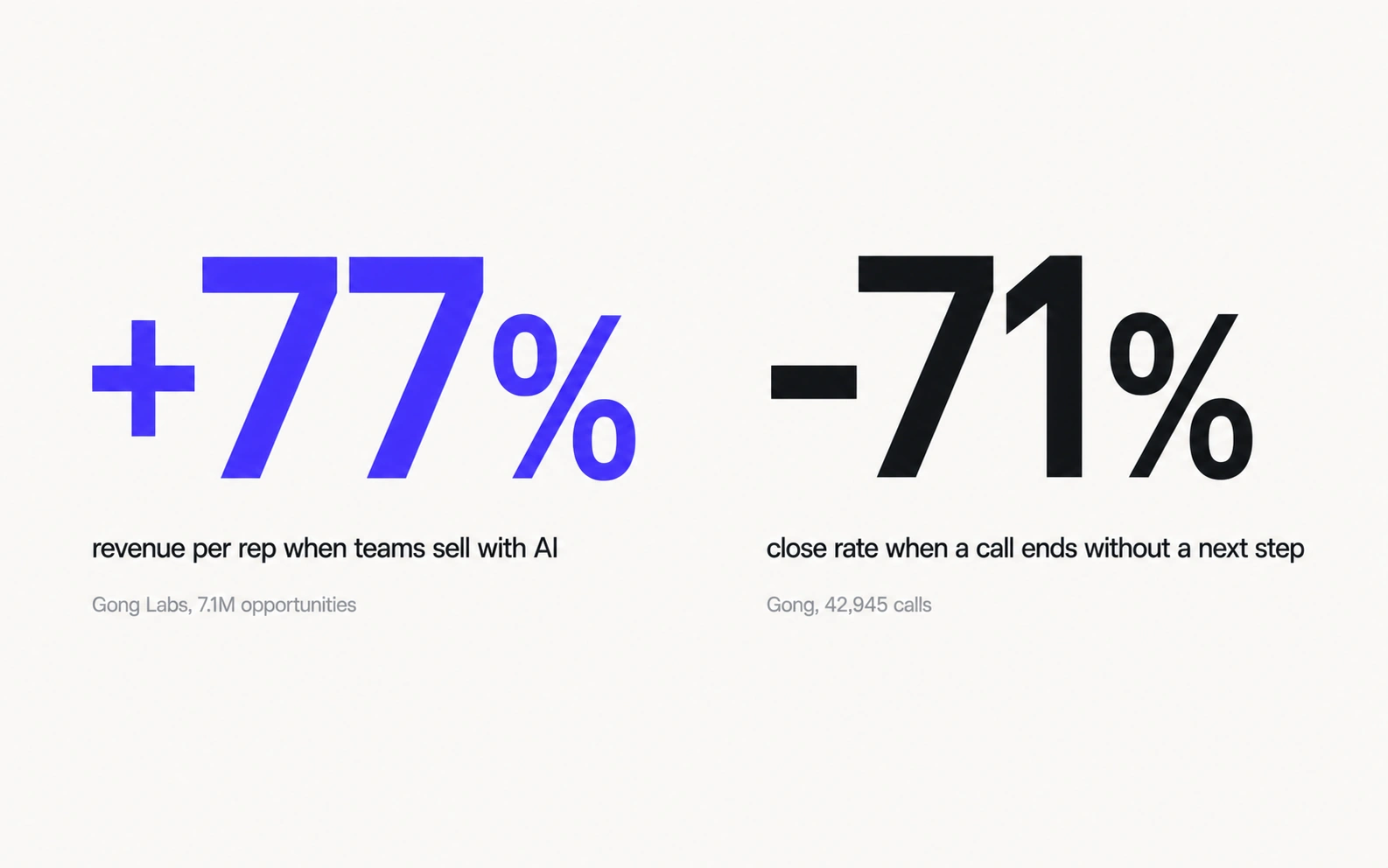
The clearest number comes from Gong's own research. Teams selling with AI generate 77% more revenue per rep than teams that do not. The sample behind it is 7.1 million sales opportunities across more than 3,600 companies, from the company that built the post-call category.
Revenue per rep is the outcome, though. To improve it you need to know which behaviors move it, and the research below keeps pointing at the same short list. None of it is "get better at closing lines."
| Metric | Impact | Source |
|---|---|---|
| Revenue per rep, AI-driven teams vs manual | +77% | Gong Labs, State of Revenue AI, 7.1M opportunities |
| Win rate at proposal stage, industry average | 47% | RAIN Group, 472 sellers |
| Win rate, elite performers (top 7%) | ~75% | RAIN Group |
| Seller/buyer alignment on the core problem, won deals | 45% | Corporate Visions, 600+ buyers |
| Seller/buyer alignment on the core problem, lost deals | 23% | Corporate Visions |
| Deals lost to buyer indecision, not to a competitor | 40 to 60% | Dixon & McKenna, HBR, 2.5M calls |
| Buying decision completed before engaging sales | ~70% | 6sense Buyer Experience Report |
| Close-rate drop when the next step is missed | -71% | Gong, 42,945 calls |
This is the part AI is good at. You cannot keep your talk ratio, the buying signals, and the right answer all in your head while staying present with the buyer. AI watches them for you, so you can just have the conversation.
Where Deals Are Actually Won and Lost
A pipeline dashboard makes a deal look like a set of stages that advance on their own. In practice a deal moves, or falls apart, in specific moments inside real conversations. A buyer says something that reveals the actual blocker, and the rep either hears it and responds or misses it and keeps pitching.
Think about your last five lost deals. My bet is that at least three of them turned on a moment you can name. The budget question you answered too fast, the stakeholder you never asked to meet, the competitor you never properly answered. None of that shows up as a "stage" anywhere. It sits as one line in a transcript you probably never went back to read.
This is why the timing of AI help matters more than how clever the analysis is. An insight during the call can still save the deal. The same insight two days later cannot. Post-call tools went deep on the analysis and accepted the delay. The teams winning in 2026 go after the delay itself, because a deal you can still influence is worth more than a detailed report on one you already lost.
The Plays That Win More Deals
Here are the five plays, in the order they show up in a real deal.
Play 1. Walk in already briefed
Most reps prep for a call by skimming the CRM for two minutes between meetings. The notes are thin, the last call was three weeks ago, and half the context lives in someone's head or nowhere at all. So the call opens with "remind me where we left off," which tells the buyer they are one of forty accounts. It is not that reps are lazy. Per Bain, they spend only about a quarter of their week actually in front of customers, and prep is one of the first things that gets squeezed (Bain).
AI closes that gap by remembering for you. Convo briefs you before the call with what was discussed last time, what is still open, and which threads went quiet. Aircover does the same with deal-aware account history, and Gong will surface it in a pre-call card. You walk in able to say "last time you said the security review would slow procurement down, did that get resolved?" That one line does more for your credibility than an hour of small talk. And because the memory builds across every conversation, it gets more useful the longer the deal runs, which is something a single-call notetaker cannot give you.
Play 2. Read the signals you would miss
Discovery is where I used to miss the most. You are doing four things at once, listening, planning your next question, reading the buyer's reactions, and scribbling notes. Something always drops, and it is usually the quiet signal that matters most, because buyers rarely repeat their real concern. They mention it once, in passing, and move on.
Real-time AI watches the parts you cannot. Your talk-to-listen ratio updates live on screen, so when you drift toward 70% talking you catch yourself and pull back before the call is over. Gong's research across tens of thousands of calls puts the sweet spot near 43% talking and 57% listening, and most reps have no idea they are past it. A budget mention, a timeline, a named decision-maker, all of it gets flagged the second it surfaces. The difference between a good and a great salesperson often comes down to catching those live, a skill that used to sit only with your best closer.
Play 3. Answer the objection while it is live
This is the play that matters most, and the reason the real-time category exists at all. A prospect says "you are more expensive than [incumbent]" and the clock starts. A strong rep has a crisp answer ready. A newer one freezes, over-explains, or discounts on the spot. That gap is rarely about talent. It is about whether the right words are in front of you in the moment you need them.
A whole category of tools now exists for exactly this moment. Aircover plays a virtual sales engineer and feeds competitive intel mid-call. Attention surfaces battlecards against your playbook and reports teams cutting their sales cycles by 18%. Balto and Trellus fire objection prompts for high-volume phone teams. Convo is built for the B2B sales call where the deal is actually decided, and it draws the answer from your own positioning and the documents you have uploaded. The mechanism underneath all of them is the one Bain tied to the 30% win-rate jump. You take the answer your best rep already gives and put it in front of everyone, the moment it is needed. The objections themselves are covered in how to handle objections in sales, but knowing the answers only helps if the right one shows up while the prospect is still talking. On the deal I lost, the right answer came to me in the shower that night. It did not help.
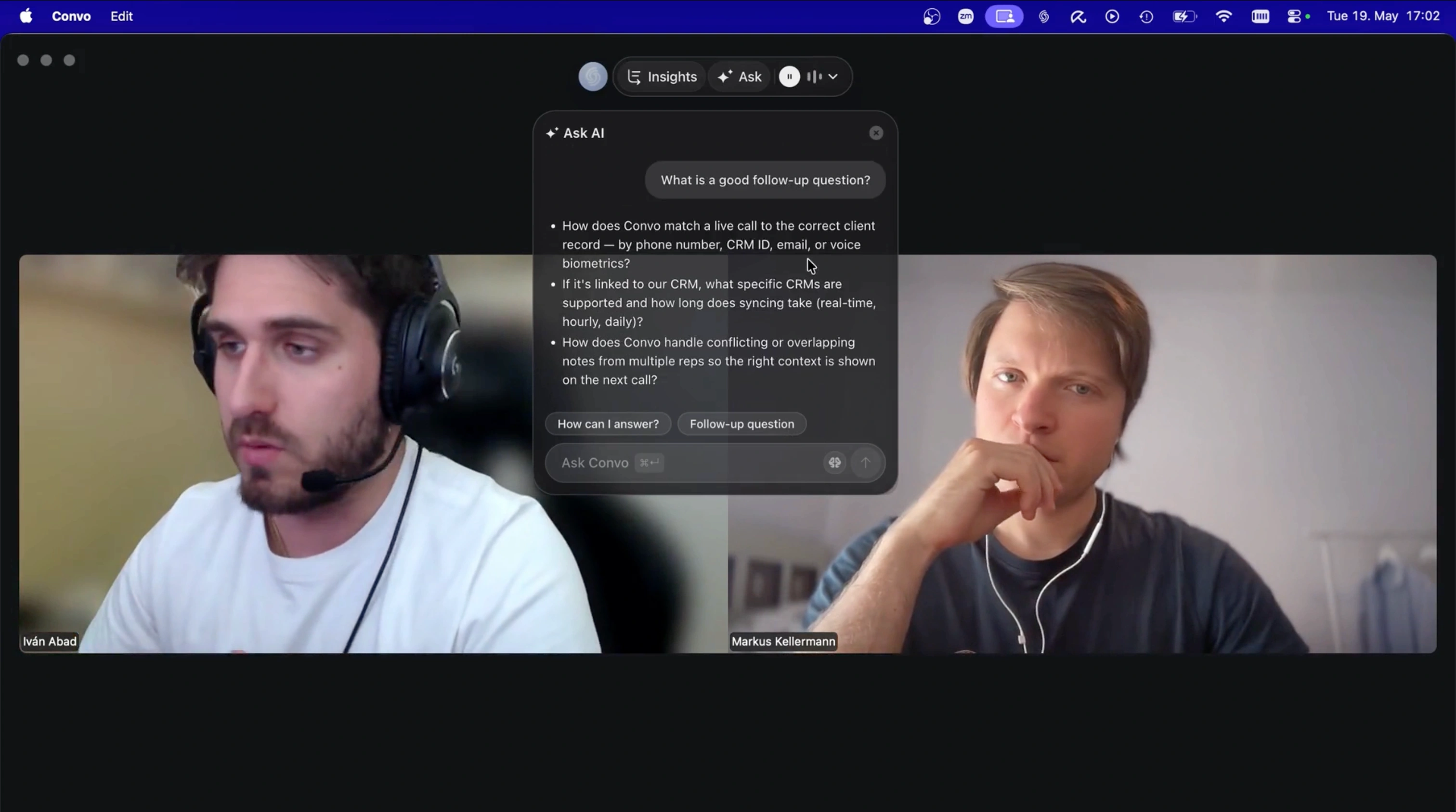
Convo surfaces the response the moment the objection lands, based on what is actually being said on the call.
Play 4. Keep the whole buying committee warm
Almost no B2B deal is one person anymore. Gartner puts the typical buying group for a complex purchase at six to ten people, each with their own worry and each able to quietly kill the deal. Deals rarely die on the call itself. They die with the stakeholder you never met, or the one who went silent three weeks ago.
Tracking this is boring, precise work, which is exactly what software is good at. AI keeps a live picture of who is in the deal, what each of them said they cared about, and who has gone quiet, then nudges you before a thread goes cold. You stop running the whole deal through one friendly champion and start managing the room, which is what gets a deal through procurement and legal in one piece.
Play 5. Never end a call without a next step
If you take one number from this guide, take this one. Missing the next-step conversation drops close rates by 71% (Gong, 42,945 calls). That does not mean a soft "I will follow up." I mean a specific, calendar-bookable next action that both sides agree to before the call ends. Of all the sales closing techniques in the data, it is the most predictive, and the easiest one to forget when a call runs long.
The follow-up matters just as much, because a deal cools quickly once the call is over. If a call is winding down without a next step, Convo reminds you before you say goodbye. Afterwards it drafts the follow-up email from what was actually discussed, so sending it takes about 30 seconds instead of sitting in your drafts until Thursday. And where you can, book the next meeting while you are still on the call. In my experience, "let me send you some times" is where deals go quiet.
See it on your next call
Every play in this guide is something Convo does for you during the call. The answer to the objection, the account's full history, the next-step reminder so the deals that turn on one moment go your way. See how sales teams use Convo.
Here is the whole loop running live on a single call, with the response surfacing while the prospect is still talking.
The Manager's Side: Winning Across the Whole Team
Everything above helps one rep win one deal. The bigger shift is what AI does for the manager.
Coaching is the highest-impact thing a sales manager can do, and it is usually the first thing that falls off the calendar. A manager with eight reps cannot sit in on more than a handful of the team's calls each week. So coaching goes to the deals that are already in trouble, while the rep who never asks about budget, or the one who talks 80% of every discovery call, goes unnoticed for months.
Software does not have that constraint. It can look at every call the team runs and surface what a human would miss, from per-rep talk ratios to the objections that keep costing deals to the places where discovery runs thin. The manager stops coaching from memory and the few calls they manage to join, and starts coaching from what actually happened on every call. Coaching that used to reach your top two reps now reaches all eight.
> Live help wins the deal in front of one rep. The team layer wins the calls you never sat in on.
This is also the layer that separates a team tool from a personal productivity gadget, which matters if you are buying for more than yourself. For the broader picture of how this fits a leader's stack, the chief sales officer's tool framework and the best sales coaching software guide both go deeper.
Real-Time vs Post-Call: Why Timing Decides the Win
Real-time help does not win every scenario, and pretending it does would make this a sales pitch instead of a guide.
Post-call platforms like Gong, Chorus, and Clari are genuinely excellent at what they were built for, which is deep after-the-fact analytics, deal-risk scoring across a big pipeline, and forecasting for a RevOps team. If you are a 200-plus-rep enterprise with a dedicated revenue operations team and a six-figure tooling budget, that depth is real and worth paying for. The revenue intelligence layer they provide is a different job from winning the individual call.
The catch is timing and cost. Their help arrives 24 to 72 hours after the conversation, and the price sits at $1,200 to $1,600 per user per year with a multi-month rollout, in line with what Gong buyers report paying. For the vast majority of teams, under 200 reps and still building the motion, that is enterprise money for coaching that arrives after the deal is already decided.
| Post-call analytics (Gong, Chorus, Clari) | Real-time help (Convo) | |
|---|---|---|
| When the help arrives | 24 to 72 hours after the call | During the call |
| Which deal it changes | The next one | The one you are on |
| Manager coaching | A sample, reviewed after the fact | A cue that fires live on every call |
| Bot in the meeting | Yes, announced to the prospect | No, audio captured locally |
| Effective price | $1,200 to $1,600 per user per year | $22.49 to $52.49 per user per month |
| Deployment | Weeks to months | Same day, next call |
| Best for | 200+ reps, deep forecasting | 5 to 200 reps, winning in the moment |
| Tool | Built for | What it does live | Starting price |
|---|---|---|---|
| Convo | Teams whose deals turn on the conversation | Objection answers from your own docs, memory across calls, must-ask nudges | $22.49/user/mo |
| Aircover | Enterprise, multi-stakeholder deals | Virtual sales engineer, competitive intel, deal history | Custom |
| Attention | Teams that live in the CRM | Battlecards plus automatic CRM autofill | Custom |
| Balto | High-volume phone and contact centers | Objection prompts, compliance, manager whisper | Custom |
| Dialpad Sell | Mid-market on a unified phone system | Live coach cards, real-time sentiment | $49 to $110/user/mo |
| Trellus | High-volume SDR teams on a budget | In-call prompts, talk-ratio alerts, works with your dialer | $59.99/user/mo |
What AI Still Will Not Do for You
Some things in selling do not change with AI. Your rep still leads the conversation, earns the buyer's trust, and asks for the deal. A tool makes each of those easier to do well, but it does not do them.
The biggest deals still turn on things no model touches. In-person meetings still convert at roughly three times the rate of virtual ones, 45% against 15%, which is why the rep who flies out to sit across the table still tends to win the account (SaaStr). Genuine curiosity, the patience to earn a cautious buyer's trust over months, reading the politics inside an account. None of that comes from a screen.
There is also a skill gap most teams underestimate. Handing a rep an AI tool does not make them good with it, any more than handing them a CRM made them organized. The teams getting the 30% train on it, watch the numbers, and keep tightening the plays.
How to Start Winning More Deals With AI Without Blowing Up Your Stack
You do not need a transformation program. You need one motion, one team, and a short feedback loop. Here is the rollout I would run.
- Pick the team where the ROI is most visible. Almost always the AEs running live sales calls, because win rate is measurable and the moments are frequent.
- Start with real-time help on the live call. Skip the extra dashboard for now. The fastest lever is help that changes the conversation you are in, so put it where the deals are decided first.
- Write your three most important cues. Your best answer to your most common objection, your most-lost competitor, and the next-step reminder. Save them as cues so they fire live.
- Watch talk ratios for two weeks. Do not coach yet. Let the team see their own live talk-to-listen numbers and self-correct. Most of the early gain comes from reps simply seeing the number.
- Add the manager layer. Once reps trust the live help, turn on the team view so coaching reaches every call rather than the few you can sit in on.
- Judge it on win rate. Compare competitive-deal win rate and next-step booking rate before and after. Those two move first.
The reason to start with real-time rather than post-call is momentum. Something that helps on the very next call earns adoption in a day. A weekly report that gets reviewed on Fridays, if it gets reviewed at all, takes months to turn into a habit. Convo deploys same-day, runs locally with no bot in the meeting, and works on the next conversation, which is exactly what you want when you need to see the impact on your numbers fast. When you are ready to compare plans, the pricing page lays out Starter and Professional.
Common Mistakes When Adding AI to Sales
Buying more pipeline when the leak is in the conversation. Adding lead volume to a team that keeps losing the live conversation just multiplies the deals you lose. If your win rate is the problem, more contact data will not fix it. The fix is help inside the conversation itself.
Optimizing for the depth of the insight over the timing of it. A more sophisticated post-call report that lands two days late loses to a good-enough prompt that lands on the call. Timing is the variable that decides whether an insight changes a deal.
Treating AI as a rep replacement instead of a rep amplifier. The research is clear that the hybrid setup, human judgment plus AI holding the context, outperforms full autonomy. The rep runs the call, and the tool carries what they cannot hold in their head at once.
Rolling out a dashboard and calling it coaching. Analytics nobody acts on changes nothing. The value shows up when an insight becomes a live cue that changes behavior on the next call, not when the chart gets nicer.
The Bottom Line
Most of what is sold as sales AI will explain, in detail, why you lost a deal. Before you buy anything, ask one question. Can it help your rep while the prospect is still talking? If not, it will not change the deals you are working on right now.
Start small. One team, real-time help on their live calls, your three best cues, and a look at the win rate after a quarter. That is the approach behind the 30% lift Bain measured, and it does not require touching the rest of your stack.
I built Convo because I needed a better answer at minute 34 and got it three days later. If deals are dying like that on your team, try Convo and put the answers on screen while the prospect is still there.
Frequently Asked Questions
How does AI help you win more deals? AI helps you win more deals by moving from analysis after the call to help during it. In 2026 the biggest lever is real-time conversation intelligence. The right objection response shows up on screen the moment a prospect pushes back, buying signals like budget and timeline get caught as they are said, a live talk-to-listen ratio keeps reps from over-talking, and a prompt reminds you to agree on the next step before the call ends. Gong's research across 7.1 million opportunities found AI-driven sales teams generate 77% more revenue per rep. Tools like Convo deliver that help live, so the correction lands while the deal can still be won.
What is the difference between real-time and post-call sales AI? Post-call AI (Gong, Chorus, Clari) records the conversation, analyzes it, and hands the rep a report 24 to 72 hours later. It is strong at deal scoring and forecasting for large pipelines. Real-time AI (Convo) runs the same analysis during the call and surfaces help while the prospect is still talking. The two differ in which deal they change. Post-call tools improve your next deal, and real-time tools improve the one you are on right now. For most teams under 200 reps, the real-time layer moves win rate faster and costs a fraction of the enterprise price.
Does winning more deals with AI require replacing my reps? No, and the data argues against it. Hybrid setups where a human rep keeps judgment and AI holds the context outperform fully autonomous approaches. The point of AI in the live call is to carry the three things a rep cannot track at once, talk ratio, buying signals, and the right response, so the rep can focus on the buyer. It amplifies a good seller rather than replacing one.
How much does real-time sales AI cost compared to Gong? Enterprise post-call platforms like Gong run $1,200 to $1,600 per user per year plus a platform fee and a multi-month rollout. Real-time conversation intelligence like Convo starts at $22.49 per user per month, with Professional at $52.49 for the full real-time sales coaching layer, both published, with same-day deployment. A 50-rep team runs Convo for roughly $31,500 a year against $130,000 or more for an equivalent Gong deployment. See Convo vs Gong for the full breakdown.
What sales metrics does AI actually improve? The ones that move first are competitive-deal win rate and next-step booking rate, because both depend on in-the-moment behavior AI can support directly. Missing the next step alone drops close rates by 71% (Gong, 42,945 calls). Over a longer horizon, AI-driven teams show 77% more revenue per rep (Gong Labs). Talk-to-listen ratio and discovery quality improve early too, since reps can see and correct them live rather than in a review.
Can small sales teams win more deals with AI, or is it only for enterprises? Small and mid-sized teams often see the fastest gains, because they lack the manager bandwidth to coach every call manually and cannot justify enterprise post-call pricing. Real-time help gives a five-person team the same in-call support an enterprise pays six figures for, deployed the same day. The manager layer then lets a single head of sales coach every rep's calls without sitting in on them. For the stack details at any team size, see the B2B sales intelligence guide.
Does AI actually improve win rates? It can, but not on its own. Bain found AI can lift win rates by more than 30%, and the teams that get there redesign how they sell around it instead of bolting it onto old habits. The counterweight is a 2025 Forbes survey where fewer than 1% of executives saw a serious return on their AI spend at all. The gap between those two numbers has little to do with the tool and everything to do with whether you change the moment where deals are actually decided, the live call.
Which real-time AI sales tool should I choose? Pick by the call you actually run. Aircover suits enterprise teams with long, multi-stakeholder deals. Attention fits teams that want battlecards wired straight into the CRM. Balto and Trellus are built for high-volume phone teams. Dialpad Sell makes sense if you want coaching inside a unified phone system. Convo is built for B2B teams whose deals are decided in the meeting itself, with objection answers drawn from your own documents and memory of every past conversation. For the post-call heavyweights, see Convo vs Gong.
Markus is the founder of Convo, building an AI meeting assistant that automates everything after the call. Years of experience building AI products. Believes technology should help people in the moment, not just analyze the past.
Ready to transform your meetings?
Join professionals using Convo to feel confident in every conversation.
Get StartedCONTINUE READING