

Markus Kellermann Founder & CEO
5 Sales Coaching Techniques That Turn Feedback Into Closed Deals
Markus Kellermann Founder & CEO
Most coaching one-on-ones are just deal reviews. Here are 5 sales coaching techniques that change how reps sell: skill vs will, GROW, talk ratio, and more.
TL;DR: Sales Coaching Techniques That Actually Change Behavior
- Most sales coaching fails before anyone picks a technique, because it isn't coaching. It's a deal review, a training, or a pep talk wearing a coaching badge. Only one of the four "modes" a manager runs in a 1:1 actually makes a rep better at selling.
- The techniques that work, in order, are diagnose skill vs will, run GROW (ask, don't tell), coach the talk-to-listen ratio, drill objections in role-play, and anchor every note to a verbatim moment.
- The biggest lever isn't the technique, it's timing. Reps coached weekly beat reps coached quarterly, and feedback that lands on the call beats a perfect note delivered three days later.
- Convo is the tool I built for that last part. It tracks the ratio live, pins each note to the exact second, and fires the lesson back as a nudge on the next call. The full tool comparison is in our sales coaching software guide.
Most Sales Coaching Isn't Actually Coaching
Next time you sit in a "coaching" 1:1 watch how fast it turns into a conversation about a specific deal. It's rarely more than a minute. After that, the whole conversation is about the opportunity, where it's stuck, what happens next, whether it lands this quarter. And that's a perfectly useful conversation to have. It just isn't coaching, and treating a deal review like coaching might be the most expensive habit in sales management.
I care about this more than is reasonable, because for two years I did every sales call at Convo myself, and I was hopeless at coaching the only rep I had, me. I'd finish a call certain it went well, lose the deal, rewatch the recording, and find I'd talked 82% of the time over a prospect who was trying to tell me their actual concern. That gap, between how the call felt and how it went, is the reason Convo exists. It's also the gap every technique in this guide is trying to close.
Here's the reframe that made it click, from My Sales Coach. Managers aren't bad coaches, they're in the wrong mode. In any one-on-one you're doing one of four things, and three of them quietly impersonate the fourth.
| Mode | What it sounds like | What it actually does |
|---|---|---|
| Deal review | "Where's the Acme deal? What's the next step?" | Updates the forecast. Develops nobody. |
| Training | "Here's how a discovery call should go." | Teaches a skill from scratch. |
| Managing | "You're at 60% of quota, pick it up." | Sets expectations. Changes no behavior. |
| Coaching | "What happened on that call, and what would you have done differently?" | The only one that makes the rep better at selling. |
Want the short answer?
The technique matters less than when the feedback lands. Convo's AI sales coach delivers it during the call itself, flagging the moment and suggesting the better line while the conversation is still happening.
The 5 Sales Coaching Techniques That Actually Work
Five techniques, in the order I'd teach a new sales manager. The first two are how you run the conversation. The last three are what you actually coach.
1. Diagnose skill vs will before you fix anything
A rep misses quota and the instinct is to teach. Half the time that's the wrong move, and you can't know which half until you answer one question. Is this a skill gap or a will gap?
A skill gap is a rep who doesn't know the move. Weak discovery, fumbled objections, no structure to the call. A will gap is a rep who knows the move and isn't making it, usually motivation, confidence, or something happening off the field. They look identical on the leaderboard and need opposite responses.
| Skill | Will | What that rep needs |
|---|---|---|
| High | High | Get out of the way. Harder accounts, let them coach others. |
| Low | High | Pure skill work. They want it. Teach the move, then drill it. |
| High | Low | A real conversation about what changed, not another training. |
| Low | Low | Clear expectations and a short runway. That's a management call. |
2. Ask, don't tell (run GROW, and check WAIT)
The fastest way to waste a session is to be helpful. A rep describes a stalled deal and ten seconds in you're telling them what you'd do. It feels generous and teaches almost nothing, because people execute their own conclusions far harder than they execute yours.
GROW is the old reliable for forcing yourself to ask. Four questions:
| Step | The question | The point |
|---|---|---|
| Goal | "What's the one thing we're fixing today?" | One focus, not ten |
| Reality | "What actually happened on that call?" | The real version, not the highlight reel |
| Options | "What could you have done differently?" | The rep generates these, before you offer any |
| Way forward | "What will you do on the next call?" | A specific action, in their words |
What goes wrong: A rep leaves unable to say, in their own words, what they learned and what they'll change. If they can't repeat it back, you talked too much and nothing changes on the next call.
3. Coach the talk-to-listen ratio
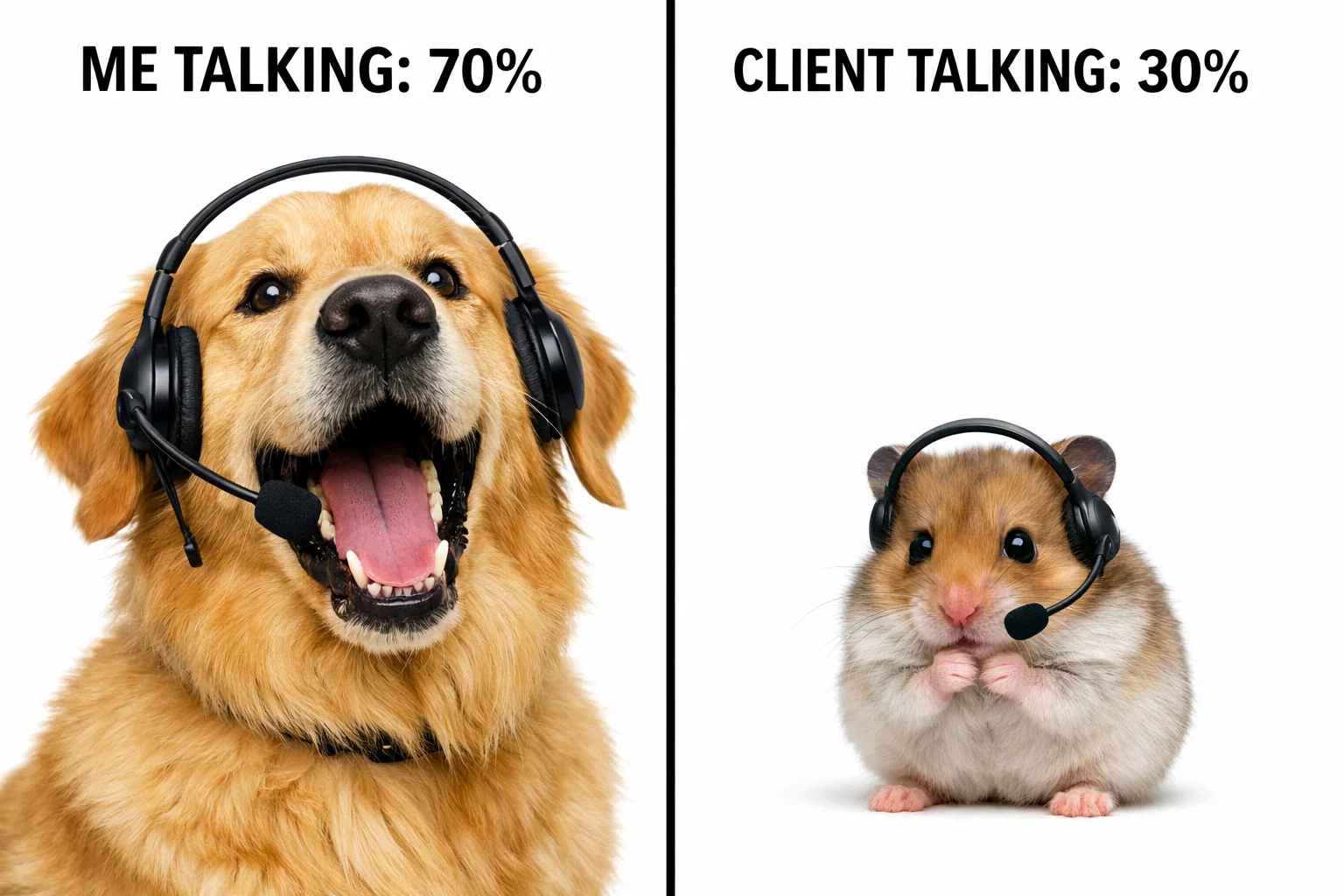
If you coach one number, coach this one. It's the most predictive metric in a sales conversation and the only one that ends the argument before it starts. "You talked too much" is your opinion. "You talked 82% of that call" is a fact, and facts don't get defensive.
| Call type | Rep should be talking | Why |
|---|---|---|
| Discovery | ~30% | You're there to learn, not pitch |
| Demo | ~50% | A conversation, not a monologue |
| Closing | 40-60% | You steer the decision, they still need room |
4. Drill objections in role-play, don't lecture them
Reps don't freeze on objections because they lack the answer. They freeze because they've never said it out loud under pressure, the way a tennis player drills a serve until breakpoint feels like Tuesday. Role-play is the only thing that fixes it, and everyone avoids it because it feels awkward.
The format that works: pick the three objections your team actually hears ("it's too expensive," "we already use X," "now's not the time"). Ten minutes a week, one rep plays the prospect, one runs the response, then swap. The full method is in how to handle objections in sales, and the part where you actually ask for the deal is in sales closing techniques.
What goes wrong: flagging that an objection happened instead of drilling the response. Knowing a rep fumbled the price question on Tuesday does nothing. Rehearsing the comeback until it's a reflex does everything.
5. Anchor every note to a verbatim moment
This is the technique that separates feedback reps act on from feedback they nod at and forget. "Be more concise" is noise. "At 4:30 you talked over them while they were raising a concern, here's the line I'd have used" is something a rep can actually fix.
Never give a growth note without the exact moment behind it and a better line to try. And cap it. Two or three notes per call, not fifteen, or the rep drowns and changes nothing. Doing that consistently across a whole team is exactly where a tool earns its place, which brings me to the honest part.
How Convo Helps You Coach
We built Convo around how you can perform better in sales and customer success. It does the two things a manager never has time for. It watches every call objectively and it takes lessons into the next one.
Every call comes back scored by Convo's conversation intelligence on the things you'd actually coach like clarity, listening, decision-making, and the talk-to-listen ratio, taken from what really happened rather than how the rep remembers it. That settles most of the argument before it starts. The real work, though, happens in the Feedback tab. A growth note isn't "be more consultative." It's the rep's own words quoted back to them ("you talked over them at 4:30") with a green "try saying X instead" line underneath, capped at the three that matter so nobody walks out holding a list they can't keep in their head.
Then there's the loop, which is the part I care about most. Hover any of those moments, hit Save as Cue, and Convo stores it as a trigger and a line to say. The next time that same situation comes up on a live call, the cue fires on the rep's screen in the moment to remind them of not makign the same mistake again. The feedback you gave on Tuesday shows up as help on Thursday, which is the whole gap between a note a rep nods at and one that actually changes the next call.
And the rep isn't only relying on you. That same real-time layer surfaces a suggested response when a prospect pushes back on price or goes quiet, so the obvious mistakes get caught while the call is still live.
What a Coaching Session Actually Looks Like
Theory is cheap, so here's the whole thing run on one rep. Take Devon, three months in, losing deals at the demo.
Diagnose first. His talk ratio sits near 70% on every demo and his discovery notes are thin, but he knows the product cold. That's a skill gap on discovery, not a motivation problem, so this is a coaching conversation, not a pep talk.
Ask, don't tell. Instead of "you talk too much," I ask what he thought happened on the Acme demo. He says it felt rushed. I ask what he'd do differently next time. He gets there on his own, ask more before he pitches. That's the goal for the week, in his words, not mine.
Anchor it to a moment. We pull up 4:30 on the recording, where he talked over the buyer asking about integration. He hears himself do it. I give him one line to use instead, "tell me more about that," and we stop there. One thing to fix, not ten.
Make it stick. That line gets saved as a cue. On his next demo, the moment a buyer trails off mid-sentence, the cue fires on his screen and he catches himself. The session took nine minutes and changed the next call, not next quarter.
Notice what didn't happen. Nobody once asked where the Acme deal was. That's the whole difference between coaching and a deal review.
The Numbers Behind Sales Coaching
A few data points worth keeping in view as you decide where to spend your coaching time. Each is sourced to its original research.
| Metric | Impact | Source |
|---|---|---|
| Team performance lift from sales coaching | ~8% | Gartner, via ZoomInfo |
| Win-rate lift from real-time, AI-guided coaching | +36% | Highspot GTM Performance Gap Report |
| Reps who valued their coaching and want more of it | 81% | Salesforce, via ZoomInfo |
| Higher win rates at firms with dynamic coaching programs | +28% | Zendesk / CSO Insights |
Post-Call Coaching vs Real-Time Coaching
Every technique above assumes the feedback reaches the rep while it still counts, and this is where most coaching quietly dies. There are two ways to deliver it, and they are not the same thing.
Post-call coaching is the standard. The call happens, someone reviews the recording later, and the feedback lands in next week's one-on-one. It's genuinely good for spotting patterns across a stack of calls. The problem is timing. By the time the note arrives, the rep has had four more conversations and barely remembers the one you mean. You're coaching a ghost.
Real-time coaching delivers the nudge while the call is still live. The talk ratio is on screen as it climbs. The objection response shows up the second price comes up. The rep fixes it in the conversation instead of hearing about it three days later.
| Post-call coaching | Real-time coaching | |
|---|---|---|
| When the feedback lands | Days later, in the 1:1 | During the call, in the moment |
| What it's best at | Spotting trends across calls | Changing the call that's happening |
| What the rep does with it | Tries to remember next time | Fixes it on the next sentence |
| The catch | The moment's already gone | Only as good as the prompt |
The Tools That Make Coaching Stick
You can run every technique above with a notebook and real discipline. Most teams can't, because a busy quarter eats the discipline first. Here's the honest tier breakdown of what helps, and where each fits.
Enterprise post-call analytics. Gong and Chorus are the default for large orgs at roughly $1,300 to $1,600 per user per year. Excellent at reviewing calls after the fact and spotting trends across a big team. Built for the post-call scorecard, not the live moment.
Mid-market recording and review. Fireflies, Otter, and Avoma cover recording, transcription, and basic analytics from $10 to $39 per user per month. Fine if your bottleneck is documentation. Lighter on actual coaching.
Real-time coaching. Convo is the approach I took, coaching during the call rather than after it, from $22.49 per user per month with no bot in the meeting. The full comparison, with prices and where each tool breaks, is in our best sales coaching software guide.
How to Coach Hard Without Turning Into a Cop
Real call data makes coaching specific. It also makes it easy to build a surveillance culture by accident. Four rules keep it on the right side.
Put your own numbers up first. Before you ask anyone to look at their talk ratio, show yours. The day I told the team I'd talked 82% of a call I was sure I'd nailed, the whole thing relaxed. We were getting better together, not catching each other out.
Coach patterns, not single calls. One bad call is noise. A rep who talks 80% across twenty calls is a pattern. Coach the pattern, or every session feels like an ambush.
Let reps coach themselves. The fastest improvement I've seen comes from reps reviewing their own calls with no manager in the room. Give them the dashboard; most people fix themselves the moment they can see the data.
Never let it into a performance review. The day coaching data becomes evidence against someone, the trust is gone for good. It's the same reason Convo captures audio locally with no bot. Coaching should feel like a mirror, not a camera.
How to Tell If Your Coaching Is Working
Most teams run coaching on faith and never check whether it moves anything. It's measurable like everything else, you just have to watch the right numbers over weeks, not judge it off a single session.
Four worth tracking:
| What to watch | What good looks like | What it tells you |
|---|---|---|
| Talk-to-listen ratio over time | Trending toward target per call type | The earliest sign coaching is landing |
| New-hire ramp time | Shrinking quarter over quarter | Coaching's clearest financial payoff |
| Win rate, before vs after | Up for the reps you've focused on | Ties coaching to revenue, not activity |
| Cues that actually fire | Reps acting on them on live calls | Proof the lesson reached the next call |
The Bottom Line
The techniques are real and they matter, but they're downstream of two things most teams skip, running an actual coaching conversation instead of a deal review, and getting the feedback to the rep while the moment is still warm.
If you change one thing this week, make it the talk-to-listen ratio. Pull your team's last ten calls, look at the number, and show each rep their own. It'll start more useful conversations than a quarter of one-on-ones.
And if you want that feedback to land on the call instead of three days late, that's what I built Convo to do. It's our take on the AI sales assistant, built for the live conversation rather than the post-mortem. Because the best time to fix a sales call is while it's still happening.
Frequently Asked Questions
What are the most effective sales coaching techniques? The techniques that change behavior are specific, timely, and based on real conversations instead of memory. The highest-leverage ones are diagnosing skill versus will before you coach, asking questions with a structure like GROW rather than handing over answers, coaching the talk-to-listen ratio, and drilling the handful of objections your team actually hears. The common thread is delivery. Get the rep to their own conclusion, close to the moment it matters.
What is the GROW model in sales coaching? GROW is a four-step question structure covering Goal (the one thing you're improving today), Reality (what actually happened on the call), Options (what the rep could do differently, generated by them), and Way forward (the specific action they'll take next). It works because it forces the manager to ask instead of tell, and reps execute their own conclusions far more reliably than advice handed to them.
What's the difference between sales coaching and a pipeline review? A pipeline review asks what is happening to the deal, where it is, the next step, whether it closes this quarter. Coaching asks why the rep got that result and what they'll do differently on the next call. Both are useful, but they're different meetings. The most common coaching mistake is running a pipeline review and calling it coaching, then wondering why selling never improves.
How do you coach a sales team that works remotely? Build the coaching on captured calls instead of presence. A remote manager can't overhear calls from across the office, so record and review real conversations, coach patterns rather than one-offs, let reps see their own data, and deliver feedback as close to the call as possible. Done this way, remote coaching is as effective as in-person, sometimes more, because the evidence is objective instead of remembered.
Can reps coach themselves, or do you need a manager? Both work, and self-coaching is often the most valuable. Reps who can see their own talk ratio, question count, and objection moments improve faster than reps who only get feedback in a 1:1. Give people access to their own data and most self-correct once they see the numbers. The manager's job shifts from catching mistakes to spotting patterns and clearing blockers.
Do I need software to coach sales reps well? No, but it makes the techniques survive a busy quarter. You can track talk ratio and flag moments by hand, but it rarely lasts. Sales coaching software measures the ratio, surfaces the verbatim moment, and delivers feedback while the behavior is still fresh. Real-time tools like Convo go further and coach during the call instead of after it.
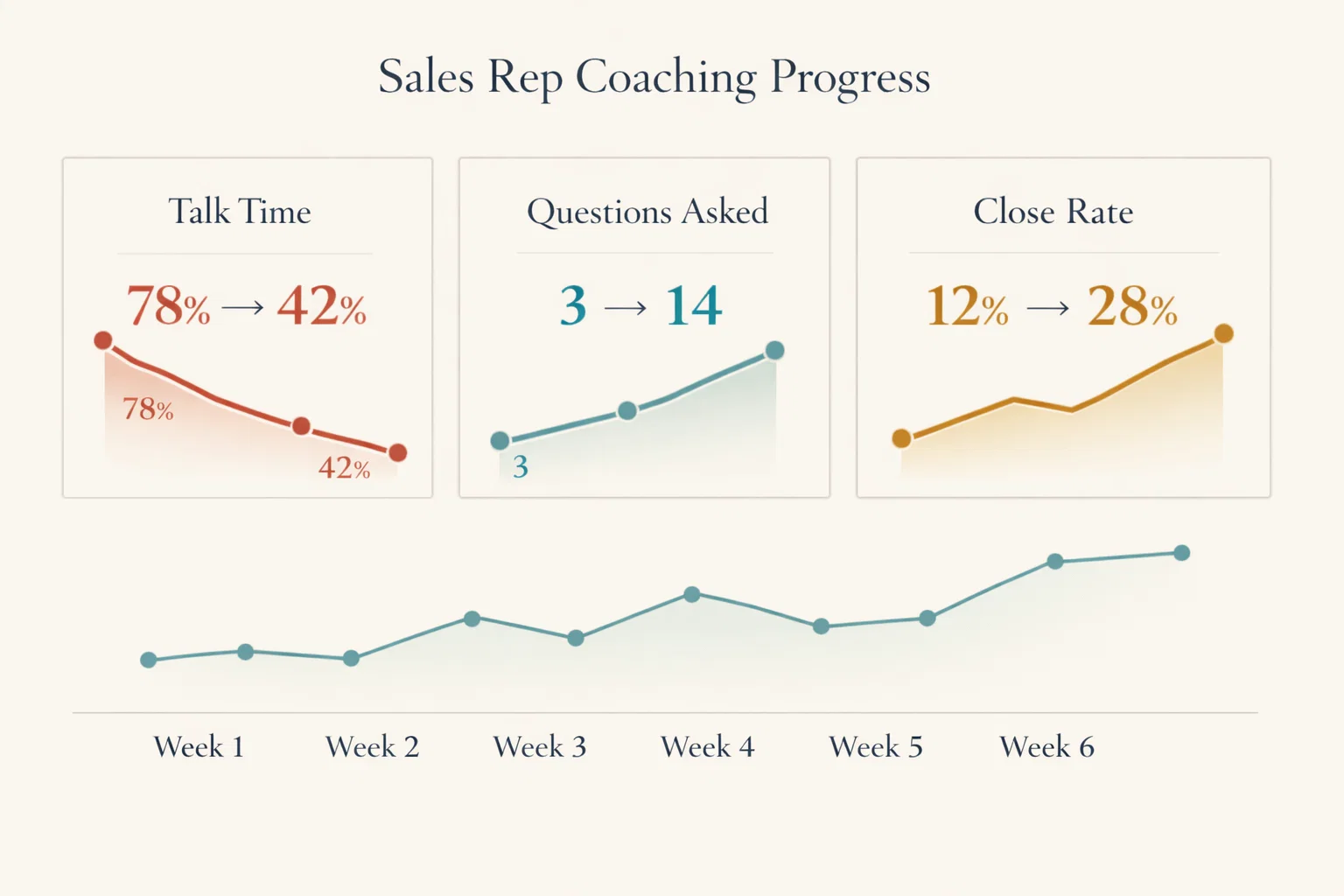
How long do sales coaching techniques take to work? Most teams see behavioral change within two to three weeks, because awareness alone drives a lot of it. Reps who see their talk-time data for the first time usually adjust on the very next call. Deeper improvements in discovery, objection handling, and close rates tend to show up over six to eight weeks of consistent, weekly coaching.
Markus is the founder of Convo, building an AI meeting assistant that automates everything after the call. Years of experience building AI products. Believes technology should help people in the moment, not just analyze the past.
Ready to transform your meetings?
Join professionals using Convo to feel confident in every conversation.
Get StartedCONTINUE READING