

Iván Abad Founder & COO
The Best Sales Closing Techniques in 2026: 12 for B2B SaaS
Iván Abad Founder & COO
Closing techniques don't decide B2B SaaS deals. Discovery does. 12 closing techniques mapped to MEDDICC, Challenger Sale, Sandler, SPICED, and consultative selling.
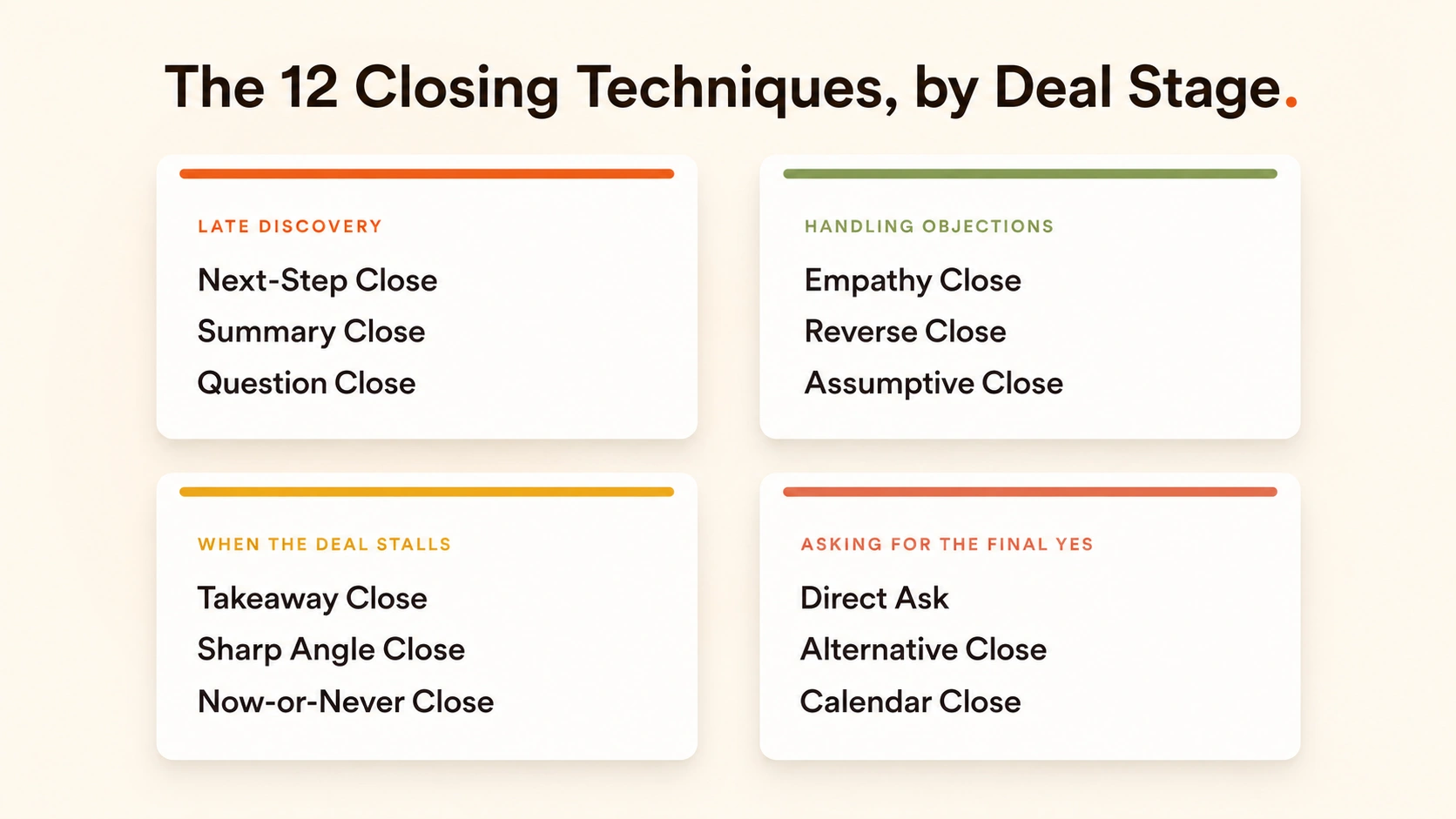
TL;DR: The Best Sales Closing Techniques in 2026
- The best sales closing techniques work because they fit specific moments in the deal. 12 of them, organized by deal stage across late discovery, handling objections, and asking for the final yes.
- The single most important is the Next-Step Close. Secure a specific, calendar-bookable next action before every call ends. Missing it drops close rates by 71% (Gong, 42,945 calls).
- Each technique mapped to the methodology you already use, whether Challenger Sale, Sandler (Up-Front Contracts), MEDDICC, MEDDPICC, SPICED, SPIN selling, and consultative selling.
- Closing techniques alone don't decide B2B SaaS deals. Discovery does. Best closers do both.
Most Closing Techniques Articles Get the Premise Wrong
A couple years back I was losing deals and I couldn't fully understand exactly why. Prospects would say yes verbally but started to ghost me in the follow-ups. I'd rewatch the call recordings to understand what I did wrong. Those lost deals are the reason Convo exists today; the patterns I missed are what it now surfaces in real time during the call.
When I went back further, to the discovery calls from two or three weeks earlier, the answer was pretty clear. I had asked the wrong discovery questions and walked into the meeting with a prospect who hadn't actually decided they needed to buy. The best reps in B2B SaaS, enterprise sales, and consultative selling don't have better closing lines. They have better discovery, tighter qualification, and an exact next step on the table before every call ends. The full research breakdown is in the Numbers section below.
This post covers 12 closing techniques that work. What to use, when to use it, the script, and what goes wrong. Every technique below has a moment in the meeting where it lands or flops; Convo catches that moment on your screen, with the prompt or the past quote you need, while the prospect is still talking. That is the difference between knowing a technique and actually using it on every call.
Want the short answer?
Convo puts these techniques to work while you're still on the call. The right one surfaces on your screen the moment the conversation needs it. Try it free for 7 days.
What Closing Techniques Are For (and What They Are Not)
A closing technique is a way to ask for the deal. That is it. It is the sentence or two that converts "we like this product" into "we will sign by Friday." It is not a substitute for the value you established earlier, the trust you built with the prospect, or the urgency that came from their actual business problem.
Most of the closing-technique advice on the internet sells you the opposite. It implies that the right phrasing at the right moment will turn a stalled deal into a closed one. The data says otherwise. Closing techniques work when the deal is already won and the prospect needs help saying yes. They do not work when the deal is not actually there.
Here is the framework I would hold in your head as you read the 12 techniques below. Each one fits a specific moment:
- Late discovery (you have done the work, time to set up the close)
- Handling objections (a real concern has surfaced, you need to resolve it without losing the close)
- When the deal stalls (something has gone wrong, you need to reset)
- Asking for the final yes (everything is aligned, you just need to ask)
Pick the technique that fits the moment. Do not try to use the Sharp Angle Close on a discovery call. Do not try the Direct Ask when there is an unresolved objection. The technique is downstream of the situation, not the other way around.
Two sales trends shape closing in 2026. First, buyers complete more of the decision before talking to anyone. 6sense's 2024 Buyer Experience Report puts that figure at around 70% of the B2B buying process. Second, AI-assisted buyer research has compressed the discovery window. Prospects show up on the first call having read your features page, your pricing tiers, and your competitor comparisons on their own. The closing techniques that survive both shifts are the ones that meet the informed buyer where they actually are, which is why Convo surfaces context during the call, not in a review three days later.
What Are the 12 Best Sales Closing Techniques?
1. The Next-Step Close
This is the most important technique in this guide and the one most reps skip. The Next-Step Close means securing an explicit, calendar-bookable next action before the call ends. Not "we will be in touch." Not "I will send you something." A specific time, a specific person, a specific decision.
When to use it: Every single call, late or early stage. Gong's analysis of 42,945 closing calls found that sellers who close fastest discuss next steps 53% more often, and missing the next-step conversation drops close rates by 71%. That single finding is the strongest argument in this guide for treating next steps as a closing technique, not a polite ending.
Script: "Based on what we have talked about, the natural next step is a 30-minute conversation with you and your CFO so we can walk through the procurement timeline. I have Thursday at 2pm or Friday at 10am. Which works?"
What goes wrong: Reps end the call on "let me follow up with materials" or "I will send a proposal." That is a soft exit dressed as a close. The prospect does not have a forcing function on their calendar, the deal slides three weeks, and the urgency that existed during the conversation evaporates. Anchor every call to a calendar event before you hang up. Convo prompts this in real time. If the call is closing without an explicit next step, the suggestion surfaces on screen before you say goodbye.
2. The Direct Ask
The Direct Ask is exactly what it sounds like. After you have covered the value, addressed the concerns, and confirmed alignment, you ask the prospect to buy. No theater. Just the question.
When to use it: When the conversation has covered everything it needs to cover, and the prospect has signaled they are ready. The signals are usually that they have asked about implementation timeline, billing details, or post-purchase support.
Script: "It sounds like we have covered what matters. Are you ready to move forward with the contract?"
What goes wrong: Most reps over-engineer this and surround the ask with so much hedging language that the question gets lost. "I just wanted to ask if maybe you might want to potentially consider..." is not the Direct Ask. The Direct Ask is one sentence. If you cannot say it in one sentence, you are not ready to use this technique yet.
3. The Summary Close
The Summary Close is a consultative recap of everything the prospect agreed they need, mapped to everything your product delivers. You walk the prospect through their own stated requirements and demonstrate, point by point, that the solution fits.
When to use it: Late in the deal cycle when the prospect is leaning toward yes but has not committed. Particularly effective for committee-driven decisions where the prospect needs to repeat the case internally.
Script: "Let me make sure I have heard you correctly. You said the team needs real-time visibility on call quality, a way to reduce ramp time for new hires, and CRM integration that does not require a six-month implementation. We do all three, at $X per seat per month, with same-day setup. Is anything missing from that summary?"
What goes wrong: Reps recite features instead of the prospect's own stated requirements. The Summary Close only works if the requirements are the prospect's words, not yours. If they did not explicitly tell you they needed something, do not put it in the summary. Convo's memory layer surfaces the prospect's exact wording from prior calls, so the summary uses their language rather than yours.
4. The Question Close
The Question Close means ending with a specific question that either surfaces the final objection or extracts the yes. The question forces the prospect to either commit or explain why they cannot.
When to use it: When you suspect there is an unspoken concern. The Question Close is a controlled way to either resolve it or expose it.
Script: "What would need to be true for you to move forward with this today?" or "If we did X, would that get us to a yes?"
What goes wrong: Generic closing questions ("How does that sound?") give the prospect a soft out and surface nothing. The Question Close has to be specific enough that the answer reveals the actual decision-making logic.
5. The Assumptive Close
The Assumptive Close moves the conversation forward as if the prospect has already agreed to buy. You talk about implementation, contract specifics, or rollout plans without pausing for the prospect to formally say yes.
When to use it: When the prospect has signaled strong intent (positive language, asking forward-looking questions) but has not yet said the word "yes." The Assumptive Close gives them permission to skip the formal yes and just proceed.
Script: "Great. So when we get you set up next week, we will start with your top three sales managers so they can drive adoption with their teams. Does that approach work?"
What goes wrong: Used too early, the Assumptive Close reads as manipulative and damages trust. Reps who use it on prospects who have not yet signaled buying intent often lose the deal entirely. This technique requires real read of the situation, not formulaic deployment.
6. The Empathy Close
The Empathy Close acknowledges the prospect's concern out loud, validates it, and then resolves it. The validation is the move. Reps who skip it sound like they are dismissing the concern.
When to use it: When the prospect raises an objection that has emotional weight, not just a logical one. "I am worried this will be too complex for the team" is an emotional objection. "What is the API rate limit?" is a logical one.
Script: "It makes sense that you are worried about adoption. Every sales VP I talk to has the same concern, and you are right that bolted-on tools usually fail. Here is how we are different..." For deeper context on this, see how to handle objections in sales. Convo can surface the exact past quote where the prospect raised the concern, which is what turns generic empathy into something the prospect actually feels.
What goes wrong: Reps fake the empathy and the prospect can hear it. If you do not actually understand why the concern matters to this specific person, do not use the Empathy Close. Use the Question Close instead, ask them more about the concern, then come back.
7. The Reverse Close
The Reverse Close turns an objection into a closing question. Instead of treating the objection as a problem to overcome, you reframe it as the criterion for the close.
When to use it: When a single, specific objection is the only thing standing between you and the deal. The Reverse Close commits the prospect to closing if you can resolve that one concern.
Script: Prospect says, "I am not sure about the implementation timeline." You say, "If we could guarantee you would be live within two weeks, would you be ready to sign?"
What goes wrong: The Reverse Close fails when the stated objection is not the real objection. If the prospect says "I am worried about price" and the real concern is "I do not trust your support team," resolving the price objection will not close the deal. Confirm the objection is real before reversing it.
8. The Alternative Close
The Alternative Close gives the prospect two options that both end in a sale. Instead of asking "do you want to buy?" you ask "do you want option A or option B?" Both options are yeses.
When to use it: Late in the deal when the prospect has accepted the buying decision but is stuck on a minor variable (which plan, which start date, which billing cycle).
Script: "Would you prefer to start with the Professional plan at $52.49 per seat, or the Starter plan at $22.49 if you want to pilot with a small team first?"
What goes wrong: Used as a manipulation tactic to force a decision the prospect has not actually made. If the prospect has not decided to buy, the Alternative Close insults their intelligence and damages the relationship.
9. The Calendar Close
The Calendar Close anchors the close to a specific date or event that creates natural urgency. "Let us get you started so you are live before your Q3 sales kickoff" is a Calendar Close.
When to use it: When the prospect has a real upcoming event (a sales kickoff, a product launch, a board meeting, a budget cycle) that creates natural urgency. The Calendar Close works because the urgency is real, not invented.
Script: "You mentioned your sales kickoff is in six weeks. If we get the contract signed this week, we can have all 50 reps trained and live before the kickoff so they walk in with the new playbook ready."
What goes wrong: Invented urgency. If the prospect does not have a real upcoming event, manufactured Calendar Closes ("our pricing goes up next quarter!") sound desperate and tank trust.
10. The Now-or-Never Close
The Now-or-Never Close uses scarcity or time-limited terms to create urgency. "If you sign today, we will lock in this year's pricing for two years" is a Now-or-Never Close.
When to use it: Sparingly, and only when the term is real. Promotional pricing, last seats in a beta, or a temporary discount you have actually been authorized to offer.
Script: "Our annual pricing increase kicks in on July 1. If we get the contract signed this month, we can lock in 2026 pricing for the full term."
What goes wrong: Fake urgency. Sophisticated buyers can smell a fake Now-or-Never Close from a mile away, and they know that if you offered them an exception, you would offer the same exception next month. Use this technique only when the deadline is genuinely real.
11. The Takeaway Close
The Takeaway Close means strategically withdrawing or de-emphasizing an option to surface real interest. "I am starting to think this might not be the right fit for your team" is a Takeaway Close.
When to use it: When the prospect is in deep deliberation mode and has not committed. The Takeaway forces a reaction. If they immediately defend the choice ("no, no, we really do want this"), you have surfaced their actual commitment. If they shrug, you have saved yourself months of pipeline drag.
Script: "I am hearing some hesitation. Honestly, if this is not a strong fit for what your team needs, we should probably not move forward. I would rather you find the right tool than commit to something that will not work."
What goes wrong: Reps use the Takeaway Close as a manipulation tactic instead of an honest signal. If you do not actually believe the deal might not be right, the prospect will hear the manipulation in your voice. The Takeaway Close only works when you mean it.
12. The Sharp Angle Close
The Sharp Angle Close converts a prospect's request for a concession into a closing condition. The prospect asks for a discount; you ask whether they would sign today if you got the discount approved.
When to use it: When a prospect explicitly asks for a price concession, contract change, or scope addition. The Sharp Angle Close uses their request as the leverage for the close.
Script: Prospect asks, "Can you do 15% off?" You reply, "Let me see what I can do. If I can get that approved, can you sign and start in time for end-of-month?"
What goes wrong: Reps offer the concession without securing the close. Once the prospect knows the concession is available, the leverage is gone. The Sharp Angle Close requires conditioning the concession on the close, not before it.
How These Techniques Fit B2B SaaS Sales Methodologies
The 12 techniques above are methodology-agnostic. They fit whatever framework your team has standardized on. Here is how each maps to the dominant B2B SaaS closing methodologies in 2026.
Consultative selling. The Summary Close and Empathy Close are pure consultative-frame moves. Both anchor to the prospect's own stated requirements and concerns rather than the rep's pitch. The Question Close is the consultative diagnostic — used in this frame, closing techniques are tools that help the prospect reach the buying decision, not tactics for getting them there.
Challenger Sale (CEB / Gartner). Teach, Tailor, Take Control. The Sharp Angle Close and Reverse Close are Challenger-flavored — they take control of the moment without sounding pushy because the rep has earned the right to through earlier teaching. The Direct Ask is the literal "Take Control" close at the end of a Challenger-style conversation.
Sandler. The Up-Front Contract is Sandler's foundational discipline, and it is functionally identical to the Next-Step Close. Securing explicit, mutual agreement on what happens after the call is the Sandler default, and it is also the single most predictive closing behavior in Gong's 42,945-call analysis.
SPIN selling (Huthwaite). Situation, Problem, Implication, Need-Payoff. The Question Close maps to Need-Payoff — it surfaces whether the prospect has actually felt the implication of the problem you've described. If they have not, no closing technique will help and you need to return to Implication questions.
MEDDICC and MEDDPICC. Qualification frameworks, not closing frameworks. But MEDDICC's Decision Process and Identify Pain pillars are what makes the close possible later. The Next-Step Close is how you stay in front of the Decision Process; the Empathy Close is how you address Identified Pain in the moment of the close.
SPICED (Winning by Design). Situation, Pain, Impact, Critical Event, Decision. The Calendar Close maps directly to Critical Event — anchoring the deal to a real upcoming date the prospect already cares about. The Direct Ask plus the Next-Step Close together map to Decision.
Across all six methodologies, the same pattern holds. Closing techniques are not magical phrasings. They are tactical moves that fit the sales process and methodology your team has already chosen. Pick a methodology, train the techniques that fit it, and let the discovery work decide whether the close lands. For the broader picture of how methodologies sit alongside content and training in a modern sales stack, see the sales enablement platforms guide.
The Numbers Behind Closing in 2026
A few data points worth coming back to as you pick which technique fits the moment in front of you. Every stat below is sourced to its primary research with methodology disclosed.
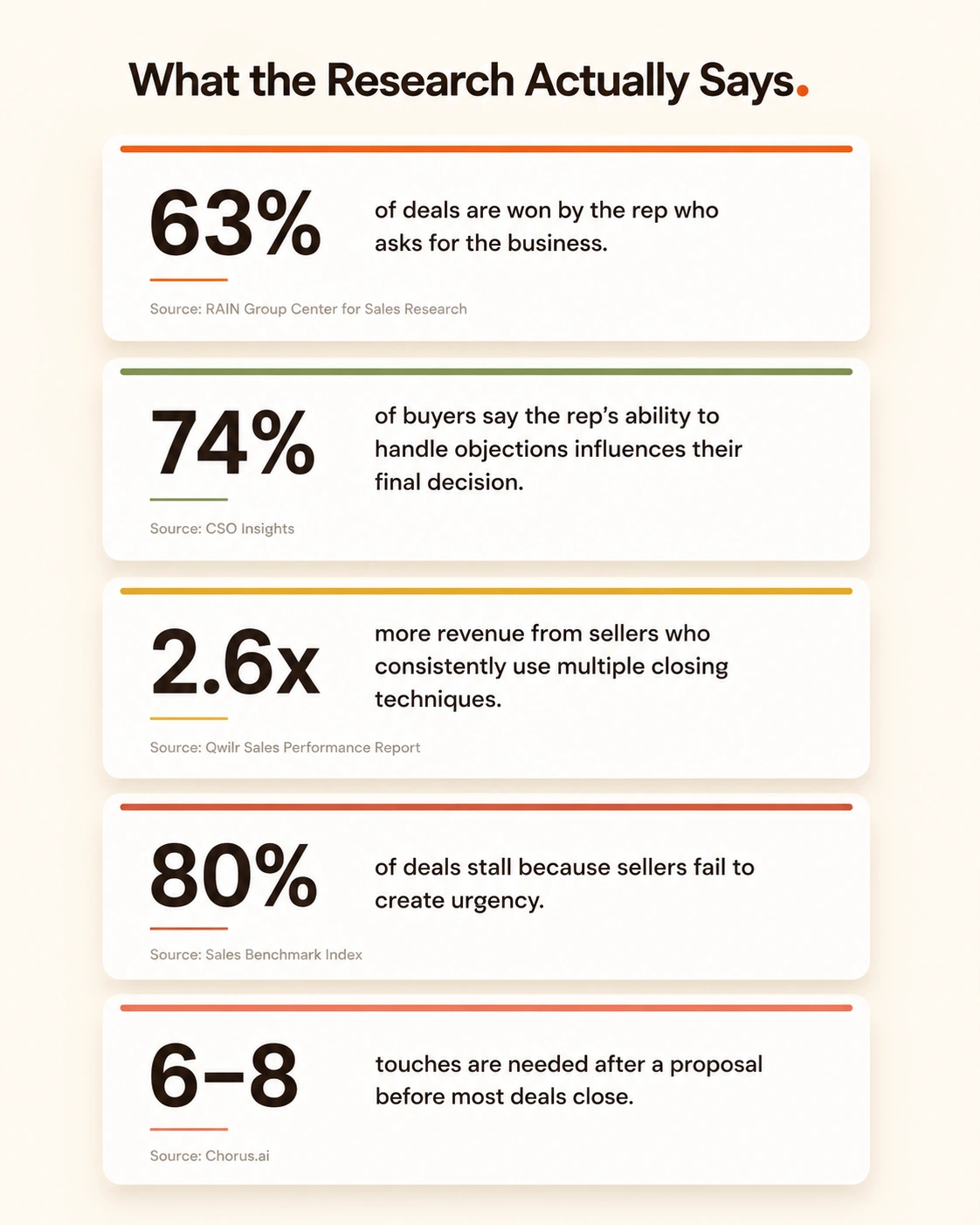
| Metric | Impact | Source |
|---|---|---|
| Win rate at proposal stage, industry average | 47% | RAIN Group, 472 sellers and execs |
| Win rate, Elite Performers (top 7%) | ~75% | RAIN Group |
| Win rate, Top Performers (top 20%) | 62% | RAIN Group |
| Seller/buyer alignment on core problem (won deals) | 45% | Corporate Visions, 600+ B2B buyers |
| Seller/buyer alignment on core problem (lost deals) | 23% | Corporate Visions |
| Deals lost to customer indecision (not competitor, not status quo) | 40-60% | Dixon & McKenna in HBR, 2.5M call analysis |
| Buyer decision completion before engaging sales | 70% | 6sense 2024 Buyer Experience Report |
| Missing next-step discussion (close rate impact) | -71% | Gong, 42,945 closing calls |
| Multi-threading in deals over $50K | +130% win rate | Gong, via HubSpot Sales Trends |
| Sales reps consistently hitting quota | 27% | HubSpot Sales Trends Report |
What Actually Closes Deals in 2026
Three things, in order of impact.
1. Real discovery work. Closing rates correlate strongly with discovery quality. The number of questions you ask, the diversity of stakeholders you involve, and the explicitness of the business problem you have named all show up in the close. A great discovery makes closing easy. A bad discovery makes closing impossible regardless of which technique you use.
2. The next-step conversation. Almost every other data point cited in this guide comes back to this one. Sellers who treat the next step as a closing technique, deployed on every call, have meaningfully higher close rates than reps who treat it as a polite ending. Make the explicit, calendar-bookable next step the goal of every conversation.
3. Real-time context. This is where the modern sales stack matters. When a prospect references something they said three weeks ago in discovery, the rep who has that context at their fingertips closes the deal. The rep who has to "circle back" loses the moment. Convo's real-time AI sales coach was built around this gap. It surfaces past conversation context, suggests the right framework at the right moment, and tracks the conversation patterns that correlate with closed deals in the research cited above. For the broader picture of where these tools sit in the sales stack, see conversation intelligence software, how to win more deals with AI, and the sales call recording software comparison.
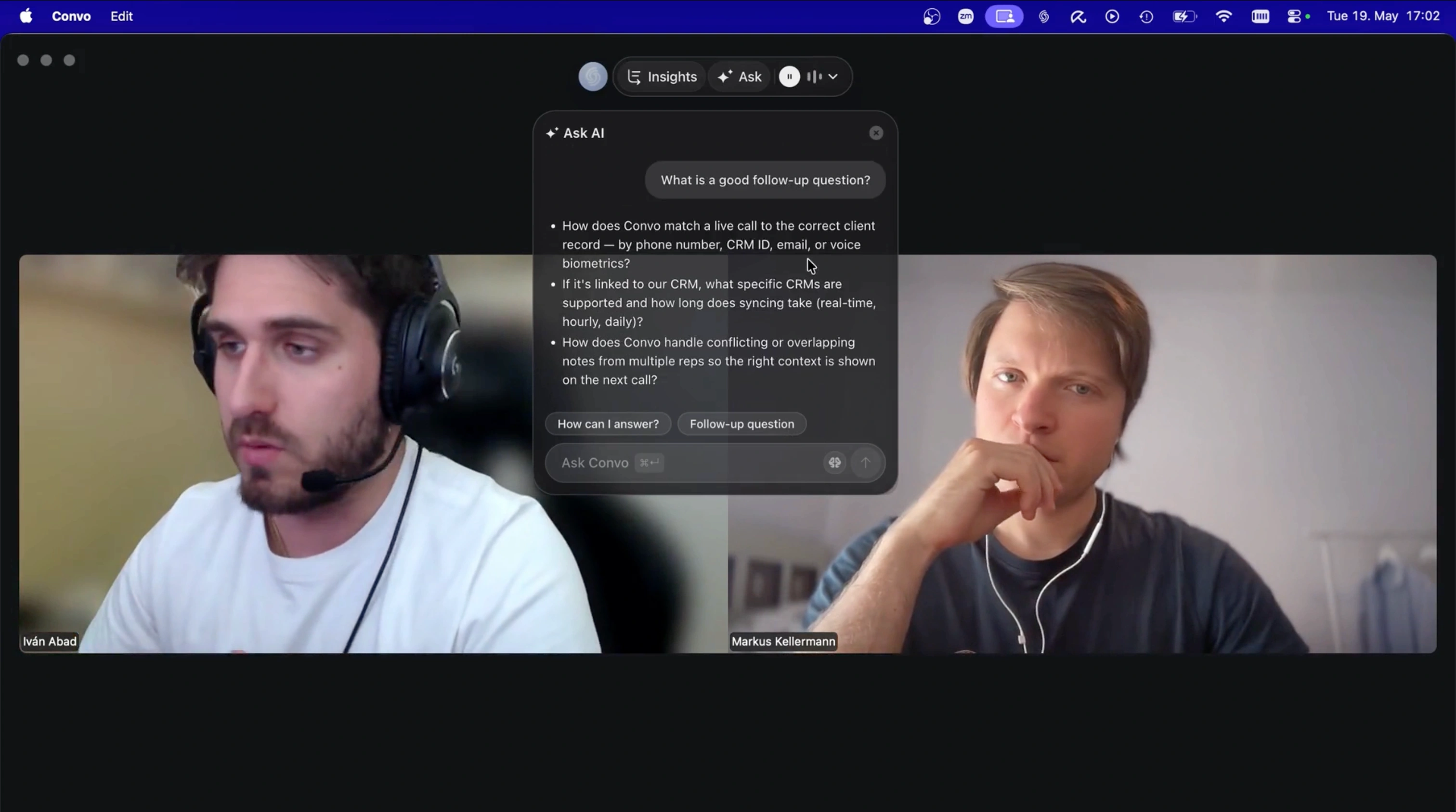
Convo surfaces the right closing technique in the moment, based on what is actually happening in the conversation.
If you want the broader picture on what separates top-performing reps from average ones, the good salesperson vs great salesperson breakdown covers the behavioral differences that show up in the conversation data.
How to Practice Closing Without Losing Real Deals
Closing is a skill you build in low-stakes situations and deploy in high-stakes ones. Three practical paths to get better.
Role-play with a peer or sales manager. Pick a real deal from your pipeline, hand the role-play partner the prospect's actual objections, and run the close. Record it. Watch yourself back. Most reps discover their closes are too long, too hedged, and too feature-heavy. Cutting the close in half usually helps.
Listen to your own recordings. If you use Convo or any other modern sales call recording tool (the sales call recording software guide covers eight of them), pull your last 10 closing calls and time the actual close. Most reps spend less than 90 seconds on the close itself, surrounded by 20 minutes of pre-close conversation. Look at the 90 seconds. That is where the technique either works or does not.
Study your wins and losses, separately. Every quarter, sit with your sales manager and review three closed-won deals and three closed-lost deals. Compare the closing calls. The discoveries. The next-step conversations. Industry research only tells you the averages. Your own data tells you what works for your specific deals.
The sales coaching software guide covers the tools that actually help with this kind of practice, and how to spot the ones that do not.
The Tools That Help You Close
You can practice all 12 techniques without buying anything. But once you have studied your own calls for a while, modern sales tools shorten the feedback loop. Here is the honest tier breakdown.
Enterprise conversation intelligence — Gong and Chorus are the category default for large sales orgs at $1,300 to $1,600 per user per year. Strong at post-call analytics, deal intelligence, and forecasting. Not built to help you in the moment of the close, which is when most closing techniques actually need to land.
Mid-market post-call tools — Fireflies and Otter offer meeting recording and basic analytics at $10 to $25 per user per month. Useful if your bottleneck is documentation and CRM logging. Both put a visible bot in the meeting, which changes the dynamic on sensitive sales calls (legal, financial, healthcare in particular).
Real-time help during the close — Convo takes a different approach. Instead of waiting for the call to end, it surfaces help during the conversation itself, like a prompt to lock in the next step before you hang up, the prospect's exact past wording when you set up a Summary Close, the quote where they first raised a concern when you go for an Empathy response. Convo runs locally, no bot joins the meeting, and pricing starts at $22.49 per user per month. For the full category breakdown, see the sales call recording software guide.
Frequently Asked Questions
What is the most effective sales closing technique in 2026? The Next-Step Close. Per Gong's analysis of 42,945 closing calls, missing the next-step conversation drops close rates by 71%, and sellers who close fastest discuss next steps 53% more often than slower closers. The technique is simple. Secure a specific, calendar-bookable next action before every call ends. No "I will follow up." A specific time, a specific person, a specific decision.
Do closing techniques actually work? Yes, but not the way most sales advice implies. Corporate Visions' research on 600+ B2B buyers finds that what separates won from lost deals is discovery alignment, not closing technique, at 45% alignment in wins versus 23% in losses. Closing techniques work when the deal is already winnable and the prospect needs help saying yes. They do not rescue a deal where the discovery was bad, and they do not solve customer indecision, which Dixon and McKenna's HBR analysis of 2.5 million calls shows accounts for 40-60% of modern losses.
What is the difference between the Assumptive Close and the Direct Ask? The Assumptive Close moves forward as if the prospect has already agreed, without explicitly asking for the yes. The Direct Ask explicitly asks for the yes. The Assumptive Close is better for prospects who have signaled strong intent but have not formally committed. The Direct Ask is better when the conversation has covered everything and the prospect is ready to make the decision.
How long should a sales close take? The actual close, the moment where you ask for the deal, takes 60 to 90 seconds in most successful sales conversations. Everything before that is discovery, value-building, objection handling, and alignment. Reps who try to compress the discovery into a 90-second close lose deals. Reps who can deliver the 90-second close cleanly, after good discovery, win them.
What is the Ben Franklin Close? The Ben Franklin Close is a variant of the Summary Close where the rep helps the prospect build a pros-and-cons list, traditionally written out, that maps stated requirements against the solution. It works in deliberation-heavy buying processes, particularly committee-driven enterprise deals. HubSpot's full list of 18 closing techniques covers this and other consultative variants.
Should I use the Now-or-Never Close? Sparingly, and only when the urgency is real. Fake Now-or-Never Closes ("our pricing goes up next month!" when it does not) damage trust with sophisticated buyers and rarely move the deal. Real Now-or-Never Closes (a genuine end-of-quarter discount you have been authorized to offer, a contract that locks in current pricing) work when the term holds up to scrutiny.
What does the data say about discounting to close? Published sales research suggests price concessions late in the cycle tend to slow deals down, not speed them up. The prospect's calculation becomes "if they offered 10% now, what would they offer next quarter if I waited?" Closing techniques that depend on price concessions (Sharp Angle, certain forms of Now-or-Never) work in narrow situations and damage future negotiating posture in most.
How do these closing techniques fit Challenger Sale, Sandler, MEDDICC, SPICED, and consultative selling? The 12 techniques are methodology-agnostic; the right technique depends on the moment in the deal, not the framework. That said, the Summary Close and Empathy Close are pure consultative-selling moves. The Sharp Angle Close and Reverse Close are Challenger-flavored. The Next-Step Close is functionally identical to a Sandler Up-Front Contract. MEDDICC and MEDDPICC are qualification frameworks rather than closing ones, but their Decision Process and Identify Pain pillars are what make the close possible. SPICED's Critical Event maps to the Calendar Close. See the methodology mapping section above for the full breakdown.
Can AI tools help with closing techniques? The useful ones, yes. Real-time help tools like Convo can surface the right closing framework at the moment the conversation calls for it, pull relevant context from past calls, and track the conversation patterns that correlate with closed deals. The unhelpful ones produce post-call dashboards that arrive 24 to 72 hours after the deal has moved on. For the full breakdown of tools and architectures, see the sales call recording software guide.
The Bottom Line
Closing techniques are useful, but they are downstream of the work that actually wins deals.
If you do one thing differently after reading this, make it the Next-Step Close. Every call. Every conversation. A specific, calendar-bookable next action, named explicitly before you hang up. The 71% close-rate decline that comes from missing this step is bigger than any other closing-technique difference in the published data.
If you do a second thing, listen to your own closing calls. Most reps overestimate how clean their close is, and underestimate how much of the conversation actually matters. The 90 seconds where you ask for the deal is where the technique lives. Everything before that is what makes the technique work.
Convo closes the gap between knowing a technique and actually using it on the call. For the broader picture on the tools sales teams use to coach and analyze conversations, the sales call recording software guide is the place to start.
Iván is the co-founder of Convo, focused on operations and growth. Background in marketing and sales. Knows firsthand what it feels like when a conversation doesn’t go the way it should.
Ready to transform your meetings?
Join professionals using Convo to feel confident in every conversation.
Get StartedCONTINUE READING