
Eight sales coaching platforms compared, with the published pricing enterprise tools hide and a simple way to pick the mode that wins more of your live calls.
TL;DR: Best Sales Coaching Software in 2026
- Sales coaching software is three different products sharing one name. There is post-call review (Gong, Chorus, Avoma, Jiminny), real-time guidance during the call (Convo, Clari Copilot, Balto), and AI practice before the call (Second Nature).
- Most regretted purchases in this category are mode mistakes. Decide whether your reps need a report, live help, or a practice partner first, then compare tools inside that mode.
- We researched real pricing, including what vendors hide. Enterprise review runs $1,200+ per user per year plus a $5,000 to $50,000 platform fee. Real-time coaching with Convo starts at a published $52.49/user/month.
- If deals die inside the calls themselves, only the real-time mode changes the outcome. Reps answer the objection while the prospect is still on the line and walk into every call briefed. Convo wins the deals the other tools can only report on.
The Expensive Mistake
I'm Iván, co-founder at Convo. I run 10 to 15 client calls a week, and before we built our own coaching layer I did what most teams do. I recorded everything and reviewed the recordings at the end of the week, noting what I should have said. The notes were usually right bu they were also useless, because the deals they referred to were already lost. That feeling as I was knowing exactly what would have won a call three days after it ended is why this category confuses buyers. The fix you need depends entirely on where your deals break.
Want the short answer?
Convo is the one to try first. It coaches your reps while the prospect is still in the room, the only moment coaching can change how the deal ends. The review platforms below earn their keep once a manager has time to run them.
How We Evaluated
Three inputs shaped this guide, and they're worth naming because most "best of" lists have none of them.
- Our own pipeline. Everyone at Convo sells. We've lived the coaching problem from the rep's seat, the objection you fumble live, the detail from three weeks ago you can't recall mid-call, the follow-up that eats your evening.
- What buyers tell us. Founders and sales leaders walk us through their Gong, Clari, and Avoma evaluations every week. Some choose Convo, and some correctly don't; both groups taught us where each tool genuinely fits.
- Verified pricing. Every number below is either published by the vendor or a consistently reported figure marked as such, re-checked in July 2026. "Quote-based" means the vendor wouldn't say.
The Quick Map
| Mode | Tools | Starts at | The outcome you're buying |
|---|---|---|---|
| Post-call review | Gong, Chorus, Avoma, Jiminny | $19/user/mo (Avoma) to ~$1,200/user/yr + platform fee (Gong) | Better next calls via systematic review, scorecards, and forecast confidence |
| Real-time guidance | Convo, Clari Copilot, Balto | $22.49/user/mo (Convo, published) | Better this call, with objections answered live and fewer winnable deals lost |
| Practice and roleplay | Second Nature | Quote-based | Faster ramp, so reps arrive at real calls already rehearsed |
Mode 1: Post-Call Review
This is what most people mean by sales coaching software. The tool records the call, transcribes it, scores it, and gives managers a library of moments to coach against, like talk ratios, question counts, objection handling, and methodology adherence. Coaching happens in the review meeting, after the deal moment has passed. That's not a flaw. For experienced teams, the outcome this mode buys is compounding. Every week of disciplined review makes the next quarter's calls measurably better, and the manager dashboards here are unmatched.
Gong
The enterprise standard, and for the right team it delivers the thing boards actually want, forecast confidence built on what buyers said, not what reps logged. Call libraries, scorecards, initiative tracking, and deal-risk warnings on the largest conversation dataset in the category. Reported pricing runs north of $1,200 per user per year plus a platform fee between $5,000 and $50,000, with seat minimums, none of it published. The right buy for 50+ rep orgs with a RevOps function. Skip it if you're under 20 reps or your problem happens during calls; the Convo vs Gong breakdown covers that trade-off in detail.
Chorus (ZoomInfo)
Post-call coaching that lives inside ZoomInfo's go-to-market suite. Scorecards, talk tracks, and recording, reportedly around $8,000 per year for a three-seat minimum. The right buy if you already run ZoomInfo and want conversation data enriching the same records your SDRs prospect from. Skip it as a standalone purchase; on its own it's an expensive way to get features Avoma sells for a fraction. The Gong vs Chorus vs Clari comparison goes deeper.
Avoma
The mid-market value pick. Recording, AI notes, scorecards, and coaching dashboards from a published $19 per user per month, though the real cost lands higher once you add the intelligence modules. The right buy for 10 to 50 rep teams that want review coaching without enterprise procurement. Skip it if you need help during the call; Avoma is honest about being mostly post-call.
Jiminny
Built around coaching culture rather than raw analytics, with team goals, side-by-side coaching, and adoption features, reportedly around $83 per seat per month. The outcome it sells is managers who actually coach, not just dashboards nobody opens. The right buy for mid-market teams where that's the real gap. Skip it if budget is tight or the need is live help.
Mode 2: Real-Time Guidance
The newest mode, and the one growing fastest. Instead of scoring the call afterward, the software listens as the conversation happens and coaches the rep while the prospect is still talking. Review coaching improves the next call. Real-time coaching wins this one, and this one is where the revenue is.
Convo
What teams buy Convo for is outcomes that show up in the pipeline. Winnable deals stop dying on unanswered objections, new hires close in their first weeks instead of their second quarter, and follow-ups go out while competitors are still writing notes.
Here is the mechanism behind those outcomes. Convo listens to the call locally and puts help on screen in the moment it's needed, the same real-time layer that powers our AI sales assistant. Pricing pushback lands and a suggested response appears in seconds. The buyer references something from three weeks ago and Convo surfaces the exact context, because it remembers every conversation with that account. The must-ask question you'd normally remember and fires as a reminder before the call ends. Here it is on a real call, so you can judge the claim instead of taking it:
A first-hand data point on what reps actually face. The three objections Convo users hit so consistently that we ship default responses for them are price pushback, "why not a cheaper notetaker like Otter or Fireflies", and security concerns. If those sound familiar, this is the mode that fixes them while they're still fixable.
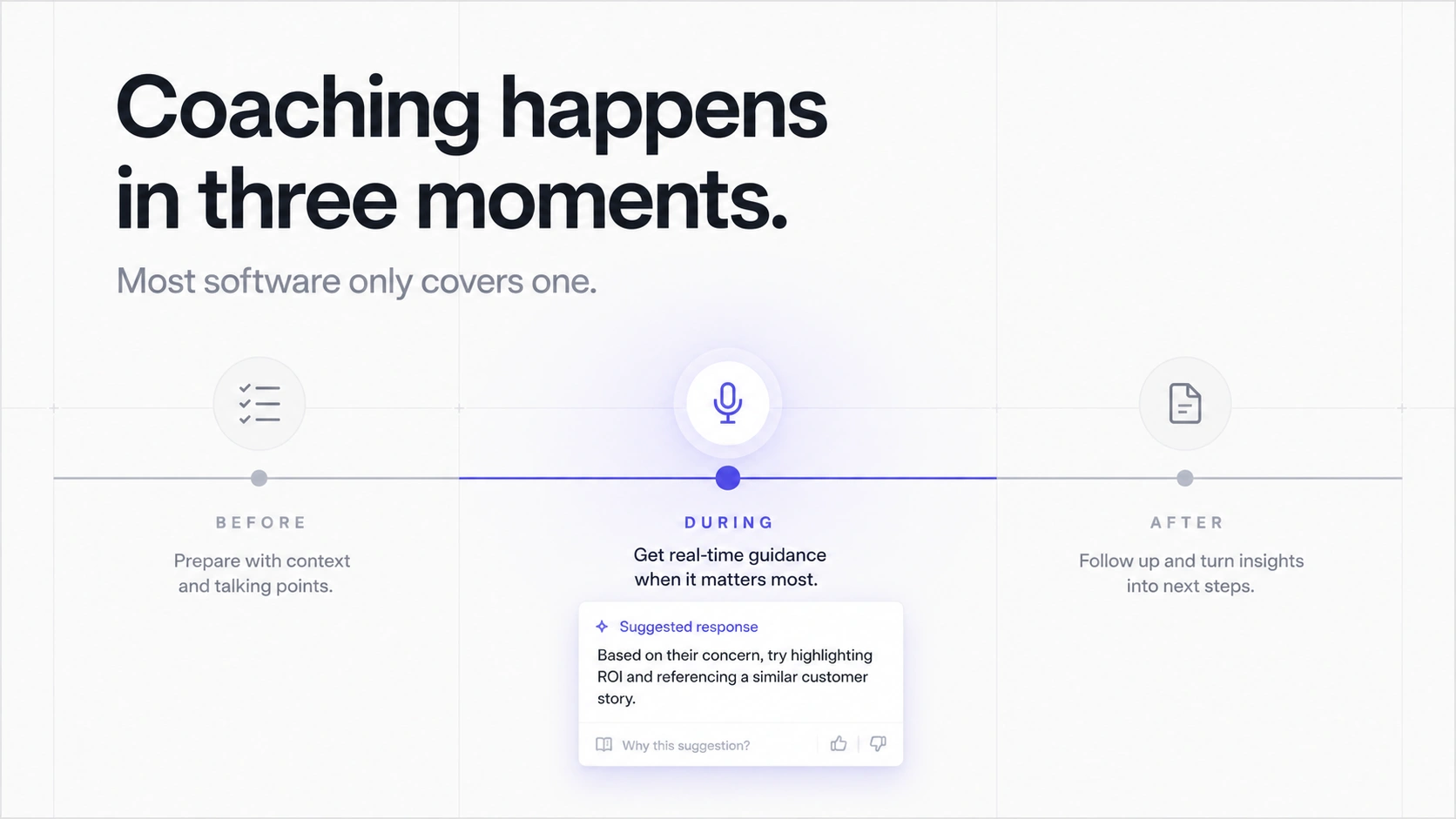
Convo also covers the before and after that pure overlays skip, with pre-call briefings so reps walk in knowing the history, and automated summaries and follow-up drafts so selling time stops leaking into admin. Pricing is published, at $22.49 per user per month Starter, $52.49 Professional, 7-day free trial with everything unlocked.
The right buy is founder-led sales and teams up to roughly 50 reps whose deals are decided inside the conversation. Skip Convo if you need manager scorecard suites, certification workflows, or enterprise forecasting; that's Gong and Clari territory, and pretending otherwise would be selling you the wrong mode. Full detail on the sales coaching software page.
Clari Copilot
Real-time battlecards and cue cards inherited from the Wingman acquisition, running inside Clari's forecasting platform at a reported $120 per user per month. Clari reports roughly 10% higher win rates for reps using live battlecards, a vendor figure worth treating as directional rather than gospel, though it matches what we see. Help during the call moves win rates in a way reports don't. The right buy if you're already on Clari or forecasting is the bigger half of your problem; the Clari vs Gong comparison maps that decision. If live help is the main requirement, Convo vs Clari Copilot compares those Battlecards with Convo's contextual help. The full real-time field, dialer coaches and contact-center assist included, is mapped in our real-time sales coaching software comparison.
Balto
Real-time guidance for high-volume phone teams, with live checklists, dynamic prompts, and compliance alerts, mostly sold to contact centers and inside sales floors. Pricing is quote-based. The right buy for SDR floors running scripted, high-frequency calls where consistency is the outcome that matters. Skip it for consultative sales over Zoom or Meet; that rhythm of conversation is what Convo and Clari Copilot are built for instead.
Mode 3: Practice and Roleplay
The mode most teams skip and shouldn't. Roleplay software gives reps an AI buyer persona to practice against, with discovery runs, objection drills, and pitch certifications, scored and repeatable, before a real prospect hears any of it. No live tool fixes a rep who has never rehearsed the pitch.
Second Nature
The established name in AI roleplay. Reps practice conversations against AI personas and get scored feedback; managers get certification tracking for onboarding cohorts and launches. Pricing is quote-based. The outcome is ramp measured in weeks. Fifty reps deliver the same new-product pitch by month's end instead of freelancing it. The right buy when ramp time is the metric that hurts. Skip it if your reps are seasoned and the problem is live deals, not preparation. It also pairs naturally with the coaching techniques that turn practice into habit, and with a real-time layer like Convo so the rehearsed answers actually show up on the live call.
Which Mode Fits Which Team
Founder-led sales, 1 to 5 people. There's no manager and no Friday review slot, so the review mode has nobody to serve. Real-time is the fit. Convo puts your best answers into every call without a coach in the room, so deals stop dying on pushback you knew how to handle. This is the segment where we see Convo change close rates fastest, because the founder IS the playbook and Convo makes it show up on demand.
10 to 30 reps where ramp is the bottleneck. Pair practice with real-time. Second Nature gets new reps rehearsed before they touch pipeline, and Convo carries the approved answers into their first real calls, briefed on every account's history from day one. New hires stop learning by losing deals.
50+ reps with RevOps and forecast pressure. This is Gong or Chorus territory, honestly. You need governance, scorecards, and pipeline analytics at a depth Convo doesn't pretend to offer. Some enterprise teams run both, the platform for management and Convo for the reps who want live help.
Customer success and renewal teams. Coaching isn't only for new business. Real-time help matters most when a renewal wobbles. Convo catches the churn signal mid-call and surfaces the save play while the customer is still on the line, which is why CS teams run it on QBRs and renewal calls.
How to Choose: Three Questions
1. Where do your deals actually break? Pull your last five losses. If deals die in discovery and objection moments, that's a real-time problem and a report can't reach it. If reps perform fine live but nobody reviews systematically, that's review. If new hires take six months to hold their own, that's practice.
2. Who is the software for, reps or managers? Review platforms are bought for managers; reps experience them as surveillance unless the coaching culture is real. Real-time and roleplay tools are bought for reps; managers get the data as a byproduct. Be honest about which purchase you're making, because adoption follows it. The difference between a good salesperson and a great one is usually coaching the rep actually wants.
3. What can you spend, really? Enterprise review platforms cost more than most small companies' entire tool budget, five figures before the first insight. Mid-market review runs $19 to $83 per seat. Real-time starts at $22.49 with Convo, published, cancel anytime. If a vendor won't publish pricing, budget for the sales process too.
The Bottom Line
For most teams the best sales coaching software is Convo, because deals die inside the calls, not in the review. Still, buy the mode that matches where your deals break, then the tool. If your reps are experienced and the gap is systematic review, Gong at enterprise scale or Avoma at mid-market will serve you well, and the conversation intelligence comparison ranks that field in depth. If new reps need rehearsal before they touch pipeline, Second Nature earns its quote-based pricing. And if deals are dying inside the calls themselves, a report next Monday is consolation, not coaching. That's the gap Convo exists to close. Reps who answer the hard question while the deal can still be won, walk in briefed, and leave with the follow-up already written. No bot in the room, from a published $22.49 a month, and the first week is free.
Frequently Asked Questions
What is the best sales coaching software in 2026? For most teams, it is Convo. Coaching only moves a deal when it reaches the rep during the call, and Convo is the best AI sales coach for that real-time mode, bot-free and from $22.49/user/month. Gong leads enterprise post-call review, Avoma is the mid-market budget pick, and Second Nature handles pre-call practice. Choose Convo unless your problem is enterprise scorecards and forecasting rather than winning the call you are on.
What is the difference between real-time and post-call sales coaching software? Post-call tools (Gong, Chorus, Avoma, Jiminny) record and score conversations so coaching happens in review sessions afterward. Real-time tools (Convo, Clari Copilot, Balto) analyse the conversation as it happens and coach the rep during the call, with objection responses and prompts on screen. Review improves the next call. Real-time wins the one you're on, which is why it's the fastest-growing mode in the category.
How much does sales coaching software cost? Mid-market review tools run $19 to $83 per seat per month (Avoma, Jiminny). Enterprise platforms like Gong reportedly exceed $1,200 per user per year plus a platform fee of $5,000 to $50,000, unpublished. Real-time coaching with Convo starts at a published $22.49 per user per month with a 7-day free trial. Balto and Second Nature are quote-based.
Does sales coaching software actually improve win rates? Vendor-reported numbers are encouraging (Clari cites around 10% higher win rates from live battlecards), but most published figures are vendor claims rather than independent studies. The consistent, verifiable returns are faster ramp and recovered selling time. Convo users get follow-ups drafted before they've left the call, and new reps carry proven answers from day one. Whether win rates move depends far more on whether coaching actually reaches the rep in time than on which dashboard records the miss.
Can a small team afford sales coaching software? Yes, if it stays out of the enterprise mode. A five-person team runs Convo Professional or Avoma for well under $300 a month total. The same team cannot clear Gong's platform fee. Small teams also get disproportionate value from real-time coaching. Without a manager to run structured reviews, Convo is effectively the coach on every call.
Do sales coaching tools put a recording bot in the meeting? Most do. Gong, Chorus, Avoma, Jiminny, and Clari Copilot all send a visible notetaker into the call. Convo captures audio locally on the rep's device, so nothing joins the meeting and prospects behave like nobody's recording, which matters in regulated industries and sensitive first calls.

Iván is the co-founder of Convo, focused on operations and growth. Background in marketing and sales. Knows firsthand what it feels like when a conversation doesn’t go the way it should.
Ready to transform your meetings?
Join professionals using Convo to feel confident in every conversation.
Get StartedCONTINUE READING