

Iván Abad Founder & COO
Clari vs Gong: Which Wins, Forecasting or Coaching? [2026]
Iván Abad Founder & COO
Clari tells you which deals will close. Gong tells you why calls go wrong. Here's which one your revenue team needs in 2026.
TL;DR: Clari vs Gong in 2026
- Clari and Gong both call it "revenue intelligence," but they fix opposite problems. Clari forecasts whether you'll hit the number. Gong coaches what reps do on calls.
- Both are enterprise buys, with platform fees, seat minimums, and multi-month rollouts. Clari's Core runs $100-120 per user per month. Gong lands around $150-250 all-in.
- Pick Clari if the forecast is what's failing. Pick Gong if reps keep losing winnable calls. On its own turf, each is the best there is.
- Gong does not coach the live call. Clari Copilot can surface a prepared Battlecard when a configured trigger fires. Convo reads the conversation and account history as the call develops, then puts the relevant response on screen without waiting for a matching card. Try it free.
Two Companies Solving Opposite Problems
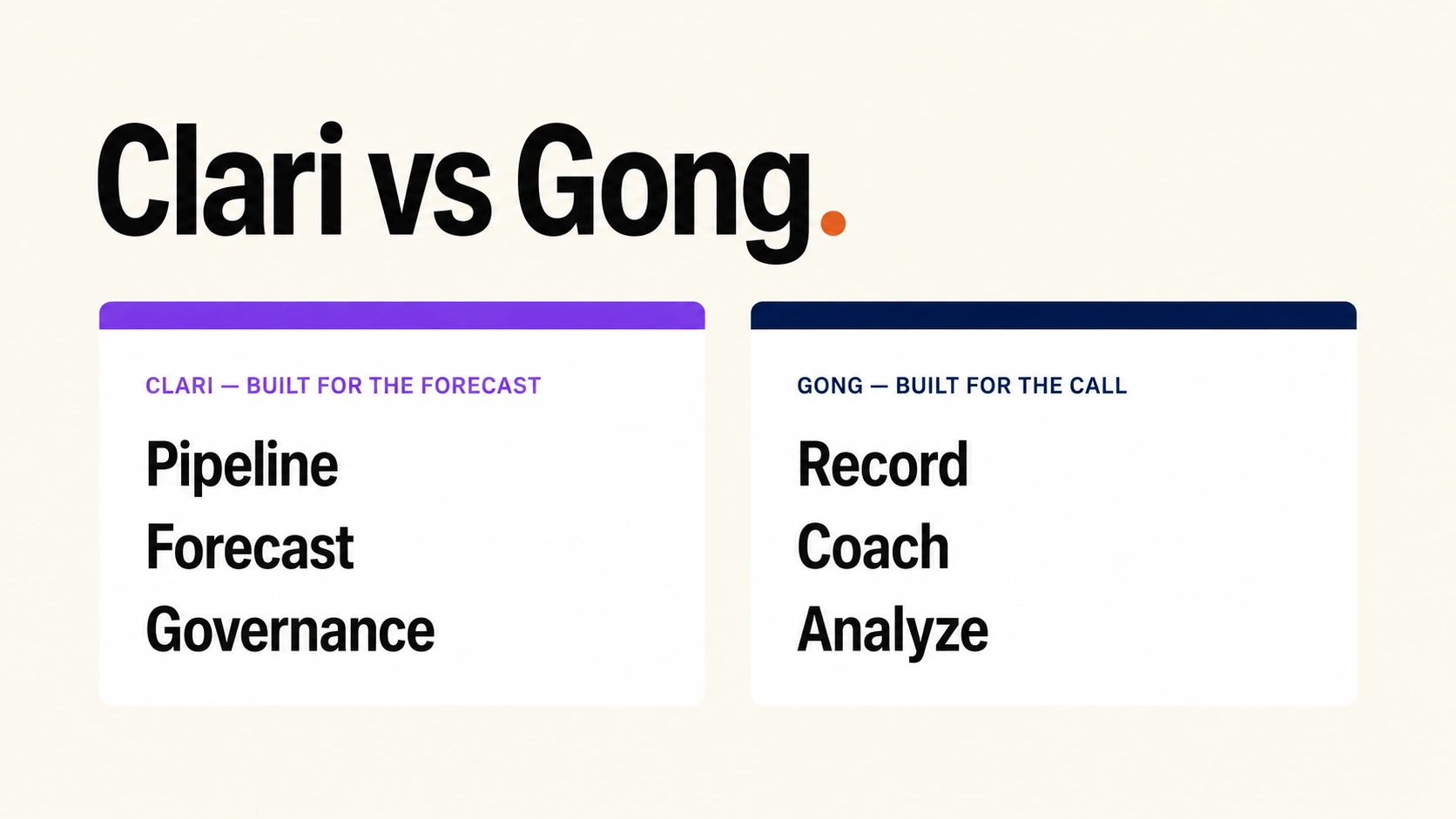
Clari and Gong get filed together because both say "revenue intelligence." Look closer and they barely overlap. Clari watches your pipeline and tells you whether the number is real. Gong sits on your calls and shows you why deals move or stall. One forecasts. The other coaches.
Most Clari vs Gong comparisons line the two up feature by feature, as if they were two versions of the same product. That misses what actually matters. They sit at opposite ends of the revenue stack, Gong working forward from the conversation and Clari working backward from the forecast. They meet in the middle and wave at each other, but they were built to answer different questions, and a feature checklist won't tell you which question is yours.
If you pick based on which brand is louder, you can spend $40,000 to $160,000 a year solving a problem you didn't have. So before you sit through either demo, here's the honest version.
The Quick Comparison
| Clari | Gong | Convo | |
|---|---|---|---|
| Built for | Revenue forecasting + pipeline governance | Conversation intelligence + call coaching | Real-time help during the call |
| Core question | "Will we hit the number?" | "What are reps doing on calls?" | "What do I say right now?" |
| Real cost | ~$100-120/user/mo Core, +$60-110 Copilot | ~$150-250/user/month all-in | $22.49/month |
| Setup time | Lengthy, modular rollout | 2-4 months | 2 minutes |
| Real-time help | Battlecards inside Copilot add-on | No (post-call) | Yes, the whole point |
| Context from past calls | Stored in CRM and forecast data | Searchable call library | Surfaced live, briefed before each call |
| Best for | CROs needing forecast accuracy | Coaching reps at scale | Any rep who wins deals on the live call |
Want the short answer?
Convo is the best first buy when calls are the problem. It reads the conversation and helps you in real-time to win more deals. Buy Clari for forecast accuracy. Gong makes sense when managers need a deep call library for later coaching.
Where Each One Came From
I made the mistake early on of treating Clari vs Gong as the same tool. It isn't. Each company grew out of a different frustration, and that origin still decides what it's good at.
Gong started with the conversation. It records the call, transcribes it, and grades it against 300+ signals like talk-to-listen ratio, question frequency, and how a prospect reacts when a competitor comes up. The whole platform grew from one question. What are reps doing on calls that wins or loses deals? Everything after that, the deal boards, the Deal Likelihood Score, the 2026 agents like Data Extractor and Ask Anything, sits on top of that conversation intelligence core. Think of Gong as a film-review room for sales calls. It plays the tape back frame by frame so a manager can see exactly where the deal went cold.
Clari started with the forecast. The question Clari answers is "will we hit the number this quarter?" It pulls from your CRM, email, calendar, and calls to build a forecast based on what deals are actually doing, not what reps typed into Salesforce last Friday. Its underlying RevDB acts as a single source of truth for revenue data, and the forecasting engine reconciles rep optimism against real signals. Clari is less a film room and more an auditor that checks everyone's homework against reality. The conversation intelligence piece, Clari Copilot, came later (it was the acquired Wingman product), and it shows in the priorities.
Once you know which question keeps your leadership up at night, the choice between Clari vs Gong usually makes itself. The trouble is that both demos are good enough to convince you that you need the other one's specialty too.
The Real Pricing in 2026
Neither company publishes real numbers, which is its own kind of answer. I've pieced this together from analyst breakdowns, buyer reports, and procurement data. Treat them as ranges, not quotes.
Gong
Gong charges a mandatory platform fee (starting around $5,000/year and climbing with org size) plus per-user licenses. Foundations seats now run roughly $1,400-1,600/user/year, up 25-56% since 2023 as features moved into higher tiers. Add onboarding at $7,500-$28,500. Full breakdown at Gong pricing.
| Team Size | Year 1 Cost (estimated) | Per User/Month |
|---|---|---|
| 10 reps | ~$28,500 | ~$238 |
| 50 reps | ~$90,000 | ~$150 |
| 130 reps | ~$152,000 | ~$97 |
Clari
Clari is modular, so the sticker price depends on how many modules you bolt on. This is the part buyers underestimate.
| Module | Estimated Cost |
|---|---|
| Core (Forecasting + Pipeline) | $100-120/user/month |
| Copilot (Conversation Intelligence) | $60-110/user/month |
| Engagement (former Groove / Salesloft) | $50-80/user/month |
| Full stack | $200-400+/user/month |
For context, Convo is $22.49/month with no platform fee and no module ladder. Wildly different scale, but it puts the enterprise tags in perspective, especially if you're the one signing the PO. And when you do need the procurement package (SSO, DPAs, security reviews), Convo's enterprise plan covers it without the six-figure anchor.
The pricing lands in the same enterprise ballpark. So the real decision in Clari vs Gong isn't cost. It's which problem you're paying to solve.
Forecasting: Clari Wins, and It Isn't Close
This is Clari's home turf. The platform claims forecast accuracy as high as 98% by the second week of the quarter, and whether or not you take that exact number at face value, the entire architecture is built to earn it. It runs structured commit, upside, and risk categories at every level of the org. Its AI reconciles what a rep submits against what the deal signals actually show, then flags exactly where revenue is leaking before the quarter closes.
Here's what that looks like in practice. A rep marks a $200K deal as "commit." Clari sees that email engagement dropped 40% last week, no next meeting is booked, and the economic buyer hasn't been on a call in three weeks. It flags the deal as at-risk and adjusts the roll-up. The VP of Sales sees the gap with two weeks to fix it. That early warning is the entire product.
If you're walking into a board meeting, Clari is the difference between "we think we'll land around $4.2M" and "our model shows $4.2M at 90%+ confidence, and here are the three deals that move it." For a CRO running 100+ reps, that's not a nice-to-have. That's the job.
Gong has closed some of the gap. Its Deal Likelihood Score draws on those 300+ conversation and engagement signals to predict close probability, and it's credible for orgs with enough call volume. But forecasting at Gong is a strong feature bolted onto a coaching platform. At Clari, forecasting is the foundation everything else sits on. For revenue intelligence in the strict sense of predicting and governing the number, Clari is the specialist.
Conversation Intelligence and Coaching: Gong Wins
Flip the question to "what are my reps actually doing on calls," and the matchup inverts.
Gong created data-driven sales coaching as a category, and nobody has fully caught up. A manager can pull a rep's last 20 calls, see they're talking 68% of the time, rarely asking open questions, and consistently losing momentum right after pricing comes up. Then they build a playlist of three calls where a senior rep handled that same pricing moment well. That's not generic advice. That's coaching from your own team's data, scored against MEDDIC, SPIN, or BANT, in 70+ languages. Its conversation analytics depth is why Gartner's Market Guide for Revenue Intelligence consistently puts Gong at the front on coaching.
Clari Copilot is genuinely capable here, more than people expect, because it inherited Wingman's real-time engine. It records, transcribes, surfaces live battlecards when a competitor or objection comes up, and auto-updates CRM fields after. Clari reports reps using real-time battlecards win about 10% more on average. But Copilot is, structurally, the feeder for the forecast. Its reason to exist inside Clari is to send buyer signals into the pipeline model, not to be the deepest coaching tool on the market. As a standalone coaching platform it's good. Against Gong's call library, scorecards, and sales coaching maturity, it's the runner-up.
The Salesloft Merger Changed the Math
One thing is genuinely new in any 2026 Clari vs Gong evaluation. In December 2025, Clari completed a merger with Salesloft into a single Vista-backed company. The stated ambition is a "Predictive Revenue System" that owns forecasting, sales engagement, and conversation intelligence under one roof.
For a buyer, that cuts both ways. The upside is one vendor for the forecast, the cadence, and the call data, with the former Groove engagement layer now part of the family. The downside is the classic platform-consolidation risk. More modules to license, a bigger surface area to roll out, and pressure to standardize on one stack before you've proven any single piece. If you were leaning toward Clari mainly for forecasting, the merger doesn't change that core strength. If you were hoping to buy just Copilot as a light conversation-intelligence tool, you're now buying into a much larger platform story. Gong, for its part, has stayed focused and gone deep on agentic AI inside its existing platform rather than acquiring its way wider.
What Both Clari and Gong Miss
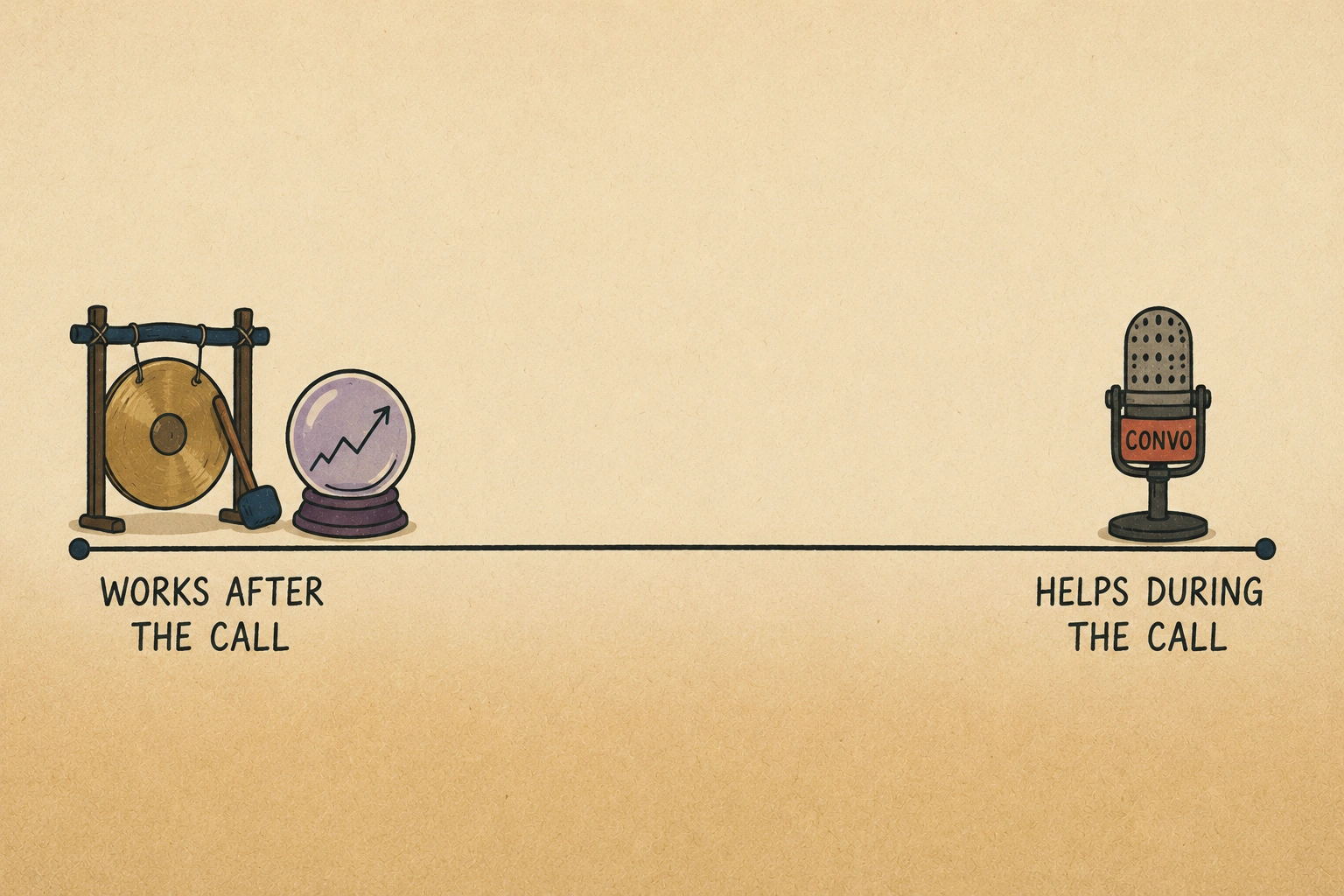
A Gong manager opens the recording after the meeting. Clari sends call signals into pipeline inspection and forecasting. Copilot can step into the live call, but only when a configured phrase matches a Battlecard. That may be exactly right for a 50-rep organisation with RevOps maintaining approved messaging.
But deals move or stall in the live conversation. A prospect raises an objection you didn't prepare for, or references a detail from a call six weeks back that you've forgotten. A forecast dashboard is no help in that second. A coaching review three days later isn't either.
Why Convo Wins the Live Call
Your rep is still talking when a detail the buyer mentioned three weeks ago appears on screen. Convo keeps following the meaning of the conversation even when nobody wrote a card for it. That makes Convo the best choice when you want to change the call in progress. Copilot handles anticipated objections with prepared Battlecards, while Gong saves the lesson for later.
Here's what that looks like on a live call. A prospect says they looked at Clari last quarter but found it too heavy for their 15-person team. Convo picks that up as they say it, reminds you on screen that they also raised budget on your last call, and suggests how to respond. You stay in the conversation, no scrambling for notes.
It works because Convo remembers your earlier calls. Before each one, it tells you what was said last time, so you never walk in cold. After the call, it writes the follow-up for you. Twenty minutes of work becomes about thirty seconds.
The fair way to read it is by what you trade away and what you gain:
| If you pick Convo over... | You give up | You gain instead |
|---|---|---|
| Gong | Team-wide call analytics and coaching at scale across 50+ reps | Coaching the second it's needed, not a playlist reviewed next week |
| Clari | Pipeline forecasting and board-grade revenue governance | In-call help, plus recall of everything the buyer said on earlier calls |
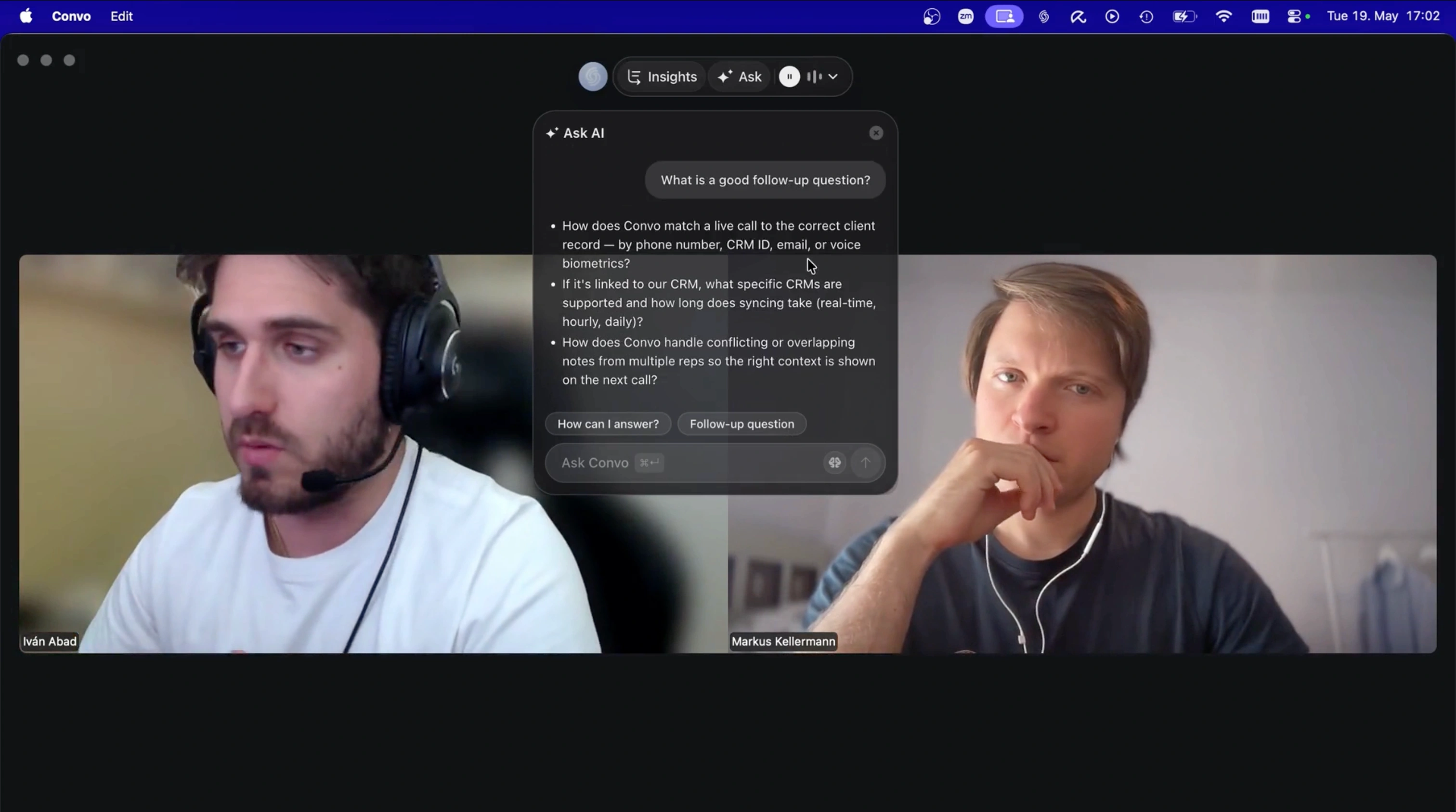
Convo surfacing a suggested follow-up mid-call, pulled straight from the live conversation.
If you want to see the real-time model next to the enterprise one, our Convo vs Clari Copilot and Convo vs Gong breakdowns go deeper, and the best conversation intelligence software guide ranks the full field.
Who Should Buy What
| Your Situation | Best Fit | Why |
|---|---|---|
| Any team whose deals are won or lost on the live call | Convo | Live help during the call, plus memory across calls, no enterprise rollout |
| 20-50 reps, want coaching without enterprise forecasting | Convo | Gong for calls, your CRM for the forecast. Cheaper than adding Clari |
| CRO/VP Sales who needs forecast accuracy for the board | Clari | Built for the number. Pipeline governance is the whole product |
| 50+ reps, coaching at scale is the priority | Gong | Deepest call analysis and coaching infrastructure in the category |
| Want forecasting AND engagement from one vendor | Clari (post-Salesloft) | One stack for forecast, cadence, and call data, if you'll use it all |
| Already deep in ZoomInfo, want call intelligence bundled | Chorus | Makes sense inside that ecosystem. See our three-way comparison |
The Honest Verdict
Clari and Gong are both excellent at the thing they were born to do, and average at the other one. If your nightmare is a board meeting where the forecast is wrong, buy Clari. If your nightmare is a winnable deal lost because a rep fumbled the call, buy Gong. The "revenue intelligence" label they share hides how little they actually overlap.
Convo is the best choice when the rep needs contextual help across the whole conversation, including the turns nobody prepared a card for. Copilot handles anticipated moments with configured Battlecards; Gong's coaching starts after the call.
Clari and Gong are the serious tools for forecasting and enablement, and they earn their price at that scale. If the gap you keep hitting is the call itself, try Convo free, the Clari alternative built for reps who sell instead of forecast. You'll feel it on the very next one, no rollout to sit through. For the math, our meeting ROI calculator shows what a slipped call actually costs.
Frequently Asked Questions
What is the difference between Clari and Gong? Clari is a revenue operations platform built around forecasting and pipeline governance. It predicts whether you'll hit the number and shows where revenue is leaking. Gong is a conversation intelligence platform built around call recording, analysis, and coaching. It shows what reps are doing on calls and how to improve. Both record calls and both call themselves "revenue intelligence," but Clari starts from the forecast and Gong starts from the conversation. Choose based on which problem is more painful for your team.
How much do Clari and Gong cost in 2026? Gong runs roughly $150-250/user/month all-in once you include the platform fee (from ~$5,000/year), per-user licenses ($1,400-1,600/user/year), and onboarding ($7,500-28,500). Clari is modular. Core forecasting is about $100-120/user/month, the Copilot conversation-intelligence add-on is $60-110/user/month, and the full stack can reach $200-400+/user/month, with minimum contracts commonly $40,000-75,000+ per year. Neither publishes pricing, so these are buyer-reported ranges.
Is Clari or Gong better for forecasting? Clari. Forecasting and pipeline governance are its foundation, with structured commit/upside/risk roll-ups and a claimed forecast accuracy near 98% by the second week of the quarter. Gong's Deal Likelihood Score is a credible forecasting feature, but it sits on top of a coaching platform rather than being the core. For CROs who need board-grade forecast accuracy, Clari is the specialist. See our revenue intelligence guide for the wider category.
Is Clari or Gong better for call coaching? Gong. It created data-driven sales coaching, with deep call libraries and scorecards aligned to MEDDIC/SPIN/BANT. Clari Copilot (formerly Wingman) does record, transcribe, and offer real-time battlecards, and it's better than most expect, but it's structurally a feeder for Clari's forecast rather than a coaching-first tool. If coaching reps is the main reason you're buying, Gong leads.
Does Clari or Gong offer real-time help during calls? Partly. Gong's model is post-call. Managers review recordings and coach afterward. Clari Copilot does offer real-time battlecards that fire when a competitor or objection is mentioned, but they are keyword-triggered cards inside Clari's enterprise stack ($200-400+/user/month). For real-time suggestions, objection frameworks, and context from past calls on a smaller budget, Convo is built specifically for the live moment.
What changed with the Clari and Salesloft merger? In December 2025, Clari merged with Salesloft into a Vista-backed company building a "Predictive Revenue System" that combines forecasting, sales engagement, and conversation intelligence. For buyers, it means one vendor can now cover the forecast, the cadence, and the call data. The trade-off is a larger platform to license and roll out. Clari's forecasting strength is unchanged; the bet is on consolidating the rest of the stack around it.
What are cheaper alternatives to Clari and Gong? For real-time help during the call, Convo ($22.49/month). For mid-market conversation intelligence, Avoma (~$24/user/month). For a free way to start recording, Fathom. For ZoomInfo customers wanting call intelligence, Chorus. These cover much of what the enterprise platforms do at a fraction of the cost. Our sales productivity tools guide breaks down the full range from free to enterprise.
Iván is the co-founder of Convo, focused on operations and growth. Background in marketing and sales. Knows firsthand what it feels like when a conversation doesn’t go the way it should.
Ready to transform your meetings?
Join professionals using Convo to feel confident in every conversation.
Get StartedCONTINUE READING