

Markus Kellermann Founder & CEO
Best Conversation Intelligence Software for Sales Teams 2026
Markus Kellermann Founder & CEO
Compare the 8 best conversation intelligence software tools in 2026. Real pricing, real-time vs post-call analysis, and which one fits your sales team.
How the Best Conversation Intelligence Software Compares in 2026
Conversation intelligence software all does the same core job. It records your sales calls, transcribes them, and uses AI to surface what happened, including the objections, the competitor mentions, the coaching moments, and the deal risks. On a feature page they all look alike. The differences only show up when you compare them on the things that decide the purchase, like how accurate the analysis is, how well it fits your CRM and stack, what it actually costs, and whether it helps during the call or only after.
This guide compares eight conversation intelligence tools worth shortlisting in 2026 across those criteria, with real pricing including the vendors who hide theirs, and a clear "best for" on each so you can match a tool to your team rather than the loudest brand.
In this post, you'll learn:
- What conversation intelligence software actually does, and the criteria worth comparing
- The 8 tools worth shortlisting in 2026, with real pricing
- Where each tool lands on real-time help vs post-call analysis
- Which tool fits which team, from solo founders to 200-rep sales orgs
What Conversation Intelligence Software Actually Does
Conversation intelligence software records, transcribes, and analyses your customer-facing calls with AI, then turns them into searchable data and insights. Talk-to-listen ratios, competitor mentions, sentiment, objection patterns, deal risk, and coaching signals. It is the layer that takes a one-hour sales call and tells you what happened in it without anyone writing notes.
The category is bigger than most people realise. One estimate from The Business Research Company puts the market at $32.25 billion in 2026, growing roughly 13% a year toward $52 billion by 2030. That figure bundles a broad set of communication-analytics revenue, so treat it as direction rather than gospel. The useful takeaway is simpler. This is a crowded, fast-growing space, and the tools inside it are further apart than the marketing suggests.
Seven things actually separate one conversation intelligence platform from another. These are the criteria worth scoring each tool against:
- Transcription and insight accuracy. How good is the transcription on real calls (accents, jargon, crosstalk), and how reliable is the AI analysis built on top of it? Everything else depends on this.
- AI summaries and search. Automatic summaries, action items, and the ability to ask questions across every past call instead of scrubbing recordings.
- Coaching and scoring. Talk-to-listen ratios, scorecards, call libraries, and manager dashboards that turn calls into coaching.
- Deal and revenue intelligence. Plain call notes and talk ratios, or full pipeline risk, deal boards, and forecasting?
- CRM and tool integrations. Native Salesforce, HubSpot, or Pipedrive sync, and how cleanly it fits the stack you already run.
- Real-time or post-call. Does it help during the conversation with live cues, or only analyse it afterward? Most tools are still post-call, but real-time is the fastest-rising differentiator in the category.
- Pricing, setup, and security. Published pricing or "contact sales," seat minimums and contract length, how long deployment takes, where your audio is processed, and whether a recording bot joins the call.
Keep those seven in mind as you read. They are what the rest of this guide compares.
The Quick Verdict
If you only have a minute, this table covers the essentials.
| Tool | Best For | Bot in Call | Real-Time | Pricing Published | Starts At |
|---|---|---|---|---|---|
| Convo | Real-time help during calls | No | Yes | Yes | $22.49/user/mo |
| Gong | Enterprise revenue intelligence | Yes | Limited | No | ~$1,200/user/yr + platform fee |
| Chorus | ZoomInfo-stack teams | Yes | No | No | ~$8k/yr (3 seats) |
| Clari Copilot | Real-time + forecasting | Yes | Yes | No | ~$120/user/mo |
| Avoma | Mid-market all-rounder | Yes | Mostly post-call | Yes | $19/user/mo + add-ons |
| Jiminny | Coaching on a budget | Yes | Limited | No | ~$83/seat/mo |
| Fireflies | Budget entry point | Yes | No | Yes | $10/user/mo |
| Outreach (Kaia) | Teams already on Outreach | Yes | Yes | No | ~$100/user/mo |
The 8 Best Conversation Intelligence Tools in 2026
1. Convo: Best for Real-Time Help During the Call
Convo is the one tool here built around helping during the call rather than after it. While the rest of this list records a conversation and analyses it later, Convo reads the call as it happens and puts help on screen while you are still talking. When a prospect pushes back on price, a suggested response appears within a few seconds. When they reference a detail from a call three weeks ago, it surfaces the exact quote. (Convo publishes this guide, which is why it sits at the top. The rest of the list is reviewed on the same terms.)
Bot Joins Meeting: No / Real-Time Help: Yes / Pricing: $22.49/user/month Starter, $52.49/user/month Professional (annual billing), Enterprise custom
What makes Convo different from Gong, Chorus, and the rest is where the intelligence shows up:
- It analyses the call live, not afterward. Convo reads the conversation every few seconds, detects the type of call (discovery, objection handling, negotiation), and surfaces what is happening while you can still use it, like the talk-to-listen ratio updating in real time, the objection currently on the table, the buying question you have not answered yet.
- Discovery frameworks that fill themselves in. Convo puts your qualification framework on screen during the call (BANT today, with SPICED and MEDDPICC on the way) and completes each field automatically as the prospect answers. You see which boxes are still empty before you hang up, instead of finding the gap in the CRM a day later.
- Coaching that routes into the next call. After the call, Convo pulls the coaching moments out as verbatim quotes from the transcript, and a Save-as-Cue control turns any of them into a prompt that fires on your next live call. The feedback lands where it can change behaviour, not buried in a scorecard nobody reopens.
- Intelligence that compounds across calls. Convo Memory recognises a returning contact and surfaces what they said in earlier conversations on its own, so context builds across a relationship instead of resetting every meeting.
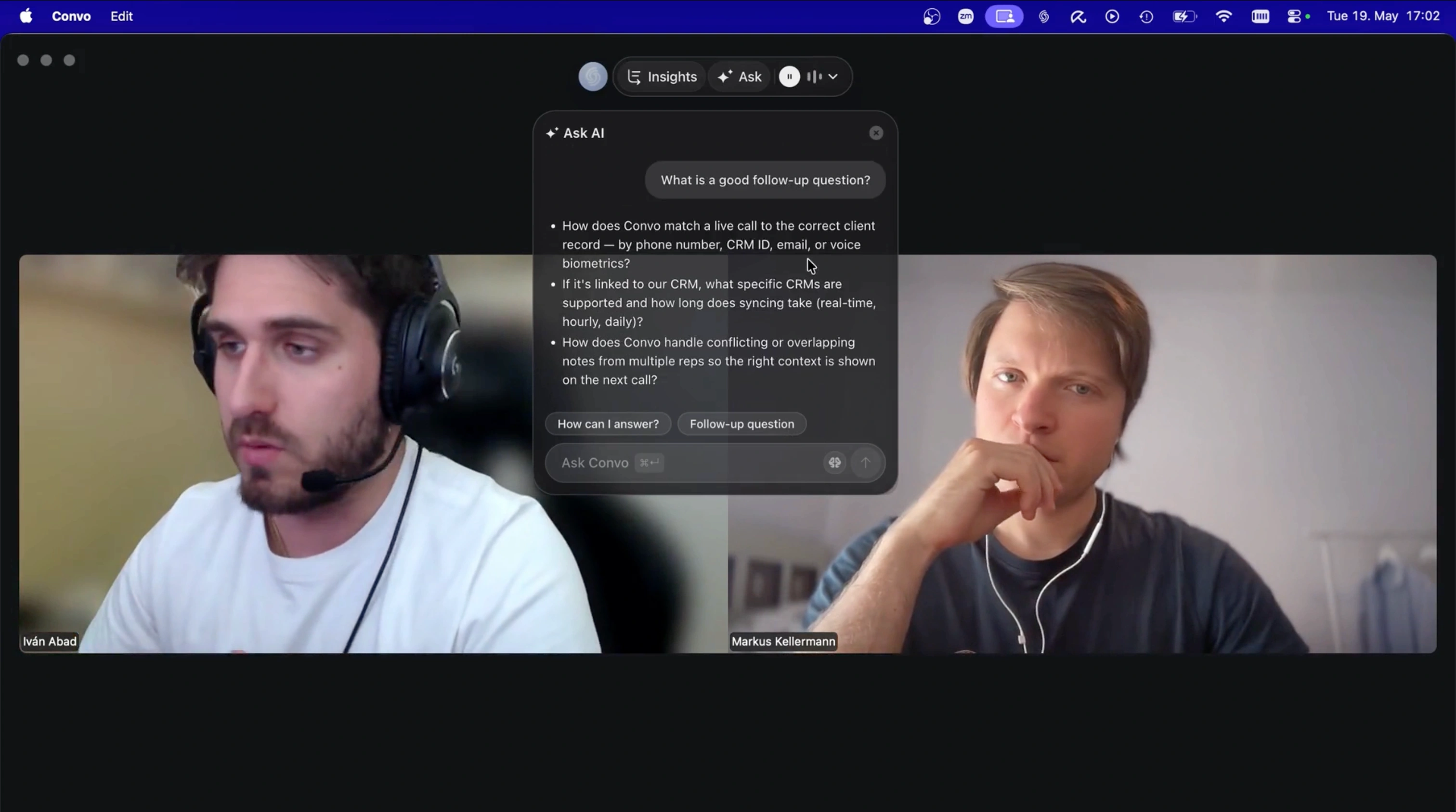
Convo's suggestions appear quietly during the call, not in a report the next morning.
What Convo does well. Real-time help nobody else offers at this price, invisible to prospects, local audio, same-day setup, and monthly billing. It still drafts the summary, action items, and follow-up email after the call and pushes them to Salesforce, HubSpot, Pipedrive, or Attio.
What Convo doesn't do. It is not an enterprise revenue-forecasting suite. It will not build a pipeline-wide deal board the way Gong or Clari will. It runs on desktop (Mac, Windows, Linux), so if your reps live on mobile, it is not the fit. And it is newer than the incumbents here.
Best for: sales teams, founders, and consultants who want reps to perform better in the conversation itself, not just review it afterward. If your problem is "my new reps freeze when a deal gets hard," a post-call report does not solve that. Real-time help does. See Convo vs Gong for the head-to-head with the category leader, and if you want the lighter meeting-assistant field rather than full conversation intelligence, our AI meeting assistants for sales teams guide covers it.
2. Gong: Best for Enterprise Revenue Intelligence at Scale
Gong is the tool everyone benchmarks against, and for good reason. For large sales organisations with a dedicated RevOps function, it is the most complete revenue intelligence platform on the market. It records and transcribes every call, scores deals, flags pipeline risk, and gives managers a coaching surface backed by more conversation data than anyone else.
Bot Joins Meeting: Yes / Real-Time Help: Limited (new live alerts in its Zoom app; core strength is post-call) / Pricing: No public pricing. Reported around $1,200 to $1,600 per user per year, plus a platform fee of roughly $5,000 to $50,000 and a ~15-seat minimum (third-party estimates, Gong does not publish rates)
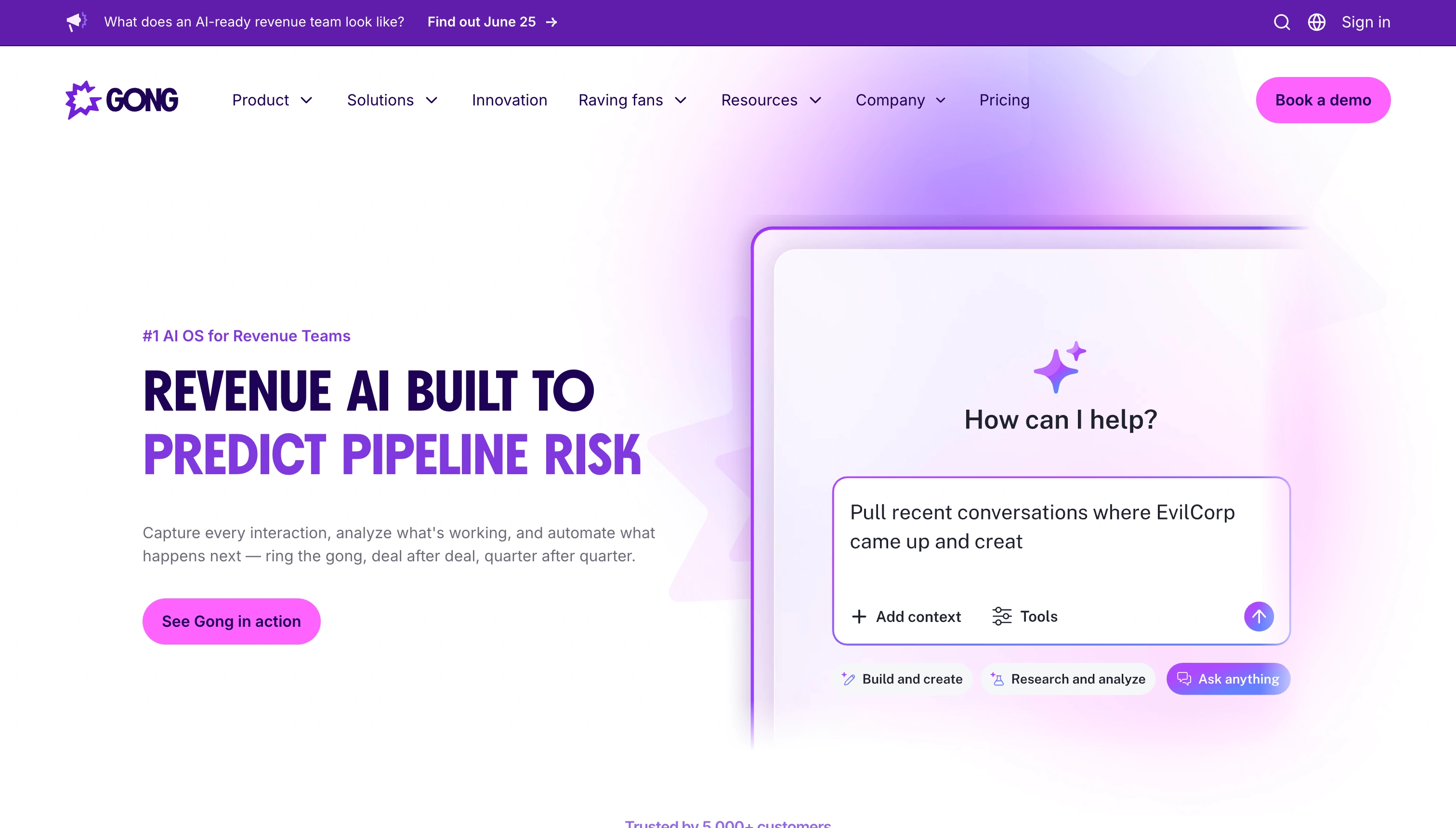
Gong's revenue intelligence dashboard (screenshot placeholder).
What it does well. Gong's intelligence is the deepest here, and the named features show why. Smart Trackers catch a concept across different wording, so a tracker trained on "asking for a discount" still flags "is that the best you can do?" Call Spotlight adds an Ask Anything layer that answers natural-language questions across every call, deal, and account, and Deal Boards surface risk across the whole pipeline. Transcription is among the most accurate here (Gong cites roughly 85 to 90 percent, though reviewers note it slips on accents and jargon), it covers 70-plus languages and 300-plus integrations, and G2 sits around 4.7 from more than 6,000 reviews.
What it doesn't do. Its real-time help is still nascent. Gong has started adding live alerts in its Zoom app (a talk-time nudge to cede the floor, for example), but it does not yet coach the rep through objections in the moment the way Clari Copilot or Convo do, and the core intelligence is analytical and post-call. Reviewers also warn that it surfaces so much data and so many alerts that it becomes noise without a disciplined RevOps team coaching against it, and the pricing is opaque, with a platform fee that lands before your first seat.
> Gong is a brilliant rear-view mirror. The question is whether your reps need a better view of the road behind them or a hand on the wheel right now.
Best for: 50-plus rep sales orgs with budget and a RevOps team to run it. Worst for: small teams, anyone who wants real-time help, and buyers who need transparent pricing. See the Gong alternatives breakdown and the three-way Gong vs Chorus vs Clari comparison.
3. Chorus (by ZoomInfo): Best If You Already Live in ZoomInfo
Chorus is the closest direct competitor to Gong, and its real advantage shows up when you are already buying ZoomInfo's go-to-market data. It records, transcribes, tracks competitor mentions and talk ratios, and feeds deal-risk analytics, with ZoomInfo's contact and intent data wired in.
Bot Joins Meeting: Yes / Real-Time Help: No / Pricing: No public pricing. Reported around $8,000 per year for three seats, climbing with the ZoomInfo bundle (third-party estimate)
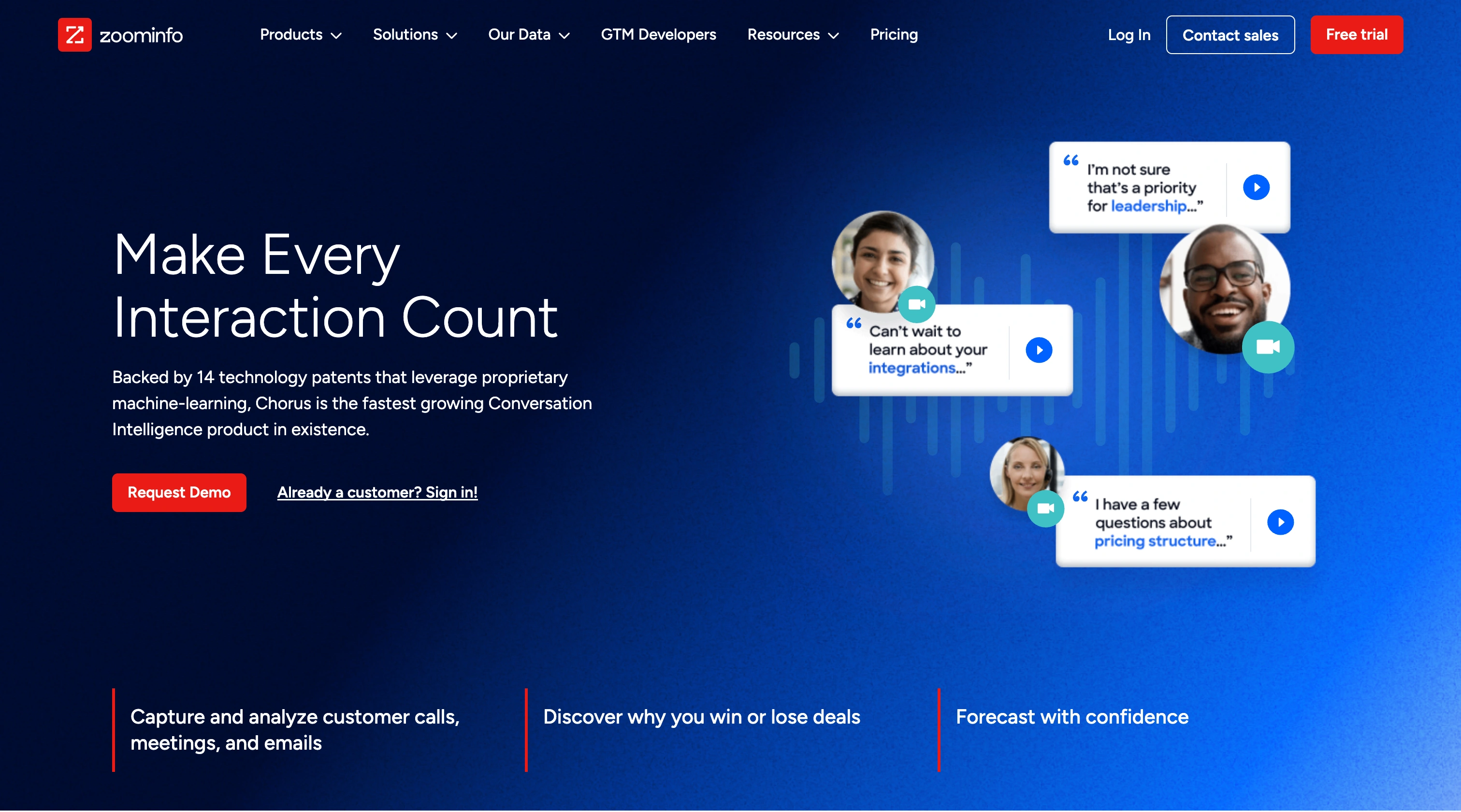
Chorus by ZoomInfo, with calls enriched by ZoomInfo data (screenshot placeholder).
What it does well. Its signature feature, Momentum, scores how fast a deal is moving through your process and ties conversation signals to ZoomInfo's account and contact data, which is intelligence a CRM activity log cannot produce. Coaching Playlists, a searchable Call Library, performance scorecards, and Commitment Phrase tracking (it maps deal-stage language) round it out. G2 sits around 4.5.
What it doesn't do. Users report transcripts commonly take 15 to 30 minutes to appear after a call, so there is little real-time value, accuracy lands around 80 to 90 percent and slips on accents and technical terms, and the dashboards are dense enough that features go unused without dedicated enablement. As a standalone tool it trails Gong, and the real value only shows up if you are committed to the ZoomInfo stack.
Best for: enterprises already on, or buying into, ZoomInfo. See Chorus alternatives for the unbundled options.
4. Clari Copilot: Best for Real-Time Battlecards Inside a Forecasting Suite
Clari Copilot (formerly Wingman) is one of the few tools here that genuinely does real-time. During a call it auto-surfaces battlecards when it hears a pricing question, a competitor name, or a common objection. It ties into Clari's forecasting and RevOps platform, so conversation data flows into pipeline and forecast views. If you're weighing that forecasting strength against Gong's coaching depth, our Clari vs Gong comparison breaks down where each one wins. If the decision is Clari's Battlecards or Convo's contextual live help, read Convo vs Clari Copilot.
Bot Joins Meeting: Yes / Real-Time Help: Yes (battlecards) / Pricing: Reported around $120 to $160 per user per month standalone, more inside the broader Clari bundle (third-party estimate)
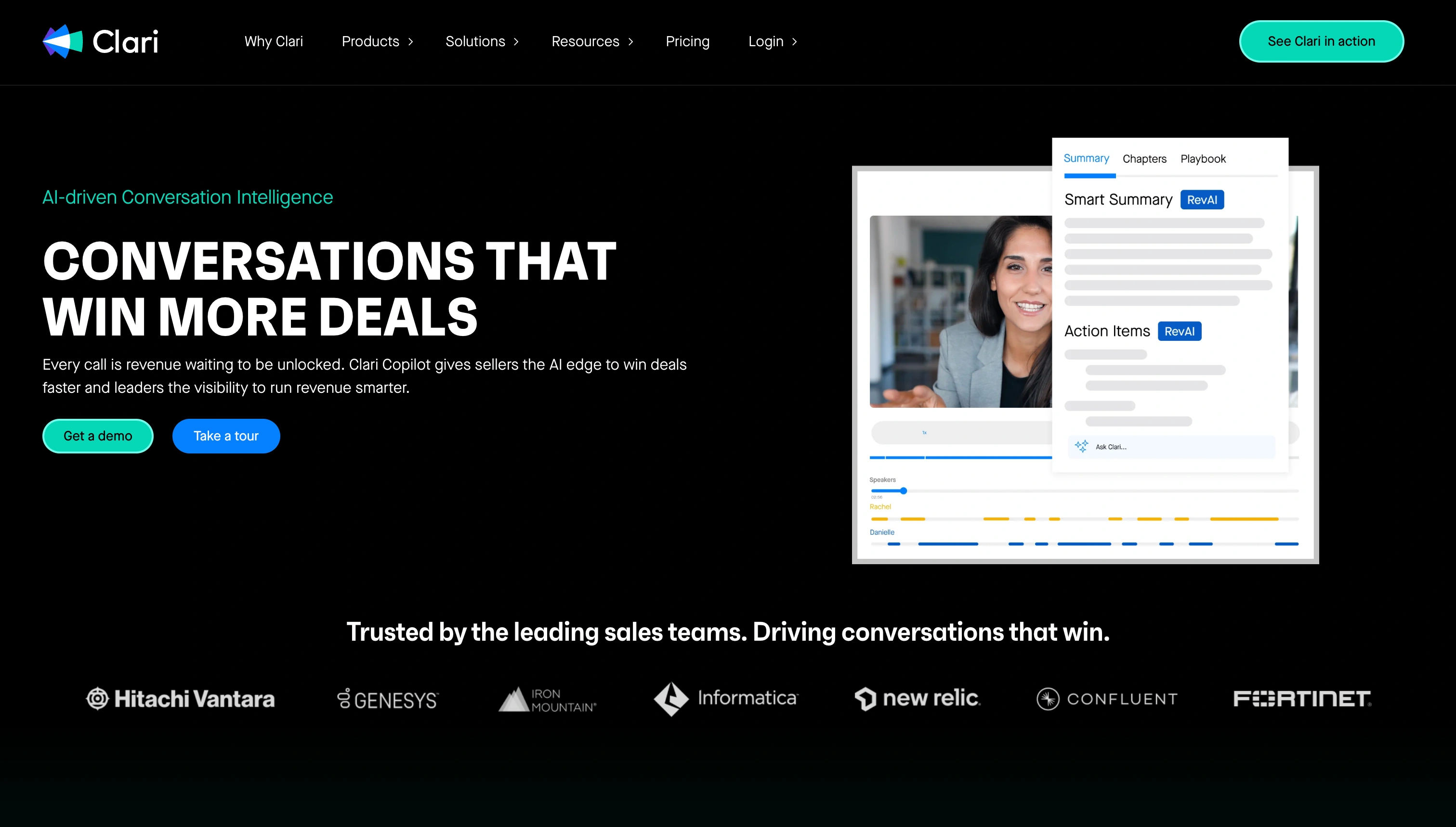
Clari Copilot's real-time battlecards during a call (screenshot placeholder).
What it does well. The real-time layer is genuine. Live battlecards fire on a detected competitor name or objection, and live monologue coaching nudges the rep to pause or pivot when they have been talking too long. Buyer Signals from the call feed straight into Clari's forecasting, and Gametapes compile winning-call reels for onboarding. Clari cites around 10 percent higher win rates from the battlecards, and the Clari platform sits around 4.6 on G2.
What it doesn't do. The battlecards are pre-built cue cards triggered by keywords rather than generated answers, transcription slips on strong accents and background noise, and reviewers note limited language support. A recording bot still joins the call, and the strongest ROI assumes you buy into the wider Clari platform, which pushes cost up fast.
Best for: sales teams that want live prompts and already use, or want, Clari for forecasting. It is the closest competitor to Convo on the real-time axis, with two differences worth weighing. Convo has no bot, and no enterprise-suite price tag.
5. Avoma: Best Mid-Market All-Rounder
Avoma is the sensible middle ground between consumer note-takers and enterprise platforms. One product covers meeting notes, conversation intelligence, scheduling, and (with add-ons) revenue intelligence, aimed at SMB and mid-market teams across sales and customer success.
Bot Joins Meeting: Yes / Real-Time Help: Mostly post-call / Pricing: Base plans $19 / $29 / $39 per seat per month (annual). The conversation intelligence add-on is +$29 and revenue intelligence is another +$29, so a fully equipped sales seat runs roughly $90 to $120 per month, not the $19 headline, per Avoma's pricing
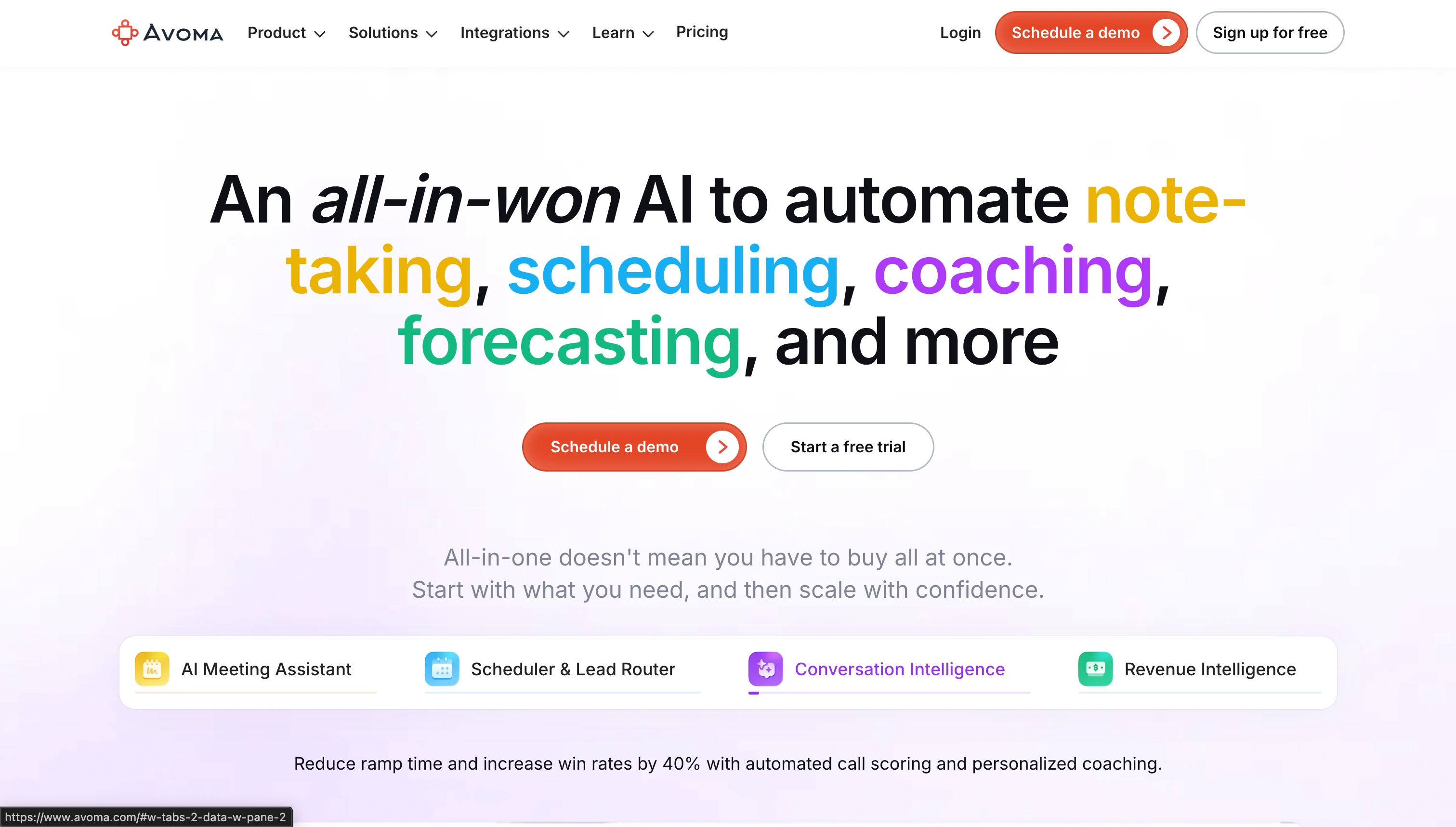
Avoma bundles notes, conversation intelligence, and scheduling (screenshot placeholder).
What it does well. For the price, the breadth is real. AI Scorecards automatically grade every call against a methodology template (MEDDIC, SPICED, BANT, or custom) so managers can jump straight to the low-scoring calls, Smart Trackers flag risk and churn language semantically rather than by exact keyword, and a Live Answer Assistant surfaces a rep-only answer card when it hears a trigger phrase. It covers 60-plus languages and 30-plus integrations, with a built-in scheduler. G2 4.6 across roughly 1,350 reviews.
What it doesn't do. The headline $19 is misleading once you add the modules that actually deliver the intelligence (a fully equipped seat is closer to $90 to $120). Reviewers report transcription dropping from around 95 percent on clean audio toward 80 percent on accents or crosstalk, occasional speaker misattribution, and post-call processing or CRM sync that can lag an hour, which blunts both same-day follow-up and the real-time Answer Assistant. The deal intelligence is also lighter than the enterprise leaders at scale.
Best for: cost-conscious SMB and mid-market teams that want conversation intelligence without an enterprise contract.
6. Jiminny: Best for Coaching Culture on a Mid-Market Budget
Jiminny leans hard into coaching. It records, transcribes, and summarises calls, then wraps scorecards, talk analytics, and deal insights around a manager-led coaching workflow, at a friendlier price than Gong.
Bot Joins Meeting: Yes / Real-Time Help: Limited (largely post-call) / Pricing: Per-seat. Reported around $83 per month for a recording seat and $42 for an insights seat that does not record, no platform fee, 12-month minimum contract (third-party estimate)
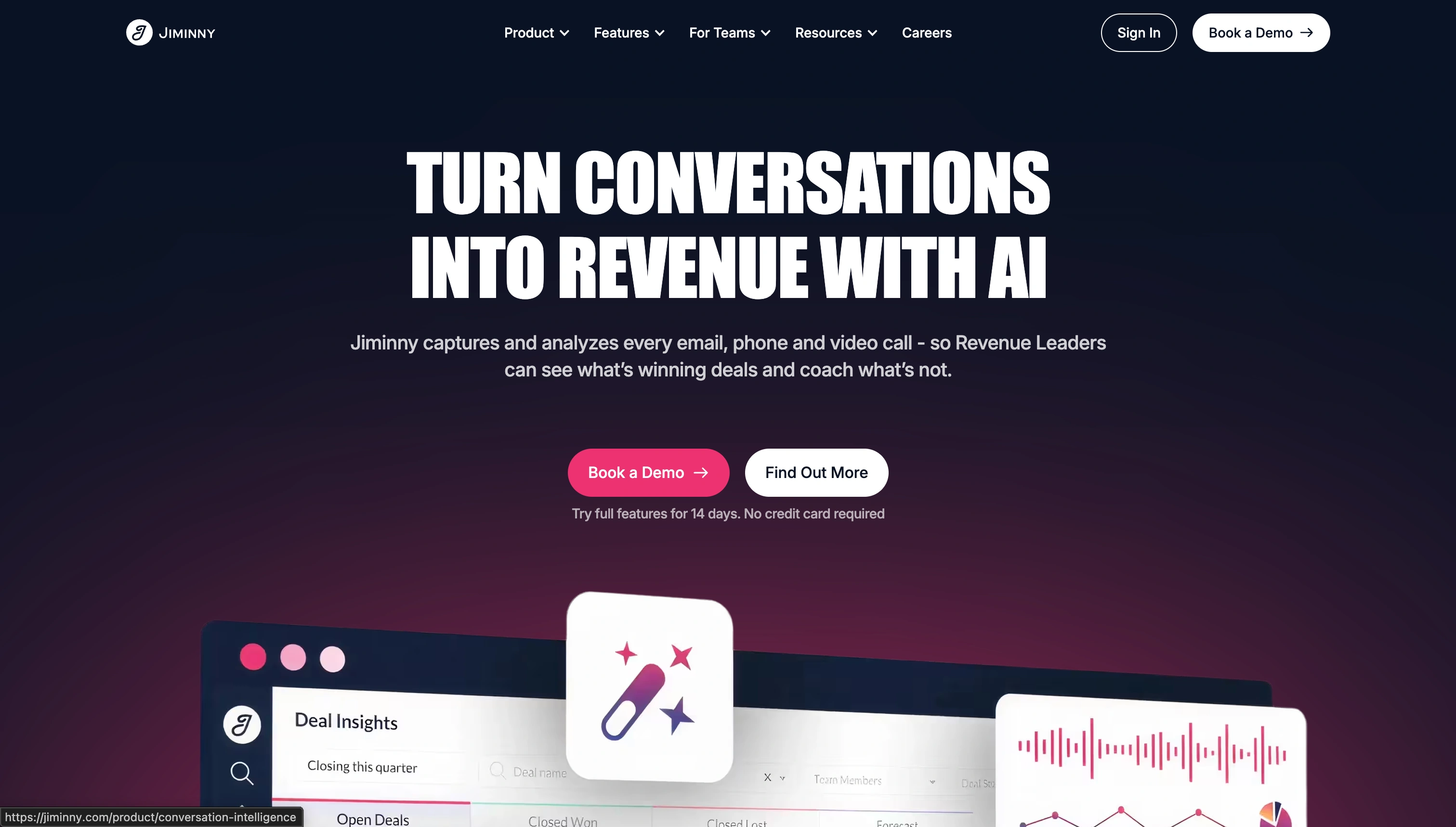
Jiminny's coaching scorecards and talk analytics (screenshot placeholder).
What it does well. Coaching is the heart of it. Real-time incognito coaching lets a manager join a live call invisibly and message the rep mid-conversation, customizable scorecards grade reps against your methodology, and the analytics go past talk ratio into question rate, monologue length, and talk speed. Ask Jiminny answers natural-language questions across the call library, and it logs to seven CRMs including Salesforce, HubSpot, and Pipedrive. 60-plus languages, G2 4.6 across about 900 reviews.
What it doesn't do. Transcription is inconsistent on strong accents, jargon, and poor audio, and the revenue-intelligence layer is shallow next to Gong. Deal-risk alerts are basic, with no AI forecasting or multi-stakeholder deal analysis. The seat structure confuses buyers (real recording needs the pricier seat), and there is a 12-month minimum contract.
Best for: mid-market sales teams that put coaching first and want it cheaper than Gong. The behavioural case for coaching is in our good salesperson vs great salesperson post.
7. Fireflies.ai: Best Budget Entry Point
Fireflies is where a lot of teams first meet conversation intelligence, because the entry price is so low. It is a popular AI meeting notetaker that adds conversation intelligence and team analytics on its Business tier.
Bot Joins Meeting: Yes / Real-Time Help: No / Pricing: Free, Pro $10, Business $19 (where conversation intelligence unlocks), Enterprise $39 per user per month (annual) per Fireflies' pricing
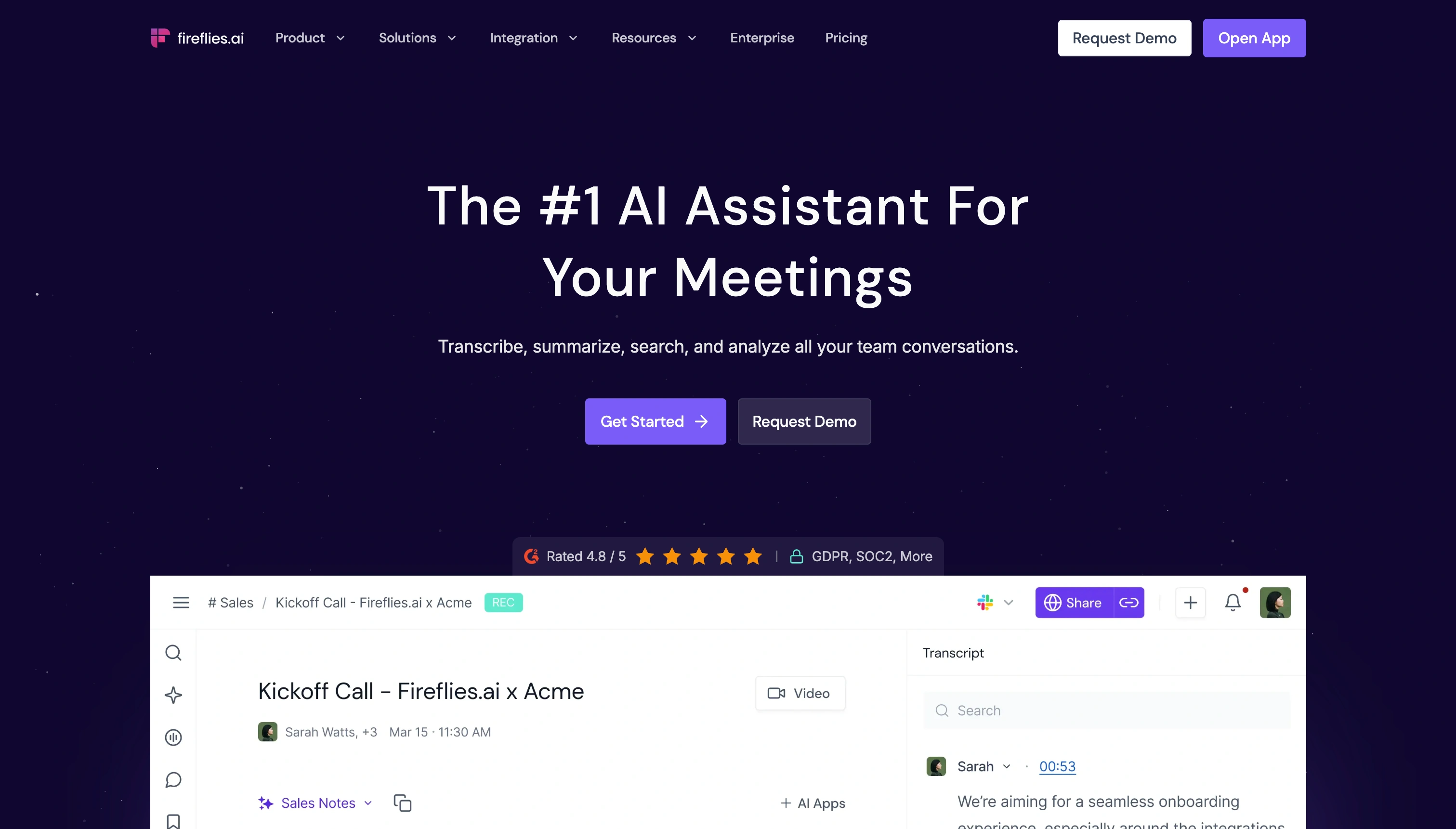
Fireflies.ai notes with the AskFred AI chat (screenshot placeholder).
What it does well. It turns your meeting archive into something you can interrogate. AskFred answers natural-language questions across past calls, Smart Search filters a long meeting by sentiment, speaker, or tracked topic, Soundbites clip shareable moments, and a library of AI Apps automates post-meeting CRM updates and follow-ups. The conversation analytics cover talk time, sentiment, longest monologue, questions asked, and filler words. Very cheap, and G2 around 4.7.
What it doesn't do. The bot visibly joins every call, speaker attribution degrades on busy multi-person calls with overlapping speech, and full analysis can lag 10 to 15 minutes on long meetings. AI features run on a credit system, and the deal and revenue intelligence is shallow next to Gong or Clari. A class action filed in December 2025 (Cruz v. Fireflies.AI Corp.) also alleges its speaker-recognition feature collects voiceprints without consent under Illinois BIPA.
Best for: SMBs and individuals who want light conversation intelligence without a real budget. See the Fireflies AI review and Convo vs Fireflies for the deeper look.
8. Outreach (Kaia): Best If You Run on Outreach Already
Outreach is a sales execution platform, and Kaia is its conversation intelligence assistant. Like Clari Copilot, it does real-time, with live transcription and content cards during the call, plus sentiment analysis and post-call summaries, all inside the Outreach workflow.
Bot Joins Meeting: Yes / Real-Time Help: Yes (Kaia cards) / Pricing: No public pricing. Reported around $100 to $170 per user per month, with real-time features gated to higher tiers (third-party estimate)
Outreach's Kaia assistant with live content cards (screenshot placeholder).
What it does well. Kaia does genuine real-time, with live transcription plus content cards that surface mid-call in four categories (competitor, product, integration, and pricing) when it detects the topic, and it captures action items as they are spoken. Afterward, the Kaia Topics Report shows which subjects come up across deals and stages, and everything syncs into Outreach sequences, tasks, and the CRM. Strongest if your team already runs on Outreach.
What it doesn't do. The live content cards, smart meeting assist, and custom topics are English-only, even though transcription supports more languages, and the cards need constant manual upkeep or the competitive and pricing guidance goes stale. Pricing is opaque, the intelligence is not sold standalone, and most of the value evaporates for teams not standardised on Outreach.
Best for: enterprise teams already standardised on Outreach who want integrated real-time assist.
A Few Tools That Didn't Make the Main List
If you mainly want clean notes rather than deal intelligence, the lighter meeting assistants are worth a look, like Otter for transcription accuracy, tl;dv for cheap recording with moment clipping, and MeetGeek for a generous free tier with a surprising "Sales Mode." They sit closer to note-taking than to true conversation intelligence, which is why they are a mention here and not a full entry. And if your world is a contact centre rather than B2B sales calls, Convin is built for that specific job, with real-time agent assist and quality scoring across support conversations.
A few newer or adjacent names round out the category. Attention and Sybill lean into real-time AI assistance and auto-generated call notes, Salesloft and Revenue.io fold conversation intelligence into a broader sales-engagement platform, and Clay sits a step earlier in the funnel as a prospecting-data tool rather than a call-analysis one. Each is either narrower or wider than the eight tools above, but they turn up often enough in the same shortlists to be worth knowing. All of them sit within the broader AI sales assistant category, where conversation intelligence is one of six types.
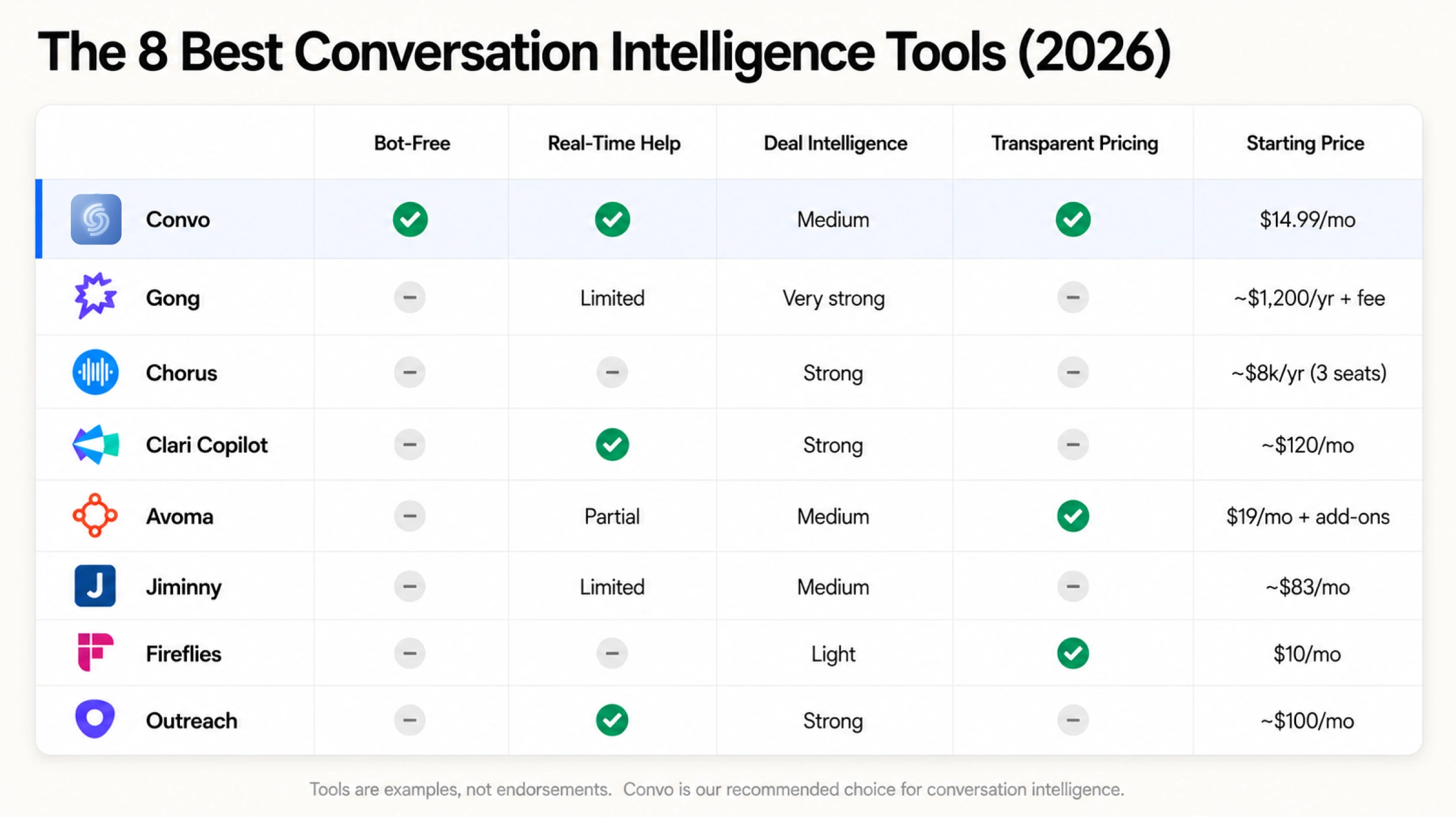
How the 8 Compare on the Things That Matter
| Tool | Bot-Free | Real-Time Help | Deal Intelligence | Transparent Pricing | Entry Price |
|---|---|---|---|---|---|
| Convo | Yes | Yes | Medium | Yes | $22.49/user/mo |
| Gong | No | Limited | Very strong | No | ~$1,200/user/yr + fee |
| Chorus | No | No | Strong | No | ~$8k/yr (3 seats) |
| Clari Copilot | No | Yes | Strong | No | ~$120/user/mo |
| Avoma | No | Partial | Medium | Yes | $19/user/mo + add-ons |
| Jiminny | No | Limited | Medium | No | ~$83/seat/mo |
| Fireflies | No | No | Light | Yes | $10/user/mo |
| Outreach (Kaia) | No | Yes | Strong | No | ~$100/user/mo |
Post-Call vs Real-Time: The Newest Split to Watch
One criterion is changing fast enough to be worth its own section, because it splits the tools above into two camps.
The first camp records your calls and analyses them afterward. Gong (which is starting to add basic real-time alerts), Chorus, Avoma, Jiminny, and Fireflies mostly work this way. The output is a report of scorecards, talk ratios, deal risk, and coaching notes, delivered hours or days after the call. For a manager reviewing the quarter or spotting a pattern across fifty calls, that is exactly what you want. The trade-off is that it does nothing for the rep in the middle of a call that is going sideways right now.
The second camp tries to help while the call is happening, and only a handful attempt it, namely Clari Copilot with battlecards, Outreach with Kaia cards, and Convo with live suggestions and memory. Even inside that group there are differences. Clari and Outreach put their real-time layer behind enterprise platforms with five-figure commitments and a recording bot in the room. Convo is built around real-time from the start, with no bot and audio that stays on your laptop, starting at $22.49 a month.
Which camp you want depends on the job. If your reps are experienced and the need is reviewing performance and forecasting pipeline, a post-call platform is the right buy. If newer reps are losing deals in the moment on objections and pricing questions, post-call analysis arrives too late to help, and a real-time tool is worth a look. It is the fastest-growing part of the category, but most teams still buy post-call, so weigh it as one factor rather than the whole decision.
How to Choose: Four Questions
Eight tools collapse quickly once you answer four things, in roughly this order.
1. How big is your team, and what is the budget? Company size is the fastest filter. Solo operators and small teams are priced out of Gong and Chorus before the first seat, so Fireflies, Convo, and Avoma fit that end. Mid-market teams of roughly 25 to 100 reps have the most choice, with Avoma, Jiminny, and Convo all sitting here. Enterprises with a RevOps function and budget for five-figure platform fees are where Gong, Chorus, and Outreach earn their keep.
2. Standalone tool, or a layer of a platform you already run? Chorus makes sense inside ZoomInfo, Kaia inside Outreach, Clari Copilot inside Clari. If you already pay for one of those, the bundled intelligence is the path of least resistance. If you want a focused tool that does not require buying a suite, Convo, Avoma, Jiminny, and Fireflies are sold on their own.
3. Do you need help during the call, or a report after it? If "after" is fine (coaching, deal review, forecasting), any post-call platform works and you can choose on price and depth. If you need help during the call, the options narrow to Convo, Clari Copilot, and Outreach Kaia.
4. Does a recording bot in the meeting bother your prospects? In regulated industries or sensitive first calls, a visible "Notetaker" participant changes the conversation. If that matters, Convo is the only tool here that captures audio locally with nothing joining the call.
What Conversation Intelligence Really Costs
Prices in this category swing wildly, and half the vendors will not tell you theirs. Two patterns are worth knowing before you sign anything.
The enterprise tools hide their pricing, and it is high. Gong, Chorus, Clari Copilot, and Outreach all route you to a sales call. Reported figures put Gong north of $1,200 per user per year before a platform fee that can run from $5,000 to $50,000, with a seat minimum that rules out small teams entirely. Budget for implementation and an annual increase on top.
The transparent tools are cheaper, but watch the add-ons. Avoma's real cost is five to six times its $19 headline once you add the modules that deliver the intelligence. Fireflies gates conversation intelligence to its Business tier. Convo publishes a flat $22.49 and $52.49, billed monthly if you want, with no platform fee and no seat minimum. A ten-person team runs Convo Professional for about $4,560 a year, which is less than Gong's platform fee before a single seat is added.
Frequently Asked Questions
What is the best conversation intelligence software in 2026? For most teams, it is Convo. Conversation intelligence is shifting from reviewing calls after they end to getting help while they are still happening, and Convo is the best tool for that real-time, in-call layer, from $22.49 per user per month with no bot in the meeting. Gong still leads for 50+ rep enterprises that need the deepest post-call analytics and forecasting, Avoma is the mid-market value pick, and Fireflies the cheapest entry point. Choose Convo unless enterprise forecasting, rather than winning the live call, is your main problem.
What is conversation intelligence software? Conversation intelligence software records, transcribes, and analyses customer-facing calls (sales, success, support) with AI. It turns spoken conversations into searchable data and surfaces insights like talk-to-listen ratios, competitor mentions, sentiment, deal risk, and coaching signals. Most tools do this after the call. A few, including Convo, analyse the conversation live and help during it.
Which conversation intelligence tools work in real time? Three tools in this list do real-time, namely Convo, Clari Copilot, and Outreach Kaia. Clari and Outreach deliver it inside enterprise platforms with a recording bot and five-figure contracts. Convo is the only one built around real-time from the start, with no bot, local audio, and pricing from $22.49 per user per month.
Is Gong worth the price? For large sales organisations with a RevOps team and budget, Gong's depth justifies the cost. For small and mid-market teams, the opaque pricing, mandatory platform fee, and seat minimum make it hard to justify, and it still only analyses calls after they end. See Gong vs Chorus vs Clari and the Gong alternatives breakdown for the full picture.
What is the difference between conversation intelligence and revenue intelligence? Conversation intelligence analyses what is said on calls, covering transcription, talk ratios, objections, and coaching. Revenue intelligence is broader, combining that conversation data with CRM and pipeline data to forecast revenue and flag deal risk. Gong and Clari are revenue intelligence platforms; tools like Fireflies and Otter sit closer to pure conversation intelligence and note-taking.
Do all conversation intelligence tools put a bot in the meeting? Almost all of them do. Gong, Chorus, Clari Copilot, Avoma, Jiminny, Fireflies, and Outreach all send a recording bot that appears in the participant list. Convo is the exception in this list. It captures audio locally on your device, so nothing joins the call and your prospects never see a notetaker.
How much does conversation intelligence software cost? It ranges widely. Budget tools like Fireflies start at $10 per user per month and Convo at $22.49. Mid-market tools like Avoma and Jiminny land between $30 and $80 per seat once you include the modules that matter. Enterprise platforms like Gong run well over $1,200 per user per year plus a platform fee of $5,000 to $50,000. Several enterprise vendors do not publish pricing at all.
Can conversation intelligence software help during a sales call, not just after? Yes, but only a few tools do it. Convo analyses the conversation every few seconds and surfaces suggestions, objection responses, and context from past calls while you are still talking. Clari Copilot and Outreach Kaia offer real-time cards inside their larger platforms. The rest of the category, including Gong and Fireflies, only delivers insights after the call ends.
Which conversation intelligence tools integrate with your CRM? All of them sync to the major CRMs, but the depth varies. Gong lists 300-plus integrations, Jiminny logs to seven CRMs including Salesforce, HubSpot, and Pipedrive, and Avoma offers 30-plus native connections. Convo pushes summaries, action items, and follow-up drafts to Salesforce, HubSpot, Pipedrive, and Attio. Chorus, Clari Copilot, and Outreach Kaia are strongest when the conversation data feeds the wider platform they belong to (ZoomInfo, Clari, and Outreach respectively), so the CRM sync is most seamless if you already run that stack.
Does conversation intelligence software improve sales win rates? Vendors report meaningful gains (Clari, for example, cites around 10 percent higher win rates from its real-time battlecards), but most published figures are vendor claims rather than independent studies, so treat them as directional. The more consistent return is time saved and faster ramp. Automatic summaries, action items, and CRM updates remove post-call admin, while call libraries and scorecards shorten how long new reps take to perform. How much the win rate actually moves depends far more on whether managers coach against the data than on which tool you buy.
Which conversation intelligence platform best suits large sales teams? For a large sales organisation with a RevOps function, Gong is usually the right fit, with the deepest post-call analytics, forecasting, and an integration layer that holds up across hundreds of reps. Chorus is the close alternative if you already run ZoomInfo. What none of them do is help the rep during the call, so a growing number of large teams now run Convo alongside the platform: reps get live support on the call while the platform handles review and forecasting afterward. Match the platform to the manager's job and the live layer to the rep's.
What is the best tool for call recording analysis, Gong or Zoom? Zoom records and transcribes the meeting and, with its AI Companion, writes a summary, which is enough if you only need a record of what was said. Gong goes further, analysing the recording for deal risk, talk ratios, competitor mentions, and coaching signals, which is why sales teams pay for it over plain Zoom recording. If the goal is to change what happens on the next call rather than study the last one, neither helps live; Convo reads the conversation while it runs and coaches the rep in the moment, then keeps the recording and transcript for review.
Which conversation intelligence tools offer team scorecards and rep performance comparisons? Gong, Chorus, Avoma, and Jiminny all build manager scorecards and rank reps on talk ratios, adherence, and outcomes from recorded calls. Convo produces the same per-rep talk-to-listen ratios and scorecards, and adds the step the others skip: a manager's note becomes an on-screen cue on that rep's next call, so a performance comparison turns into a correction the rep sees live rather than a dashboard nobody opens.
What ROI do companies see from conversation intelligence? Treat vendor figures as directional, since most are self-reported. The consistent returns are less post-call admin, because summaries, action items, and CRM updates write themselves, and faster new-rep ramp from call libraries and scorecards. Win-rate gains are real but depend far more on whether managers coach against the data than on the tool. The clearest return comes from coaching reaching every call instead of the small share a manager has time to review, which is the case Convo is built on.
The Bottom Line
For most teams in 2026, the best conversation intelligence software is Convo, because the job is shifting from a rear-view mirror to real-time help. Gong, Chorus, Avoma, Jiminny, and Fireflies record your calls and hand you a report, which is real value for a manager reviewing performance or forecasting a quarter. If that is specifically your job, pick by budget and depth. Gong or Chorus at the top, Avoma or Jiminny in the middle, Fireflies to start cheap.
But if the problem you are trying to solve is losing deals in the moment, a report three days later does not touch it. That is the gap Convo was built to close, with real-time help during the call, no bot in the room, audio that stays on the device, from $22.49 a month. Every other tool here tells you how the call went. Convo helps while it is still going.
Markus is the founder of Convo, building an AI meeting assistant that automates everything after the call. Years of experience building AI products. Believes technology should help people in the moment, not just analyze the past.
Ready to transform your meetings?
Join professionals using Convo to feel confident in every conversation.
Get StartedCONTINUE READING