

Markus Kellermann Founder & CEO
8 Best Sales Call Recording Software in 2026 (Tested & Ranked)
Markus Kellermann Founder & CEO
8 sales call recording tools tested and ranked, with real prices for every team size. See which one helps you win the deal while the call is happening.
TL;DR: Best Sales Call Recording Software in 2026
- Gong runs $130K-200K a year for a 50-rep B2B SaaS team after modules ($1,300-1,600 per user per year base). Seven alternatives cost a fraction.
- The architectural choice that matters most is real-time help during the call (only Convo delivers it) versus post-call analytics (everyone else). Bot in meeting versus bot-free is the second.
- Convo starts at $22.49 per user per month. Gong leads enterprise post-call analytics at $1,300-1,600 per user per year. Avoma ($19 per user per month) is the cheapest mid-market Gong alternative. Fireflies ($10-19 per user per month) has the deepest Salesforce and HubSpot integration.
- Selling mostly by phone? Aircall, CloudTalk and Nooks record dialer calls and have their own section below. Also evaluated: Clari, Wingman, Jiminny, Clay, and Attention (compared against Gong further down).
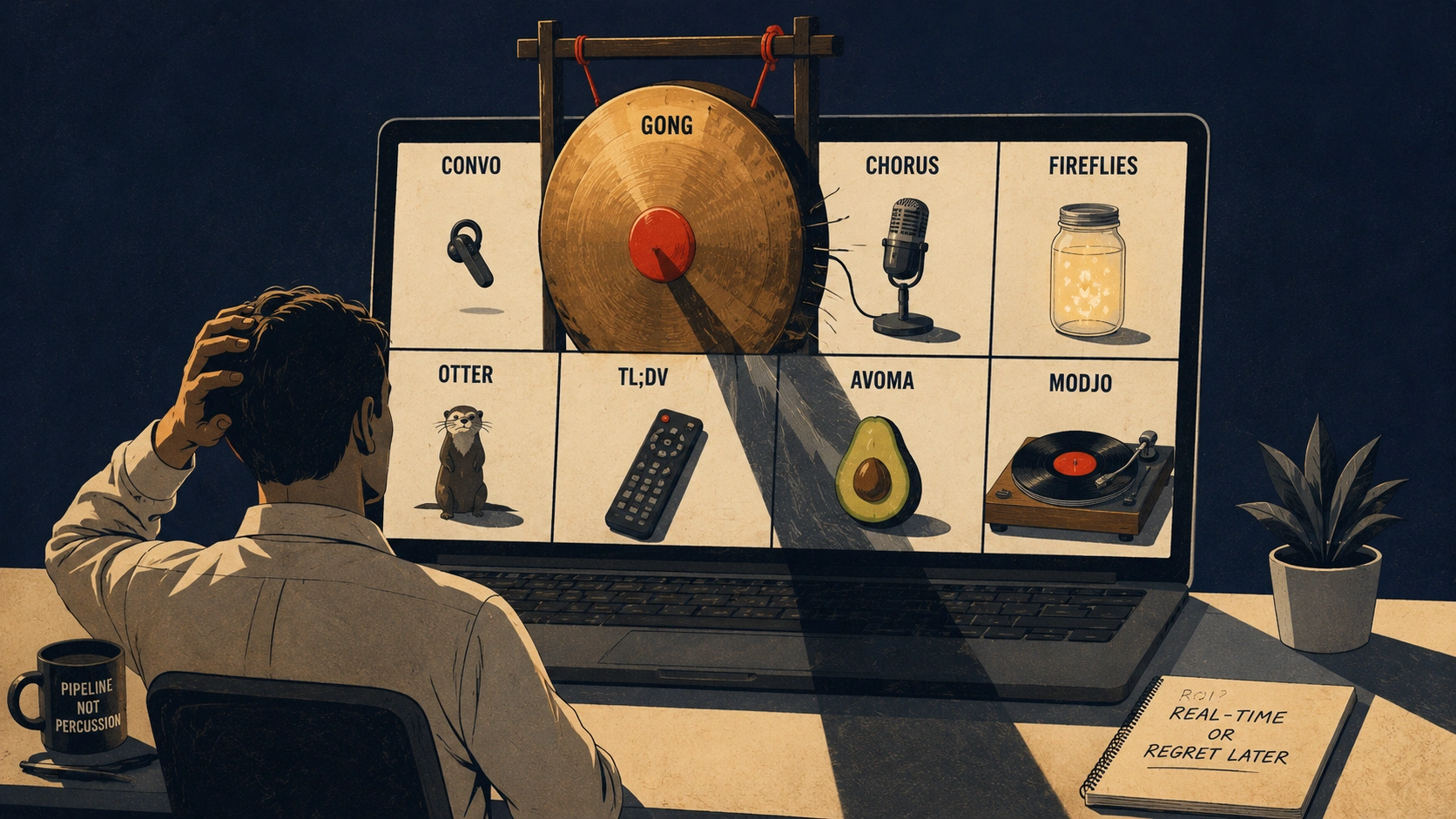
The $130K Question
A 50-rep B2B SaaS sales team running Gong in 2026 will pay somewhere between $130,000 and $200,000 a year by the time you add the modules (Forecast, Engage), the platform fees, and the onboarding services nobody mentions until the contract is on the table. The base license alone is $1,300 to $1,600 per user, smaller teams report quotes on Reddit that are proportionally worse, and what those threads recommend switching to is its own story. Most of the conversations I have with sales leaders about it start with some version of "we are paying that and I am not sure what we are getting that I could not replicate for a quarter of the cost."
That conversation didn't happen this often in 2022. A few things shifted. The underlying transcription stack commoditized. AssemblyAI, Deepgram, and OpenAI Whisper turned 92%+ accurate speech-to-text into a cheap building block, which let new entrants compete on workflow rather than accuracy. Real-time intelligence finally got viable around the same time. Convo provides real-time help while the call is happening rather than in a 24-hour-later review. And the bot-in-the-meeting friction started to be a problem for buyers. Clients who used to tolerate a "Gong Notetaker" participant now ask questions about it, especially in legal, financial, and high-trust enterprise sales.
The result is that a sales team in 2026 has seven serious alternatives to Gong, at price points spanning $6,000 to $72,000 a year for the same 50-rep team. Some are cheaper than Gong on every dimension. One of them (Convo, at roughly $9K to $23K a year) does something Gong does not, regardless of price. This guide covers eight sales call recording tools for Zoom, Google Meet and Teams that I tested across a few months of live client calls, plus the best options for phone and dialer calls. You get what they actually cost, where they break, and the three questions most buyers do not think to ask. If you are specifically replacing Gong, our Gong alternatives for small teams guide goes deeper.
Want the short answer?
A recording can only tell you why the deal died. Convo helps the rep while the deal can still be saved, and you get the recording and summary anyway. Try it free for 7 days.
The Quick Verdict
If you only have a minute, this is the table I wish every "best sales call recording software" article opened with instead of burying pricing under five paragraphs of SEO filler. Gong sits at one end of the price spectrum at roughly $130K a year for a 50-rep team. The other seven tools land between $6K and $72K.
| Tool | Best For | Bot in Meeting | Real-Time Help | Starting Price |
|---|---|---|---|---|
| Convo | Real-time help during the call | No | Yes | $22.49/user/month |
| Gong | Enterprise revenue intelligence | Yes | No (post-call only) | ~$1,300-1,600/user/year |
| Chorus (ZoomInfo) | Bundled with ZoomInfo data | Yes | No | ~$1,200/user/year |
| Fireflies.ai | CRM automation | Yes | No | $10/user/month |
| Otter.ai | Searchable transcript archives | Yes | No | $16.99/month |
| tl;dv | Light teams, generous free plan | Yes | No | $18/user/month |
| Avoma | Mid-market alternative to Gong | Yes | No | $19/user/month |
| Modjo | European sales teams (GDPR-first) | Yes | Limited | Custom (~$80/user/mo) |
The longer answer follows.
What Sales Call Recording Software Actually Does in 2026
The category used to be a black box that turned audio into text and stored it somewhere your manager could find later. That is not what these tools are anymore. Strip away the marketing and a 2026 sales call recording platform does five things.
It captures the audio, either through a bot that joins the call as a visible participant or by listening to your device's output locally. The architectural choice has bigger consequences than most buyers realize. More on that in the next section.
It transcribes the conversation using one of the three or four commodity speech-to-text models that now dominate the market. Accuracy in 2026 sits around 90 to 95 percent in clean audio across every tool here. Differences at this layer are small and shrinking every quarter.
It generates a summary, action items, and a follow-up email draft within seconds of the call ending. This used to be a feature. It is now expected at every tool.
It pushes the data into your CRM as a call activity, with deal stage, contact, and account properly mapped. Fireflies, Chorus, and Gong have the deepest CRM workflows. The rest do the basics through Zapier or Make.
It surfaces patterns across calls so a manager can spot what good reps do that struggling reps do not. Talk-to-listen ratio, monologue length, objection frequency, competitor mentions. This is where the prices start diverging hard. Gong's enterprise version of this analytics layer is what justifies the $1,600 per seat. Whether it is worth that to your team is the actual buying decision.
Two newer capabilities sit on top of this base, and they are where the category is moving.
Real-time help during the call. Suggestions surface while the rep is still on the line. An objection response framework appears when pricing comes up. The exact quote from a previous call surfaces when a prospect references something they said three weeks ago. A reminder to ask the discovery question they skipped. The right sales closing technique surfaces on screen the moment the conversation calls for it. Convo is currently the only tool in this guide that delivers this in the form most sales reps would actually use. Gong, Chorus, and Allego deliver "coaching" as a post-call scorecard, which is a fundamentally different product.
Bot-free capture. Audio is recorded from your device locally, with nothing joining the meeting as a participant. Convo and a few others take this approach. Gong, Chorus, Fireflies, Otter, and tl;dv all put a visible bot in the meeting. The friction matters more in some sales cycles than others, and it never matters less than buyers think going in.
The Two Architecture Questions Most Buyers Skip
Pricing transparency is one issue. The harder buying decision is structural. Two architectural choices baked into each of these tools will determine whether the platform actually changes how your team sells or just produces a different shape of meeting notes.
Question 1: Bot in the meeting, or audio from the device?
When Fireflies or Gong joins your sales call, your prospect sees "Fireflies Notetaker" or "Gong" in the Zoom participant list. Some prospects do not notice. Most do. A meaningful fraction of them ask about it, and a smaller but non-trivial fraction get cautious and talk less for the rest of the conversation.
That friction shows up most clearly in four sales contexts:
- Legal, financial, and healthcare sales, where prospects are trained to notice recording disclosures
- Enterprise procurement conversations, where buyers are unusually privacy-aware
- First discovery calls, where trust has not been established yet
- Any call with a privacy-conscious individual buyer, which now includes a meaningful share of European prospects
Convo and a couple of others avoid this by capturing audio locally from the device. Nothing joins the meeting. Your prospect has no visible signal that AI is processing the conversation. This matters more than the average sales VP estimates until they compare bot-on versus bot-off close rates in their own pipeline.
Question 2: Coaching during the call, or coaching after?
Every tool in this guide records the call and produces analysis afterward. The post-call review workflow is mature. A manager opens the recording, watches at 1.5x, fills out a scorecard, and gives the rep feedback in the next one-on-one. Three to seven days later.
By the time that feedback arrives, the rep has had ten more conversations, the deal has moved on, and the moment the coaching was supposed to fix has passed.
Real-time help is structurally different. The suggestion shows up on screen while the conversation is still live. When the prospect raises a price objection, a response framework appears within seconds. When a client references something from a previous call, the exact quote surfaces automatically. The rep adjusts in the conversation, not in next month's review.
This architecture is not a feature you can bolt onto a post-call tool. Either the suggestion arrives during the call or it does not. Convo is the only tool in this guide built around the during-the-call architecture. The others can build dashboards and scorecards better than Convo can. None of them currently help the rep on the call that is happening right now.
| Capability | Post-call architecture | Real-time architecture |
|---|---|---|
| Coaching delivery | 24 to 72 hours after the call | Live, while the call is happening |
| Tools | Gong, Chorus, Fireflies, Otter, Avoma, Modjo | Convo |
| Manager workflow | Recording review plus scorecard | Real-time visibility into rep's screen |
| Rep impact | Improves the next quarter | Improves the next sentence |
| Best for | Documenting and reviewing past calls | Adjusting the next answer in conversation |
What Is the Best Sales Call Recording Software in 2026?
I co-founded Convo. It goes first in this list because it is the only tool here that delivers coaching during the call, which is the gap I think matters most for sales teams in 2026. Below, what Convo does, what it does not do, and then a fair shake at the other seven.
1. Convo - Best for Real-Time Help During the Call
Convo is a sales call recording and conversation intelligence platform that runs locally on Mac, Windows, and Linux, captures audio without joining the meeting, and surfaces coaching suggestions while the call is still happening. I built it because every other tool in this list told reps what they should have said after the deal was already lost.
Bot in meeting: No / Real-time help: Yes / Pricing: $22.49/user/month Starter, $52.49/user/month Professional (annual billing)
What Convo does that the others do not:
- Coaching suggestions during the conversation. Convo analyzes the call every few seconds, detects what type of conversation you are in (discovery, demo, negotiation, objection handling), and surfaces relevant guidance on screen. The suggestions appear in a separate window that only you can see. Your prospect has no idea the AI is there.
- Memory across every call you have ever had with that account. When a prospect references "what we discussed last quarter," Convo surfaces the exact quote from the right meeting in under a second. No more "let me pull that up and circle back."
- Local audio capture. Nothing joins the meeting. Your prospects do not see a "Convo Notetaker" in the participant list. For sensitive sales conversations (legal, finance, healthcare, regulated enterprise), this is the difference between using AI in your calls and not using it at all.
- Conversation analytics that ladder up to coaching, not dashboards. Talk-to-listen ratio updates live during the call. Reps see the number move on screen and adjust in real time, which is closer to how a sales coach actually intervenes than a post-call dashboard ever was.
- Same-day deployment, monthly billing, no implementation fees. A 50-rep team is up and running before lunch. Convo Professional for that team costs $22,800 per year. Gong for the same team starts around $80,000 and lands closer to $130,000 to $200,000 after modules and platform fees.
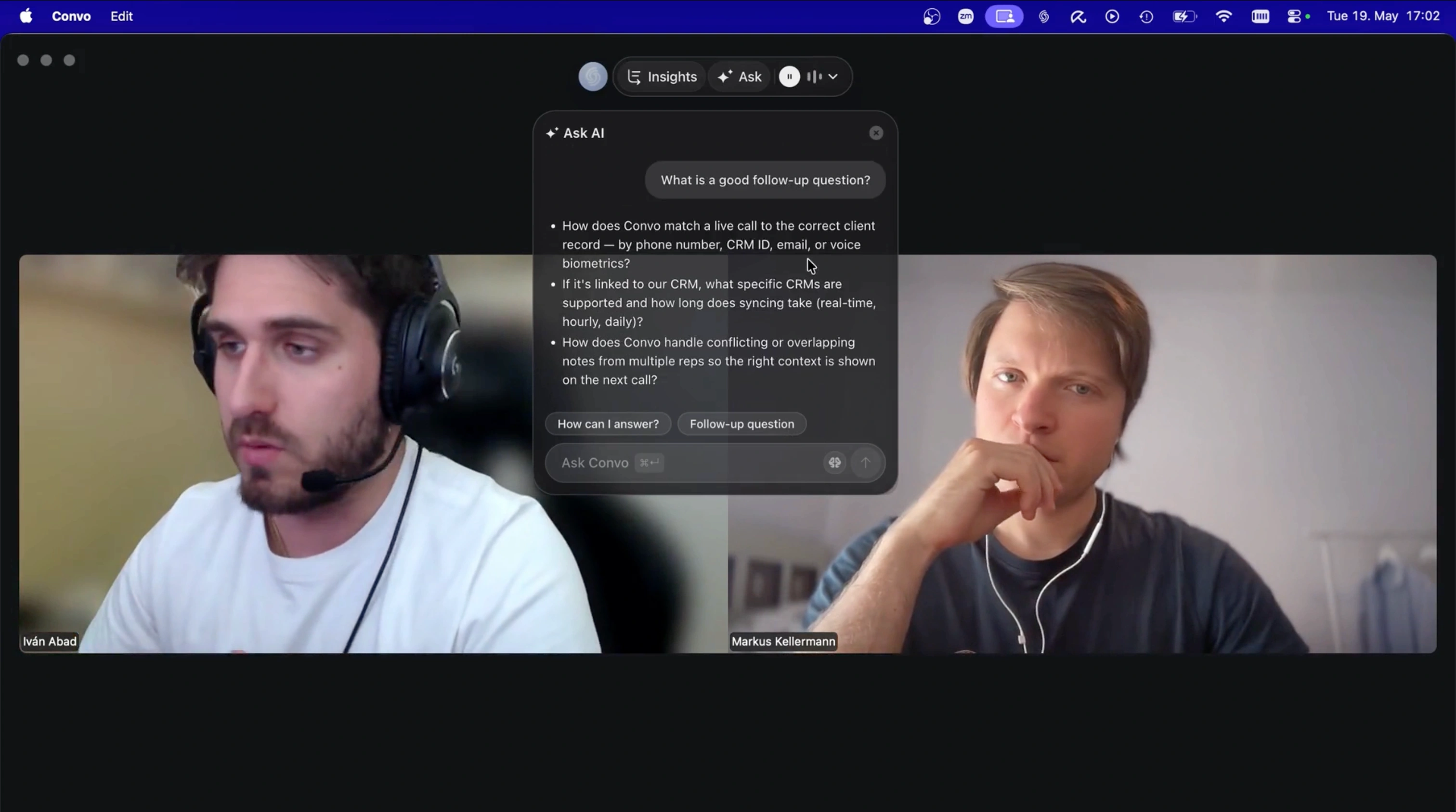
Convo's coaching appears while the call is still live, not in a recording you review three days later.
What Convo does not do yet:
- Library-grade content management. If you want a content portal that marketing fills with battle cards and case studies, pair Convo with Seismic, Highspot, or Spekit. I covered that tradeoff in the sales enablement platforms guide.
- CRM auto-push at Fireflies's depth. Convo writes the call summary and drafts the follow-up email in 30 seconds, then pushes to Salesforce, HubSpot, Pipedrive, and Attio. The deepest field-level CRM workflows that Fireflies and Avoma have built for sales ops teams are still on the Convo roadmap.
- A bot for users who actually want one. Some teams prefer a visible recording disclosure for compliance reasons. Convo's bot-free architecture is a deliberate choice, not a fallback, and it is not right for every workflow.
Best for: Sales teams who care more about the next call going better than about reviewing the last one in higher resolution. Founders and AEs running discovery calls where every conversation counts. Mid-market sales orgs (10 to 100 reps) who want conversation intelligence without the $130,000+ Gong price tag.
Worst for: Enterprise sales orgs that have standardized on Gong, have dedicated enablement headcount running post-call review workflows, and need every feature in the Gong ecosystem (forecasting, deal warnings, MEDDIC scoring). For those teams, Convo is a coaching layer to pair with Gong rather than a replacement.
For a deeper look, see the full Convo vs Gong breakdown, the AI sales coach page for the live-coaching layer on its own, and the conversation intelligence overview.
2. Gong - Best for Enterprise Revenue Intelligence
Gong is the category leader by revenue and the platform every other tool here is implicitly compared to. The product is mature, the analytics are deep, and the customer base skews enterprise. It is also the most expensive tool in this list by a meaningful margin.
Bot in meeting: Yes / Real-time help: No (post-call only) / Pricing: ~$1,300 to $1,600/user/year base, plus platform fees and module pricing
The $130K math. Here is how a 50-rep Gong deployment lands at six figures. The base license at $1,300 to $1,600 per user puts you at $65,000 to $80,000 a year for seats alone. Add the modules that used to sit in the base bundle (Forecast for pipeline analytics, Engage for outreach workflows) and you are looking at another $30,000 to $50,000 depending on how many you take. Platform fees and one-time onboarding services typically add $20,000 to $50,000 in year one. Realistic total contract value for a 50-rep team runs $130,000 to $200,000. That is before the 5-15% renewal uplift that almost every Gong customer reports at year two.
What Gong does well:
- The deepest call analytics in the category, with strong deal warnings, topic tracking, and competitor mention detection
- Mature integrations with Salesforce, HubSpot, and the broader revenue stack
- Forecasting and deal intelligence modules that go well beyond pure call recording
- Strong enterprise compliance posture (SOC 2 Type II, ISO 27001, HIPAA available)
What Gong does not do well:
- Pricing keeps moving in one direction. Effective per-user pricing rose from approximately $160/user/month in 2023 to $200-250/user/month by 2026, a 25-56% increase depending on the bundle. The full Gong pricing breakdown covers the tier math
- Forced module bundling. Features that used to be in the base tier (forecasting, advanced analytics) are now paid modules
- No real-time help during the call. "Coaching" in Gong means a scorecard a manager fills out after watching the recording
- Bot is visible in every meeting, with all the prospect-friction implications that creates
- No free trial, no monthly billing, no seat-reduction flexibility mid-contract
Best for: Enterprise sales orgs (100+ reps) with dedicated revenue operations headcount that will operate the platform full-time and the budget to absorb $130,000 to $200,000 per year in license and module costs.
Worst for: Mid-market and SMB teams. The price-to-value ratio gets brutal below 50 reps. See the Gong alternatives breakdown for the realistic options at smaller scale.
3. Chorus (ZoomInfo)
Chorus is the conversation intelligence platform inside the ZoomInfo data stack. Since ZoomInfo's 2021 acquisition, Chorus has been the call recording layer for teams whose primary procurement decision was the ZoomInfo contact database, with conversation intelligence bundled in.
Bot in meeting: Yes / Real-time help: No / Pricing: ~$1,200/user/year (typically bundled within ZoomInfo contract)
What Chorus does well:
- Tight bundling with ZoomInfo contact and intent data
- Strong Salesforce integration and call activity logging
- Solid post-call analytics, especially for mid-market sales orgs already paying for ZoomInfo
What Chorus does not do well:
- Standalone pricing is opaque and typically only competitive when bundled with broader ZoomInfo spend
- The ZoomInfo auto-renewal trap covered in my B2B sales intelligence guide applies here. Contracts auto-renew unless cancelled 60 days in advance, with no monthly billing option
- No real-time help
- Innovation pace has slowed since the acquisition, and Salesloft's late-2025 combination with Clari has added competitive pressure
Best for: Sales teams already paying for ZoomInfo who want conversation intelligence without a second vendor relationship.
Worst for: Standalone CI buyers. As a pure call recording platform, several tools in this list deliver more for less. See the Chorus alternatives page for realistic standalone options.
4. Fireflies.ai
Fireflies is the cheapest credible CI platform in this list, the most CRM-integrated, and the one with the widest Zapier coverage. The tradeoff is that it leans hard on the bot-in-the-meeting architecture and processes everything in the cloud.
Bot in meeting: Yes / Real-time help: No / Pricing: Free (400 min transcription + storage), Pro $10/user/month, Business $19/user/month
What Fireflies does well:
- A real free plan with 400 minutes of transcription and storage
- Best CRM sync of any tool in this list, with deep field-level automation for Salesforce and HubSpot
- 7,000+ integrations via Zapier
- Solid conversation analytics: talk-to-listen, topic tracking, sentiment
What Fireflies does not do well:
- Bot is visible in every meeting
- Significant cloud privacy footprint. A class action filed in December 2025 alleges biometric voiceprint collection without consent under Illinois BIPA
- No real-time help
- Several universities (Cornell, Oxford) have institutionally blocked Fireflies bots from internal meetings
Best for: Sales teams whose CRM is the source of truth and whose primary need is auto-pushing call activity into Salesforce or HubSpot. See the Fireflies AI review and the Convo vs Fireflies comparison.
Worst for: Privacy-sensitive sales contexts (legal, healthcare, regulated finance) or any team where prospect-visible bots create friction.
5. Otter.ai
Otter is the longest-running tool in this list and the one with the strongest transcription accuracy, around 93 to 95 percent in clean audio. The product was built as a meeting transcript archive, and that is still where it is strongest.
Bot in meeting: Yes / Real-time help: No / Pricing: Free (300 min/month), Pro $16.99/month, Business $30/user/month
What Otter does well:
- Best transcription accuracy in the category
- Strongest speaker identification on calls with three or more participants
- Deepest meeting archive search across past conversations
- Solid mobile apps
What Otter does not do well:
- Stingy free tier (300 minutes/month, 30-minute per-conversation cap)
- AI summaries are fine but not best-in-class
- No real-time help
- Bot is visible in every meeting
- CRM integrations are thinner than Fireflies or Chorus
Best for: Sales teams that constantly reference past meetings and need the strongest search across a multi-year archive. See the Otter AI review and the Otter vs Fireflies vs Fathom comparison.
6. tl;dv
tl;dv is the lightweight option here. Built for solo operators and small teams who want clean meeting notes and a generous free plan, not a full conversation intelligence stack.
Bot in meeting: Yes / Real-time help: No / Pricing: Free (10 AI notes/month), Pro $18/user/month (annual), Business $98/user/month
What tl;dv does well:
- Strong free plan with 10 AI meeting notes per month
- Excellent moment clipping and shareable timestamped highlights
- 30+ language support, the strongest localization in this list
What tl;dv does not do well:
- Recordings on the free plan delete after 3 months
- No CRM, Slack, or Notion sync on the free tier
- The Business plan price jump ($18 to $98) is steep
- Bot still joins the meeting
Best for: Solo founders and small teams who need meeting notes more than they need a sales coaching platform.
My tl;dv review covers the desktop workflow and free-plan restrictions in more detail.
7. Avoma
Avoma sits between consumer tools and enterprise platforms. It bundles meeting notes, conversation intelligence, scheduling, and basic CRM auto-save into one product at a mid-market price.
Bot in meeting: Yes / Real-time help: No / Pricing: Startup $19/user/month, Organization $29/user/month, Enterprise $39/user/month
What Avoma does well:
- Real conversation intelligence at roughly one-fifth of Gong's per-user cost
- Built-in meeting scheduler reduces tool sprawl
- HIPAA compliance available on Enterprise
What Avoma does not do well:
- Modular add-ons (Revenue Intelligence, Lead Router) inflate the bill quickly
- Heavier setup than consumer tools
- Bot in every meeting
- No real-time help
Best for: 10 to 50 person sales teams who want conversation intelligence without the enterprise Gong price tag. Our Avoma vs Gong comparison goes through the two side by side.
8. Modjo
Modjo is the European entry. Headquartered in Paris and built with GDPR compliance as a primary design constraint rather than an afterthought. The product is strongest with European sales teams selling into the EU.
Bot in meeting: Yes / Real-time help: Limited (some live signals) / Pricing: Custom, typically $80 to $120/user/month
What Modjo does well:
- GDPR-first architecture with European data residency
- Strong French, German, Italian, and Spanish language coverage
- Solid CRM integrations for European sales stacks (Pipedrive, HubSpot)
What Modjo does not do well:
- Custom pricing only, on the higher side of mid-market
- Smaller US presence and ecosystem
- Limited live coaching capabilities
- Bot in every meeting
Best for: European sales teams with strict EU data residency requirements and multi-language conversation needs.
Recording Phone and Dialer Calls
The eight tools above are built for video calls on Zoom, Google Meet and Teams. If your team sells mostly by phone, the recording usually comes from the phone system itself.
| Tool | Best for | Starting price | What to know |
|---|---|---|---|
| Aircall | Sales teams calling from local numbers in several countries | $30 per licence a month, billed annually | Minimum of three users. Call summaries and conversation intelligence need the Professional plan at $50. |
| CloudTalk | Small teams that want recording on every plan | €19 per user a month, billed annually | Call recording is included on all plans, including Lite. |
| Nooks | SDR teams making a high volume of calls | Quote only | Vendr reports a median contract of $30,105 a year. |
Other Tools We Evaluated (But Did Not Make the Main List)
A handful of adjacent tools came up during testing without earning a dedicated section in this guide. They are worth knowing if your stack already includes one.
Clari is primarily a revenue intelligence and forecasting platform with conversation features attached; it competes more with Gong's enterprise stack than with the recording-first tools, and pricing typically lands in the same six-figure range. Wingman (now part of Clari) and Jiminny are mid-market conversation intelligence platforms positioned similarly to Avoma but with lighter analytics depth. Dialer-first platforms such as Aircall and Nooks are covered in the phone section above. Clay is an AI prospecting platform rather than a recording tool and sits outside this comparison entirely.
Attention vs Gong
Buyers researching this category keep comparing Attention and Gong, so it deserves a straight answer. They share the same architecture. Attention joins your meetings as a participant, in its own words you "have Attention join all your calls", then records and transcribes them in 100+ languages, grades each call against MEDDIC, BANT, or custom scorecards, and auto-fills CRM fields afterwards. That is a younger, automation-heavier take on the Gong workflow, not a different kind of product. Pricing is quote-based, with nothing published.
The sorting question between them is contract depth. Gong brings the deepest analytics, the mature ecosystem, and the six-figure contract math covered above. Attention brings a lighter, more automated version of the same post-call motion for revenue teams that want scorecards and CRM hygiene without the Gong rollout. Neither helps the rep while the conversation is still happening. If that is the capability you were hoping the comparison would settle, it lives in a different category, the AI sales coach architecture, mapped tool by tool in the real-time sales coaching software guide.
What Does Sales Call Recording Software Cost in 2026?
Most "best sales call recording software" articles avoid this table because the enterprise vendors prefer it that way. I do not.
| Tool | Monthly | Annual (per user) | 50-rep team annual | Notes |
|---|---|---|---|---|
| Fireflies Pro | $10/user | $120 | $6,000 | Cheapest paid tier; bot-based |
| Otter Pro | $16.99 | $204 | $10,200 | Per-user, not per-seat |
| tl;dv Pro | $18/user (annual) | $216 | $10,800 | Free plan exists |
| Avoma Startup | $19/user | $228 | $11,400 | Mid-market CI |
| Fireflies Business | $19/user | $228 | $11,400 | Deeper CRM workflows |
| Convo Starter | $22.49/user | $270 | $13,500 | Real-time help at this price is unique |
| Avoma Enterprise | $39/user | $468 | $23,400 | Modular add-ons can double this |
| Convo Professional | $52.49/user | $630 | $31,500 | Full real-time help, memory, analytics |
| Modjo (custom) | ~$80-120/user | ~$960-1,440 | $48,000-72,000 | European focus, custom contracts |
| Chorus (bundled) | ~$100/user | ~$1,200 | $60,000 | Almost always sold with ZoomInfo |
| Gong base | ~$110-135/user | ~$1,300-1,600 | $65,000-80,000 | Before modules and platform fees |
| Gong with modules | ~$200-250/user | ~$2,400-3,000 | $120,000-150,000 | Realistic total contract value |
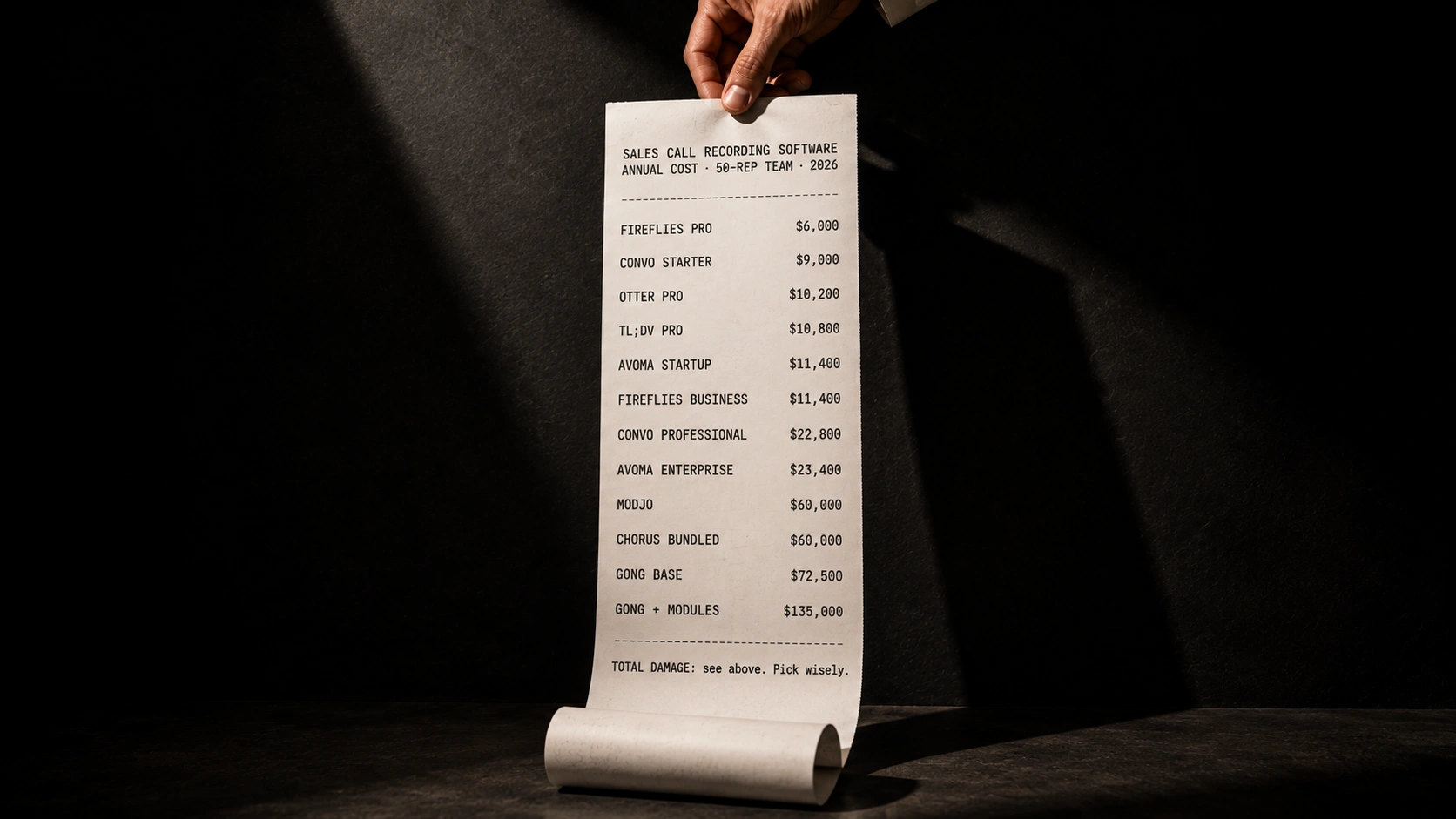
Three patterns sit underneath that table.
First, the per-user gap between the cheapest real-time help platform and the most expensive post-call enterprise platform is roughly 10x. Second, none of the enterprise vendors publish pricing on their websites. Everything above the $40/user line is derived from Vendr procurement data, G2 reviews, and customer-reported quotes. Third, the post-call versus real-time architecture difference is orthogonal to price. Convo at $22.49 does real-time help that Gong at $130,000 a year does not.
If your team is shopping at the enterprise tier, push hard on these specifics before signing:
- Per-user price cap at year-2 renewal, in writing
- Seat-reduction clause (default Gong contracts do not allow seat reductions mid-term)
- What is in the base bundle versus paid modules
- Cancellation window (especially for Chorus/ZoomInfo, where 60-day auto-renewal is the default)
If you want the real-time help layer of this stack without the enterprise contract overhead, try Convo free for 7 days. Same-day setup, monthly billing, drop seats whenever the team shrinks.
Is Sales Call Recording Legal?
The short answer is yes, with consent rules that vary by jurisdiction. The longer answer matters because getting this wrong is a fast way to invalidate every recording you have made.
United States. Federal law and most states use one-party consent, meaning one participant in the conversation (often the rep) can legally record without notifying the other party. Eleven states require all-party consent (sometimes called two-party). They are California, Connecticut, Delaware, Florida, Illinois, Maryland, Massachusetts, Montana, New Hampshire, Pennsylvania, and Washington. If your prospect is physically located in one of these states, all parties must be notified before recording starts.
The safe practice across all US states. Open every call with a consent line that is clear, brief, and explicit before any substantive conversation, something like "I am recording this call for note-taking purposes. Are you comfortable with that?" Most tools in this list, including Convo, can be configured to surface this prompt at the start of a call or to pause recording until consent is acknowledged.
Europe (GDPR). The General Data Protection Regulation treats voice recordings as personal data. All participants must be informed of the recording, given the purpose, and given a path to access or delete the recording. Practically, this means an explicit consent line at the start of every call, plus a documented data retention policy. EU data residency is a hard requirement for many regulated industries. Modjo's EU-first architecture is specifically designed around this.
The bot versus bot-free distinction matters here too. When a recording bot joins a meeting, the disclosure is visual and explicit. The prospect sees "Recording" on screen and a participant labeled accordingly. When a tool like Convo captures audio locally without joining the meeting, the disclosure is your responsibility as the rep. The legality is identical. The workflow is different.
Class actions and consent litigation in 2025-2026. Several conversation intelligence vendors have faced consent litigation in the last year. A class action filed in December 2025 alleges Fireflies collected biometric voiceprints without consent under Illinois BIPA. Several universities (Cornell, Oxford, Cambridge) have institutionally blocked recording bots from internal meetings. The legal landscape is tightening, and "we forgot to ask" is no longer a defensible position.
For a deeper read, see is it illegal to record someone without their permission.
How to Choose: Three Questions That Decide the Tool
Eight tools is a lot. Three questions narrow it down.
1. Do you want help on the next call, or analysis of the last one?
If you want help on the next call, choose Convo. It is the only tool in this list that delivers coaching during the conversation rather than after. The other seven all deliver post-call analysis in slightly different shapes.
If you want analysis of the last one, any of the others, picked on price and CRM fit. Gong is the gold standard if budget is no object. Avoma is the credible mid-market alternative. Fireflies is the cheapest credible option.
2. Does a visible bot in your meetings hurt your sales motion?
If yes (legal, financial, healthcare, high-trust enterprise, European buyers), Convo is the only tool here that avoids the participant-list disclosure.
If no (internal calls, top-of-funnel B2B SaaS, transactional inside sales), any tool in this list works, and the bot architecture is not your deciding factor.
3. Where does the meeting data need to live?
If the answer is "auto-pushed into Salesforce or HubSpot with field-level mapping", go with Fireflies or Chorus. Avoma is third.
If the answer is "a searchable archive my whole team can query for past conversations", it is Otter, with Gong as the enterprise alternative.
If the answer is "the rep's screen, while the call is happening", it is Convo.
If the answer is "anywhere, I just need a transcript I can email myself after", use tl;dv or Otter on the free tier.
The Bottom Line
The sales call recording software category is more crowded and more useful than it was three years ago. Eight credible tools cover a price range from free to $1,800 per user per year, and the cheapest tool in this list does something the most expensive one does not. It helps your rep on the call that is happening right now.
If you are shopping for a sales call recording platform in 2026:
- Decide on the architecture first. Bot versus bot-free, real-time versus post-call. The vendor decision follows from there.
- Pilot with one team for 30 days. Every tool in this list has either a free plan or a trial. Use it before signing an annual contract.
- Do not overpay for analytics dashboards you will not open. 75% of sales leaders log into their enablement platform fewer than five times per quarter, per Highspot's own data. Sales call recording has the same adoption problem at the enterprise tier.
- Prioritize the coaching pillar. Whichever tool you pick, the highest ROI from sales call recording in 2026 comes from making the next call better, not from documenting the last one in higher resolution. Convo was built specifically for that, and you can try it free for 7 days.
For broader context on the conversation intelligence category, see conversation intelligence, the Convo vs Gong comparison, and the revenue intelligence breakdown. For the enablement layer that sits above this, see the sales enablement platforms guide. For the rest of the stack, from CRM to proposals, see our guide to the best B2B sales tools.
Frequently Asked Questions
What is sales call recording software? Sales call recording software is a category of tools that capture, transcribe, and analyze sales conversations. Modern platforms go beyond audio storage to provide AI-generated summaries, action items, CRM activity logging, conversation analytics (talk-to-listen ratio, topic tracking, competitor mentions), and in some cases real-time help suggestions delivered during the call. The category includes enterprise platforms like Gong and Chorus, mid-market tools like Avoma and Fireflies, and real-time help platforms like Convo.
Is sales call recording legal? Yes, with consent rules that vary by jurisdiction. The United States uses one-party consent at the federal level and in most states, meaning one party to the conversation can legally record. Eleven states require all parties to be notified. They are California, Connecticut, Delaware, Florida, Illinois, Maryland, Massachusetts, Montana, New Hampshire, Pennsylvania, and Washington. Europe's GDPR requires explicit consent from all participants and treats voice recordings as personal data. The safe practice across all jurisdictions is to open every call with an explicit consent line.
What is the cheapest sales call recording software? Fireflies Pro at $10/user/month is the cheapest paid tier with serious CRM workflows. Convo Starter at $22.49/user/month is the cheapest tier in this list that includes real-time help during the call. tl;dv and Otter both have free tiers with reasonable per-month limits if you do not need full sales analytics. Our AI meeting assistants for sales teams guide compares these tiers side by side.
Do all sales call recording tools put a bot in the meeting? No. Most do, including Gong, Chorus, Fireflies, Otter, tl;dv, Avoma, and Modjo. Convo captures audio locally from the device without joining the meeting as a participant. The bot versus bot-free distinction matters most in sales contexts where prospects are unusually privacy-aware (legal, financial, healthcare, European enterprise).
What is the difference between sales call recording and conversation intelligence? Sales call recording is the underlying capability of capturing and transcribing audio from sales conversations. Conversation intelligence is the analytics and coaching layer built on top, covering talk-to-listen ratios, topic tracking, competitor mentions, deal warnings, coaching scorecards. Every tool in this guide does both to some degree. Gong and Chorus are conversation intelligence platforms with recording built in. Otter and tl;dv lean more toward recording with light analytics. Convo is unique in delivering conversation intelligence during the call rather than after it.
Which sales call recording software has the best CRM integration? Fireflies has the deepest field-level Salesforce and HubSpot automation in this list, with the broadest Zapier coverage at 7,000+ integrations. Gong and Chorus also have mature CRM integrations, with the deepest enterprise workflows around deal warnings, forecasting, and revenue attribution. Convo pushes call summaries, action items, and follow-up drafts to Salesforce, HubSpot, Pipedrive, and Attio automatically.
Does Gong have a free trial? No. Gong does not offer a free trial or free plan. The standard sales process requires a demo, custom quote, and annual contract. Per public pricing breakdowns, per-user pricing rose from approximately $160/user/month in 2023 to $200-250/user/month by 2026. Most of the alternatives in this list, including Convo, Fireflies, Avoma, and tl;dv, offer free trials or free tiers.
Is Attention better than Gong for sales call recording? They solve the same problem with the same architecture. A bot joins the meeting, the call is recorded and transcribed, and the analysis arrives afterwards. Attention grades calls against MEDDIC, BANT, or custom scorecards and auto-fills CRM fields, with quote-based pricing and nothing published. Gong has the deeper analytics, the bigger ecosystem, and the higher price. Neither coaches the rep during the live conversation; for that capability, see the real-time sales coaching software guide. Our MEDDPICC guide explains the framework those scorecards build on.
What is the best sales call recording software for small teams? For small sales teams (1 to 25 reps), the best picks are Convo at $22.49 to $52.49/user/month for real-time help, Fireflies at $10 to $19/user/month for CRM-heavy workflows, and Avoma at $19/user/month for a Gong-style experience at a mid-market price. The enterprise platforms (Gong, Chorus) are priced and implemented for teams of 100+ reps and do not deliver proportional value below that scale.
Can I use sales call recording software for cold calls and phone dialer conversations? Yes, with the caveat that most tools in this list are built primarily for video meetings (Zoom, Google Meet, Teams). If you sell mostly by phone, phone systems such as Aircall and CloudTalk record calls directly, and the phone section above compares them. For phone dialer integration, Fireflies and Gong have mature workflows. Convo captures audio from any application running on your machine, including phone dialer apps. Otter and tl;dv are weaker for phone-only workflows.
How accurate is AI transcription for sales calls in 2026? Across the tools in this guide, transcription accuracy in clean audio sits around 90 to 95 percent. Otter and Gong are slightly ahead at 93 to 95 percent. The remaining tools cluster around 90 to 92 percent. Accuracy drops in noisy environments, with strong accents, or in calls with overlapping speakers. The differences between vendors at this layer have shrunk every year since 2023 and are now small enough that transcription accuracy alone should not drive the buying decision.
Markus is the founder of Convo, building an AI meeting assistant that automates everything after the call. Years of experience building AI products. Believes technology should help people in the moment, not just analyze the past.
Ready to transform your meetings?
Join professionals using Convo to feel confident in every conversation.
Get StartedCONTINUE READING