

Markus Kellermann Founder & CEO
10 Best AI Sales Assistants by Category [2026]
Markus Kellermann Founder & CEO
'AI sales assistant' means four different things. The 10 best tools sorted into outbound agents, prospecting platforms, call assistants, and CRM copilots.
TL;DR: Best AI Sales Assistants in 2026
- "AI sales assistant" is four different products wearing one name. They are autonomous outbound agents (Artisan, 11x, Regie.ai), prospecting data platforms (Clay, Apollo.io), call assistants (Convo live during the call, Gong and Avoma after it), and CRM copilots (Salesforce Agentforce, Lindy).
- Buyers rarely regret the brand they picked. They regret the kind. Diagnose your bottleneck first, whether pipeline volume, data quality, call performance, or CRM admin. Each kind fixes exactly one.
- Real pricing where it exists. Call assistance is the kind with the most transparent entry point (Convo publishes $22.49/user/month), while most outbound agents are quote-based and enterprise analysis platforms run five figures.
- Deals are won or lost inside the conversation, and of the four kinds only the call assistant helps you there. That is Convo's segment, and it is still the least crowded of the four.
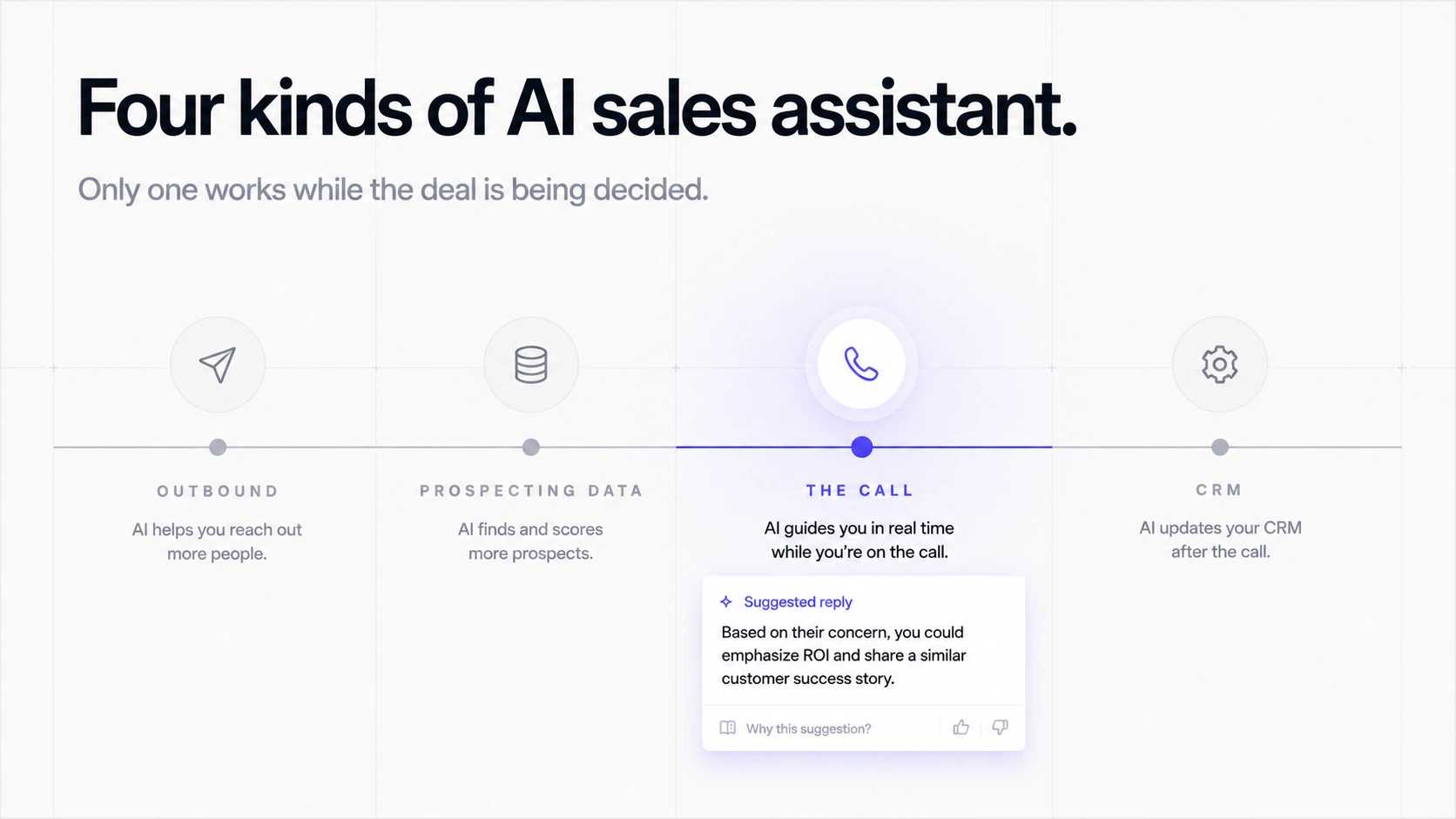
"AI Sales Assistant" Means Four Different Products
Ask an AI engine for the best AI sales assistant and you'll get a list that mixes tools which write cold emails, tools which enrich lead data, tools which analyze your calls, and tools which live inside your CRM. The category genuinely spans the whole revenue motion now, and a list that treats an autonomous SDR and a call coach as interchangeable is how teams end up buying the wrong thing confidently.
Want the short answer?
Every other tool here gets you more meetings or a cleaner CRM. Convo helps you win the call itself, handing you the answer the moment a prospect pushes back. Try it free for 7 days.
What Counts as an AI Sales Assistant (and What Doesn't)
The label gets stapled onto everything, so it helps to be precise. An AI sales assistant does some of the rep's selling itself. Does the tool act inside a revenue moment, or summarize it after the moment is over? Writing the outbound email counts. So does sitting on a live call and feeding the rep the answer when an objection lands. A dashboard that flags a poor talk ratio on Tuesday's calls does not count. It only watches the selling from the outside.
That rules out most CRMs, forecasting dashboards, and transcription tools, whatever their marketing says. The ten tools below earn the name. They just act at four very different points in a deal.
The Field at a Glance
| Tool | Kind | Acts during live calls? | Pricing published? | Best for |
|---|---|---|---|---|
| Convo | Call assistant (real-time) | Yes | Yes ($22.49/user/mo) | Deals decided in conversations; founder-led and small teams |
| Gong | Call analysis (post-call) | No | No (~$1,200/user/yr + platform fee) | Enterprise revenue intelligence |
| Avoma | Call analysis (post-call) | Partial | Yes ($19/user/mo + add-ons) | Mid-market meeting workflows |
| Apollo.io | Prospecting platform | No | Yes (free tier + per-user plans) | Pipeline volume on a budget |
| Clay | Prospecting platform | No | Yes (credit-based) | Data enrichment and creative outbound research |
| Artisan (Ava) | Outbound agent (AI SDR) | No | No (buyers report $2-5k/mo) | Automating top-of-funnel outreach |
| 11x | Outbound agent (AI SDR) | No | No (reported ~$5k/mo, annual) | High-volume autonomous outbound |
| Regie.ai | Outbound agent | No | Yes (from $180/user/mo) | AI sequencing inside existing outreach motion |
| Salesforce Agentforce | CRM copilot | No | Yes (usage-based, ~$0.10/action or $2/conversation) | Salesforce-first orgs |
| Lindy | General agent platform | No | Yes (from $49.99/mo + credits) | DIY sales workflow automation |
Kind 1: Outbound Agents (AI SDRs)
These are the tools most people mean by "AI sales agent" in 2026. They are autonomous systems that research prospects, write personalized outreach, send sequences, and book meetings with minimal human touch. The outcome you're buying is pipeline volume without headcount.
Artisan (Ava)
The best-known name in the segment. Ava researches prospects, writes the emails, runs the sequences, and handles replies until a meeting lands on the calendar. Artisan keeps a public pricing page, but you still finish in a sales call. Buyers report $2,000 to $5,000 a month for meaningful lead volume, on annual contracts usually paid upfront.
Two things to check in a pilot. Ava targets on ICP fit alone, with no read on whether an account is actually in a buying window, so your list criteria decide everything. And buyers who did get meetings report prospects on the calendar with no budget and no authority. The right buy when outbound volume is the only bottleneck and a human vets what Ava books. Skip it if your market is mostly EMEA, where users report the data runs thinner.
11x (Alice)
11x sells the same job with bigger volume ambitions, reportedly around $5,000 a month on an annual commitment, and quotes climb from there. A March 2025 TechCrunch investigation reported companies listed as customers who said they weren't, and churn estimates as high as 70-80%. The Alice 2.0 rebuild since then is a real improvement. Ask for three current references and actually call them anyway. The product complaint that survived the rebuild is outreach that reads machine-written no matter how much ICP detail you feed it.
Regie.ai
The moderate path is AI sequencing and content plugged into the outreach motion you already run, with the rep still in the loop for replies. It is also the one with visible numbers, from $180 per user per month, and a Force Multiplier tier at $499 that adds enrichment credits and a parallel dialer loading up to nine lines at once. G2 reviewers mostly praise how fast sequence building gets, hours of work down to minutes. The recurring gripe is that drafts need a human edit before they go out. The right buy for an SDR team that wants speed without handing over the keys. Skip it if nobody has time to edit AI drafts, because unedited is how you end up in everyone's spam folder.
The honest limits of the whole kind. Reply rates on AI-written outbound have been falling as inboxes fill with it, and none of these tools help once the meeting they booked actually starts. The handoff moment, where an AI-booked prospect meets an unprepared rep, is exactly where the next kind picks up. Convo isn't in this segment and won't pretend to be. If your bottleneck is top-of-funnel volume, buy here, not from us.
Kind 2: Prospecting Data Platforms
Apollo.io and Clay feed the machine with contact data, enrichment, intent signals, and workflow automation for outbound teams. Neither pretends to help on calls; they make sure the right people get contacted with the right context.
Apollo.io
The value pick, and probably the most-bought tool on this list. A real free tier, then published plans from about $49 to $119 per user per month on annual billing, covering a 200M+ contact database, sequencing, and a dialer in one subscription. That consolidation is the whole appeal for a small team, and its G2 score sits at 4.7 across more than 9,000 reviews.
The catch is data quality outside North America. Reviewers report outdated titles and dead phone numbers across European and APAC contacts, and teams commonly see double-digit bounce rates on exported lists, so run a verification step before anything sends. On Trustpilot it scores 2.9, mostly billing disputes. The right buy for pipeline volume on a budget. Skip it if your market lives mostly outside the US, or budget for a separate email verifier if you stay.
Clay
The power tool. Clay chains dozens of data providers and AI research steps into enrichment workflows a good operator can shape into almost anything, like waterfall enrichment, hiring-signal triggers, routing website visitors into sequences. It rebuilt its pricing in March 2026, now from $185 a month plus usage credits, and the credits decide the real bill. Teams fully enriching a thousand contacts a month commonly land between $1,300 and $2,400 all-in once the credit spend settles.
The other cost is time. The most consistent review theme is a learning curve measured in weeks, and teams without a dedicated growth or RevOps person tend to stall before the fancy workflows ever run. The right buy when someone owns outbound data as an actual job. Skip it if you need results in the first month with nobody to drive it.
Skip this whole kind if your pipeline is already full and deals stall in conversations. More data doesn't fix a discovery call that goes sideways; that failure mode belongs to the next kind.
Kind 3: Call Assistants, Where the Deal Actually Closes
Every tool so far works before the conversation. This kind works on the conversation itself, and it splits in two. There are assistants that help after the call, and the smaller set that helps during it. Our meeting assistants for sales teams guide ranks this kind tool by tool.
If you’re buying for yourself, compare AI sales call assistants for individual reps, including one-seat prices and the plans that include live help.
Convo (works during the call)
Teams buy Convo for the thing the other nine cannot do. The live call is where it works, and a winnable deal can turn on a single hard question. It preps the rep going in and writes up the call afterward.
Convo helps you during the call. If a prospect pushes back on price, Convo prompts you with a response before the pause turns awkward. It identifies buying signals that would normally go unrecognized, like budget or who really decides, and nudges the discovery question they would otherwise remember an hour too late. After the call it also handles the post-call work, including summaries, conversation analytics, CRM sync, and a drafted follow-up. In our own pipeline the deal usually turns in the thirty seconds after a tough question, and that is the moment Convo works on. The first week is free.
It is the right buy for founder-led sales, small and mid-size teams, and anyone whose deals are decided live. Skip it if your problem is outbound volume (Kind 1's job) or if you need enterprise forecasting governance (Gong's territory below). For more, see the Convo vs Gong comparison and our sales coaching software guide. If you came here from Cluely, the Cluely alternatives for sales calls roundup maps that field.
Gong (works after the call)
The enterprise standard for post-call analysis, with call libraries, deal intelligence, forecasting, coaching dashboards, built on the category's largest conversation dataset. Budget expectations run high. Reports put it above $1,200 per user annually before a five-figure platform fee, and none of it is published. It earns that cost at fifty-plus reps with a RevOps function. Below twenty reps it's hard to justify, and whatever it finds, it finds after the deal moment is over.
Avoma (works after the call, mid-market price)
The value pick for meeting-centric teams, with recording, AI notes, scheduling, post-call coaching from a published $19/user/month before add-ons. Honest about being mostly post-call. The right buy for 10-50 rep teams that want Gong-shaped analysis without Gong-shaped procurement. Our conversation intelligence guide compares this segment tool by tool.
Kind 4: CRM Copilots and General Agents
Salesforce Agentforce
The native answer for orgs that live in Salesforce, with AI agents handling quoting, data entry, lead follow-up, and service handoffs inside the CRM you already run. Pricing moved to usage in 2026. Flex Credits run $500 per 100,000, a standard agent action burns 20 of them, so call it ten cents per action, or there's a flat $2 per conversation if you'd rather have a predictable bill. The bigger cost sits underneath. Agentforce needs Data Cloud to work properly, and for plenty of buyers that foundation costs more than the agent licensing itself. The right buy for a Salesforce-first org with real CRM admin pain and an admin who owns the rollout. Skip it if your team only opens Salesforce to log activity at the end of the week.
Lindy
The build-it-yourself route is a general agent platform with prebuilt sales templates for lead capture, meeting scheduling, and follow-up automation, from $49.99 a month. Assembling an agent takes minutes and reviewers rate the builder highly. The economics are what to watch. Everything runs on credits that expire monthly, heavier AI models burn roughly ten times more of them, and you only learn what a step cost after it runs. Its Trustpilot score sat at 1.7 in July 2026, dominated by billing surprises. The right buy for a technical founder automating their own workflow who will watch the meter. Skip it for anything that has to run unsupervised.
Both are strongest where the work is structured and repetitive, and weakest in the live human moments where structure disappears.
Where Your Team Fits
Founder doing your own sales. You don't have a volume problem; you have twelve hats and no coach. A call assistant pays for itself in the first saved deal, and Convo was built for exactly this seat. Your best answers show up in every call, and the follow-up admin stops eating your evenings.
Small team, thin pipeline. Volume first, so Apollo for data and sequencing, or an AI SDR if outbound is your whole motion. Add call assistance when the meetings you book start mattering more than how many you book.
Mid-market team with full calendars and flat win rates. The bottleneck is conversion, not volume. Post-call analysis (Avoma, or Gong at scale) tells you why calls fail; real-time assistance changes the call while it's still happening, which is the core of how to win more deals with AI. Teams increasingly run both, analysis for managers and live help for reps.
Enterprise on Salesforce with RevOps. Gong for revenue intelligence, Agentforce for CRM automation, and honestly, Convo only for the pockets of reps who want live help; we're not your governance layer, and the B2B sales intelligence guide maps that bigger stack.
Three Questions Before You Buy
1. Where does revenue leak first? Count backward from missed quota. Not enough meetings booked points to Kind 1 or 2. Enough meetings, poor conversion points to Kind 3. Deals won but data chaos points to Kind 4. Buy exactly one kind, prove the fix, then expand.
2. Act or analyze? Analytics tools produce insight and depend on someone applying it later. Acting tools change the outcome in the moment, like the sent email or the surfaced answer. If nobody on the team has time to apply insight (most small teams), buy tools that act. Convo exists because insight arriving Monday doesn't help a deal that died Thursday.
3. Can you verify the price? Half this market is quote-based. Published pricing (Convo, Avoma, Apollo, Clay) means you can model cost before a sales call; quote-based means budget for the negotiation too. If a vendor won't print a number, assume it's higher than yours.
The Bottom Line
Four kinds, one honest sorting question. Where does your revenue actually leak? An empty calendar points at the outbound agents and prospecting platforms (Artisan, Apollo, Clay). A clean pipeline with chaotic admin points at Agentforce or Lindy. But when the meetings happen and the deals still slip away, the leak is inside the conversations themselves, and nine of these ten tools have already clocked out by then. That last moment is Convo's whole job. The rep walks in briefed, gets the right answer while the prospect is still talking, and walks out with the follow-up drafted. No bot, no quote-based mystery, and the first seven days cost nothing.
Frequently Asked Questions
What is the best AI sales assistant in 2026? It depends on the job, because the category spans four kinds. But if your bottleneck is the live call, the best AI sales assistant is Convo. It gives real-time coaching that handles objections and surfaces context while you are still talking, bot-free, from $22.49/user/month, where Gong and Avoma only analyze calls afterward. For autonomous outbound it is Artisan or Regie.ai, for prospecting data Apollo.io or Clay, and for CRM-native agents Salesforce Agentforce. Match the kind to your bottleneck, and if it is call performance, choose Convo. The live-coaching field itself is compared in our real-time sales coaching software map.
What's the difference between an AI sales assistant and an AI SDR? An AI SDR is one kind of AI sales assistant. It is an autonomous agent that prospects, writes outreach, and books meetings (Artisan, 11x). The broader category also covers prospecting platforms, call assistants like Convo that coach reps during live conversations, and CRM copilots. An AI SDR fills the calendar; a call assistant wins the meeting.
Can an AI sales assistant really help during a live call? Yes, though only a few do. Convo listens locally, then surfaces answers for handling objections, buying-signal flags, and context from past conversations while the prospect is still talking, with no bot in the meeting. Most tools marketed as sales AI, including Gong and the AI SDRs, do their work before the call or after it ends.
How much does an AI sales assistant cost? By kind, prospecting platforms start free to low per-user (Apollo, Clay's credit tiers). Real-time call assistance is a published $22.49/user/month with Convo. Post-call analysis runs $19/user/month (Avoma) to $1,200+/user/year plus platform fees (Gong). Autonomous SDRs are mostly quote-based, and Agentforce is priced per conversation.
Do these tools work with HubSpot and Salesforce? The serious ones all sync to major CRMs. Agentforce is Salesforce-native by definition. Apollo, Avoma, and Gong have deep two-way integrations. Convo pushes summaries, action items, and follow-up drafts into Salesforce, HubSpot, Pipedrive, and Attio automatically after each call.
Are autonomous AI SDRs actually worth it in 2026? They can be, with eyes open. Reply rates on AI-written outbound have fallen as buyers learn to spot it, pricing is rarely published, and the segment has had credibility wobbles (11x's 2025 press cycle among them). They work best when list quality is strong and volume genuinely is the constraint. Pilot on a short contract, measure booked-and-held meetings rather than emails sent, and keep a human editing the first templates.
Can I combine the kinds, and what does a sensible small-team stack look like? Yes, and most growing teams end up with exactly two, one that fills the calendar and one that wins the meetings. A common pairing under $100 per rep is Apollo for data and sequencing plus Convo on the calls themselves, with CRM copilots and enterprise analysis layered in later, once there's enough revenue to govern.
Will an AI sales assistant put a bot in my meetings? The post-call recorders mostly will. Gong, Avoma, and similar tools join calls as a visible participant. Convo takes the opposite route. Audio stays local on the rep's machine, no participant appears in the meeting, and nothing changes how your prospect talks. In regulated industries and first meetings, that's not cosmetic.
Markus is the founder of Convo, building an AI meeting assistant that automates everything after the call. Years of experience building AI products. Believes technology should help people in the moment, not just analyze the past.
Ready to transform your meetings?
Join professionals using Convo to feel confident in every conversation.
Get StartedCONTINUE READING