

Markus Kellermann Founder & CEO
Convo vs Avoma: Which Helps Your Sales Team Win More Deals?
Markus Kellermann Founder & CEO
Convo vs Avoma: a sales team pays about the same for either. One analyzes calls after they end, one helps you in real-time. With 2026 pricing.
TL;DR: Convo vs Avoma in 2026
- Convo and Avoma both put AI on your sales calls but at different moments. Avoma is the all-in-one meeting platform, with scheduling, notes, CRM sync, and call analysis that starts once the call ends. Convo helps you during the conversation by providing live support on what to say next.
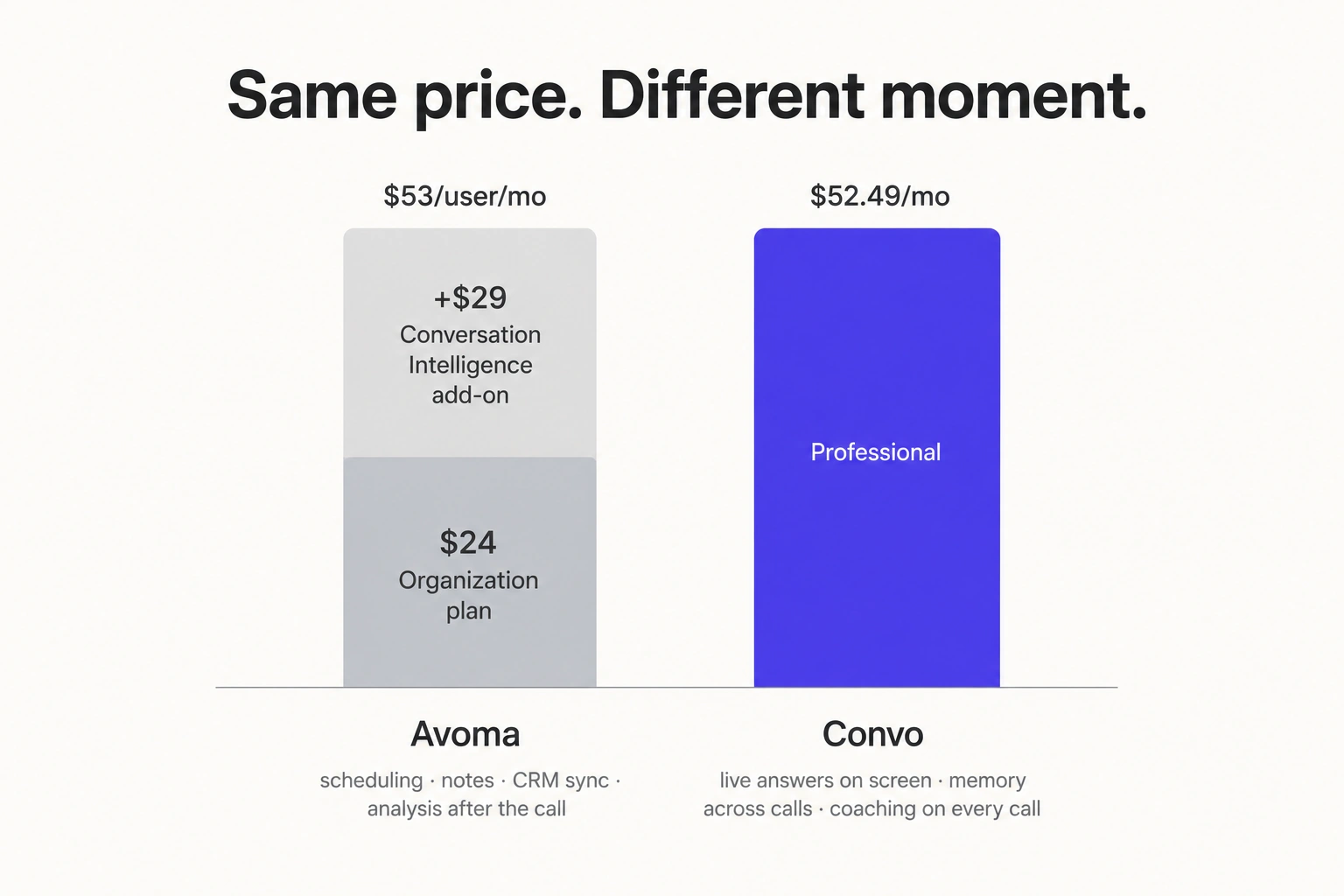
- For a sales team the prices are nearly identical. Avoma's Organization plan plus its conversation intelligence add-on comes to $53 per user per month. Convo Professional is $52.49. Price will not make this decision for you.
- Avoma's live layer is real but scripted. Answer Cards fire when a keyword you configured lands, and stay on screen for 20 seconds. Convo reads the conversation itself, so it helps on the objection you never wrote a card for, and it remembers what this prospect told you three calls ago.
- Convo changes how the call itself goes. The response arrives while you can still use it, and a manager's note from one call becomes on-screen help on the rep's next one. Avoma's job is admin done well, one bill for scheduling, notes, and Salesforce sync. If your deals are decided live, try Convo free.
The 10-Person Sales Team Asking "Avoma vs Convo"
"Avoma vs Convo for a 10-person sales team?"
Someone asked ChatGPT exactly that question a few weeks ago. I know because I check what AI assistants tell buyers about us, the same way you would read your own reviews. The answer it produced pulled six pages from Avoma's site, one page from ours (the pricing table), and recommended Avoma.
I'm the founder of Convo, so read this with that in mind. The verdict itself bothered me less than the reason for it. The machine had almost nothing of ours to read. Avoma has a published page for nearly everything it ships. We had prices.
So this is the missing page. Real numbers from both pricing pages, checked this week. A precise description of what each product does while your prospect is talking, because the entire difference between the two lives there. And an honest list of the places Avoma is simply the better buy, because there are some.
Want the short answer?
Convo is the only one of the two that helps while the deal is still live. The objection gets answered on your screen as it lands, and what this prospect told you three calls ago surfaces the moment it matters. Avoma earns its place when the job is scheduling, notes, and CRM sync on one bill.
Convo vs Avoma at a Glance
| Convo | Avoma | |
|---|---|---|
| Built for | Winning the live call | Running the whole meeting workflow |
| Core question | "What do I say right now?" | "Can one tool handle scheduling, notes, and analysis?" |
| Real cost for a sales team | $52.49/month Professional ($22.49 Starter) | $24/user/mo + $29 CI add-on, about $53 |
| Real-time help | Reads the conversation, works on unscripted objections | Answer Cards, keyword-triggered, 20 seconds on screen |
| Memory across calls | Briefs you on this prospect's history before and during the call | Searchable archive, no live recall |
| Manager layer | Team view, per-rep talk ratios, Save-as-Cue | Scorecards and coaching after the call (add-on) |
| Bot in meeting | No | Yes (Avoma Notetaker) |
| CRM | Attio native, Zapier and Make for the rest | Salesforce and HubSpot native |
| Setup | 2 minutes | Days |
| Trial | 7-day free trial | 14-day free trial |
Two Products Built From Opposite Ends
Avoma started from the subscription pile. Before it, a revenue team ran its meetings on four separate products, something for booking, something for notes, something for conversation intelligence, something for routing inbound leads, each with its own bill. Avoma's bet was one platform and one invoice for all of it, at a number a founder can approve on a credit card. That bet worked, and it explains the whole product. Breadth came first, and conversation intelligence is sold as a $29 module on top rather than built in as the core.
Convo started from a moment. I was doing founder sales, ten to fifteen calls a week, and kept losing ground in the seconds after a hard question. The recording of me fumbling was never what I needed. I needed the answer while the prospect was still mid-sentence. So we built the tool that does that. It listens locally, reads the conversation as it happens, and helps you respond, ask, and remember in the moment. The rest of the product, summaries, follow-up drafts, the coaching layer for managers, grew around that live core.
The Pricing, Verified in August 2026
Both companies publish their pricing, which already makes this a fairer fight than most in this category. I pulled these numbers from Avoma's pricing page this week.
| Avoma plan or add-on | Annual | Monthly | Notes |
|---|---|---|---|
| Startup | $19/user/mo | $29/user/mo | Up to 25 paid seats |
| Organization | $24/user/mo | $39/user/mo | "Most popular," up to 100 seats |
| Enterprise | $39/user/mo | $39/user/mo | Minimum 10 paid seats |
| Conversation Intelligence add-on | +$29/seat | +$35/seat | Scorecards, coaching, Answer Cards |
| Revenue Intelligence add-on | +$29/seat | +$35/seat | Deal signals, pipeline risk |
The number that matters for a sales team is not the $19. Scorecards, coaching, and the live Answer Cards all sit inside the Conversation Intelligence add-on, so the realistic price is $24 plus $29, about $53 per user per month on annual billing. The free viewer seats stay a genuine plus, since managers who only read summaries never cost a license.
Convo is $22.49 per month on Starter and $52.49 on Professional, billed annually, with pricing published the same way. No platform fee on either side, and no seat minimums below Avoma's Enterprise tier.
So at the tier a sales team actually needs, both products cost about $53 a seat, and the decision comes down to what those $53 buy. One side buys an admin stack plus analysis of finished calls. The other buys help while the call is happening, memory across every conversation, and coaching that reaches every rep. The rest of this post is detail on that sentence.
Where Avoma Wins
Some buyers should stop reading here and get Avoma. Here is who.
If your team is drowning in tool sprawl, Avoma genuinely collapses it. Scheduler, notes, transcription, a searchable meeting archive, lead routing, and CRM sync live under one login and one invoice. Replacing a Calendly subscription, a notetaker, and a spreadsheet of call notes with one product is a real outcome, and nothing else at this price does that breadth as completely.
The CRM sync matters too. Avoma pushes notes and activity into Salesforce and HubSpot natively. Convo syncs natively with Attio and reaches other tools through Zapier and Make. If automatic Salesforce hygiene is the job you are hiring for, Avoma does it out of the box.
Then there is the review base. Avoma holds 4.6 out of 5 on G2 across 1,352 reviews. Convo averages 4.6 from 64 reviews. Same average, very different sample sizes, and I am not going to pretend those weigh the same. Avoma has been at this since 2017, and the maturity shows in the archive, the admin controls, and the scorecard library.
One caveat belongs in this section, because no theme repeats more often in those reviews. The bot. Avoma captures calls by sending "Avoma Notetaker" into the meeting, and reviewers keep describing the same failure. "Avoma shows up late, drops from calls randomly and sometimes just doesn't show up," as one G2 reviewer put it. Avoma's own analysis of its reviews says the timing issues come from older feedback and have largely been fixed. Maybe so. The 14-day trial is long enough to find out on your own calls, and you should.
What Avoma's Real-Time Layer Actually Is
This is the section the feature grids flatten, and it is where the two products stop being comparable.
Avoma ships a real live layer, and I want to describe it precisely rather than wave at it. Answer Cards appear on your screen when Avoma detects a keyword or phrase you configured in advance, an objection name, a competitor mention, and each card stays visible for 20 seconds. Framework checklists for MEDDIC, BANT, SPIN, SPICED, Sandler, and Challenger tick off in real time as topics come up, so a rep can see which qualification questions are still open. There is also Ask Avoma, which answers questions about the deal mid-call. For scripted situations this system works, and it is more than most tools in the category offer live.
Now the mechanism, because the mechanism is the limit. Answer Cards are flashcards you wrote before the exam. When the question on the table matches a card, you look prepared. When a prospect raises an objection nobody scripted, references a conversation from six weeks ago, or asks the question sideways so the keyword never fires, the card library stays silent. And all of it arrives through the same bot that had to join the meeting in the first place.
Where Convo Wins: The Unscripted Call
Convo does not work from a card library. It listens locally on your machine, reads the conversation every few seconds, and works out what would help. Take a real call. Your prospect says the timing is wrong because budget resets in January. Convo catches the timeline signal, reminds you this same contact said that before last quarter's expansion, and puts a next step on screen that keeps the deal moving instead of parked. Your BANT, SPICED, or MEDDPICC playbook fills itself in as the prospect talks. Ask Anything answers from the live transcript, your uploaded documents, and every past call with this account. Nothing joined the meeting to do any of it, and the overlay stays hidden from screen sharing.
The memory is the part no card system can imitate. Convo briefs you before each call on what was discussed, what is still open, and which commitments were made, then carries that context into the live help. It is closer to a copilot who has flown this exact route with this exact passenger before. The more calls you run, the more useful it gets.
The Manager Layer
The buyer ChatGPT sided with Avoma for was a manager, and the reasoning was fair on the surface, since Avoma's add-on brings AI scorecards, methodology tracking, and coaching reviews. If you want Tuesday's calls graded by Wednesday, it does that well. The wider field of coaching tools, Avoma included, is ranked by mode in our best sales coaching software guide.
Convo's answer to the same manager is coverage. The team view shows per-rep talk-to-listen ratios and scored feedback anchored to the verbatim moment it refers to, with a "try saying this instead" alternative attached. Save-as-Cue closes the loop. A manager saves a note on one call, "stop leading with the discount," and it appears as live help on that rep's next call, at the moment it applies. Coaching stops being a meeting on the calendar and starts happening inside every call, including all the ones nobody had time to review.
The gap this closes is documented well outside our walls. Gong's own research group, surveying 3,048 revenue leaders and analyzing 7.1 million sales opportunities, found that teams making deep use of AI generate 77% more revenue per rep. That lift comes from reps getting helped while they sell, not from a neater archive of scored recordings.
If you want to see what this looks like on your own team's calls, Convo takes about two minutes to set up and the first week is free.
The Trade, Honestly
| If you pick... | You give up | You get |
|---|---|---|
| Convo over Avoma | The built-in scheduler, the deep searchable archive, native Salesforce and HubSpot sync | The response on screen mid-call, memory of every past conversation with the account, coaching that reaches every rep on every call, no bot |
| Avoma over Convo | Help on unscripted objections, cross-call memory, bot-free capture | The whole meeting workflow on one bill, CRM hygiene handled, unlimited free viewer seats |
Which Tool Fits Which Team
| Your situation | Best fit | Why |
|---|---|---|
| A 10-person sales team choosing its first serious call tool | Convo | Same ~$53 price as Avoma with CI, and it works on the calls where the revenue is decided |
| Deals won or lost in live conversations | Convo | The response is on screen before the objection finishes landing, not in a Thursday review |
| A manager who cannot review every recording | Convo | Per-rep ratios, feedback anchored to verbatim moments, Save-as-Cue on the next call |
| Customer success running renewals and check-ins | Convo | Briefings before each check-in, flags on relationships going cold |
| A team of 15 juggling a scheduler, a notetaker, and no system | Avoma | One bill replaces three tools, and viewers stay free |
| RevOps wants Salesforce filled in without nagging reps | Avoma | Native CRM sync is its home turf |
| 50+ reps and a board that lives on the forecast | Neither | That is Gong territory, covered in our Avoma vs Gong breakdown |
The Verdict
Avoma is a good product. If this comparison ends with you buying it for the scheduler, the archive, and the CRM sync, you will not regret the admin time it hands back. That job is real, and Avoma does it well.
But most teams reading a Convo vs Avoma comparison are not shopping for admin. They are shopping because deals keep slipping in the conversation itself, in the moment the hard question lands and the rep is alone with it. Avoma meets that moment with a 20-second card, if you scripted one. Convo meets it by reading the call and putting the answer on screen, and at the same $53 a seat, that is the difference you are actually buying.
Run your own numbers on what a won or lost call is worth with the meeting ROI calculator, then try Convo free on your next call. If it does not change how that call goes, the trial cost you nothing.
Frequently Asked Questions
Avoma vs Convo: which is better for a 10-person sales team? Convo, in most cases. The prices are nearly identical once you add Avoma's Conversation Intelligence module ($53 vs $52.49 per user per month), so the choice is about the moment of help. A 10-person team has no enablement function reviewing recordings, and Convo coaches every rep during the call, with responses on screen, buying signals caught, and playbooks filling themselves in. Pick Avoma instead if scheduling, a notes archive, and Salesforce sync are the actual problem you are solving.
What is the difference between Convo and Avoma? Avoma is an all-in-one meeting platform covering scheduling, AI notes, CRM sync, and conversation intelligence that analyzes calls after they end, with keyword-triggered Answer Cards as its live layer. Convo is a real-time AI sales assistant. It reads the conversation as it happens, puts the right response on your screen, remembers past calls with the account, and gives managers per-rep coaching on every call. Avoma documents and analyzes your meetings. Convo helps you win the one you are in.
How much do Convo and Avoma cost in 2026? Both publish pricing. Avoma runs $19-39 per user per month on annual billing, but the sales features live in the Conversation Intelligence add-on at $29 per seat, so a sales team lands around $48-53 per user per month, with unlimited free viewer seats. Convo is $22.49 per month on Starter and $52.49 on Professional, annual billing, no seat minimums. Neither charges a platform fee. Full detail on Convo's pricing page and Avoma's.
Does Avoma offer real-time help during sales calls? Yes, within limits worth understanding. Avoma's Answer Cards appear when it detects a keyword or phrase you configured, stay on screen for 20 seconds, and its framework checklists (MEDDIC, BANT, SPIN, SPICED) update live during the call. It is scripted help. The card must exist and the trigger must fire. For objections nobody wrote a card for, questions asked sideways, or anything that depends on what this prospect said weeks ago, Convo reads the conversation itself rather than matching keywords, and that is exactly the situation it was built for.
Do Convo and Avoma use meeting bots? Avoma does. "Avoma Notetaker" joins as a visible participant, and its only bot-free capture path runs through paid Zoom cloud recording. Complaints about the bot joining late or dropping are the most consistent criticism in Avoma's reviews. Convo uses no bot at all. It captures audio locally on your device, nothing appears in the participant list, and the overlay stays hidden from screen sharing by default.
Can Convo replace Avoma? For the sales job, yes. Convo covers live help, summaries, action items, follow-up drafts, pre-call briefings, and manager coaching, which is the work most sales teams buy Avoma's CI add-on for. It does not replace Avoma's scheduler or its native Salesforce and HubSpot archive sync. If those are core to your workflow, keep Avoma for the admin layer or pair Convo with a scheduling tool.
Is Avoma or Convo better for customer success teams? Avoma documents check-ins well, and its archive suits QBR prep. Convo is built for the renewal conversation itself. It briefs you before each check-in on what was discussed and what is still open, flags relationships going cold before they become churn, and remembers every account conversation. For customer success teams whose renewals are decided in live conversations, that memory plus live help is the better fit.
Markus is the founder of Convo, building an AI meeting assistant that automates everything after the call. Years of experience building AI products. Believes technology should help people in the moment, not just analyze the past.
Ready to transform your meetings?
Join professionals using Convo to feel confident in every conversation.
Get StartedCONTINUE READING