

Markus Kellermann Founder & CEO
Meeting Cadence: How Often Should Your Team Actually Meet?
Markus Kellermann Founder & CEO
Meeting cadence is the rhythm of your recurring meetings. How to set the right frequency for standups, one-on-ones, and all-hands, and fix what wastes time.
We Had 14 Meetings a Week. For a Team of Two.
When Iván and I started building Convo, we had a daily standup, a weekly product sync, a weekly marketing review, a biweekly investor prep, a Friday retro, and a handful of "quick syncs" that were never quick. Fourteen meetings a week. Two people.
It sounds absurd now. But it happened gradually. Every time we felt misaligned on something, we created a recurring meeting to fix it. And it worked, briefly, until the meetings themselves became the problem. We were spending so much time talking about work that we weren't doing any.
One Wednesday in October, I looked at my calendar and realized I had 45 minutes of uninterrupted time in the entire day. Iván had even less. We were a two-person startup with the meeting load of a 50-person company. Something had to change.
In this post, you'll learn:
- What meeting cadence actually means and why it matters more than any single meeting
- The recommended cadence for every common meeting type, broken down by team
- How to spot the signs that your cadence is broken
- A practical audit framework to fix it

What Meeting Cadence Actually Means
Meeting cadence is the rhythm and frequency of your recurring meetings. Not the one-off brainstorm or the emergency incident call. The recurring ones. The standups, the syncs, the 1:1s, the all-hands. The meetings that show up on your calendar every week whether you need them or not.
Think of your meeting cadence like a heartbeat. Too fast and the team is exhausted. No time to think between pulses. Too slow and things go silent. Alignment drifts, decisions stall, small problems grow into big ones because nobody caught them early enough. The goal is a steady rhythm that keeps the team alive without wearing it out.
> "The biggest productivity killer isn't bad meetings. It's the 20 minutes of admin work that follows each one."
Most people focus on making individual meetings better. Better agendas, better facilitation, better follow-ups. That matters, but the cadence question is upstream of all of it. Get the rhythm wrong and even perfectly run meetings become a net drain on the team.
Here's the direct answer if you're in a hurry:
| Meeting type | Recommended cadence | Duration | Who attends |
|---|---|---|---|
| Daily standup | Daily | 15 min | Core team |
| Team sync | Weekly | 30-45 min | Full team |
| 1:1 with reports | Weekly or biweekly | 25-30 min | Manager + report |
| Sprint review/demo | Biweekly | 45-60 min | Cross-functional |
| All-hands | Monthly | 45-60 min | Entire org |
| Strategic planning | Quarterly | 90-120 min | Leadership |
Now let's look at why getting this right has such an outsized impact on team productivity.
Meeting Cadence Terms, Defined
"Cadence" comes with a cluster of near-synonyms that mean slightly different things at work. Here is each one in a single line, so you can match your calendar to what people actually expect.
What is a biweekly cadence?
A biweekly cadence means the meeting repeats once every two weeks. It sits between a weekly rhythm, which can feel heavy for a stable team, and a monthly one, which is often too slow to catch problems early.
- Common uses: sprint retros, 1:1s with senior individual contributors, and cross-functional reviews.
- In work tools like Asana and Fellow, "biweekly" means every two weeks, not twice a week. If you mean twice a week, write "semiweekly" so nobody double-books.
- Teams on two-week sprints usually run a biweekly retro so the meeting lands on the same beat as the sprint.
What is a bi-weekly sync?
A bi-weekly sync is a standing team check-in held once every two weeks, usually 30 minutes, to review progress and clear the decisions that piled up since the last one.
- Reach for it when a weekly sync keeps repeating the same updates but a monthly gap lets issues grow.
- Keep the live time for decisions and blockers, and push status into a shared doc so the sync does not become everyone reading their update out loud. Our Should This Be a Meeting? tool helps you decide what belongs in the room.
What is a cadence call or cadence meeting?
A cadence call is any meeting that recurs on a fixed rhythm, weekly, biweekly, or monthly, rather than being booked once for a single topic. The name points to the schedule, not the agenda.
- Sales teams use "cadence call" for standing pipeline and account reviews.
- The value is the fixed slot. People prepare because they know it is always there, and small issues get a regular place to surface.
What does a 2-week cadence mean?
A 2-week cadence is the same as a biweekly cadence: the event happens once every two weeks. Teams running two-week sprints often set their retro and planning to this rhythm so the meeting schedule matches the work schedule.
Why Cadence Matters More Than You Think
Microsoft's Work Trend Index found that weekly meeting time has increased 252% since early 2020. And Harvard Business Review research shows that executives now spend an average of 23 hours per week in meetings, up from less than 10 hours in the 1960s.
That's not a scheduling problem. That's a cadence problem. Nobody wakes up and decides to book 25 meetings. It happens one recurring invite at a time.
The cost is real. A company with 50 employees averaging 25 meetings per week at a loaded cost of $75/hour is spending roughly $4.8 million per year on meetings. (Want to see the math for your team? Try our Meeting Cost Calculator.) Even cutting 20% of unnecessary recurring meetings saves close to a million dollars.
But cost isn't the only issue. Bad cadence creates three specific problems:
Context switching destroys deep work. A meeting at 10am and another at 11:30am doesn't give you a free hour. It gives you 90 minutes of fragmented time where you can't start anything meaningful because you're mentally preparing for the next call. Research from the American Psychological Association shows that task switching can cost as much as 40% of someone's productive time.
Meeting overload signals distrust. When a team has daily standups AND weekly syncs AND biweekly reviews AND monthly retrospectives, the subtext is: "We don't trust each other to stay aligned without constant check-ins." That erodes autonomy and morale.
Under-meeting creates drift. The opposite extreme is just as dangerous. Teams that meet too rarely discover misalignment too late. I've seen teams go three weeks without a sync and realize they'd been building two different things. The cost of that rework is far higher than a 30-minute weekly call.
The right cadence sits in a narrow band. Enough structure to stay aligned, enough space to do the actual work. Let's look at what that looks like for different meeting types.
Common Cadence Patterns (and When Each Works)
Not all meetings serve the same purpose. A daily standup and a quarterly planning session exist in different universes. The cadence should match the purpose.
Daily Standup (15 minutes)
The standup exists for one reason: surface blockers early. Not status updates. Not deep discussions. Not problem-solving. If someone says "I'm blocked on X," the answer is "Let's take that offline after this call." If your standup regularly runs past 15 minutes, it's doing too much.
Works for: Engineering teams in active sprints, sales teams with daily pipeline activity, support teams with queue-based work.
Doesn't work for: Strategy teams, creative teams, or any group where the work doesn't change meaningfully day to day. If the answer to "what are you working on?" is the same three days in a row, you don't need a daily standup. Switch to twice a week or use an async update in Slack.
For ideas on making standups more engaging, check our guide on morning meeting questions that actually surface useful information.
Weekly Team Sync (30-45 minutes)
This is the backbone of most teams' cadence. The weekly sync covers progress, priorities for the coming week, and any decisions that need group input. Keep it to 30 minutes for teams under 8, stretch to 45 for larger groups.
The trap: Weekly syncs become status report ceremonies where each person reads their update while everyone else zones out. Fix this by banning round-robin updates. Instead, use a shared doc for status and spend the live time on decisions, blockers, and discussions that genuinely need real-time conversation. Not sure if something qualifies? Run it through our Should This Be a Meeting? tool.
1:1s (Weekly or Biweekly, 25-30 minutes)
The 1:1 between a manager and their direct report is the most important meeting in most organizations, and the one most likely to be skipped or half-hearted.
| Cadence | Best for | Risk |
|---|---|---|
| Weekly | New hires, underperformers, high-growth phases | Can feel excessive for senior ICs |
| Biweekly | Senior ICs, stable teams, strong async culture | May miss fast-moving issues |
| Monthly | Very senior leaders, well-established relationships | Too infrequent for most situations |
All-Hands (Monthly, 45-60 minutes)
The all-hands is about alignment and transparency, not information transfer. If you're reading slides that could be a memo, you're wasting everyone's time. The best all-hands I've attended had 10 minutes of company updates and 35 minutes of Q&A. The worst were 60-minute PowerPoint marathons.
At Convo, we do a monthly all-hands (which, for a two-person company, is essentially a structured conversation about where we are and where we're going). Even at our size, having a dedicated time to zoom out from daily execution is valuable.
Quarterly Planning (90-120 minutes)
This is where strategy meets execution. What worked last quarter, what didn't, what are we betting on next. These meetings are long by design, so make them count. Send pre-reads 48 hours in advance. Come with data, not opinions. Leave with written commitments.
For practical advice on running these well, our virtual meeting etiquette guide covers the facilitation principles that make longer meetings productive.

Cadence by Team Type
Here's where most "meeting cadence" guides stop. They give you the generic daily/weekly/monthly breakdown and call it a day. But a sales team and a product team have fundamentally different rhythms.
| Team | Daily | Weekly | Biweekly | Monthly | Quarterly |
|---|---|---|---|---|---|
| Sales | Pipeline standup (15 min) | Team forecast (30 min) | Deal review (45 min) | Win/loss review (60 min) | Quota planning |
| Product/Engineering | Sprint standup (15 min) | Sprint planning or sync (45 min) | Sprint retro (45 min) | Roadmap review (60 min) | OKR planning |
| Customer Success | - | Account review (30 min) | Escalation review (30 min) | QBR prep (45 min) | Strategy planning |
| Consulting | - | Client pipeline (30 min) | Engagement review (45 min) | BD strategy (60 min) | Partner planning |
| Recruiting | Candidate pipeline (15 min) | Hiring sync (30 min) | Process review (30 min) | Sourcing strategy (45 min) | Headcount planning |
What I learned: When we were consulting with early Convo users, the recruiting teams had the most chaotic cadences. They'd have 6-8 interviews per day plus internal syncs. Their calendars were a war zone. The fix wasn't fewer meetings. It was separating interview blocks from internal meetings and batching the internal ones.
If you're running a sales team and want to see how meeting analytics can reveal coaching opportunities, we've written about that in depth in our conversation analytics guide.
Signs Your Cadence Is Broken
You don't need a consultant to diagnose this. Here are the symptoms:
Too Many Meetings
- Your calendar has less than 2 hours of uninterrupted time per day
- People regularly decline or skip recurring meetings
- The same information gets repeated across multiple meetings
- "Let's schedule a meeting to discuss" is the default response to every question
- Your team's meeting time audit shows over 60% of working hours in calls
Too Few Meetings
- Misalignment surfaces late. Someone builds the wrong thing for two weeks before anyone notices.
- Decisions take days because they require hunting down the right person asynchronously
- New hires feel isolated and don't know who to ask for help
- The team operates in silos with little awareness of what others are doing
- Small problems compound into big ones because nobody caught them early
Wrong Cadence for the Phase
This is the subtlest failure. Your cadence might have been perfect six months ago, but the team grew, the project shifted, or the market changed. A startup in build mode needs more frequent syncs than the same team in maintenance mode. A sales team during a product launch needs different rhythms than during steady state.
> "The best meeting cadence is the one you revisit every quarter."
The transition from one phase to another is where cadence breaks silently. You added that daily standup during a crunch and never removed it. The biweekly investor update continued after you closed the round. Meetings are easy to create and hard to kill.
The Meeting Audit: A Practical Framework
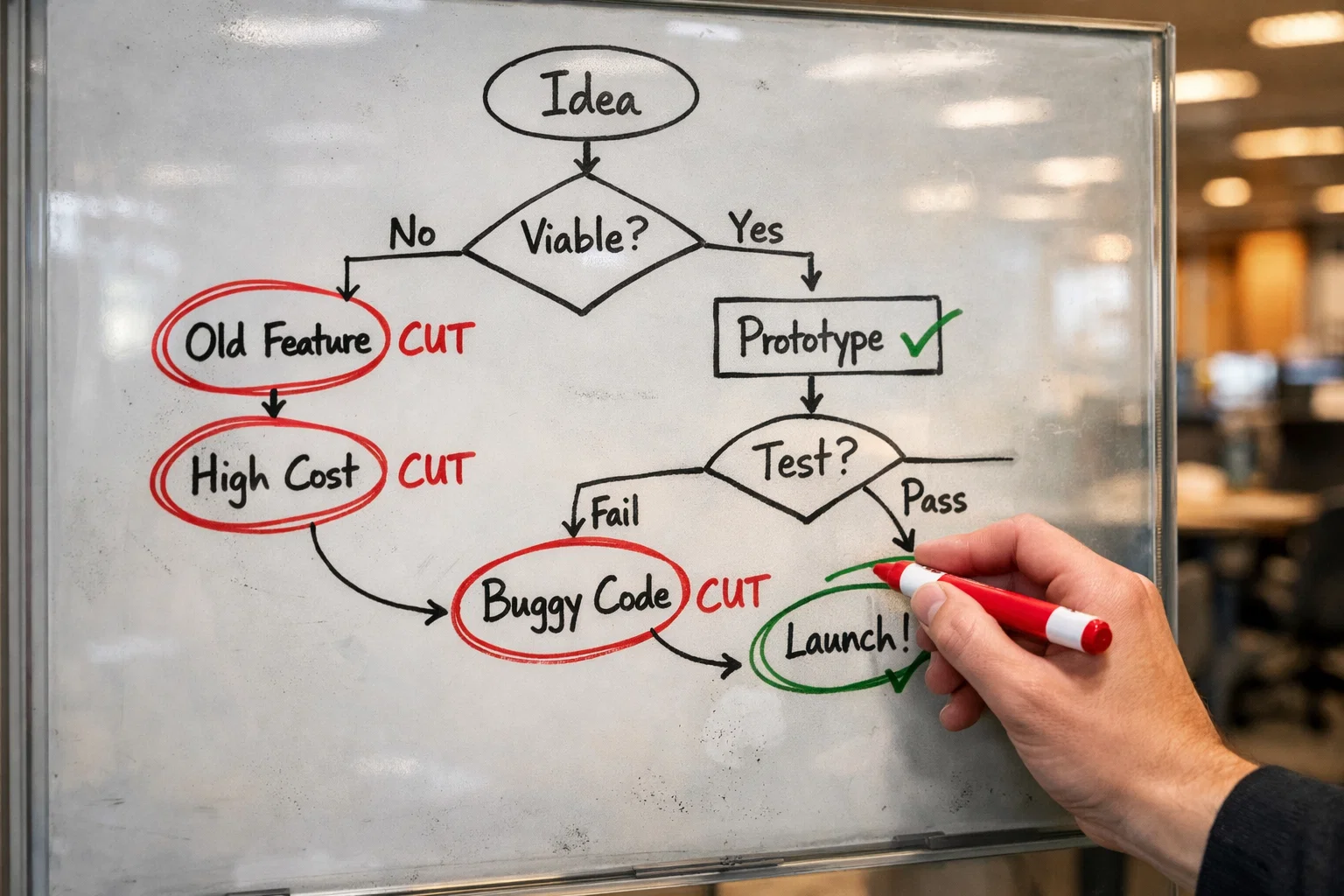
Here's the framework Iván and I used to go from 14 meetings a week to 6. You can do this in about 30 minutes.
Step 1: List every recurring meeting. Export your calendar or just write them down. Include the name, frequency, duration, number of attendees, and your honest assessment of how useful it is.
Step 2: Categorize each meeting. Is it a decision meeting, an information-sharing meeting, a relationship-building meeting, or a status update? Be honest. Many "decision" meetings are actually status updates in disguise.
Step 3: Apply the test.
| Question | If YES | If NO |
|---|---|---|
| Does this meeting require real-time discussion? | Keep it | Replace with async (Slack, Loom, doc) |
| Would anyone notice if we skipped it for 2 weeks? | Keep it | Cut it |
| Does this meeting have a clear owner and agenda? | Keep it | Fix it or cut it |
| Are the right people in the room? (Not too many, not too few) | Keep it | Restructure attendees |
| Is the frequency right for how fast things change? | Keep it | Adjust frequency |
Step 5: Set a review date. Put a recurring calendar event 90 days from now to re-audit. Cadences drift. New meetings creep in. The audit isn't a one-time event.
When Iván and I ran this audit, we cut 8 meetings and merged 2 others. We went from 14 to 6. The daily standup became three times a week. The separate marketing and product syncs merged into one weekly meeting. The Friday retro became monthly. We didn't lose alignment. We gained 8+ hours of focused work time per week.
If you want to see what your meetings actually cost, run the numbers through our Meeting Cost Calculator. Seeing "$1,200/month on a weekly sync that could be a Slack post" changes behavior fast.
Measuring Whether Your Cadence Is Working
Setting a cadence is the easy part. Knowing whether it's actually working is harder. Here's what to watch:
Action items per meeting. A productive meeting generates clear next steps. If your meetings consistently end without action items, they're probably information-sharing meetings disguised as something else. Consider going async.
Attendance and engagement. If people are skipping or multitasking (cameras off, muted, clearly doing email), the meeting isn't earning its time slot. That's not a discipline problem. It's a signal.
Decision velocity. How long does it take your team to make a decision once it's raised? If decisions stall because they're "waiting for the next sync," your cadence might be too slow. If decisions are being made in every meeting but not sticking, your follow-up process is broken.
This is where Convo actually helps us. After every meeting, we can see the talk-to-listen ratio, whether action items were captured, and how the conversation flowed. When I noticed that our Tuesday product sync had a 85/15 talk ratio (me doing 85% of the talking), that told me something. I wasn't running a sync. I was giving a lecture. We restructured the meeting, and the ratio shifted to 55/45 within two weeks.
You can also see patterns over time. If your Monday standup consistently generates 5-6 action items but your Thursday one generates zero, maybe you only need a Monday standup. The data tells you what to keep and what to cut. For a deeper look at how to use these patterns, see our meeting minutes feature.
If you're preparing for meetings with the right context and measuring what comes out of them, you'll know within a month whether your cadence is right.
Setting a New Cadence (Start Lean)
If you're building a cadence from scratch or resetting after an audit, follow this principle: start with fewer meetings than you think you need and add only when there's a clear gap.
Here's a baseline cadence for a team of 5-15 people:
| Meeting | Frequency | Duration | Purpose |
|---|---|---|---|
| Standup | 3x/week (Mon, Wed, Fri) | 15 min | Surface blockers |
| Team sync | Weekly (Tuesday) | 30 min | Decisions + priorities |
| 1:1s | Weekly | 25 min | Coaching + feedback |
| Retro | Monthly | 45 min | Process improvement |
| Planning | Quarterly | 90 min | Strategy + goals |
One more thing. When you add a meeting, set an expiration date. "Let's do a daily sync for the next two weeks while we ship this feature" is infinitely better than creating a permanent recurring meeting. Temporary cadences prevent permanent bloat.
Good virtual meeting etiquette applies to every slot in your cadence. If the meetings themselves are run poorly, no amount of schedule optimization will help. Get the rhythm right first, then make each meeting count.
For tools that help with individual meeting quality, check how Convo's real-time AI works during calls, or try recording your Zoom meetings, Google Meet calls, or Teams sessions to review patterns over time.
Frequently Asked Questions
What does meeting cadence mean? Meeting cadence refers to the rhythm and frequency of your recurring meetings. It includes how often each meeting happens (daily, weekly, biweekly, monthly), how long it lasts, and how different meetings relate to each other across the week. A healthy cadence balances alignment and communication with enough uninterrupted time for focused work.
How often should a team have meetings? Most teams work well with 3-5 structured meetings per week: a standup 2-3 times per week, a weekly team sync, and weekly or biweekly 1:1s. Add a monthly retrospective and quarterly planning session. The right number depends on team size, project phase, and how much real-time discussion your work actually requires. Start lean and add only when there's a clear gap. Use our Should This Be a Meeting? tool to test whether a new meeting is justified.
What is the ideal cadence for one-on-one meetings? Weekly 1:1s of 25-30 minutes work best for most manager-report relationships. For senior individual contributors or very stable teams, biweekly can work. Monthly is almost always too infrequent. The key is consistency. A skipped or rescheduled 1:1 sends a signal that the relationship isn't a priority, even if that's not the intent.
How do you know if you have too many meetings? The clearest sign is that you have fewer than 2 hours of uninterrupted time per day. Other signals: people regularly decline recurring meetings, the same information gets shared in multiple meetings, and your team frequently says "I didn't have time to finish X because I was in meetings all day." Run a meeting time audit to see the actual numbers.
Should standups be daily? Not always. Daily standups work for teams in active sprints or with fast-changing priorities (sales, engineering during a release). For teams with longer work cycles, three times per week is often enough. The test: if the update is the same two days in a row, your standup is too frequent. Check our morning meeting questions guide for ideas on keeping standups productive regardless of frequency.
How do you reduce meetings without losing alignment? Replace synchronous meetings with async alternatives where possible. A daily standup can become a Slack thread. A weekly status update can become a shared dashboard or Loom video. A biweekly review can become a written report with a comment thread. Keep real-time meetings for decisions, brainstorming, and relationship-building. For fun ways to keep team connection alive with fewer meetings, see our virtual icebreakers guide or try the Icebreaker Questions Generator.
What is the difference between meeting cadence and meeting frequency? Meeting frequency is how often a single meeting occurs. Meeting cadence is the overall pattern across all your recurring meetings. You might have a weekly team sync (frequency) but your overall cadence includes dailies, weeklies, and monthlies working together as a system. Cadence is about how the entire rhythm feels, not just one slot.
How often should you audit your meeting cadence? At minimum, quarterly. Set a calendar reminder. Pull up your recurring meetings, apply the audit framework (does it require real-time discussion? would anyone notice if we skipped it?), and make cuts. Teams that audit quarterly consistently report better use of time than those who set a cadence once and never revisit it.
Markus is the founder of Convo, building an AI meeting assistant that automates everything after the call. Years of experience building AI products. Believes technology should help people in the moment, not just analyze the past.
Ready to transform your meetings?
Join professionals using Convo to feel confident in every conversation.
Get StartedCONTINUE READING