

Markus Kellermann Founder & CEO
Discovery Call Guide: Questions, Script and Template
Markus Kellermann Founder & CEO
How to run a better discovery call and qualify deals properly. Includes questions, a script and a one-page template.
TL;DR: How to Run a Discovery Call
- Most discovery advice gives you more questions. I would rather hear five good follow-ups than twenty prepared questions. Always think how you can make most out of the time with the person you're talking to.
- You should leave the call able to explain why the buyer is considering a change and how the decision would be made. If the answer is vague, the deal needs more clarity.
- The script further below helps you open the call and agree on the next step. The template keeps budget, timing and the decision process in one place.
- Convo helps you run better discovery calls and qualify leads properly. It helps you ask the right questions while the buyer is still there to answer them.

The Question I Thought of Too Late
Before Convo, I kept leaving meetings with the same frustration. Once the call was over, the question I should have asked became obvious.
During the call, I was listening to the buyer while trying to remember everything we still needed to cover. When they gave me an unexpected answer, I sometimes missed the chance to ask one more question because I was already thinking about the next topic.
The follow-up usually came to me once there was nobody left to answer it.
We built Convo around that problem. It keeps track of what the buyer has answered and what is still missing, which lets me stay with the answer in front of me.
What Is a Discovery Call Actually For?
A discovery call is an early sales conversation where the buyer and seller work out whether there is a problem worth solving together.
You need to understand what is happening now and how the company would decide to change it. The buyer needs enough from you to judge whether another conversation is worth their time.
If a buyer spends half an hour answering my questions and learns nothing, I have wasted their time. April Dunford argues that the first proper sales call should help you understand the buyer and give them a reason to continue the conversation.
Discovery works better as a working session. Ask something, listen properly, and say back what you heard before contributing your view. A relevant customer story may be enough. For a buyer already evaluating products, a five-minute product view can be more useful.
The call has done its job when you can answer these questions with evidence:
| What you need to know | What useful evidence sounds like |
|---|---|
| Problem | A recent example, not a broad complaint |
| Impact | Money, time, risk, or a business result that is getting worse |
| Timing | A real event or deadline behind the interest |
| Budget | How the company expects to fund and assess the purchase |
| Decision process | Who uses, influences, approves, and can stop it |
| Concerns | What makes the buyer cautious or could make adoption difficult |
| Next step | A dated action with a reason and the right people involved |
A 30-Minute Discovery Call That Gives Something Back
Armand Farrokh's minimum viable discovery framework is a good starting point for a 30-minute call. Agree on the purpose first, then spend most of the time on one or two problems. Leave enough time to share something useful and decide whether to continue.
A recent 30MPC discovery playbook suggests dividing the time like this:
| Time | What happens | What the buyer gets |
|---|---|---|
| 0 to 5 minutes | Agree on what the call is for | The buyer can change the agenda |
| 5 to 20 minutes | Ask about one or two recent examples | You both understand what happened and why it matters |
| 20 to 25 minutes | Share a relevant example or show how you could help | The buyer can judge whether you understand the problem |
| 25 to 30 minutes | Ask how a purchase would happen and agree on the next step | Both sides decide whether to continue |
> "We have 30 minutes. I would like to understand what prompted the conversation, look at how you handle it today, and share where we may be able to help. By the end, we can decide whether another conversation makes sense. What would you like to make sure we cover?"
The last question matters. Winning by Design's discovery-call blueprint recommends agreeing on the end goal and asking what each attendee wants from the meeting. You learn the buyer's priority early, before your agenda pushes it aside.
Sales Discovery Questions Worth Bringing
Gong analysed 519,291 sales conversations and found the strongest outcomes around 11 to 14 targeted questions across a typical discovery call. Use that as a rough limit, not a target. Top reps spread their questions through the conversation instead of asking them all at once.
Bring these sales discovery questions as a small toolkit. You will rarely need all of them.
| What you need to learn | Discovery call questions |
|---|---|
| Problem | "What prompted this conversation now?" "Walk me through the last time the problem showed up." "Where does the current approach break?" |
| Impact | "Who had to deal with it?" "What did it cost or delay?" "What gets worse if nothing changes by next quarter?" |
| Timing and decision | "Is there a date when you need something in place?" "How do you expect to fund a change?" "Who else needs to test or approve it?" |
| Concerns | "What have you already tried?" "What would make this hard to introduce?" "What worries you most about changing the current approach?" |
Budget belongs in discovery once there is enough context for the question to make sense. Ask how the company expects to fund a change and how an investment at that level gets approved. If the buyer asks your price first, answer it. A buyer cannot judge value while you hide the cost.
A Discovery Call Script You Can Actually Use
Use this discovery call script for the opening and closing. Let the buyer's answers shape the middle.
Open the call
> "We have 30 minutes. I want to understand what brought this up and see whether we can help. Then we can decide whether another call makes sense. What do you want to cover?"
Find the real starting point
> "What was happening when you decided to look at this?"
When the answer stays broad, ask for the most recent example. You want something that happened, not an opinion about what usually happens.
Follow the consequence
> "What did that affect?"
Do not move on when you hear "it takes too long." Ask what was delayed or who had to step in. The answer tells you whether the problem is annoying or worth paying to fix.
Give something back
> "It sounds like managers only see the gaps once the deal reaches the forecast. Have I got that right?"
If they agree, show how you would help. Keep it short enough for the buyer to challenge what you say or ask another question.
Understand how a decision would happen
> "If this looks useful, how would you pay for it? Who else needs to be involved?"
Recap and suggest the next step
> "You want managers to catch weak discovery before it reaches the forecast, and you would like to test this before the new reps start in October. Is that right?"
Let the buyer correct you. If the summary holds, suggest the next call instead of asking, "What would you like to do?"
> "Let's bring the sales manager into the next call and look at how you would run this with two reps. Does Thursday work?"
I prepare the opening and recap. Everything in between depends on what the buyer says.
The One-Page Discovery Call Template
Copy this discovery call template into your CRM or notes. Keep the entries short enough to read during the call.
Before the call
- What do we already know from earlier calls?
- Why did this buyer agree to speak now?
- Which problem can we help them solve?
- What could I show or share if that problem comes up?
During the call
- What happened the last time the problem came up?
- What did it cost or delay?
- What would the buyer like to change?
- Why now?
- Where would the money come from, and who approves it?
- Who else will use or judge the product?
- What have they tried already?
- What still worries them?
Before ending
- Recap the problem in the buyer's words
- Questions we still have not answered
- Next meeting: what it is for, who joins, and the date
After the call
- Why should we keep working this deal?
- What could stop it?
- Which part of the call should we review?
Blank fields are useful. They show what still needs to be learned. Filling them with assumptions only makes the CRM look healthier than the deal.
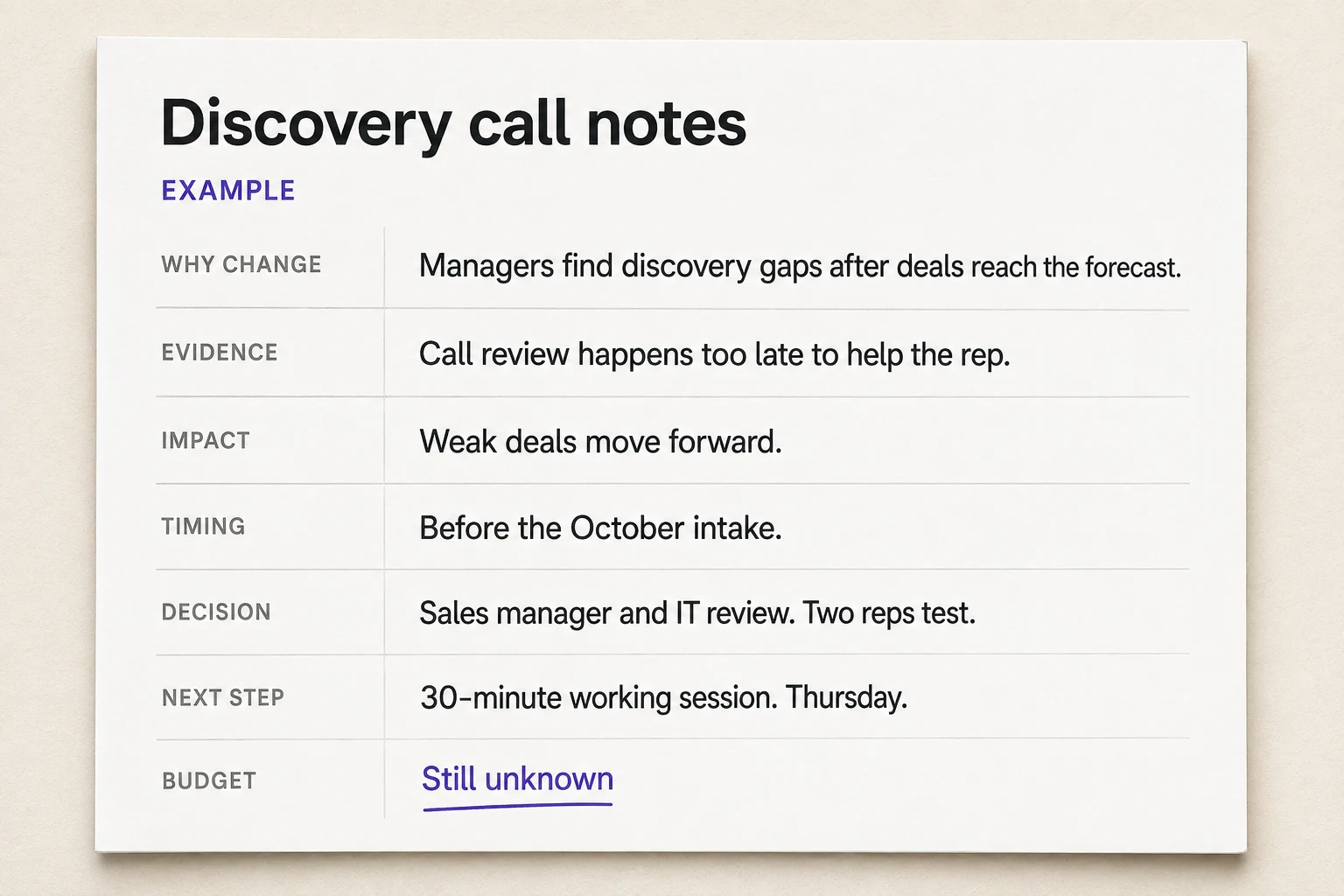
Teams can add these questions to the sales playbook. Agree on what a rep needs to know before moving a deal forward, but let the buyer's answers decide the order.
How Convo Helps You Run Better Discovery Calls
Convo helps you stay with the buyer's answer without losing track of the questions you still need to ask.
Your sales playbook can follow BANT, SPICED, MEDDPICC, or your team's own questions. As the buyer talks, Convo fills in what they have already answered and keeps the missing parts in view. If you have not asked who approves the budget, the question stays open until you do.
Say the buyer mentions an October deadline. Live Assistant may suggest asking what needs to be ready by then. If budget came up on an earlier call, Ask AI can bring back exactly what the buyer said. You can also tap "Follow-up question" when you know there is more to learn but cannot find the wording.
You keep listening instead of searching through notes or trying to remember the whole playbook. By the end of the call, you know whether the deal is worth another conversation and what needs to happen next.
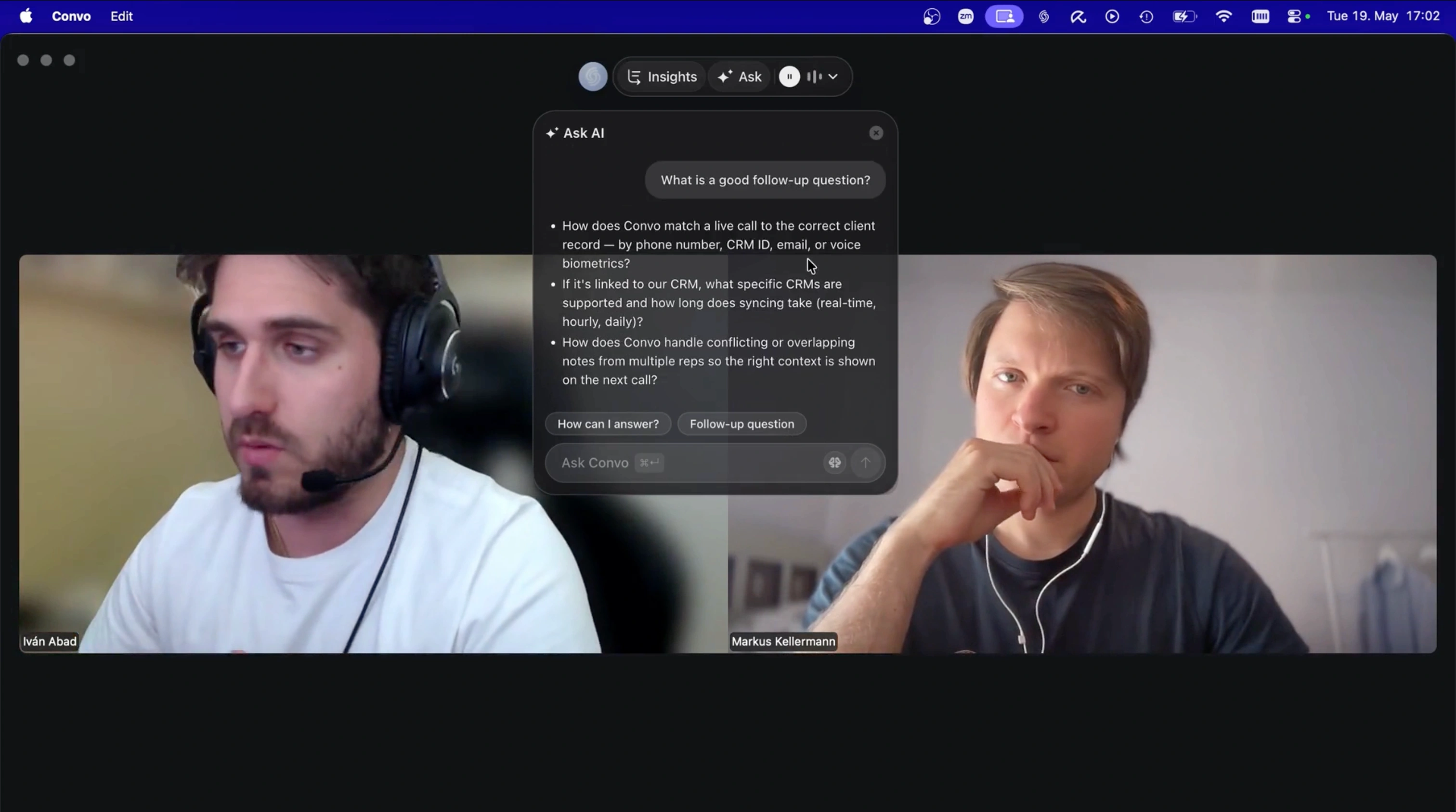
Ask AI uses the live conversation to help the rep find the next question without leaving the call.
After the call, Convo's AI sales coach shows where you moved on too soon. A manager can save the question you should have asked as a Cue. On the next similar call, Convo brings it back while the buyer is still there to answer it.
What Usually Goes Wrong
Do not rush through your question list. When the buyer gives you a real example, stop and ask what happened. Find out who had to deal with the problem and why they want to fix it now. One clear example tells you more than five answers you never explore.
Give the buyer something useful. Discovery should not feel like a one-way interview. Repeat back what you heard so they can correct you, then share a relevant example or explain how you could help. The buyer should leave the call with a clearer view of the problem.
Ask about budget once you understand the problem. You do not need to bring it up in the first five minutes, but do not leave it until the end. Ask whether money has already been set aside. If not, find out where it would come from and who would approve the spend.
Ask what an objection means before answering it. “Too expensive” may mean there is no budget. It may also mean the buyer does not see enough value yet, or that someone else needs convincing. Our guide to handling sales objections explains how to respond once you know what the real concern is.
Agree on a clear next step. Do not end the call with “I’ll send something.” Decide what needs to happen next and who should be involved. Put a date in the calendar before the call ends.
The Bottom Line
On your next discovery call, forget about getting through every question. When the buyer says something that matters, stay there and ask one more. One useful follow-up will tell you more than the rest of the list.
I built Convo so I can ask the question during the call rather than thinking of it ten minutes later.
Frequently Asked Questions
What is a discovery call? A discovery call is an early sales conversation where the buyer and seller decide whether there is a meaningful problem they should keep working on together. The seller learns about the impact, timing, budget, decision process, and concerns. The buyer gets useful perspective and enough evidence to judge whether another conversation is worthwhile.
What is the purpose of a discovery call? The purpose is to find out whether the buyer has a problem you can help with and whether it is worth another call. You should leave knowing why they want to change and how they would make the decision.
How should you structure a 30-minute discovery call? Use the first five minutes to agree on the goal, the next fifteen to develop one or two important problems, five minutes to share relevant proof, and the final five to test fit and agree on next steps. Treat those timings as guardrails and adjust them to the buyer's stage.
What questions should you ask on a discovery call? Start with what prompted the call and ask for a recent example. Follow up on what happened and why the buyer wants to fix it. Before the call ends, ask how they would pay and who needs to be involved. Agree on what happens next.
How many discovery call questions should you ask? Gong's analysis of 519,291 sales conversations found that 11 to 14 targeted questions correlated with the strongest outcomes on a typical discovery call. Treat that as a range, not a quota. Executives often need far fewer questions, and one detailed answer may cover several areas at once.
Should you ask about budget during a discovery call? Yes, once the buyer has explained enough of the problem for the question to have context. Ask how the company expects to fund a change, how it will assess the investment, and which approval level applies. If the buyer asks your price first, answer it directly.
Should a discovery call include a product demo? It can include a short product view when it proves something the buyer has just said matters. Avoid a standard tour before you understand the problem. A complex product usually deserves a separate demo shaped around the use case and attended by the right stakeholders.
How do you end a discovery call? Recap the problem and business impact in the buyer's words, then ask them to correct you. Suggest a specific next action with an owner, date, purpose, and the people who need to attend. If the opportunity is weak, ending without another meeting is a valid result.
Can AI help with discovery calls? Yes. Convo keeps track of which qualification questions the buyer has answered and which ones are still open. Live Assistant can suggest a follow-up before the call moves on. You can also use Ask AI to bring back an earlier answer or help with the next question. Managers can review the call and save a better question for the next one.
Markus is the founder of Convo, building an AI meeting assistant that automates everything after the call. Years of experience building AI products. Believes technology should help people in the moment, not just analyze the past.
Ready to transform your meetings?
Join professionals using Convo to feel confident in every conversation.
Get StartedCONTINUE READING