

Iván Abad Founder & COO
65 Ice Breaker Questions for Team Meetings by Type [2026]
Iván Abad Founder & COO
Most icebreakers flop because they're wrong for the moment. Here are 65 questions organized by meeting type, plus when to skip the icebreaker entirely.
The Icebreaker That Made Someone Leave the Call
Last year, I joined a 40-person all-hands at a company we were partnering with. The facilitator opened with: "Let's go around the room and each share your name, your role, and a fun fact about yourself."
Forty people. One by one. For twenty-three minutes.
By person fifteen, I watched someone's camera blink off. By person twenty, three more had gone dark. By person thirty, the facilitator was visibly sweating, rushing people along with "great, next!" The fun facts had devolved from "I once met Barack Obama" to "I like pizza." Nobody was listening. Nobody cared.
When it was finally over, we had twelve minutes left for the actual meeting, and no energy left to use them.
That meeting taught me something I now believe deeply: a bad icebreaker is worse than no icebreaker at all. But a good one, the right question at the right moment, can shift a room from passive to present in under sixty seconds.
In this post, you'll learn:
- 65 ice breaker questions organized by meeting type (not just random lists)
- When icebreakers actually help and when you should skip them entirely
- The questions that consistently bomb (so you can avoid them)
- How to facilitate an icebreaker without making it awkward
When Icebreakers Work (and When They Backfire)
Here's something most "100 icebreaker questions!" articles won't tell you: icebreakers are not always appropriate. Using one in the wrong context does more harm than skipping it entirely.
When they work:
- The team is new or has new members who haven't built rapport yet
- Energy is low and people need a reset before diving into work
- The meeting is collaborative (brainstorm, retro, planning) and needs creative energy
- It's a recurring meeting that's gone stale and needs a pattern interrupt
When they backfire:
- People are clearly busy and just want to get through the agenda
- The meeting is short (under 20 minutes). Don't spend 5 minutes on an icebreaker for a 15-minute standup.
- It's a serious meeting (performance reviews, incident response, bad news). Read the room.
- The group is over 20 people and you're planning to go one by one. Just don't.
- You do the same icebreaker every single week. It stops being a warmup and starts being a chore.
> "The best icebreaker is the one that fits the room you're actually in."
This is why organizing questions by meeting type matters more than organizing by tone. You don't need "funny questions" or "deep questions." You need the right question for this specific meeting with these specific people.
Now let's look at whether your current meetings could benefit from better structure. Our Should This Be a Meeting? tool can help you figure out which meetings deserve the investment in the first place.
Quick Questions for Daily Standups (Under 60 Seconds)
These are designed for speed. One question, everyone answers in chat simultaneously, move on. No round-robin. No monologues.
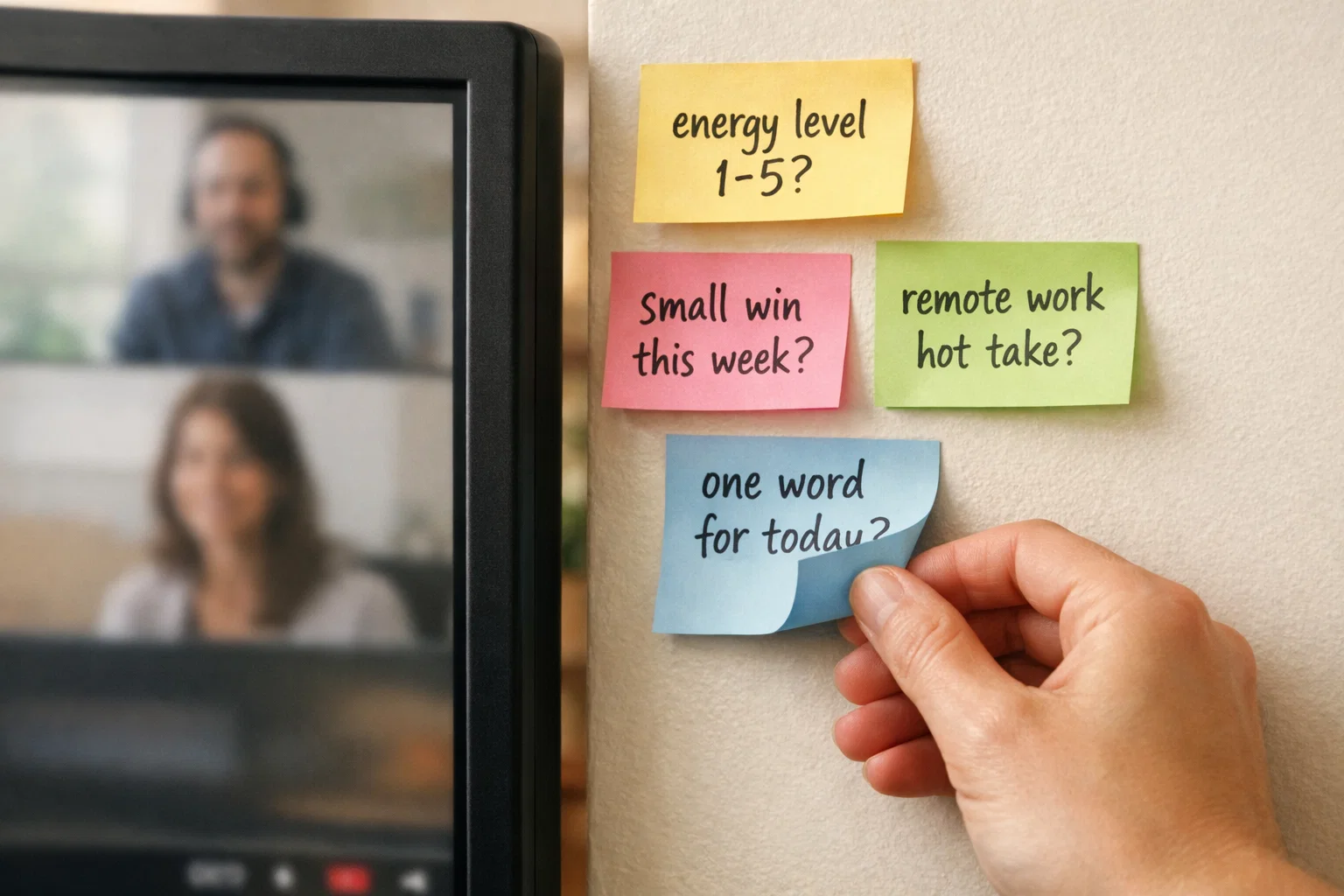
- What's your energy level today, 1 to 5?
- One word to describe your morning so far.
- What's the first thing you're tackling after this call?
- Coffee, tea, or something else today?
- What's one thing you're looking forward to this week?
- If today had a weather forecast, what would it be?
- What song is stuck in your head right now?
- Are you a "start the day strong" or "build momentum slowly" person today?
How to run it: Drop the question in chat. Say "everyone type your answer, go." Wait 15-20 seconds. Read out 2-3 interesting answers. Done. Total time: 45 seconds.
Why this works: Simultaneous chat answers are inclusive. Introverts don't have to speak up. Nobody waits their turn. And you get an instant read on team energy without anyone having to perform.
For more questions designed specifically for morning standups, check our guide on morning meeting questions.
Questions for Weekly Team Meetings (2-3 Minutes)
The weekly sync needs a slightly warmer start than a standup, but still can't eat into the agenda. These questions invite a sentence or two, not a monologue.
- What's a small win you had this week that nobody knows about?
- What's something you learned this week (work or life)?
- If you could delegate one task from your plate right now, what would it be?
- What's something on your to-do list that keeps getting pushed back?
- Rate your week so far: movie sequel, reboot, or original masterpiece?
- What's a tool or shortcut you've discovered recently that saves you time?
- If your current project were a TV show, what genre would it be?
- What's the best meeting you attended this week, and what made it good?
- What would make this week a success for you?
- If you had an extra hour today, what would you do with it?
Invite, don't go around: Ask the question, then let 3-4 people share briefly. Say "anyone want to jump in?" The pause feels awkward for 3 seconds, then someone speaks. If nobody does after 5 seconds, share your own answer first. That breaks the seal.
My favorite weekly question: Question 9 ("small win nobody knows about") earns its place. It surfaces work that would otherwise go unrecognized, and people light up when they get to share something they're proud of. It also gives you, as a manager, visibility into what your team is actually doing. The hard part is remembering it a week later. I used to lose those small wins by the next sync, so now I let Convo keep the thread and open with "last week you shipped the onboarding fix, how's it landing?" instead of a cold generic question.
Questions for New Teams and Kickoffs (3-5 Minutes)
When people don't know each other yet, the icebreaker carries more weight. These questions are personal enough to build connection but professional enough to feel appropriate.
- What's your go-to comfort food after a long day?
- What's the most interesting project you've worked on in the last year?
- If you could instantly become an expert in one new skill, what would it be?
- What's one thing you wish people knew about your role?
- Describe your working style in three words.
- What's your biggest pet peeve in meetings? (Yes, the irony is intentional.)
- If you weren't in your current role, what would you be doing?
- What's a book, podcast, or article that changed how you think about work?
- What time of day do you do your best thinking?
- What's a professional norm you secretly think is pointless?
Set the length up front: For kickoffs, it's okay to go around the room if the group is under 12. Give people a heads-up: "We're going to go around, keep it to 30 seconds each." Setting expectations on length prevents the five-minute rambler from hijacking the room.
For more advice on running kickoffs and new team meetings well, our virtual meeting etiquette guide covers the principles that make these sessions productive.

Questions for Remote and Hybrid Meetings (2-3 Minutes)
Remote meetings start cold. There's no hallway chat, no coffee machine small talk. These questions bridge that gap and work especially well over video.
- What does your workspace look like today? (Show us if you want.)
- What's one thing in your room that makes you happy?
- What's the best thing about working from home? The worst?
- If you could work from anywhere in the world for a month, where?
- What's your remote work hot take that would get you cancelled?
- What's the last non-work thing you did during work hours? (No judgment.)
- Camera on or camera off person, and why?
- What's your go-to background noise while working? Music, podcasts, silence?
- Have you ever forgotten you were on mute and kept talking? How long?
- What's one remote work hack that changed your daily routine?
The one that always lands: Question 37 (the mute story) gets a laugh every single time. Everyone has one. It instantly creates shared experience and reminds people they're all dealing with the same remote work absurdity.
For interactive virtual activities beyond questions, see our virtual icebreakers guide, which covers show-and-tell, scavenger hunts, and other formats that work well on video.
Questions for All-Hands and Large Groups (1-2 Minutes)
Large groups can't do round-robin. These questions work as polls, chat prompts, or quick raise-of-hands.
- On a scale of 1-10, how excited are you about this quarter? (Poll)
- What's one word that describes the company culture right now? (Chat)
- What department do you wish you could shadow for a day? (Chat)
- If the company had a mascot, what animal would it be? (Chat)
- What's one thing we should start doing as a company? (Anonymous poll)
- If you could add one perk to the office, what would it be? (Chat)
- What's one thing about your team's work that the rest of the company should know? (Chat)
Use a poll, not a round-robin: Use your video platform's built-in poll or chat. Ask the question, give 20 seconds for responses, then highlight 2-3 interesting ones. For large groups, anonymous polls work best because they remove social pressure. Total time: 60-90 seconds.
Deeper Questions for Offsites and Retreats (5-10 Minutes)
When you have time and trust, go deeper. These questions work for small groups (under 10) in settings where real connection is the goal.
- What's something you've changed your mind about in the last year?
- What's the hardest lesson you've learned in your career?
- What does this team do well that we should never stop doing?
- If you could go back and give yourself advice on your first day here, what would it be?
- What's a failure that taught you more than any success?
- What kind of work makes you lose track of time?
- What's one thing about your life outside of work that shapes how you show up here?
- What do you need more of from this team right now?
- What's something you're genuinely proud of that has nothing to do with work?
- If we could fix one thing about how we work together, what should it be?
> "The questions that build real trust are the ones where the answer makes you slightly uncomfortable to share."
Important: These only work in teams with psychological safety. If people don't trust each other, asking "what's a failure you've had?" will get polished corporate answers, not real ones. Build trust with lighter questions first. Don't jump to depth before you've earned it.
Questions That Always Bomb (Learn From My Mistakes)
I've facilitated hundreds of meetings. These questions fail almost every time. Save yourself the awkward silence.
| Question | Why it fails |
|---|---|
| "Share a fun fact about yourself" | Nobody has a fun fact ready. You get panic answers like "I have a cat." |
| "What are you grateful for?" | Too intimate for a work setting. People feel pressured to perform gratitude. |
| "If you were a kitchen appliance, what would you be?" | Weird, forced, nobody cares about the answer. |
| "What's your spirit animal?" | Culturally insensitive for some. Also just strange. |
| "Let's go around and introduce ourselves" | Not a question. And deadly in groups over 10. |
| "Tell us something nobody knows about you" | Too much pressure. Either you get something boring or something overly personal. |
How to Facilitate Without Making It Awkward
The question is only half the equation. How you deliver it matters just as much.
Announce it casually. "Before we start, quick warmup question" is better than "Okay everyone, time for our icebreaker!" The word "icebreaker" itself makes people tense up.
Answer first. Share your own answer before asking others. This sets the tone, shows the expected length, and removes the "who goes first?" anxiety. If you give a 15-second answer, people will match that length. If you give a 2-minute monologue, so will they.
Use chat for speed. For groups over 8, always default to chat responses. "Drop your answer in chat, go." Simultaneous answers take 15 seconds. Sequential sharing takes 15 minutes.
Give the opt-out. "Jump in if you want to share" is better than calling on people. Some people warm up by listening first. That's fine.
Time-box it. Set a mental limit. If it's dragging, wrap it: "Love these answers. Let's carry this energy into the agenda." Nobody will be mad you moved on.
Rotate the facilitator. If you do icebreakers regularly, let different people pick the question each week. It distributes ownership and keeps it fresh.
If you want to see whether your icebreakers are actually doing anything, Convo tracks talk-to-listen ratios and participation balance across your meetings. Our Tuesday syncs that opened with a quick question had visibly more balanced participation than the ones where we jumped straight in. The quiet people actually spoke up. Seeing it in the data is what convinced me the 45 seconds was worth it.
See whether your icebreakers are working
Convo tracks talk-to-listen ratios and participation across your meetings, and remembers what people shared so you can pick the thread back up next time. Try Convo free for 7 days.
Quick Reference: Picking the Right Question
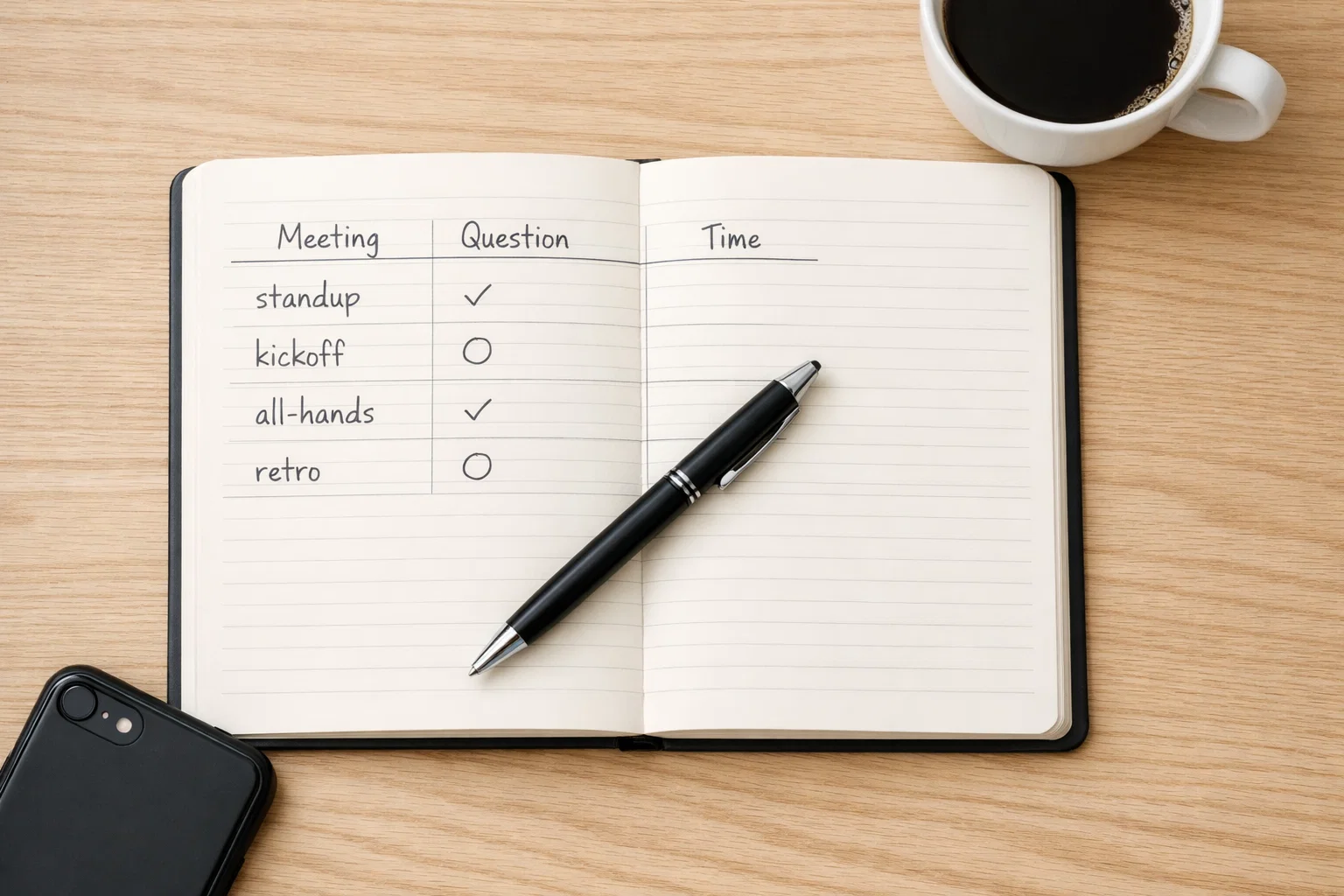
| Meeting type | Group size | Time | Best format | Go-to question |
|---|---|---|---|---|
| Daily standup | 3-10 | 30 sec | Chat poll | "Energy level, 1 to 5?" |
| Weekly sync | 5-15 | 2 min | 3-4 volunteers | "Small win nobody knows about?" |
| New team kickoff | 5-12 | 3-5 min | Go around | "Describe your working style in 3 words" |
| Remote/hybrid | Any | 2 min | Chat | "Remote work hot take?" |
| All-hands | 20+ | 1 min | Anonymous poll | "One word for company culture right now?" |
| Offsite/retreat | 4-10 | 5-10 min | Open discussion | "What do you need more of from this team?" |
| 1:1 check-in | 2 | 1-2 min | Conversational | "What kind of work makes you lose track of time?" |
If you want a question picked for you, our Icebreaker Questions Generator selects one based on your meeting type and group size.
The Remaining 10: Wildcard Questions for When You're Tired of the Usual
These are for the meetings where you want something different. Not categorized, just good.
- What's the worst advice you've ever received?
- What's a conspiracy theory you secretly find entertaining (not harmful ones)?
- If our team had a theme song, what would it be?
- What's a hill you'll die on that doesn't matter at all? (Pineapple on pizza, etc.)
- What's a skill that's completely useless but you're oddly good at?
- If you could have any job for one week, no consequences, what would it be?
- What's the most overrated thing about your industry?
- You can only eat one cuisine for the rest of your life. What is it?
- What's a trend you refused to follow and turned out to be right?
- If you could make one rule that everyone in the company had to follow for a day, what would it be?
These are the ones people remember. Use them sparingly. Save them for when the team needs a spark.
Getting the right meeting cadence means you know exactly which meetings deserve an icebreaker and which should get straight to business. Not every meeting needs a warmup. But the ones that do deserve a good one.
Frequently Asked Questions
What are the best ice breaker questions for team meetings? The best icebreaker questions match the meeting type and group size. For quick standups, use chat-based polls ("energy level 1-5"). For weekly syncs, ask open questions ("small win nobody knows about"). For new teams, go slightly more personal ("describe your working style in three words"). The key is matching the question to the context, not picking the "funniest" or "deepest" option. Try our Icebreaker Questions Generator to find one matched to your situation.
How long should an icebreaker last in a meeting? For a 30-minute meeting, spend no more than 2 minutes. For a 60-minute meeting, 3-5 minutes max. For standups under 20 minutes, keep it to 45 seconds using simultaneous chat responses. The icebreaker should never take more than 10% of the total meeting time. If it does, it's too long.
Do icebreakers actually improve team meetings? Yes, when used correctly. Engagement early in a meeting tends to carry through the rest of it, and a good icebreaker is one of the simplest ways to get people participating from the start. In our experience at Convo, meetings that opened with a quick question had more balanced participation across the team than the ones that jumped straight into the agenda.
What icebreaker questions work for large groups? For groups over 20, avoid round-robin sharing entirely. Use anonymous polls ("rate your excitement for this quarter, 1-10"), chat-based prompts ("one word for company culture right now"), or raise-of-hands questions. The goal is simultaneous participation, not sequential sharing.
How do you break the ice in a meeting without being awkward? Three rules: call it a "quick warmup" not an "icebreaker" (the word itself creates resistance). Answer the question yourself first to set the tone and expected length. And use chat for groups over 8 so nobody has to unmute and speak into awkward silence. Casual delivery is everything.
What icebreaker questions should you avoid at work? Avoid questions that require creativity on the spot ("if you were a kitchen appliance..."), are too intimate for a professional setting ("what are you grateful for?"), or are culturally insensitive ("what's your spirit animal?"). Also avoid any format that requires going around a room of more than 12 people one by one. See the "Questions That Always Bomb" section above for specific examples.
How often should you use icebreakers in recurring meetings? Not every meeting needs one. Use them when energy is low, when there are new team members, or when the meeting needs collaborative energy (brainstorms, retros, planning). For recurring weekly meetings, once or twice a month is enough. Every single week and it becomes background noise. Mix up the questions when you do use them.
What are good icebreaker questions for virtual meetings specifically? Questions that leverage the remote format work best: "what does your workspace look like today?", "camera on or camera off person?", "what's your go-to background noise while working?". Also, any question answered via chat works better virtually than in person because everyone can respond simultaneously. See our full guide on virtual icebreakers for activities beyond just questions.
Iván is the co-founder of Convo, focused on operations and growth. Background in marketing and sales. Knows firsthand what it feels like when a conversation doesn’t go the way it should.
Ready to transform your meetings?
Join professionals using Convo to feel confident in every conversation.
Get StartedCONTINUE READING